by Jonel Abellanosa
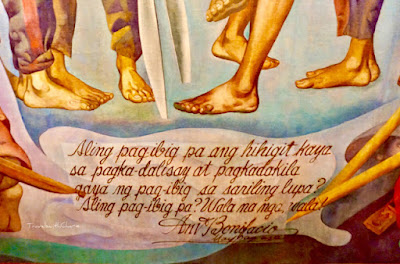 |
| "What love is greater than the wholesome and heroic love of your own country? What other love? Nothing else." In this detail from a painting by Carlos "Botong" Francisco are the words of Andres Bonifacio, one of the founders of Kataas-taasan, Kagalang-galangan Katipunan ng Anak ng Bayan (KKK or Katipunan), a secret society organized in 1892 to gain independence from Spain through a revolution. Source: travels withcharie |
Our ancestors knew subjugation forced
into throats where no words break, silence
sharp as bayonet, glass shards shimmered.
The noose gripping the tongue, expressions
of words deprived of sounds, fall and thud
turning choked air into death’s white light.
The garrote spells our history’s strangulation
in the hands of war criminals. Our heroes
and martyrs tell us we, with our rich lands
and seas, have to keep vigil how the heroic
unfolds where sunflowers are eternal as their
land. Our flag has their yellow and blue,
our dreams vast as their barley and wheat fields.
Ukrainians show, by their love for freedom,
they are Filipinos, too, their rights and reasons
to be free seven thousand as our islands.
They are our countrymen. Across our archipelago
bordered by disputed waters, we are also Ukrainians.
Jonel Abellanosa lives in Cebu City, The Philippines. His works have been nominated for the Pushcart Prize, Dwarf Stars and Best of the Net Awards. His poetry and fiction have appeared in hundreds of magazines and anthologies, including The New Verse News, The Cape Rock, Muddy River Poetry Review, Chiron Review, Invisible City, The Lyric, The McNeese Review, and The Anglican Theological Review. His poetry collections include Songs from My Mind’s Tree and Multiverse (Clare Songbirds Publishing House, New York), 50 Acrostic Poems, (Cyberwit, India), In the Donald’s Time (Poetic Justice Books and Art, Florida), and Pan’s Saxophone (Weasel Press, Texas). He is a nature lover, with three companion dogs—Yves, Donna and their lovechild Daisy.


