Guidelines


Submission Guidelines: Send 1-3 unpublished poems in the body of an email (NO ATTACHMENTS) to nvneditor[at]gmail.com. No simultaneous submissions. Use "Verse News Submission" as the subject line. Send a brief bio. No payment. Authors retain all rights after 1st-time appearance here. Scroll down the right sidebar for the fine print.
Showing posts with label sarin. Show all posts

Monday, April 10, 2017

INFLICTION

by Jess Granger


I watch you from a noncommittal screen, you
with your arm outstretched in the gray mud, you
with your gaping maw that fumbles in the fresh

water for air, nerves searing deep beneath your
blood in convulsions of toxicity, raw rabid foam
enveloping your crooked teeth, the restless muscles

dancing like maggots devouring a fresh carcass,
the yellow vomit spilling from my lips as I watch
your children suffer in their colorful pajamas.

I hold my breath feeling the burn in my lungs as the
alveoli strain to breathe for you, eyes that try to
compensate for your fixed pupils and focus on

the heavy bodies on top of you, pressing you down
into a time where you once knew peace. I’m coming
to help you, I hear your call in the ozone that separates

us, separates you from me, the space I need to ready
my weapons, load the PBXN-109 in their casings
and post your pictures on the metal, the infliction

of my might, for I am civilized, will come in flashes
of light to exploit your torn flesh, modify it into
incendiary ash on the sand of Khan Sheikhoun.


Jess Granger is a U.S. Army veteran and an MFA student in the Creative Writing program at the University of Texas El Paso. 

7899

by Promise Li


USS Ross firing a Tomahawk missile towards the Shayrat Airbase base. —U.S. Navy photo by Mass Communication Specialist 3rd Class Robert S. Price/Released via Wikipedia.


As of March 28, 2017 [i.e. prior to the firing of 59 Tomahawks that reached Shayrat Airbase], the U.S. and coalition have conducted a total of 19,300 strikes (11,460 Iraq / 7,840 Syria). —US Department of Defense

While the attack [in Idlib Province on Tuesday] was among the deadliest uses of chemical weapons in Syria in years, it was far from an isolated case. During the war, the Assad government has been accused of regularly using chlorine gas, which is less deadly than the agent used on Tuesday and is legal in its commercial form. According to the Violations Documentation Center, an antigovernment watchdog, more than 1,100 Syrians have been killed in chemical weapons and gas attacks. —The New York Times, April 5, 2017


They say sarin flies high,
when it touches
turns lungs into deadlocks;
instead of death,
knots cough death into tedium.

Do you remember the last time—
unacknowledged,
No: only then knots were not yet familiar
only to think they know,
but the rhythms don't add up;
fit for numbers then,
now elegies unnumbered,
and where were the answers when
gory and mute drooling cool poison,
sirens unsounded, not songs but only
tuneless coughs unmourned.

Last time
remembering to triple-knot
those shoes
as not to trip bloody.


Promise Li studies early modern literature at Occidental College and is also a socialist activist in Los Angeles. 

SYRIA

by Antonia Clark


A man breathes through an oxygen mask as another one receives treatment, after what rescue workers described as a suspected gas attack in the town of Khan Sheikhoun on Tuesday Reuters via The Independent, April 6, 2017.


The heart overflows,
a deluge of hard
salty rain that can’t
wash away

the yellow fog that rusts
the sheet-metal sky,
fills lungs with fluid
and foam

or obscure the naked
and torn, the rows
of pale corpses
in the streets.

Sorrow’s burnt offering
of smoke and dust
scorches the throat,
sears the tongue
of the world.


Antonia Clark has taught creative writing and co-administers an online poetry forum, The Waters. She is the author of the poetry chapbook Smoke and Mirrors and the full-length collection Chameleon Moon. Her poems and stories have appeared in numerous journals, including The Cortland Review, Eclectica, The Pedestal Magazine, and Rattle.

SARIN WORK

by Alejandro Escudé


Volunteers wear protective gear during a class of how to respond to a chemical attack, in the northern Syrian city of Aleppo on September 15, 2013.JM LOPEZ/AFP/GETTY IMAGES via Wired.


The mood is sarin and the light is sarin
there are sarin children dancing in the air
convulsing skyward, there are sarin trees
and sarin ships firing sarin missiles
at sarin airports where sarin helicopters
sit ready to traverse sarin lands, over sarin
rooftops, blanketing a country of sarin,
a language of sarin, the sarin of resorts
where the leaders of sarin meet to discuss
treaties over sarin and ice cream. But one
needs two chemicals to form sarin, and sarin
lasts a short time, sarin is short as life itself,
meaningless really, unless it is packaged
just right; still, a world without sarin is a world
flooded in sarin, with sarin dreams like those
of the sarin children who felt it rain down
on them and saw their fingers turn to roads,
their lungs become mountains, their hearts
pumping sarin into their sarin souls.


Alejandro Escudé published his first full-length collection of poems My Earthbound Eye in September 2013. He holds a master’s degree in creative writing from UC Davis and teaches high school English. Originally from Argentina, Alejandro lives in Los Angeles with his wife and two children.

Thursday, April 06, 2017

TRITINA FOR SYRIA'S CHILDREN

by Jo-Ella Sarich


A man carries the body of a child, after what rescue workers described as a suspected gas attack in the town of Khan Sheikhun. Photograph: Ammar Abdullah/Reuters via The Guardian, April 5, 2017


My daughters’ faces, quivering beneath Heavy
Water, their lips pucker and slide breath
from the inception of the word to the final release of the air.

And I all at once catch a flicker of them in the air,
their lungs grown bone-heavy.
I seize breath, before my own breath

is pressed, mouth-to-mouth to force breath
to form the word in them, air
becomes mercury in the glass and the heavy

air between us too much like one breath or word-clouds across our heavy sky.


Jo-Ella Sarich has practised as a lawyer for a number of years, recently returning to poetry after a long hiatus. Her poems have appeared or are forthcoming in Quarterday Review, Cleaver Magazine, Blackmail Press, Barzakh Magazine, Poets Reading the News, The Galway Review, Anti-Heroin Chic, takahē magazine and the Poetry New Zealand Yearbook 2017@jsarich_writer

Sunday, February 17, 2013

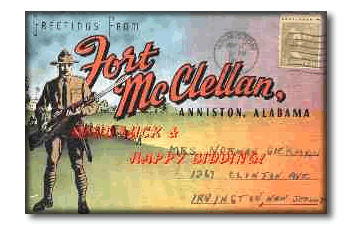
GREETINGS FROM FORT McCLELLAN, 1944-1995

by Laura Shovan

Image source: Transition Force, US Army Garrison, Fort McClellan, Alabama


This is a really beautiful camp.
I found George in excellent health.
Love,_____

                                    Please help.
I was stationed at Fort McClellan.
I have developed a symptom of passing out.
Doctors called it "Syncope".
None of them could figure out
what caused it. 

Hi my name is: _____
I went through Basic training
in Echo 1 company. We had to go through
that building they called the Gas Chamber.
Does anybody know what type of gas
or chemical was in there?

I want to hear from you.
We were exposed to toxic substances,
big time. The McClellan Cocktail:
depleted Uranium, Sarin gas, mustard gas,
and let's not forget that old standby,
Agent Orange.

                                    I drove track vehicles
through dust and mud, unknowing the danger.
I taught troops to make the smoke
that covered the base, was told Fog Oil SGF2
was harmless. We breathed it in for hours.
I went thru the live nerve agent chamber.
They drew blood to check us but never
told us why.

                                    I was face down
in toxic-smelling stuff on the firing range.
They sprayed stuff to keep the bugs away.
They sprayed us in the "gas chamber,"
said I had "sensitive skin" when I broke out
in weeping blisters and dizzy spells.
We were "just women." It's a damn shame
they couldn't tell us what we were
crawling around in.

                                    Tell you more
when I get home.


Author’s note: This is a found poem. The italics in this poem are taken from a used postcard, cancelled in 1944. All of the stanzas not italicized are taken directly from blogs and internet postings by veterans who trained at Fort McClellan. I deleted a word here and there, but have not changed the vets’ language.

Editor of Little Patuxent Review, Laura Shovan was a finalist for the 2012 Rita Dove Poetry Award. Her chapbook, Mountain, Log, Salt and Stone, won the Harriss Poetry Prize. She edited Life in Me Like Grass on Fire: Love Poems and co-edited Voices Fly: An Anthology of Exercises and Poems from the Maryland State Arts Council Artist-in-Residence Program, for which she teaches. In January and February, 2013, Laura is blogging 44 poems inspired by antique postcards at www.authoramok.com.
.