Guidelines


Submission Guidelines: Send 1-3 unpublished poems in the body of an email (NO ATTACHMENTS) to nvneditor[at]gmail.com. No simultaneous submissions. Use "Verse News Submission" as the subject line. Send a brief bio. No payment. Authors retain all rights after 1st-time appearance here. Scroll down the right sidebar for the fine print.
Showing posts with label Nepal. Show all posts

Saturday, August 29, 2026

WHAT SETTLES WHEN WE LAY OUR BODIES DOWN TO REST

by Paula J. Lambert


Really, it’s just the claggy kind of snot struggling

to decide if it wants to stay low in your chest—


where your heart beats and every breath passes

through—or if, rising, clinging to the last breath,


it has the strength to finally release itself

to the world. We know by now what can travel 


on the tiny particles of our gasping exhalations: 

disease, devotion, the promise that death is no end. 


We might wish otherwise, drifting in and out 

of these strange dreams of drowning. We know


what happened in Nepal, North Carolina, Texas. 

We all might be called mystics when, prone, 


our bodies wrestle with desire, each wobble of faith 

in our resolve to go on a little death of its own.  


Paula J. Lambert of Columbus, Ohio, has published eleven collections of poetry including Terms of Venery, Revised (Sheila-Na-Gig 2025) and Sinkhole (Bottlecap 2025). Her work has been supported by the Ohio Arts Council, the Greater Columbus Arts Council, and the Virginia Center for Creative Arts.

Wednesday, January 11, 2023

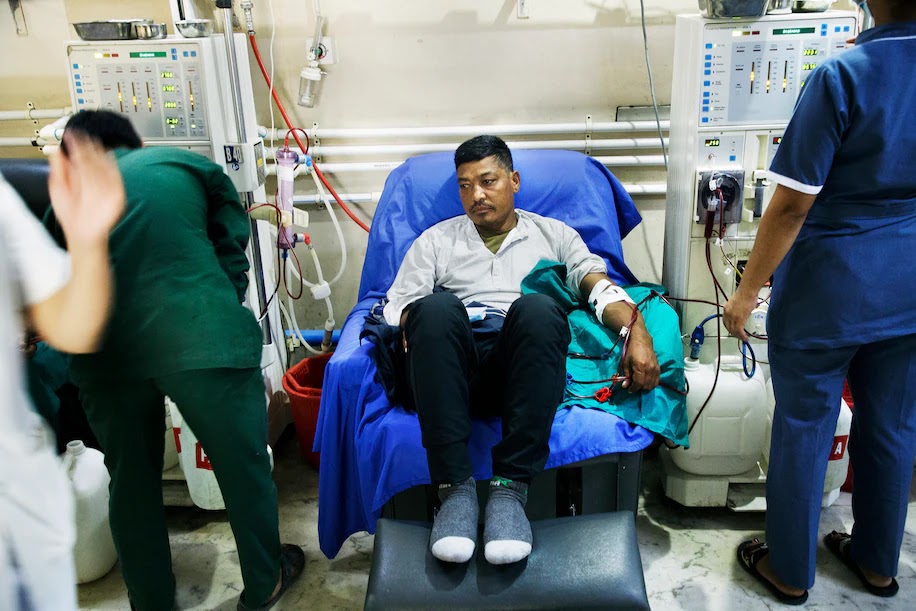
ON THE CLOCK

by Diana Morley


The world’s torrid future is etched in the crippled kidneys of Nepali workers. Kidney disease has become epidemic among Nepali migrant laborers working in the extreme heat of the Persian Gulf, presaging the world's climate change future. Photo: Sak Bahadur Chhantyal, 48, was working on a construction site in Oman for six years before he was diagnosed with chronic kidney disease. He has been on dialysis at the National Kidney Center in Kathmandu for almost two years. (Sagar Chhetri) —The Washington Post, January 6, 2023


Surely it’s time.

Time to say
we’re fueling 
our pot 
heating on
high

now scalding 
our insides 
after shriveling 

our skin 
raising black spots
burned not tanned
where we sit
not 

stirred— 
to get up
in uproar
to say 

our kidneys 
now cooking
like 

beans.


Diana Morley has published poems online and in journals as well as two books of poetry and a photographic/poetic documentary of Oregon’s 2020 wildfire and renewal. She writes and resides in North Carolina. 

Thursday, August 27, 2015

MOBBED

by Anuja Ghimire


At least eight people, mostly security personnel including a Senior Superintendent of Police, and a two-year-old boy died when demonstrators protesting against proposals for administrative reform clashed with police in Tikapur of Kailali district on Monday. Scores of others were injured in the incident. Photo: Injured police personnel being treated on the premises of Tikapur Hospital in Kailali on Monday. Forty three personnel and three protesters were admitted to the hospital. —Ganesh Chaudhary, Kathmandu Post, August 25, 2015


Together, we are a tainted mass.
We fuel venomous gases that churn ashes.

Together, our tongues hiss flames and smoke.
We howl; red rivers dance like snakes on the ground.

Together, we are hotter than the iron blades
That sever veins with single strikes.

Together, our knees grind the earth and kill the soil.
What flower wishes to bloom in beds of blood?


Anuja Ghimire is from Kathmandu, Nepal. Her poetry is published in Red River Review, Words Like Rain, Glass, Clay, Ishaan Literary Review, The Rainbow Journal, La.Lit Literary Magazine, Stone Path Review, the MOON Magazine, Right Hand Pointing, The New Verse News, Zest Literary Magazine, Euonia Review, One Sentence Poems, Cyclamens and Swords, Shot Glass Journal, and Constellations. She lives in Dallas, Texas with her husband and two little girls and writes poetry.

Monday, May 11, 2015

DREAMING NEPAL

by Valerie Sonnenthal


Saili, 25, from Selang, said that her 2-year-old son died in the earthquake and that her home was destroyed. She and her two surviving children are now living in a shelter with four other families. Credit: Gardiner Harris/The New York Times, May 9, 2015


silencing her words
lips moving
wordless breeze
swallowing syllables
caught like a tumor
growing slowly
her throat aching
hands twisting
body somewhere
dust thickened
eyes blink
between dreams
days
like yesterday
calm carrying on
errands at the market
life a dream
she once was living
thankful
now thick
in the thick
slow stuck time
floating in wait
weighted
by a city
she once knew


Valerie Sonnenthal joined the Cleaveland House Poets when she moved to Martha's Vineyard in 2006. She writes the Chilmark Town Column plus arts and lifestyle stories for the MV Times, Arts & Ideas magazine, and  publishes Errata Editions' Books on Books series. 

Tuesday, April 28, 2015

KALI YUGA

by Susan Roney-O’Brien


A Buddha statue is surrounded by debris from a collapsed temple in the UNESCO world heritage site of Bhaktapur on April 26, 2015 in Bhaktapur, Nepal. Photograph: Omar Havana/Getty Images via The Guardian.


Blood screams, floods rice fields,
dyes water red. A woman shrieks,
cries out in an unfamiliar language.
From behind the wall
a man growls
deep in his throat.

Outside a dog barks, a child wails
as though there is no country
beyond sorrow.
Over the balustrade
potted roses bear dark thorns.
It is just past dawn.

The Kathmandu Kumari,
red-gowned, is now five-years old.
She twists her naga necklace,
conceals the rash spreading
over her chest, pulls
at her tight black topknot

and between the capital and Pokhara
near Bandipur, the earth
cracks open. A small hill temple
rattles and falls. The world
shudders as the epicenter
sends tremors roiling.

Shiva strides through Kathmandu,
levels Narayanhti, topples buildings
smashes bricks, bodies to the ground.
All over Nepal, red blood flows,
a color we all know and recognize
in this epoch of violence.


Susan Roney-O'Brien lives in Princeton, MA, has won the William and Kingman Page Poetry Book Award, been nominated for 5 Pushcart Prizes, been selected NEATE's Poet-of-the-Year, works with young writers to publish their books, and has published widely in literary magazines. She returned from a trip to Nepal last week.

Sunday, March 01, 2015

GOING TO CLASS BEFORE EVERYTHING CHANGES

by Anuja Ghimire


Two teenage Nepalese schoolgirls suffered burn injuries after a boy hurled acid at them early Sunday, police said. The girls, aged 15 and 16, were admitted to a hospital with burn injuries after the youth attacked them with a bottle of acid. The two were sitting in class at a coaching centre in Kathmandu waiting for other students when the attack occurred. "A masked boy came into the room and threw acid at them," senior police officer Narayan Khadka told AFP. Khadka said an investigation was underway to find the attacker, and added that his motive had not yet been established. Acid attacks, which disfigure and often blind their overwhelmingly female victims, are often a form of revenge in South Asia linked to dowry, land disputes or refusal to a man's advances. Although acid attacks are now a criminal offence in neighbouring India, there are no specific laws addressing it in Nepal.  --Yahoo! News, February 22, 2015; Kathmandu Post photo by NARENDRA SHRESTHA & Nimesh Jang rai


To stick
a little round ball
of chewed gum under the desk
And spread notebooks
over the two initials and the arrow
Carved with a ball point pen,
shielded with a heart
Your mouth
buried in a friend’s ear
The latest
on the boy who smiled
 in the hallway,
again
The crumpled yellow paper
wet with your sweat
Because words
only spoken
are too soon
forgotten

To relearn
Pythagorean theorem,
though you don’t understand
why
You wear
the red sweater
 your mother hand washed
-- It should last another year --
And the white shirt
your father ironed
So the collar is creased
just right
Because rules
followed
unlock
happy tomorrows

To pull out
the new protractor
your brother bought
The last one
chipped and broke
into three uneven bits
You measure
the angles of triangles,
your duty
And sit
with dreams
folded in your pockets
Before the unguarded door
opens
letting in
the rushed steps
Because you
are beautiful,
but you have
to become someone


Anuja Ghimire is from Kathmandu. Her poetry is published in Riverlit, Glass, Clay, Ishaan Literary Review, Zest, Right Hand Pointing, Stone Path Review, Constellations, and others. She lives in Dallas.