Guidelines


Submission Guidelines: Send 1-3 unpublished poems in the body of an email (NO ATTACHMENTS) to nvneditor[at]gmail.com. No simultaneous submissions. Use "Verse News Submission" as the subject line. Send a brief bio. No payment. Authors retain all rights after 1st-time appearance here. Scroll down the right sidebar for the fine print.
Showing posts with label asylum-seekers. Show all posts

Friday, April 15, 2022

ARE WE THERE YET?

Passover 2022
by Anita S. Pulier
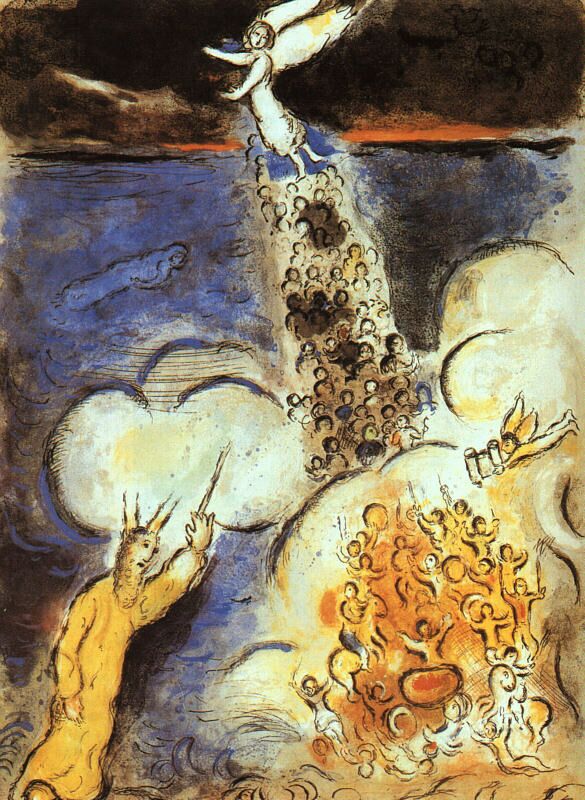

Marc Chagall's "Passover Haggadah"


Celebrate forty years of wandering.
40 years of searching.

Read Haggadah to the children,
give thanks,

sing praises
for the tribe surviving.

Focus on the ancients,
not the news.

Ignore ICE, as it issues
this warning: if officers

view you as Other,
hear a foreign accent,

take notice of shabby clothes,
you will be wrangled

like cattle into pens
and, paperless or not, deported.

To where? Weep, explain
you have lived here

since you were two,
this is your home.

Your wife, your children,
your aged mother

may never see you again.
Glory be to what?

Listen! Angry screams nurtured
by hatred, drown out the cries

of kids in Florida, or Texas, or next door.
How many more will be force fed this poison

in the name of a merciless God
punishing the sin of survival?

Tonight, we Jews co-opt words;
suffering, pain, freedom.

I imagine the day that
anyone’s God

will deliver enlightenment,
angels will sing,

heavenly light will shine
on the cruel irony of the self-righteous,

the day each of us will be revealed
as the supplicant,

each of us the Other.
The day our ancient journey,

our Passover celebration,
will not fall so woefully short

of the promised land.


Anita S. Pulier’s chapbooks Perfect Diet, The Lovely Mundane, and Sounds of Morning and her books The Butcher's Diamond and Toast were published by Finishing Line Press. Anita’s poems have appeared in many journals and her work is included in nine print anthologies. Anita has been a featured poet on The Writer's Almanac.

Tuesday, September 03, 2019

BREATHING LESSONS

by Mary K O'Melveny


“Can’t breathe” by Hong Kong artist Benson Koo at society6.


I CAN’T BREATHE

said Eric Garner, his loosies scattered
like toothpicks on the street, his chest
and neck compressed, his body battered,
then prone, as Daniel Pantaleo pressed
down harder until nothing mattered,
leaving questions for some later inquest.

WE CAN’T BREATHE

said Hong Kong protesters whose lungs
filled with tear gas as police fired
more cannisters and aimed their guns
toward their hearts, hoping they would grow tired
of trying to imagine worlds of other suns
where democracy was still admired.

THEY CAN’T BREATHE

said medics in hospital rooms, as patients
arrived in great numbers, gasping for air
while tobacco CEOs made deals in spacious
office suites for vaping products, aware
that regulations are slim and use contagious,
betting as usual that not enough would care.

SHE CAN’T BREATHE

said the driver who found a woman walking
alone on the roadway as Paradise fires raged,
her car abandoned long before, tires melting.
From his pickup, too hot to touch, he gauged
the odds of rescue and the dangers of stalking
cinders, then leapt out—one catastrophe assuaged.

THEY CAN’T BREATHE

said migrants still floating on choppy seas
about fellow travelers catapulted overboard
flailing, then sinking, while they watched with unease.
They had prayed to gods when they climbed aboard
these flimsy rafts and trembling skiffs. Those pleas
have thinned to terror as they continue seaward.

HE CAN’T BREATHE

said the mother whose wheezing child
struggled for each breath in and out,
while methane gas levels went wild
and fossil fuel fumes expanded throughout
their Appalachian hills. Even with their air defiled.
some still said there’s nothing to worry about.

WE CAN’T BREATHE

said Southeast Asian villagers choking in heat
and smog. Their farmlands cleared for palm oil,
nothing remains to be burned except the peat
which smolders like angry words beneath soil
while carbon fills the air with coppery sleet
and once lush jungles are forever spoiled.

I CAN’T BREATHE

said Mother Earth as Amazonian flames
joined those in Africa and Alaska to devour
her greenest places. As thick forests turned to arid plains
and savannahs, what once were leafy bowers
degraded to dieback deserts. Scientists maintain
some hope but she’s fast losing respiratory powers


Mary K O'Melveny is a recently retired labor rights attorney who lives in Washington DC and Woodstock NY.  Her work has appeared in various print and on-line journals. Her first poetry chapbook A Woman of a Certain Age is available from Finishing Line Press. Mary’s poetry collection Merging Star Hypotheses will be published by Finishing Line Press in January, 2020.

Thursday, April 18, 2019

45

by Gil Hoy


Members of a family reunite through the border wall between Mexico and United States, during the "Keep our dream alive" event, in Ciudad Juarez, Chihuahua state, Mexico on December 10, 2017. Families separated by the border were reunited for three minutes through the fence that separates Ciudad Juarez Park in Mexico and Sunland in New Mexico, United States, during an event called "Keep our dream alive", organized by the Border Network for Human Rights on the International Human Rights Day. HERIKA MARTINEZ/AFP/GETTY IMAGES via Texas Public Radio


In this poem, proper sentence 
structure will be followed.

For example, sentences will start
with a capital letter and end

with a proper punctuation mark.

Sentences will be grammatically correct.

Some may say that this will likely detract 
from the poem’s poetic quality,

but I’m not sure I can agree.

I’m also not sure real poems require words

I italicize for emphasis.

For example, is an image held 
in the mind of crying children—

of thousands of immigrant families

separated at the border—never
to be reunited, poetic?

Is the image symbolic and evokes
strong emotions? Is it repetitive 
and sick at heart?

Are the precise words of one’s 
internal dialogue describing the image 

what make it poetic or not?

Can a number be a poem, or at least poetic?
Such as the title of this poem?

I will never think of “45” in the same way again.


Gil Hoy is a Boston poet and semi-retired trial lawyer who studied poetry at Boston University through its Evergreen program. Hoy previously received a B.A. in Philosophy and Political Science from Boston University, an M.A. in Government from Georgetown University, and a J.D. from the University of Virginia School of Law. He served as a Brookline, Massachusetts Selectman for four terms. Hoy’s poetry has appeared most recently in Chiron Review, TheNewVerse.News, Ariel Chart, Social Justice Poetry, Poetry24, Right Hand Pointing/One Sentence Poems, I am not a silent poet, The Potomac, Clark Street Review, the penmen review and elsewhere.

Thursday, April 11, 2019

ASYLUM SONG

by M.H. Spicknall


Hundreds of migrants are being held under an El Paso, Texas bridge without clean water or proper shelter. —NowThis News, March 29, 2019


When all the dogs run into the wood
  When all the forests stiffen to stone
    When all the rocks dissolve into dust
When all the debris buries the thrones

When all good gods have fall’n to their knees
  When all the faithful have done what they could
    When all the deeds done do not hold the hounds
When all of us have forgotten the good

When all the pleas are lost silent screams
  When all the quiet has set loose a fate
    When all coming time reflects only us
When all our mirrors reflect only hate

When all our fears have walled off the world
  When all of this land is for just us alone
    When all of them crawl back to the wood
When all that’s left is to gnaw on their bones


Author’s Note: The poem can be sung to Dylan’s “Masters Of War,” and includes a sad nod to Woody Guthrie.


Mark Spicknall is a manufacturing and business consultant, who writes simply to help distill things to their essence for his own understanding.

Wednesday, February 27, 2019

STATE OF EMERGENCY

by Donna Katzin


The House on Tuesday passed a resolution to overturn President Trump’s declaration of a national emergency on the southern border, as majority Democrats painted an apocalyptic portrait of a lawless chief executive out to gut the Constitution. —The Washington Post, February 26, 2019


An emergency                                                              
sleeping in our subways, Sal
knows no other home.                                                              

Her belly a beast,
Alma picks through the trash when
no one is looking.

Pedro camps between
boards that used to be his house
in Puerto Rico.

Santa Rosa Ruth
sifts through rubble where wildfires
devoured her mother.
                             
With bare feet we map
our way through the wilderness,
build bridges—not walls.


Donna Katzin is the founding executive director of Shared Interest, a fund that mobilizes the human and financial resources of low-income communities of color in South and Southern Africa. A board member of Community Change in the U.S., and co-coordinator of Tipitapa Partners working in Nicaragua, she has written extensively about South Africa, community development and impact investing. Published in journals and sites including TheNewVerse.News and The Mom Egg, she is the author of With the Hands, a book of poems and photographs about post-apartheid South Africa’s process of giving birth to itself. 

Wednesday, August 22, 2018

WIRE CUTTERS

by Bill Sullivan


"Cutting Barbed Wire" by Toyo Miyatake (circa 1944/1945).


Somehow Mr. Miyatake was able to smuggle in his lenses,
build a makeshift box camera out of what scraps were available
in the Manzanar Internment Camp. Confinement could not
constrain his ingenuity, his spirit, his need to document injustice.
So we have a black and white record of this shameful action
as well as photos of a resilient, proud people to absorb and remember.

               I am looking at his image of a raised arm, a hand
clutches a wire cutter, as if it were a lifeline, its blades open,
ready, eager, one senses, to sever a strand of razor sharp barbed wire.
In the top left-hand corner, we see the guard tower looming
over the scene. Yes, a given time and place. A dark piece
of our past, but it could have been taken at one of the Nazi
concentration camps, a Siberian gulag, any one of too many
political prisons. Clashing symbols; the desire to be free
and the drive to imprison.

               I am thinking of the suspicion, fear and greed
that led to the confinement of Japanese Americans decades ago
but also, the recent images of Central American children separated
from parents, crammed into cages, lying there on concrete
or thin pads, alone, sobbing, some silently, Brown children, vermin
to some, quarantined, held as hostages to convince their parents
to return to their countries and to deter other asylum seekers
from crossing the border. All that cruelty to assure the whiteness
of America prevails.

Has a photographer pressed his shutter, captured
the indifference and abuse in this house of horrors?
Has a filmmaker documented the bewilderment
and innocence of children, the anguish of parents?
So that after the wires are severed and they are free
and united, we and our children's children can see,
know shame and anger, reap love from the ashes
of our history.


Shoes and toys left at a port of entry to the U.S. in Tornillo, Texas. Photo by Brendan Smialowski/AFP/Getty Images accompanying “Toddlers fend for themselves in immigration court thanks to Trump,” an op-ed by Sen. Richard Durbin, Chicago Sun-Times, August 17, 2018. "The policy began in secret. The Trump administration denied such a policy existed. And when it finally acknowledged that migrant children were being separated from their parents at the border, chaos ensued. Only now is the full picture of what happened and why becoming clear." —The Daily podcast presents "Divided."


Bill Sullivan taught English and American studies at Keene State College, co-authored books on Twentieth century American poetry, co-produced two documentary films, and most recently published Loon Lore: In Poetry and Prose.

Thursday, July 12, 2018

BY THE RIVER

by Jan Steckel


“Happy is he who takes your little ones
and dashes them against the rocks.”
—Psalm 137:9


By the waters of the Rio Grande
our hands were cuffed,
our children taken.

We didn’t know in Bohemia’s Terezin,
Theresienstadt was a model camp.
Propaganda film: a Jewish orchestra
before it went up in smoke.

We’d heard Argentina
stole babies for barren
military couples, dropped mothers
from helicopters into the sea.

Tornillo in the Texas desert:
white tents pitched overnight.
Drone-photo of boys marched in lines.
Journalists not allowed inside.

In jail I got a receipt
for my wallet, but none for my son.
By the Rio Grande,
I lay down and wept.


Jan Steckel'poetry book The Horizontal Poet (Zeitgeist Press, 2011) won a 2012 Lambda Literary Award. Her fiction chapbook Mixing Tracks (Gertrude Press, 2009) and poetry chapbook The Underwater Hospital (Zeitgeist Press, 2006) also won awards. Her fiction and poetry have appeared in Scholastic Magazine, Yale Medicine, Bellevue Literary Review, Canary, Assaracus, and elsewhere. Her work was nominated three times each for the Pushcart and Sundress Best of the Net anthologies, won the Goodreads Poetry Contest three times, and earned various other awards.

Saturday, February 04, 2017

THE GOVERNMENT

by Samantha Pious


after a ballade by Christine de Pizan


Where will outcasts comfort find
—asylum-seekers, refugees—
 now the land we thought to be
the sunset gates, the golden door,
the harbor where the tired, poor,
and fearful could at last breathe free
has neither love nor amnesty?
The one-percenters are severe;
the young professionals, resigned.
The government won’t deign to hear.

To lawyers they have no recourse,
ill-counseled by their advocates,
without protection from the courts.
The officers who stop and frisk
interrogate with undue force—
and sometimes suspects disappear
before they’re properly accused.
(But could that ever happen here?)
The magistrates condemn, unmoved;
the government won’t deign to hear.

Where shall they go, when there is no
safety here, or anywhere
that hope is vain, and friend is foe?
The underground will take them in
if they believe the garbled voice,
the tiny hands, the laquered hair,
the orange pawn—or puppeteer?—
who has big plans for his first year.
(But will he keep Obamacare?)
The government won’t deign to hear.

Folks, after this election year
the ship of state has sprung a leak
while navigating up shit creek.
We’ll have to pray or maybe hope
our captain doesn’t rock the boat.
The government won’t deign to hear.


Samantha Pious's first book A Crown of Violets (Headmistress Press, 2015) offers a selection of the French poetry of Renée Vivien in English translation. Some of her other translations and poems have appeared in Adrienne, Lavender Review, Mezzo Cammin, and other publications. Her poem "The Government" is loosely adapted from the Middle French of Christine de Pizan (1364-ca. 1430), an Italian-French woman poet and philosopher of the Late Middle Ages.