Guidelines


Submission Guidelines: Send 1-3 unpublished poems in the body of an email (NO ATTACHMENTS) to nvneditor[at]gmail.com. No simultaneous submissions. Use "Verse News Submission" as the subject line. Send a brief bio. No payment. Authors retain all rights after 1st-time appearance here. Scroll down the right sidebar for the fine print.
Showing posts with label landscape. Show all posts

Thursday, October 19, 2023

EACH DEVASTATION

by Linda Conroy


“Blue Shadow” (original hand painted Acrylic painting of Blue petals in different shades) by Deepu.


brings blue shadow to the landscape

reminding of the weight of volatility


a volatility so broad that it might 

slam the farthest reach of sky.               


I see that the farthest reach of sky,

a place that could bring joy in its daily birth,       


a birth that may absolve our sins in joy,

is blurred with splashes of red dawn.          


A rawness of red dawn reflecting

all spilt blood, acts of a night just gone.


Blood this night spilled, done for now

and slunk away, not pushed by any squall.


No morning squall can push beyond                              

the bruised blue shadows of this day.


Linda Conroy is a retired social worker who likes to observe and comment on the human behaviors that we see around us, and on the connection between human nature and the natural world. Her work has appeared in many journals.

Friday, December 16, 2022

P-22

by Barbara Parchim


The famous Hollywood-roaming mountain lion known as P-22 is drastically underweight and was probably struck and injured by a car, wildlife experts who conducted a health examination on the big cat said on Tuesday. The male cougar, whose killing of a leashed dog has raised concerns about its behavior, probably will not be released back into the wild and could be sent to an animal sanctuary or euthanized, depending on its health, the California department of fish and wildlife said. —The Guardian, December 14, 2022


you overstepped your allotment
designated when we took over the landscape—
 
wandered into the backyards of
designer dogs that scamper like prey
 
crossed the wrong freeways—
a concrete grid overlaid on the land
 
meaningless, artificial boundaries
not mapped in your DNA
 
how could you know
only certain spaces were allowed?
 
how solitary your existence
far from the Santa Monica mountains
 
the occasional park,
a checkerboard of wild between our constructs
 
what happens next is our decision
as we decide everything in our dominion
 
your celebrity may evoke some empathy
as the wild slips away
 
 
Barbara Parchim lives on a small farm in southwest Oregon.  She enjoys gardening and hiking and volunteered for several years at a wildlife rehabilitation facility.  Her poems have appeared in Allegro, Isacoustic, The NewVerse News, Turtle Island Quarterly, Windfall, Front Porch Review, Jefferson Journal, Cirque, and others.  Her first book What Remains was published by Flowstone Press in October, 2021.

Thursday, June 23, 2022

UNNATURAL DISASTER

by Dick Altman


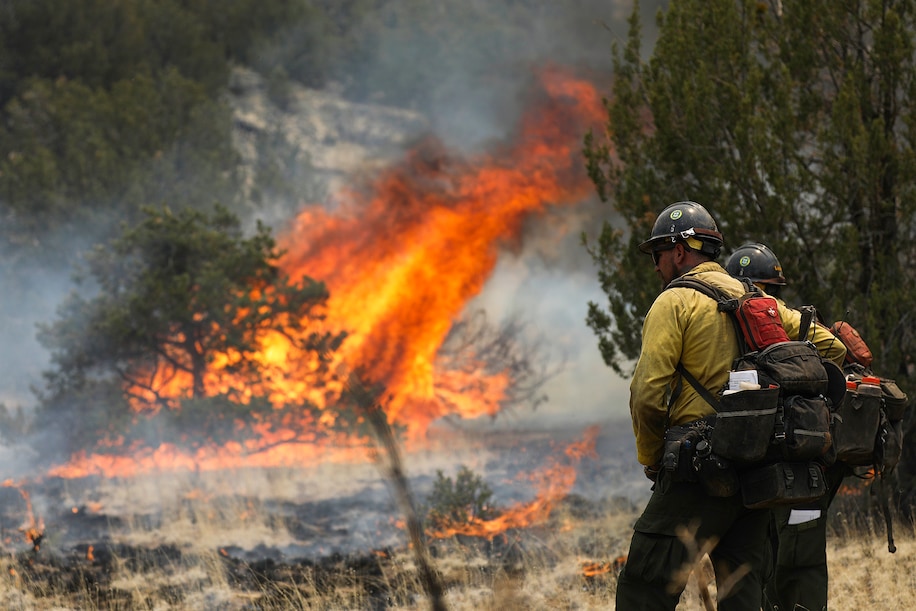
The U.S. Forest Service failed to consider how a changing climate could make the landscape more flammable, didn’t adequately estimate the risk of a controlled fire escaping and used incomplete weather information as a prescribed burn went awry and later formed the largest wildfire in New Mexico history, the agency said in a report released Tuesday. The 85-page report describes how federal fire managers, who felt under pressure to complete the prescribed burn while they had the available personnel, made miscalculations and overlooked warning signs—including low humidity, the potential for erratic winds on complex terrain and the heavy, dry fuel loads that could stoke a runaway fire. Although crews followed the burn plan, it contained flawed and incomplete analyses, and some guidelines were out of date amid a prolonged drought, the report said. The result: The prescribed burn ignited a wildfire that later merged with another prescribed burn to create the Hermits Peak/Calf Canyon Fire, scorching 341,746 acres as of Tuesday and destroying hundreds of homes in a 500-square-mile area. Santa Fe New Mexican, June 21, 2022. Photo: Hot shot crew members keep an eye on a blaze June 15 as fire crews ignite the underbrush in an effort to contain the Pipeline Fire near Flagstaff, Ariz. (Rachel Gibbons/Arizona Daily Sun/AP via The Washington Post)


Northern New Mexico

Sixty days of flame—
and I watch the sky
as a sailor watches the sea—
for signs in color and wind
and heading—to tell me
how even the air tires
of hefting its load of ash—
of remains of homestead
and livestock—tall-pine
forest—tractor and pickup
 
Until you’ve seen
a high plains landscape
scorched into a nightscape—
a contagion of char—
blackness wherever you look—
you don’t realize what a task
to bend language
into a portrait of asteroidal
extinction—a voided canvas
of negative space that may
take nature forever—if ever—
to paint over and fill in
For friends who’ve lost all—
out of fire simmers the future
in a boil of uncertainty—
a rage smoldering in the mind—
no dream fully smothers
 
How can I with words reseed
generations of struggle—
sow trust that morning ignites yet
with sun’s benign fury—perhaps
not tomorrow—or the next—
but one day—amid sapling
of needle and leaf—short
grass prairie fed upon
by mother and calf—fields
you begin again to recognize
as the only soil you’ve worked—
and wept over—since you were
born
 
 
Dick Altman writes in the high, thin, magical air of Santa Fe, NM, where, at 7,000 feet, reality and imagination often blur. He is published in Santa Fe Literary Review, American Journal of Poetry, riverSedge, Fredericksburg Literary Review, Foliate Oak, Blue Line, THE Magazine, Humana obscura, The Offbeat, Haunted Waters Press, Split Rock Review, The RavensPerch, Beyond Words, The New Verse News, Sky Island Journal, and others here and abroad.  A poetry winner of Santa Fe New Mexican’s annual literary competition, he has in progress two collections of some 100 published poems. His work has been selected for the first volume of The New Mexico Anthology of Poetry forthcoming from the New Mexico Museum Press.

Saturday, December 26, 2020

MUNDUS NOVUS

by Pauletta Hansel


In this Oct. 27, 2020 photo, artist Suzanne Brennan Firstenberg walks among thousands of white flags planted near RFK Memorial Stadium in Washington in remembrance of Americans who have died of COVID-19. Credit: Patrick Semansky, AP via The Detroit News, December 14, 2020.


300,000 US dead, I read
this morning (old news
by the time you read these words).
This pandemic’s
in month nine, fully gestated.
The curve of it ready to pop.
My husband, the historian, 
looks across the table at me,
tells me this won’t be the last pandemic
of our lifetime, this won’t be the worst.
We’re in our sixties now. How much longer
does the next one have to find us?
Twenty, thirty years?
How many of them would we choose
to claim, years not given up to pills and tubes,
the cancer that his mother didn’t fight,
the dementia that wrote the ending
of both my parents’ stories?
I pick up again the book
that names my New World kin—
Ezekiel, Margaret—
newlywed and not among
300 grisly dead that year,
Jamestown, 1622, settlers
with their own weapons slain,
the Powhatan’s wasted dose
of our own medicine
to rid themselves of our encroaching whiteness.
Rapacious is the word
the author gives to my ancestral 
plundering of the world 
that was not new or ours,
and even now we thrust our will
across this landscape, not unlike the virus
we no longer call novel.  


Pauletta Hansel’s eighth poetry collection is Friend, epistolary poems written in the early days of the pandemic; her writing has been featured in Oxford American, Rattle, and The New Verse News, among others. Pauletta was Cincinnati’s first Poet Laureate (2016-2018) and is past managing editor of Pine Mountain Sand & Gravel, the literary publication of Southern Appalachian Writers Cooperative (2010-2020).