Guidelines


Submission Guidelines: Send 1-3 unpublished poems in the body of an email (NO ATTACHMENTS) to nvneditor[at]gmail.com. No simultaneous submissions. Use "Verse News Submission" as the subject line. Send a brief bio. No payment. Authors retain all rights after 1st-time appearance here. Scroll down the right sidebar for the fine print.
Showing posts with label flame. Show all posts

Saturday, March 14, 2026

BREADCRUMBS IN A NATION OF LOAVES

by Jazmine Crandall 


The economic fallout of the US-Israeli assault and Tehran’s retaliation is spreading fast, and pushing the most vulnerable towards disaster. —The Guardian, March 12, 2026 
 

In the marble halls where voices echo  
like coins dropped into deep, indifferent wells, 
they debate the price of labor 
as though it were a frivolous shadow; 
weightless, distant, theoretical. 

Outside, the morning opens its weary eyes. 

A banker straightens his Hermes tie 
that costs more than a week of someone's rent. 
His salary is quite the dome; 
built stone by stone, pension and bonus, 
arches of security rising 
towards stained-glass futures. 

A manager clocks in, 
midway up the ladder of breathing space. 
Her wages are a narrow bridge—
not golden, not broken,  
but sturdy enough to cross the river of bills 
if the current stays calm. 

And then there is the worker 
whose hands smell of fryer oil and sanitizer, 
whose chapped palms hold the ghosts  
of a thousand barcodes, 
and ears fatigue of a million complaints. 

Their meager wage is a candle in winter. 

Each hour they feed the flame, 
yet the room refuses to grow warm. 

And no one says the quiet truth aloud: 
this fire was never meant to heat the house. 

It was meant to prove endurance. 

So the worker learns the mathematics of survival—
how many hours equal a gallon of milk  
and a carton of eggs, 
how many aching hours on torn soles 
and blistered toes equal rent, 
how many meals must disappear 
so the light bill does not. 


Jazmine Crandall is a Colombian-Cuban poet in Atlanta, Georgia. She's beginning her journey of sharing her poetry and strives to make a difference. Her work explores feminism, inequality, and the struggles of immigrants and the working class, using her writing to advocate for marginalized voices.

Sunday, December 07, 2025

A RECOLLECTION ON PEARL HARBOR DAY

by Katherine Leonard


It's blotchy the past

the silent man

in his uniforms


the child knows his withdrawn presence

but sometimes he would play

with her    for short bursts       when she was very little


he lived in a world of diesel and flame

oil and water mixed on the destroyer deck

bomb dropped where he stood 5 minutes before


gun turret melted metal and pieces of arm

face blood leg and black smoke

his men faceless except in his memory


daily    weekly            yearly the men lay 

submerged in his South Pacific 

they were with him through his submarine assignment


in the mouth of the River Kwai          bands of broken brothers

breaks the hearts of the survivors

breaking broken like metal shards 


until one day

that fragile plank holding those shiny dress

officer shoes broke


And he with that plank and metal splinters

sank too

consumed by the black rolling sea


of his mind now in command

of his hand

on the rope


Author's Note: Poem for my father, Commander Robert E. Leonard, USN Ret. who served in the South Pacific in WWII at a time when PTSD was unknown and silent men and women were numerous and all rejoiced mightily at the fall of fascism in Germany, in Japan and in Italy.


Katherine Leonard is the author of the chapbook Requiem for the Beekeeper (Bottlecap Press 2024). Her poems have been published in Sonora Review, Querencia Press Anthologies, Hole in the Head Review, Speckled Trout Review, FERAL, Allium and Stone Canoe among other journals and anthologies. She is a graduate of the Syracuse YMCA Writer's Voice (formerly Downtown Writers Center) Pro Program in poetry. She has been a chemist, a geologist and an oncology nurse/nurse practitioner. Her writing has been deeply influenced by time spent in New Mexico, Texas and Colorado for space and heat and Vermont and Maine for ice and clarity and by living in Washington, DC for lies and redemption. She is married to the woman with fire in her guitar.

Wednesday, June 04, 2025

BOULDER

by Jeremy Nathan Marks


Sunrise over the Flatiron Range near Boulder, Colorado.


A man has been charged with a federal hate crime and multiple other felonies after he allegedly used a makeshift flamethrower and incendiary devices to attack a crowd of people who were raising awareness for Israeli hostages in Gaza, injuring 12 victims. Mohamed Sabry Soliman, 45, is alleged to have shouted “Free Palestine” as he attacked the crowd on Sunday. The FBI said Soliman told police he planned the attack for a year and had specifically targeted what he described as the “Zionist group”, the Associated Press reported. —The Guardian, June 3, 2025


The Boulder mountains began as fire
perhaps that’s why they are known
as the Flatiron Range
 
If you look into their hearts you will find
fossils from the sea. Simple single cellular
creatures. Who by fire and Who by water.
 
In America, many folks like to say our story
will end in flame. I’ve seen John 3:16 signs
at Coors Field and when Mel Gibson made 
his film about Jesus, some pastor hung 
a billboard above I-25 saying the Jews 
Killed Christ. Jews kill Jews. Who gets to 
say.
 
A man throwing Molotov cocktails 
at people who want Israeli hostages freed, 
is he the authority on Jews Israel’s 
ambassador and foreign minister believe 
him to be.
 
The pressure which births mountains is 
hard to imagine. What it takes to sustain 
foundational myths across time, rebuild
temples, dream of olive trees is a pressure 
of perhaps equal force in human terms 
and very hard to fathom.

As I write this, someone would have 
you believe Jews possess a divine power 
to solve or cause all the worst excesses 
in the world. They might also think all
Palestinians want an eye for an eye. 
What is a Mashiac. Who are the prophets. 
Should we ask the mountains over Boulder.
 
The work of the Flatirons is not malevolent.
Moses didn’t receive tablets from Sinai 
but on it. Universes come and go with each 
blink of the high peaks.
Brahma sits on his lotus. 
Generals confer in bunkers.
The Earth’s crust floats on lava. 
Hashem has many names that depict 
His moods.
Not everyone says He is merely a He.
Christians speak of trinities.
 
Today, free speech invites a fire fight. 
We assemble in our mortar formations. 
I pumped gas this morning 
and it’s all I can taste.


Jeremy Nathan Marks is a former Colorado resident who lives and writes in Canada.

Thursday, July 13, 2023

HEAT WAVE

by Richard Schiffman


If sweat were gold, I’ve lost millions. 
If hell were cold, I’d be in heaven.
If heat were meat, I’d feed the world.
If hot were smart, this day’s a bloody genius.

Robin redbreasts with lolling tongues 
are begging for the spare change of rain. 
Today even the fire ants are panting like puppies. 
The dog days of summer, they whimper, they drool.

Pigeons in heat spontaneously combusting,
bridges diving like ducks into rivers, 
green leaves boiling and bubbling from trees, 
trees hawking their shade to the highest bidder.

Still, there is something in me that loves a flame. 
That burns baby burns complacency’s ghetto.
Whose body is grease for its very own pyre.
Whose soul is on fire like a summer in Georgia.

Some seasons are mild, some seasons are fiery
If June kissed the moon, the moon would go loony.
If July were a stud, every mare would come screaming.
When mid-August simmers, the whole world is soup. 

Today only mad dogs and Englishmen are strolling.
And possibly some poets and wandering monks.
Fervid souls, assorted fools. We know who we are.
We know what we’re up to.


Richard Schiffman, based in New York City, is an environmental reporter, poet, and author of two biographies. His poems have appeared on the BBC and on NPR as well as in the Alaska Quarterly, the New Ohio Review, The Christian Science Monitor, The New York Times, Writer’s Almanac, This American Life in Poetry, Verse Daily, and other publications. His first poetry collection What the Dust Doesn't Know was published in 2017 by Salmon Poetry.

Thursday, June 23, 2022

UNNATURAL DISASTER

by Dick Altman


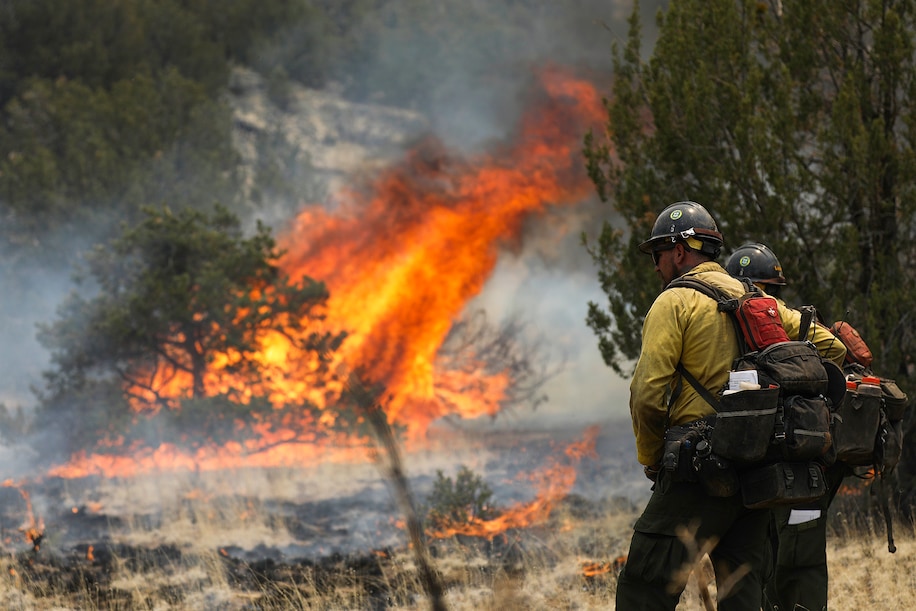
The U.S. Forest Service failed to consider how a changing climate could make the landscape more flammable, didn’t adequately estimate the risk of a controlled fire escaping and used incomplete weather information as a prescribed burn went awry and later formed the largest wildfire in New Mexico history, the agency said in a report released Tuesday. The 85-page report describes how federal fire managers, who felt under pressure to complete the prescribed burn while they had the available personnel, made miscalculations and overlooked warning signs—including low humidity, the potential for erratic winds on complex terrain and the heavy, dry fuel loads that could stoke a runaway fire. Although crews followed the burn plan, it contained flawed and incomplete analyses, and some guidelines were out of date amid a prolonged drought, the report said. The result: The prescribed burn ignited a wildfire that later merged with another prescribed burn to create the Hermits Peak/Calf Canyon Fire, scorching 341,746 acres as of Tuesday and destroying hundreds of homes in a 500-square-mile area. Santa Fe New Mexican, June 21, 2022. Photo: Hot shot crew members keep an eye on a blaze June 15 as fire crews ignite the underbrush in an effort to contain the Pipeline Fire near Flagstaff, Ariz. (Rachel Gibbons/Arizona Daily Sun/AP via The Washington Post)


Northern New Mexico

Sixty days of flame—
and I watch the sky
as a sailor watches the sea—
for signs in color and wind
and heading—to tell me
how even the air tires
of hefting its load of ash—
of remains of homestead
and livestock—tall-pine
forest—tractor and pickup
 
Until you’ve seen
a high plains landscape
scorched into a nightscape—
a contagion of char—
blackness wherever you look—
you don’t realize what a task
to bend language
into a portrait of asteroidal
extinction—a voided canvas
of negative space that may
take nature forever—if ever—
to paint over and fill in
For friends who’ve lost all—
out of fire simmers the future
in a boil of uncertainty—
a rage smoldering in the mind—
no dream fully smothers
 
How can I with words reseed
generations of struggle—
sow trust that morning ignites yet
with sun’s benign fury—perhaps
not tomorrow—or the next—
but one day—amid sapling
of needle and leaf—short
grass prairie fed upon
by mother and calf—fields
you begin again to recognize
as the only soil you’ve worked—
and wept over—since you were
born
 
 
Dick Altman writes in the high, thin, magical air of Santa Fe, NM, where, at 7,000 feet, reality and imagination often blur. He is published in Santa Fe Literary Review, American Journal of Poetry, riverSedge, Fredericksburg Literary Review, Foliate Oak, Blue Line, THE Magazine, Humana obscura, The Offbeat, Haunted Waters Press, Split Rock Review, The RavensPerch, Beyond Words, The New Verse News, Sky Island Journal, and others here and abroad.  A poetry winner of Santa Fe New Mexican’s annual literary competition, he has in progress two collections of some 100 published poems. His work has been selected for the first volume of The New Mexico Anthology of Poetry forthcoming from the New Mexico Museum Press.

Monday, December 23, 2019

FAITH

by David Chorlton


The lady’s hair protests
too much; it shines against her age
with glitter in the green
dye cresting on her head. She holds
a cigarette between her first
and middle fingers, exhaling into
the morning just now
clearing from the early clouds
as she walks with her breast on display
by way of the five bold
letters silvered on her black shirt that proclaim
her FAITH.
                     In what
remains unstated. And all the upper case sparkle
gives nothing away
as to what or why she believes,
but inspires a guess regarding which sea
her soul is sailing on
in these impeachable, divisive
and uncertain days within sight
of Christmas. The pigeons
circling overhead have faith
that someone’s crumbs will fall for them,
the traffic lights
that cars will stop when they turn
red, the president that every lie
will one day be a jewel
in his legend’s crown. But faith
is a blind man’s mirror,
                                          a step in the dark,
the makeup on a woman’s face
when she is past her prime
and needs it to steady
her walk. She’s sitting now, on a stool
looking across the parking lot, while
the country teeters
on a tightrope and the great
questions just hang in the air like
the scarf of smoke around her face.
Whether there’s a god
                                           and who
he’d vote for; how old
is the mountain draped beneath the northern
sky; what kind of pen
was used to write the Constitution?
These careless moments
spent gazing
at life’s passage end
with a tobacco stub trodden into the ground.
There:
something finished, over
and done with. What comes next?
                                                                Maybe read
a few pages of the King James version, or
the National Enquirer. A cough
to clear the throat, a storm to clear
the air. Walk a little
up and down, practice how it feels to doubt
which direction is the best. Look
into the clear light for rain,
check for bargains
at the Safeway, light another
and inhale the belief that nicotine
can heal. A little bell
                                     keeps ringing
charity, charity.  At her place in the arcade
here’s a warrior fighting time alone
while the starlings on the power line
chatter strength in numbers
and when she strikes another match
on the year’s shortest day
the flame reflects
upon the word by which she lives,
taking comfort in uncertainty.


David Chorlton was born in Austria, grew up in Manchester, England, and lived in Vienna before moving to Phoenix in 1978. The Bitter Oleander Press published Shatter the Bell in my Ear, translations of poems by Austrian poet Christine Lavant. Reading T. S. Eliot to a Bird is from Hoot ‘n Waddle, in Phoenix, and a long poem Speech Scroll comes from Cholla Needles Arts & Literary Library.

Friday, April 12, 2019

PRESENCE IN THE ABSENCE

by Mary K O'Melveny


Illustration by Andy Gilmore for The New York Times, October 4, 2018. Stephen Hawking said that particles that fall into a black hole “can’t just emerge when the black hole disappears.” Instead, “the particles that come out of a black hole seem to be completely random and bear no relation to what fell in. It appears that the information about what fell in is lost, apart from the total amount of mass and the amount of rotation. If determinism breaks down, we can’t be sure of our past history either,”  Hawking said. “The history books and our memories could just be illusions. It is the past that tells us who we are. Without it, we lose our identity. Black holes are stranger than anything dreamed up by science fiction writers, but they are clearly matters of science fact.” —NWO Report, April 24, 2016


Black holes have our attention
once again. We still know little
or nothing. They are consummate
known unknowns, as Rumsfeld once said.

An image haunts us as we guess
at portraits of bending space, our
breath catches mid-inhale, as we
ruminate on combustion.

Or collapse. I had a lover
once who made me feel I could do
both at the same time—plummet from
heat to nothingness in seconds.

How I gravitated to flame
and then to black ice still amazes
all these light years later even
when my days now rotate with sun.

Perhaps we are obsessed with past
lives when they become places of
no return. Where memories curve
inward, leave us to read between lines.

That is why we hunger for things
we don’t know or can’t remember.
Why, even though ignorance may
devour us, shadows of faith adhere.


Mary K O'Melveny is a recently retired labor rights attorney who lives in Washington DC and Woodstock NY.  Her work has appeared in various print and on-line journals. Her first poetry chapbook A Woman of a Certain Age is available from Finishing Line Press.

Tuesday, September 27, 2016

FALL LEAVES IN CHARLOTTE

by Ralph La Rosa


A memorial to Keith Scott in Sunday near where Scott was killed by police in Charlotte, N.C. (AP Photo/Emery P. Dalesio) —The Washington Post, September 26, 2016.


The brighter they are
the faster they fail.

The higher they are
the farther they fall.

The fewer they are
the faster they fall.

The darker they are
the fiercer they flame.


Ralph La Rosa's most recent book is Ghost Trees.

Wednesday, February 11, 2015

A MAN BURNED ALIVE IS REINCARNATED AS A FIREFIGHTER

by Jay Sizemore


Ocean of Fire by Gate to Nowhere at DeviantArt


Kinship with ash,
he once wept smoking a cigarette.
Why do my tears smell like gasoline?

Nightmares in orange,
he’s sweat enough to saturate cities.
Sometimes, he dreams he is Joan of Arc.

Skin charred like paper,
blood still escapes
through the cracks, a dark syrup.

His armor gets heavy,
breath shallow in the smoke,
searching for survivors,

he loses his voice,
feels his ashen jaw come unhinged,
remembers the prayer he muttered

before first touching the flame:
Let me live again
as an ocean avenging an effigy.


Jay Sizemore brought the high-five out of retirement. He did not graduate from college, and is personal foot masseuse to his lovely wife. He knows the words to almost every Ryan Adams song. You can find his work in places online and in print. He lives in Nashville, TN, where music goes to die. His chapbook Father Figures is available on Amazon.

Monday, December 08, 2014

ELEGY FOR CLAUDIA EMERSON

by Joan Mazza


Claudia Emerson, Florida, 2008. Photo by Joan Mazza.


Even when your flame flickered, you still

shone in photos of the stitches of your

upper arm, broken when opening a jar.


Through surgeries and radiation, you coupled

your words with music, stanzas we entered

unafraid. You kept your smile when your hair


fell out, and showed us how to fall in love

with love again when you and Kent gazed

at each other. You said that when you were gone


women would line up around the block

with casseroles for Kent. He’s widowed

twice now. Another late wife.


Before your brain surgery, you wrote,

I hope I wake up! and you did.

How we’ll miss your light and words.


Joan Mazza has worked as a medical microbiologist, psychotherapist, seminar leader, and has been a Pushcart Prize nominee. Author of six books, including Dreaming Your Real Self (Penguin/Putnam), her poetry has appeared in Rattle, Kestrel, The MacGuffin, Mezzo Cammin, Buddhist Poetry Review, and The Nation. She ran away from the hurricanes of South Florida to be surprised by the earthquakes and tornadoes of rural central Virginia, where she writes poetry and does fabric and paper art.

Sunday, February 16, 2014

WHITHER WEATHER #2: FIRE OR ICE

by Tricia Knoll


Image source: KXL


The poet weighed the ends of flame and freeze
as if the fulcrum balanced between love and hate.

We are coming to know enough of both
to see the crux is fog of mind and sloth.

The west burns, the south freezes,
the ice is a river we cannot push.

Fire takes the wildwood
we saw first in black and white

now mixed sooty ash and snow.
The glaciers melt like films

children will never see,
the peaches they will not eat.


Tricia Knoll is a Portland poet, snowbound alone in her house for seven days. Her chapbook Urban Wild is now available from Finishing Line Press.

Thursday, December 13, 2012

TIBET IS A COUNTRY

by Judith Partin-Nielsen


Image source: globalpost


BEIJING — Chinese police officials have detained a Tibetan monk and his nephew and accused them of playing a role in a series of self-immolations, according to Xinhua, the state news agency. The move appeared to be part of a campaign to prosecute Tibetans who are accused of aiding others who set fire to themselves in protest of Chinese rule. --Edward Wong, The New York Times, December 10, 2012 


1

young monk’s red
and saffron robes
dissolving into flame
the intersection of
faith, courage and despair

2

Outside the rug shop
Tibetan flag flutters
Mourning the death
of the “land of Snows”


Following a trail of words, mountains, spirit and tears, this writer, mother, wife and eventually psychoanalyst left Texas for Colorado in 1985.  The land of the Arapahoe welcomed me and called me by name.  The love of poetry, poet and high mountain valleys has warmed my heart and made my home.  Freud said “everywhere I go, the poet has gone before me.”  May we keep following those footsteps on our paths thru the worlds.  Judith Partin-Nielsen teaches contemplative psychotherapy at Naropa University, practices psychoanalysis and writes poetry.