Guidelines


Submission Guidelines: Send 1-3 unpublished poems in the body of an email (NO ATTACHMENTS) to nvneditor[at]gmail.com. No simultaneous submissions. Use "Verse News Submission" as the subject line. Send a brief bio. No payment. Authors retain all rights after 1st-time appearance here. Scroll down the right sidebar for the fine print.
Showing posts with label oregon. Show all posts

Wednesday, November 27, 2024

THE THINGS GOOD PEOPLE DO

by Cecil Morris


Portland’s ‘frog taxi’ offers a life-saving lift to a struggling species. Volunteers shuttle Northern red-legged frogs across U.S. Highway 30 to prevent real-life Frogger. —OPB News, November 23, 2024


A little morning news that made me smile:
In Oregon, the Harborton frog shuttle,
a handful of concerned amateurs,
a collection of volunteers, patrol,
through November chill, at night in the rain,
to gather spawning Northern red-legged frogs
and transport them, free of charge, across blur
of traffic on U. S. Highway 30,
thus preventing a slaughter of innocents.


Let me be like those people, tender-hearted
and kind and brave and willing to protect
the ones who, alone, cannot save themselves.
Let me join the flotilla of volunteers
who come out in dark of difficult times
to ferry those in need back to safety.


Cecil Morris, a retired high school English teacher and Pushcart and Best of the Net nominee, has poems appearing in The Ekphrastic Review, Hole in the Head Review, The New Verse News, Rust + Moth, and elsewhere. He and his partner, mother of their children, divide their year between the cool coast of Oregon and the relatively hot Central Valley of California.

Sunday, August 11, 2024

BOWSER THE RUNAWAY TORTOISE

by Cecil Morris


Slow and steady runaway tortoise crosses highway before Portland police rescue —Oregon Public Broadcasting. August 2, 2024


This summer’s heat beat his hard shell
like a hammer on an anvil,
and even the dandelions
were discouraged onto wilting,
so he decided he had to go
like OJ in his white Bronco,
slow-mo escape through open gate.
He thought he’d find a place both lush
and cool, the greens still succulent,
the dandelions crisp delight.
He thought Cool Hand Luke shaking it.
He hummed slow tortoise on the run,
felt the sun like cymbals on him,
heard passing cars as electric
guitars. In two days gone, he went
a mile and crossed the 205.
This was his flight, his fancy free,

til he was caught. Should we say found?
Now Bowser’s back in the yard,
a new tracker on his arm,
and wishing like all of us
to taste freedom one more time.


Cecil Morris, a retired high school English teacher, has poems appearing or forthcoming in Ekphrastic Review, Hole in the Head Review, The New Verse News, Rust + Moth, Sugar House Review, Willawaw Journal, and elsewhere. He and his patient partner, the mother of their children, divide their year between the cool Oregon coast and California’s relatively dry Central Valley.

Sunday, May 05, 2024

WAYWARD BIRD CROSSES OCEAN AND BORDERS

by Cecil Morris


When hobbyist photographer Michael Sanchez snapped this picture of a blue rock-thrush subspecies on the coast of northern Oregon last week, he didn't know how rare the bird was until he posted it to social media: a blue rock-thrush, far from its native breeding habitat in parts of Europe, Africa and Asia. —NPR, May 3, 2024


The blue rock-thrush, bewildered,
finds itself on an Oregon beach
blown thousands of miles east from its
Asian land, its native air,
the green greens of home, the known,
familiar browns, the sunset skies.
Here the seagulls speak an angry
foreign tongue, a forbidding scream,
and it’s just another vagrant,
one more illegal immigrant
someplace it doesn’t belong
and, maybe, looking for a home.


Cecil Morris taught high school English for 37 years.  Now retired, he spends his time writing poems and shaking his head at the news.  He has poems in or forthcoming from Cimarron ReviewHole in the Head Review, The New Verse NewsRust + MothSugar House ReviewWillawaw Journal, and other literary magazines.

Tuesday, November 07, 2023

WINNER OF INTERNATIONAL BAT WEEK, 2023

by Cecil Morris


Bureau of Land Management wildlife technician photographed William ShakespEAR, a female Townsend's big-eared bat, in Jackson County. William ShakespEAR won BLM's 2023 Bat Beauty Contest. Photo courtesy Emma Busk / Bureau of Land Management via Oregon Public Broadcasting.


William ShakespEAR—right, not the poet-actor-
playwright who, maybe, made your high school English
class a drag, but a Townsend’s big-eared bat—won
the National Bat Beauty Contest this Halloween
and brought his bouquet of mosquitoes and moths
home to Ashland in southern Oregon, home
of a pretty famous Shakespeare Festival
where, I must admit, I was not bothered by
any flying insects during an evening
performance of Romeo and Juliet
in the outdoor theater. So good on you,
William ShakepEAR. Perhaps you can bring back
glamour to big ears, which would benefit
me, a man almost 70, with thinning hair
and elongating ears (think King Charles III
or the pendulous lobes of Nicole Kidman).
I do not want to be Dumbo with a flat
tire, Dumbo depressed, or Alfred E. Neuman
deflated. Of course, you, Mr. ShakespEAR
have perky, pricked up, Doberman-like ears,
and I am sure no one makes fun of you.
Too bad Bat Week has not had the success
of Shark Week. We need a Spielberg thriller
with blood and menace: EARS. Who’s listening now?
 

Cecil Morris taught high school English for 37 years. Now retired, he spends his time writing poems and shaking his head at the news. He has poems in or forthcoming from Cimarron ReviewHole in the Head ReviewThe New Verse NewsRust + MothSugar House ReviewWillawaw Journal, and other literary magazines.

Wednesday, September 14, 2022

FIRE SEASON

by Laton Carter


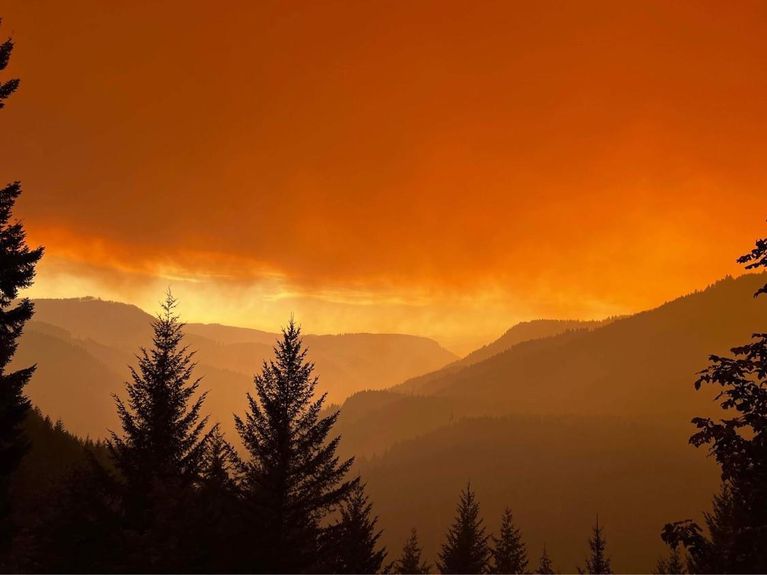
Smoke turns the morning light orange on Saturday in this photo taken near the Huckleberry Lookout, provided by the Cedar Creek Fire Incident Command. Credit: Cedar Creek Fire Incident Command via InciWeb and OPB, September 12, 2022


It is not that fire is snow. It is not even
that falling ash is snow. The sky
 
is stunned, swallowed
by a yellow glove whose palm
 
opens to haze and drifting filament. Burned
bodies, trees that pursed their mouths, that
 
refused to gasp or cry, handrails that melted, that
obeyed the persistence of time, they are
 
floating. (Floating only appears directionless.)
Summer is winter. Hold up your hand. In winter
 
no one answers. It is not that snow
is winter. Breathe in. Your lips, your throat,
 
your lungs. Prepare yourself.
Floating is not a weightless task.
 
Crucible,
blind pilot, un-
yielding conflagration.


Laton Carter's Leaving (University of Chicago Press) received the Oregon Book Award. His writing also appears in Indiana Review, Narrative, and Split Lip Magazine.

Monday, September 13, 2021

AFTER DROUGHT IN CENTRAL OREGON


Penelope Scambly Schott is a past recipient of the Oregon Book Award for Poetry. Her newest book is On Dufur Hill, poems about the cycle of the year in a small wheat-growing town.

Tuesday, July 27, 2021

THE BOOTLEG FIRE IS CREATING ITS OWN WEATHER

by Francine Witte


As the Bootleg fire in Southern Oregon rages on, the massive wildfire is creating its own weather systems. "The fire is so large and generating so much energy and extreme heat that it's changing the weather. Normally the weather predicts what the fire will do. In this case, the fire is predicting what the weather will do," Marcus Kauffman, a spokesman for the state forestry department, told The New York Times. —EcoWatch. Photo: A pyrocumulus cloud from the Bootleg Fire drifts into the air near Bly, Oregon on July 16, 2021. PAYTON BRUNI / AFP via Getty Images via EcoWatch.


Smokedrift and sunblot
from the fire spreading
like deathpain, the heat
so hot it spins the wind,
pinches lightning out
of the sky. Used to be
the wind would tell
the fire where to go.
 
Here in the east, we watch
the fire on TV. The silhouettes
of houses falling cardlike,
the bare hands of trees reaching up
in useless prayer. The weatherman
tells us the clouds we see
in the New York sky aren’t clouds
but smoke from out west.
 
It makes me think of other weathers,
the ones that weren’t weathers,
the storm of my father leaving so fast
the windows quaked, and then, the quiver
 
of hospitals filling up again, the rain
in the eyes of the left-behind.
The quiet drought of a man,
somewhere, shaking his head
sending the word “hoax” into the
air like a butterfly.
 

Francine Witte’s poetry and fiction have appeared in Smokelong Quarterly, Wigleaf, Mid-American Review, and Passages North. Her latest books are Dressed All Wrong for This (Blue Light Press), The Way of the Wind (AdHoc fiction), and The Theory of Flesh (Kelsay Books). Her chapbook The Cake, The Smoke, The Moon (flash fiction) will be published by ELJ in Fall 2021. She is flash fiction editor for Flash Boulevard and The South Florida Poetry Journal. She lives in NYC.

Saturday, July 24, 2021

PRAYER AGAINST HEALING

by Liz Ahl


A satellite view of the Bootleg Fire burning in Oregon last week.Credit: NOAA, NASA Goddard Space Flight Center, CIRA via The New York Times.

 
While flash floods hurl  
muddy torrents elsewhere, 
this NYC-sized fire lets loose  
its own brand of torrent,  
floods the drought-dried mountains 
with its hungry spill. 
 
I broadcast a cruel variant  
of prayer: that the destruction  
wreaked by the last big fires 
is still stark moonscape enough  
to refuse this newest ravaging;  
 
that the forest hasn’t recovered enough yet, 
that the masochistic cheatgrass  
hasn’t sprung up enough in between  
the skeletal remains of the trees,  
that the Winter Ridge—awful wish!
might still be more barren wound than healed;  
that it can’t offer enough fuel yet  
to carry such a conflagration further 
or to deliver its blazing deluge all the way 
to the shrinking shores of the lakes 
or, somehow, beyond. 
 
That we won’t have to wait or pray 
for the too-late balm of October rains.  
 
That this ongoing ruin  
might have some use against itself. 
 

Liz Ahl is the author of Beating the Bounds (Hobblebush Books, 2017), as well as several chapbooks of poetry. Much of her recent published work was composed or revised during visits to the Playa Artist Residency Program, on the shore of Summer Lake, currently threatened by the Bootleg fire. She lives in Holderness, New Hampshire.

Wednesday, December 16, 2020

NEW START

by Matt Witt


Photo by Matt Witt


It used to be
that if you walked along Bear Creek
that runs next to town
you could see the stream
only in a few moments
because the view was blocked
by brambles of highly flammable blackberries
and tangles of branches.
 
Then this summer’s inferno
burned everything to ash,
clearing out the old understory
and leaving only a sprinkling of
charred tree trunks,
like ghosts from the past.
 
Now you can walk freely
across cleared black ground
and see how the stream community works,
the side creeks feeding it,
the ducks and coots and geese
finding food and
shelter from predators.
 
It used to be
that if you walked through town
you could see the money stream
only in a few moments
because the view was blocked
by fairy tales about
rugged individuals and
the generosity of the rich
without ever asking
who all that wealth was
taken from.
 
Then the fire burned everything to ash,
leaving those who could least afford it
to scramble for survival
while developers and bankers met
to discuss how they might profit
by grabbing up the close-in valuable land
and moving “their” workers,
many with brown skin,
to the valley’s outskirts,
all in the name of charity.
 
Now you can see
how money and power flow
from bottom to top
filling giant pools for a few
with not much left to trickle down.
 
Along Bear Creek,
just weeks after the fire,
small sprouts of green
bring the possibility of
a new community
better than the old
with each plant and bird and animal
doing its part.
 
In town,
new sprouts of community
are taking root too
as people work together
to make sure everyone has
food and shelter and hope
and to ask what we can do
so what grows back
will be better for all of us,
now that we can see.


Matt Witt is a writer and photographer from Talent, Oregon. 

Tuesday, September 22, 2020

IMPOSSIBLE

by Diana Morley


A neighborhood destroyed by fire is seen as wildfires devastate the region, Thursday Sept. 10, 2020 in Talent, Ore. (AP Photo/Paula Bronstein via The Record Searchlight)


Two long days driving
through thick smoke
behind, ahead, behind
other fleeing drivers,
all going seventy, eighty mph
to get to air.
 
Diverted from inland to coast
from coast to inland—
fire grenades exploding 
in the hills alongside,
confusing the confused

on the road through 
Sweet Home
behind family
trailer homes
horse trailers
evacuating out of town 
till I reach a motel
where I need news— 

the radio 
assures me at 5 pm—

stock market up a tad

China, a valuable resource
for released Disney film—
‘an impossible resource to ignore.’


Author’s Note: I escaped the Alameda fire in Talent last Tuesday. For two days I thought my house was gone, then learned mine and one other neighbor’s survived on the block. That’s fire for you. My return won’t be to the neighborhood; it will be to both sorrow for my neighbors and joy for all those helping and planning for the future.


Diana Morley has published two books of poetry, one in 2019, one this year, been awarded honors by the Oregon Poetry Assn.  Lived in Oregon for 20 years, in Talent for 15 years. 

Friday, September 18, 2020

YOU SHOULD WRITE A POEM, YIAYIA—MY GRANDCHILDREN TEXT ME

by Pamela Devereaux Wilson


our well stopped working five days ago
i hand-pump water from storage containers
boil for cleaning, food prep and drinking
flush toilet with a pail

the physical work, breathing hazardous wildfire ash
that coats and clogs my mask as temperatures reach 80
advised to stay indoors but i pray best under the old apple tree
today we are told we have the worst air quality in the world

500,000 people, a tenth of Oregon's population, evacuated
when they go home, will they find piles of smoldering ash
where their lives were once lived and fulfilled
22 missing at least 10 dead

millions of acres of Oregon's Cascades blackened for years
i may never see it green again nor walk forests of wade rivers
when rains come, hillsides will flow into rivers—crisis within crisis

many are water insecure - travel miles for water
dwindling or polluted sources
greed, corruption—survive every day without potable water

drenched in this heat, breathing ash-filled air
my dog won't go outside
my head aches constantly—i don't have water—I can't breathe

in tears i rage—i can't fix anything for anyone right now
do you know how much five gallons of Costco water costs

so i haul, pump, boil, cool and pour water
write this poem for my hopeful grandchildren
full of spunk, promise and joy yet I shall not
share the despair this poem sings --
                                                                                             without clean water
                                                                                          without breathable air life
                                                                                              stutters stumbles dies


Pamela Devereaux Wilson lives on acreage north of Corvallis in the Luckimute Watershed. There she gardens, continues to learn about herbal medicine and writes. As she ages, changes, uninvited and unforeseen have begun to shape her writing but the influence of her grandchildren has been a steady force.

Wednesday, September 16, 2020

THE EXECUTIONER'S FACE

by Matt Witt


Dozens still missing in Oregon. Jackson County District 5 firefighter Captain Aaron Bustard works on a smoldering fire in a burned neighborhood in Talent, Ore., Friday, Sept. 11, 2020, as destructive wildfires devastate the region. (AP Photo/Paula Bronstein via OregonLive)


We load the car—
two sets of clothes and
a lifetime of memories—
as skyscraper flames are destroying
hundreds of homes of
friends and neighbors
a mile away.
Did they get out in time?
And then what?

We hit the back roads,
searching for safety,
with Bob Dylan howling through car speakers:
"The soles of my feet,
I swear they're burning."

Decades of reports said
this was coming
without climate action.
"Hotter temperatures."
"Disappearing snowpack."
"More frequent and more intense fires."
"Urgent transition needed to solar."
"Rapid investment in energy efficiency."

We can already picture
the photos the media will feed us
of some scraggly guy with stringy hair
who may have dropped a match—
with headlines: “What caused the fire?”

There will be no photos of
corporate lobbyists
whose puppets for years said
let's double down on what got us here
or who gave us half measures
and asked for applause.

We drive through the smoke,
community destroyed,
and now Dylan’s voice is sounding more desperate:
"The executioner's face,” he wails,
“is always well hidden."


Matt Witt is a writer and photographer from Talent, Oregon. His website is MattWittPhotography.com.

FIRES THIS TIME

Clackamas, Oregon, September 12, 2020


by Carolyn Martin
Dozens still missing in Oregon. Burnt roses are seen outside a destroyed home as destructive wildfires devastate the region on Friday, Sept. 11, 2020, in Talent, Ore. (AP Photo/Paula Bronstein via OregonLive)


While I check out evacuation routes
and pray our packed cars are precaution,
not necessity, thousands have lost
all there is to lose except each other
and maybe a treasure or two:
a dog, a cat, livestock raced
to fairgrounds, a child’s diary.

They don’t see what we—
the hunkered-down-in-place—see:
miles of ash heaps, contorted
cars and trucks, war-weary firefighters
who breathe the unbreathable.

Meanwhile, my mother lies in a NJ nursing home.
She can’t remember if she ate her lunch
or how to answer her phone. I watch her mind
slip into the smoke that wipes out
our Douglas firs and seeps into our home.
Today she doesn’t know her air is clean
or that nineteen years ago, she breathed
the ash of 3000 souls drifting
through another blackened sky.


Carolyn Martin is happily retired in Clackamas, OR where she gardens, writes, and plays with creative friends. She is the poetry editor of Kosmos Quarterly: journal for global transformation.

Saturday, September 12, 2020

FIRE SEASON IN OREGON

by Penelope Scambly Schott


The white daybed in the corner
between crammed bookshelves

An afghan of crocheted squares
draped across the rocking chair

Forty years of talk over supper
A spark and a festive red flare

The dangerous minutes we took
stuffing both cats into the pick-up


Fire Evacuation, Level 3: Go Right Now


The lavender glass perfume vial
from the grandmother’s dressing table

the silver pendant the mother hung
from around her scrawny neck

The yellow Brooks Brothers dress shirt
the father wore to his office

A stained first edition of Mending Wall
signed in person by Robert Frost

plus wallet and passport and computer
and checkbook and cash and bed pillow

and two days’ worth of clean underwear
and the pill bottles and a nice cold Pepsi

and two lightly browned slices of toast
with just the right amount of butter


Author's Note: We are safe but 1/10 of the population has evacuated, and friends have lost everything. One poet friend of mine lost her house but saved her alpacas.


Penelope Scambly Schott is a past recipient of the Oregon Book Award for Poetry. Her newest book is On Dufur Hill, poems about the cycle of the year in a small wheat-growing town.

FIRE INCANTATION

by Miriam Steinbach


    oh, bitter flame     run
run until you find home again     I know
you tripped over your own skinny legs
behind your mother’s church, knee caps crowned with
     shards of glass     I know
     the sting     I know
the swig, then scorch of vodka trickling over
bare bone, the taste of
     copper and salt     I know
     the screaming days     I know
     the flickering rage     I know
this isn’t death, this is a reset
life will breathe again,
in our garden of ash


Miriam Steinbach is a college student and poet based in Salem, OR. She enjoys being outdoors, playing cello, and posting poetry on her Instagram (@baldmilk).

Wednesday, September 09, 2020

THE RUT

by Pepper Trail


They are coming out of the hills into town
Young bucks, spiked with peachfuzz velvet
Old bulls, necks thick and haunches heavy
Veterans of the autumn brawls of many years

They enact the understood rituals of threat
Send signals of dominance, await submission
This has worked among themselves forever
In the sparring, none got hurt, usually not

But now, nothing is enough for respect
Not the bellow, the big beard, the big arms
Not the waved flag, the holstered sidearm
Not even the AR-15 - nothing is enough

So there will be trouble - how not?
Baffled by the strangers in their way
Hearing only challenge in the voices raised
They lower their heavy heads and, blindly, charge


Pepper Trail is a poet and naturalist based in Ashland, Oregon. His poetry has appeared in Rattle, Atlanta Review, Spillway, Kyoto Journal, Cascadia Review, and other publications, and has been nominated for Pushcart and Best of the Net awards. His collection Cascade-Siskiyou was a finalist for the 2016 Oregon Book Award in Poetry.

Tuesday, June 18, 2019

THE BAKER'S SONG

by Tricia Knoll


The Supreme Court on Monday passed up the chance to decide whether a baker’s religious objections to same-sex marriage mean she can refuse to create a wedding cake for a gay couple when state law prohibits discrimination based on sexual orientation. Photo: Melissa Klein, co-owner of Sweet Cakes by Melissa, in Gresham, Ore., in 2013. (Everton Bailey Jr./AP) —The Washington Post, June 17, 2019


I got hooked on hood ornaments
(not naked figureheads, glaring skulls,
or flying chrome goddesses on stud mounts)
early on. Swooping red firefighter hats
gold eagles on flagpoles—
top-notch things on top.

A baker’s puffy hat lured me
to flour and frosting—
whisper your cake wish—
kitties, mermaids, pirate ships
Thomas the tank, horses charging
on a cinnamon sugar beach,
king cakes: you dream it, I bake it,
ice it, add a top knot.
I’ve got all kinds.

My favorites
are wedding cakes, love cakes,
banana cream to pineapple upside down
rocked in a sea of sugar cream,

two women, two men, people
in wheel chairs, dark men, light women,
dark women, light men, men in skirts,
women in tuxedos,
one guy married a tree.

That’s all right with me.


Tricia Knoll is proud to live in Vermont which was the first state to allow same-sex marriages. She lived in Oregon when this legal case first erupted. She is a poet who would consider marrying a tree if she weren't already married and has children who are trees.

Wednesday, April 24, 2019

TOWARD A GENTLER GOOD NIGHT

by Elane Gutterman


N.J. Gov. Phil Murphy signs the Medical Aid in Dying for the Terminally Ill Act Friday, April 12, 2019 at the New Jersey Statehouse in Trenton, N.J. New Jersey joins seven other states and Washington, D.C. to enact a law permitting terminally ill patients to seek life ending medication. The law takes effect in August. (Credit: New Jersey Office of the Governor via WHYY)


The trigger for me was the research for a poem, my artful
turn on two decades of Oregon envy, wanting their Death
with Dignity to apply in New Jersey as a law abiding act.

I stumbled on the lobbying group and the way grew less abstract.
Supporters met up at the State House. Our message fine-tuned art,
we engaged lawmakers on the need for choice when near to death.

Those opposed called it suicide, minimized long-suffering death.
Finally, the bills came up for a vote, would they be enacted?
I stared at the display as votes in favor mounted like hanging art.

Work of art, my state enters the pact. Governor affirms choice in death.


In this tritina, Elane Gutterman celebrates a milestone in advocacy work with Compassion & Choices. Her poems have been published in U.S 1 Summer Fiction Issue, Kelsey Review, Patterson Literary Review, and TheNewVerse.News.

Friday, February 08, 2019

TIC TAC TOE

by Matt Witt


The Oregon Senate’s Housing Committee advanced a bill that would enact a statewide rent control policy and restrict evictions, sending it to the full Senate for a vote. Lawmakers heard nearly four hours of testimony from renters and landlords as Senate Bill 608 had its first hearing in the Senate’s Housing Committee. It’s poised to cruise through the Legislature, with support from leaders of the Democratic majority in both the House and Senate. Renters and tenants’ rights activists largely argued the bill would help protect against eye-popping rent increases that have frequently grabbed headlines across the state. —The Oregonian, February 5, 2019. Among those presenting testimony was the group of tenants pictured above who met at the Rogue Action Center in Jackson County in late November to discuss how to get local and state officials to take action on housing affordability. Nearly half of households there are renters, and one in three of those pay more than half their monthly income for rent. Credit: Matt Witt Photography


As a child
I played tic tac toe.
Should I go here,
or should I go there?

Then I learned:
you never win
if the other person goes first
with an X in
the middle square.

Olivia tells the city council
she and her son
had to move three times
after rent increases
left nothing to spare.

She works at Walmart
but after the rent
the paycheck covers only
food and bus fare.

Frank, who builds expensive homes
and has fifty rental units,
tells the council he would love to
help people like her,
he really would,
but prices are
whatever the market will bear.

Profit first.

The X in the middle square.


Matt Witt is a writer and photographer who lives in Talent, Oregon. He was recently selected a Writer in Residence at Mesa Refuge in California and has been selected an Artist in Residence at Crater Lake National Park, John Day Fossil Beds National Monument, Cascade-Siskiyou National Monument, and PLAYA in Summer Lake, Oregon. His writing has been published in the Washington Post, Los Angeles Times, New York Times, the literary journal Cirque, and many other publications. His photography may be seen at MattWittPhotography.com.

Friday, December 21, 2018

TONIGHT

by Penelope Scambly Schott


The Oregon state legislature passed a law that will go into effect on Jan. 1, 2019, that will allow the city and state to work together to clear camps under an intergovernmental agreement. In many cases, local officials are better equipped to help connect people with needed services like shelters and affordable housing. The partnership will also make clearing camps that exist on neighboring city and state property more streamlined. Under the agreement that Portland City Council approved Dec. 19, officials will give people at least 48 hours notice, and up to 10 days notice, to move from Oregon Department of Transportation property. That timeframe will significantly speed the process of sweeping encampments on ODOT property. Photo credit: Joe Riedl. —Willamette Week, December 19, 2018


Winds gust.
Rain slashes.
Douglas firs bend.
Pine cones pound my metal roof.
Have I mentioned how much I love my roof?
Have I described cardboard over sleeping bags?
Shopping carts stuffed with wet belongings?
Did I specify how bitter tonight’s rain?
In our whole city there is not
enough hot soup.


Penelope Scambly Schott, author of a novel and several books of poetry, was awarded four New Jersey arts fellowships before moving to Oregon, where her verse biography A is for Anne: Mistress Hutchinson Disturbs the Commonwealth received an Oregon Book Award for Poetry. Several of Penelope’s books and individual poems have won other prizes. Her individual poems have appeared in APR, Georgia Review, Nimrod, and elsewhere.