Guidelines


Submission Guidelines: Send 1-3 unpublished poems in the body of an email (NO ATTACHMENTS) to nvneditor[at]gmail.com. No simultaneous submissions. Use "Verse News Submission" as the subject line. Send a brief bio. No payment. Authors retain all rights after 1st-time appearance here. Scroll down the right sidebar for the fine print.
Showing posts with label hospitals. Show all posts

Thursday, December 07, 2023

MEDITATION ON FEAR AND LOVE

by Heather H. Thomas


“Reflected Autumn Light 2 Photograph” by Catherine Lottes


If I say I love god and hate my brother, I must be a liar.


Roots protrude over knots of weeds 

and wildflowers overgrowing the path 


to the old bench: knife scars. Initials dotted 

with bird shit. Today the ceasefire ended. 


Bombs resumed falling on crowded hospitals 

where the attacker says the enemy hides 


command centers that must be destroyed. 

The water’s green-black gloss. 


Slanted sun flares across it, flashes onto trees. 

Angled, the sun doubles its reflection, blinding me. 


For a second my face turns up to the sky 

glaring down. If I cannot love my brother


whom I have seen, how can I love god whom I 

have not seen? Quickly I turn away. 


My eyes burn. Behind them the sun repeats 

on my eyelids, retina, optic nerve. 


The riverbank is bathed in golden shimmers, 

shaking the leaves, making old branches dance.  


Pockets of air vibrate without breeze or wind, 

shaking me. Shifting reflections fracture into 


prisms of light flowing far away to the rubble, 

the dead, the injured, the taken, shaking every 


stripped-open heart that’s part of it all, the pulsing

downstream, the cross-stream ripple, the light 


refracted in this instant, as if the river upended 

and we were all under water. 


Heather H. Thomas is the author of Vortex Street (FutureCycle Press, 2018), and six other poetry collections. Her work has won awards from the Joy Harjo Prize, the Rita Dove Prize, and the Academy of American Poets, among others. Barrow Street; Cutthroat: A Journal of the Arts; Pedestal Magazine; and The Wallace Stevens Journal have published her recent work. Widely anthologized, Heather's poems are translated into six languages, including Arabic. She lives along the Schuylkill River in Reading, Pennsylvania, and has taught creative writing for many years.

Tuesday, March 15, 2022

RISKY

by Colette Tennant


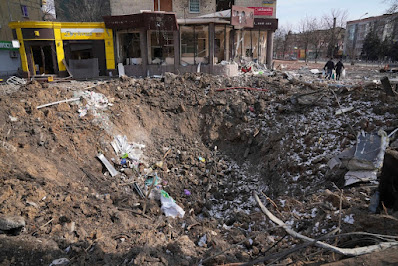
People walk past a crater from the explosion in Mira Avenue (Avenue of Peace) in Mariupol on March 13. (Evgeniy Maloletka/AP via The Washington Post, March 15, 2022)


streets filled with rubble,
a bombed maternity hospital, pregnant women
bloodied, lying on gurneys in a swirl of confusion,
Sasha, a baby goat with broken front legs,
trying to nurse a vet tech’s ear.
Her owner promised she’d return for her
because she loves her.


We watch the news from Ukraine –
refugees bundled against late-winter cold,
In between these stories, news channels
run commercials for various cures –
Nucala for severe asthma sounds great,
but it might cause shingles.
Trelegy treats COPD yet increases
the risk of thrush, pneumonia
and osteoporosis.
Farxiga, for chronic  kidney disease,
could lead to dehydration, fainting, weakness,
genital redness and swelling, and hypoglycemia. 


It’s a tricky balance,
the cure and its reaction, so
military experts sit with newscasters,
their hands folded on the studio table.
They discuss various scenarios
for how to help Ukraine, each one
peppered with what ifs.
One possible cure – establish a no-fly zone
unless Putin reacts with chemical weapons.
Supply warplanes to the Ukrainians,
order an airstrike on that 40-mile-long convoy,
but any of those moves might start World War III.
It’s a terrible quandary,
this war we watch between commercials –
trying to find a remedy for this devastation,
knowing the reaction may be awful.


Colette Tennant is an English professor living in Salem, Oregon. She has two books of poetry: Commotion of Wings, published by Main Street Rag, and Eden and After, published by Tebot Bach. Her most recent book, Religion in The Handmaid’s Tale: a Brief Guide, was published in September, 2019 to coincide with Atwood’s publication of The Testaments. Her poems have been nominated for the Pushcart Prize and have appeared in various journals, including Rattle, Prairie Schooner, Poetry Ireland Review, and Southern Poetry Review.

Thursday, March 10, 2022

CONSIDERING WAR

by Amy Shimshon-Santo


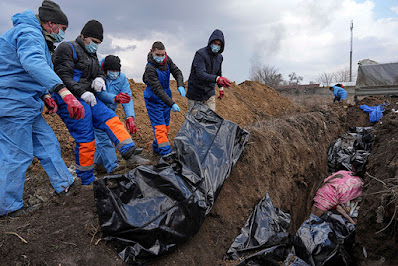
Dead bodies are placed into a mass grave on the outskirts of Mariupol, Ukraine, on March 9. (Evgeniy Maloletka/AP)


considering that bombs 
leave craters in the earth
making it difficult
to mobilize hospitals,
carry pregnant mothers
across fields of rubble

comprehending the cold breath of sunday
broken bridges, 
families gathered beneath them 
without exact destinations
beyond a border

understanding that mammals with bombs
are cold hearted
explosive-death-machines, 
considering that men
—and I will call them that
because of their bombs —
explode sites
leaving the enduring silence
of family members

understanding that a cadaver
cannot speak

& I am just a storyteller
still living 
with the possibility of voice
I will make my breath a sign
painted in horror 
across the sky
that begs the bombing 
to stop


Amy Shimshon-Santo is a poet and educator who believes that culture is a powerful tool for personal and social transformation. Her interdisciplinary work connects the arts, education, and urbanism. She is the author of Even the Milky Way Is Undocumented (Unsolicited Press, Pushcart Prize & Rainbow Reads Award nominee). 

Tuesday, July 27, 2021

THE BOOTLEG FIRE IS CREATING ITS OWN WEATHER

by Francine Witte


As the Bootleg fire in Southern Oregon rages on, the massive wildfire is creating its own weather systems. "The fire is so large and generating so much energy and extreme heat that it's changing the weather. Normally the weather predicts what the fire will do. In this case, the fire is predicting what the weather will do," Marcus Kauffman, a spokesman for the state forestry department, told The New York Times. —EcoWatch. Photo: A pyrocumulus cloud from the Bootleg Fire drifts into the air near Bly, Oregon on July 16, 2021. PAYTON BRUNI / AFP via Getty Images via EcoWatch.


Smokedrift and sunblot
from the fire spreading
like deathpain, the heat
so hot it spins the wind,
pinches lightning out
of the sky. Used to be
the wind would tell
the fire where to go.
 
Here in the east, we watch
the fire on TV. The silhouettes
of houses falling cardlike,
the bare hands of trees reaching up
in useless prayer. The weatherman
tells us the clouds we see
in the New York sky aren’t clouds
but smoke from out west.
 
It makes me think of other weathers,
the ones that weren’t weathers,
the storm of my father leaving so fast
the windows quaked, and then, the quiver
 
of hospitals filling up again, the rain
in the eyes of the left-behind.
The quiet drought of a man,
somewhere, shaking his head
sending the word “hoax” into the
air like a butterfly.
 

Francine Witte’s poetry and fiction have appeared in Smokelong Quarterly, Wigleaf, Mid-American Review, and Passages North. Her latest books are Dressed All Wrong for This (Blue Light Press), The Way of the Wind (AdHoc fiction), and The Theory of Flesh (Kelsay Books). Her chapbook The Cake, The Smoke, The Moon (flash fiction) will be published by ELJ in Fall 2021. She is flash fiction editor for Flash Boulevard and The South Florida Poetry Journal. She lives in NYC.

Sunday, May 24, 2020

OF HEAVEN AND HELL

by Katherine West


An abandoned corpse wrapped in plastic and covered with cardboard lies on a sidewalk in Guayaquil, Ecuador, on April 6. —CNN

There is wind but no water
After a truck drives by the dust
Takes a long time to settle
Bushes along the road are not green
Bushes along the path
In the evening
Light
Are more than green
Burning bushes all of them
They are the prophets
The saints
The messiah

Orange butterflies
Kissing
On yellow daisies
Are psalms

The hundred birds at dawn
Hosannas

And the dust?
And the drought?
The dying
Lined up outside hospitals
In Guayaquil?

The fires?
Burning before houses
Signal fires
So someone will come
Pick up the dead

Carry them away
To heaven
Seraphim and cherubim
And hymns
And again the birds
At dusk
The elegy of the thrush

And you limping
And me listening
And sapling shadows long across the path
Like a gate


Katherine West lives in Southwest New Mexico, near the Gila Wilderness, where she writes poetry about the soul-importance of wilderness, performs it with her musician husband, Yaakov, and teaches seasonal poetry workshops that revolve around "wilderness writing."  She has written three collections of poetry: The Bone Train, Scimitar Dreams, and Riddle, as well as one novel, Lion Tamer.  Her poetry has appeared in journals such as Lalitamba, Bombay Gin, and TheNewVerse.News  which recently nominated her poem "And Then the Sky" for a Pushcart Prize.

Friday, May 22, 2020

MICAH IN THE MIDST OF THE PANDEMIC

by Katherine M. Clarke


Micah


Our puppy arrives, six pounds
of squirming golden fluff chirping and burrowing
under my arm, trembling against my breast.

I reach back to my mother’s knee to find
what I’ve forgotten I know, singing
knick-knack paddy whack give the dog a bone

and nestle him into his crate with Mr. Krinkle
whose face he chews off but who still obligingly rustles,
offering rope hands and feet to gnaw on in the night.

As pandemic chaos reigns outside, love grows inside,
my beloved Lily handling and tending this small body
bursting into life, insisting on what he wants and needs

tired or not, frightened or not, a life counting on her.
She walks softly in stocking feet to feel him underfoot
to know when he races over her toes to hide.

Scooped up Micah rides high along her arm,
a pasha attended by his servant.
Firsts abound—sleeping through the night,

tasting snow, eating grass, throwing up.
Accepting a collar and lead as she hustles
him out the side door to the yard.

Victory, cheering, applause. Relief for both.
No need for social distance as the lord of all wriggliness
plays with Delores, a stuffed sheep, and Road-Kill Buzzy,

the flat woodchuck toy. A spiky rubber teething ring
on the shower curtain spread over the living room rug
as if a sphere of the virus had leapt from the television

screen filled with images of tents and stadiums for hospitals
warehouses loaded with coffins, trucks filled with bodies
while we shelter at home, grateful, joy strewn all around.


Katherine M. Clarke is a professor emeritus of Antioch University New England. Her essays and poetry have appeared in Writing it Real, Breath and Shadow, Wordgathering, Oasis, The Sun Magazine, and Northern New England Review.

Tuesday, May 05, 2020

AVAILABLE BEDS

by Dawn Corrigan


The diorama simulates the rising and setting points of the Sun. —Stanford University


Like sunrise, like hurricanes,
it moved east to west.

We feared it was coming
for that hole in your chest.

You said, Perhaps I should meet it
while there's still open beds.

But we made you a fortress
and hid you instead.


Author’s Note: This poem is a response to my immunocompromised husband, who suggested a couple of weeks ago that perhaps he should deliberately seek exposure to the virus before our local ICUs filled up. For now he remains safe and our local hospitals are below capacity, though with public beaches and restaurants reopening, I don't know if we can expect this state of stasis to last.


Dawn Corrigan has a black belt in social distancing.

Friday, April 10, 2020

THESE FRAGMENTS I HAVE SHORED AGAINST THE VIRUS

by Eric Weil


with apologies to T. S. Eliot


I. The Burial of the Dead

April is a viral month, breeding
Contagion out of the air, mixing
Distance and desire, streaming
Dull shows with spring pollen.

I will show you fear in a handful of dust.


II. A Game of Chess

The Lectern he stands at, like a burnished throne,
Glows in TV lights, where the ass
Between the flags flings his fruited lies
While gilded sycophants peep out
(And Fauci hides his eyes behind his wing),
Doubles the flames of narcissistic rage.


III. The Fire Sermon

The hospitals are broken, the last surgical masks
Fray and sink into wet piles.

Twit twit twit
Jug jug jug jug jug jug

So rudely forc’d.


IV. Death by Water

Phlebas the Epidemiologist, a fortnight dead,
Has missed the nurses’ cries, ironic memes,
Corpses lain in reefer trucks.

O you unmasked who shop and cough to windward,
Consider Phlebas, who was once healthy and hale as you.


V. What the Thunder Said

After the ICU lights on sweaty faces
After the agony in sterile places
The shouting and the crying
Prison and palace and hospital hall
They who were living now are dead
We who are living now are dying
With a little patience
Shantih   shantih shantih


Eric Weil stays inside in Raleigh, NC. He's a retired English prof who has three chapbooks in print: A Horse at the Hirshhorn, Returning from Mars, and Ten Years In. Other poems have recently appeared or will soon appear in Red Planet Review, Free State Review, Pinesong, Kakalak, and Ponder Review.