Guidelines


Submission Guidelines: Send 1-3 unpublished poems in the body of an email (NO ATTACHMENTS) to nvneditor[at]gmail.com. No simultaneous submissions. Use "Verse News Submission" as the subject line. Send a brief bio. No payment. Authors retain all rights after 1st-time appearance here. Scroll down the right sidebar for the fine print.
Showing posts with label shelter. Show all posts

Friday, March 06, 2026

SHELTER FROM THE STORM

by Steven Kent


The Guardian, March 4, 2026


Our kids feel safe, say dads and moms

(Except for, you know, all the bombs).

They learn their science, math, and spelling

(Also how to hide from shelling).

Bless these teachers—they're the boss!

(Damn both Bibi and Hamas!)


Steven Kent is the poetic alter ego of writer and musician Kent BurnsideHis work appears in 251, Asses of Parnassus, The Dirigible Balloon, Light, Lighten Up Online, The Lyric, New Verse News, The Orchards Poetry Journal, Philosophy Now, The Pierian, Pulsebeat Poetry Journal, The Road Not Taken: A Journal of Formal Poetry, Snakeskin, and Well Read. His collections I Tried (And Other Poems, Too) (2023) and Home at Last (2025) are published by Kelsay Books.

Wednesday, September 10, 2025

SURVIVOR

by Ginny Lowe Connors


As of August 27, there had been 44 school shootings this year alone.

And then today...


No poem, no melody can ever drown out
the sounds that follow this child,
the pop pop of an automatic weapon,
screams of classmates,
friend, blabbermouth, violinist,
pencil-chewer, joker, soccer champ—
each one turned into a victim photo
on the evening news.
 
No cartoon, no billboard can ever block out
the sights that haunt this child,
the boy who fell on top of him, how he shook
and went still, the teacher shielding two girls
with her own body, the book on the floor,
pages slowly turning red.
 
How do we hold him,
how do we shelter
his splintered glass heart?
 
This is an American story
that has no end. A ten-year-old
goes to school one day and returns home,
just blinking and blinking.
He no longer speaks.


Ginny Lowe Connors is the author of six poetry collections, the most recent of which is White Sail at Midnight. Among her awards are the Sunken Garden Poetry Prize, Atlanta Review’s Grand Prize, the NFSPS Founders Award, Passager Poetry Contest Winner, and Poet of the Year (New England Association of Teachers of English). She holds an MFA in poetry from Vermont College of Fine Arts. As publisher of her own press, Grayson Books, Connors has edited several poetry anthologies. A Board Member of the Connecticut Poetry Society, she is also Managing Editor of Connecticut River Review.

Friday, July 04, 2025

I SUPPORT THE CONSTITUTION

by Indran Amirthanayagam

I had a community read last night. Yes, a good old 

sharing of verse and opinions about the state 

of things, society, government, the neighbor laying 

a pillow outside the Martin Luther King library 

on G Street in the capital, to spend the night 

al aire libre, in the free air, on the eve of 

the 4th of July. Hey, buddy, do you want 

a dollar? How can I get you to the shelter?

Are the shelters disappearing with the ticker tape

after the Big Bloated Butchery Bill? Oh, how 

easy to go after MAGA, just twist the words 

and support the appointments of former 

insurrectionists to the Department of Injustice, 

to the Uncivil Rights Division, to the god-forsaken 

Black House. How unfortunate colors and 

their associations. Let’s change the popular 

perception. When I from black and he from 

white cloud freeBlake said it almost 

two hundred and forty years ago, 

during  the English campaign against 

slavery then. Now we see ourselves

shackled by the police state, surveilled,

our social security numbers sold to Palantir. 

This is rotten, my friends And yet we 

bring out hot dogs and coca cola today 

to feast the 249th anniversary of 

our independence. How sweet it is. 

How bitter. To say Goodbye to All That

To say, hello concentration camps 

in every hamlet. To say, NO. NO. NO. 

And yes I pledged my allegiance 

to the Constitution when I naturalized 

in 1988. I did not sing God Save the King.


Indran Amirthanayagam has just published El bosque de deleites fratricidas ( RIL Editores). Other recent publications include his translation of Kenia Cano’s Animal For The Eyes (Dialogos Books, 2025), Seer (Hanging Loose Press), and The Runner's Almanac (Spuyten Duyvil). He is the translator of Origami: Selected Poems of Manuel Ulacia (Dialogos Books). Mad Hat Press published his love song to Haiti: Powèt Nan Pò A (Poet of the Port). Ten Thousand Steps Against the Tyrant (BroadstoneBooks) is a collection of Indran's poems. He edits The Beltway Poetry Quarterly. He hosts the Poetry Channel on YouTube and publishes poetry books with Sara Cahill Marron at Beltway Editions.


Friday, June 07, 2024

THE FORTRESS, MY UNCLE

by Indran Amirthanayagam


President Biden announced an executive order on Tuesday to essentially block asylum at the southern border, a major shift in how the United States has historically handled claims for protection. The move, a suspension of longtime guarantees that give anyone who steps onto U.S. soil the right to seek a safe haven, is intended to deter illegal border crossings, an issue that has weighed on Mr. Biden’s political fortunes as he heads into the November presidential election… Immigration advocates have said the changes, taken together, amount to a virtual suspension of the asylum system for people crossing the border. The Biden administration “is eliminating key protections to prevent refugees from being returned to harm through imposition of this ‘shout test,’” said Robyn Barnard, a lawyer at Human Rights First. “It will be a recipe for disaster and certainly result in refugees being sent to danger or worse death.” —The New York Times, June 4, 2024


The fortress, the wall, thou shalt
not enter these rolling hills and 
grasslands where bison and 
Natives once roamed. You will 

not drink at the rancher’s 
trough or sleep in the sanctuary 
city’s single residency hotel. You 
will not get bussed to the liberal

East where a temporary home
waits until shelter services stop 
at sixty days and you find
yourself on the proverbial street

unless you have relatives willing 
to keep you off the public books. 
This is no grand illusion, no 
welcome, but you have left 

your local gangs to find 
a safer and more fitting union, 
turned into a red and blue 
wall. Incredible failure 

of the big heart to open, 
to say we will find a way 
to allow the Dream free again 
as in the old poems and movies 

that led our fathers and mothers 
to make the trek west and east, 
north and south. Goodbye 
to all that jazz America. Goodbye.


Indran Amirthanayagam is the translator of Origami: Selected Poems of Manuel Ulacia (Dialogos Books). Mad Hat Press has just published his love song to Haiti: Powèt Nan Pò A (Poet of the Port). Ten Thousand Steps Against the Tyrant (BroadstoneBooks) is a collection of Indran's poems. Recently published is Blue Window (Ventana Azul), translated by Jennifer Rathbun. (Dialogos Books). In 2020, Indran produced a “world" record by publishing three new poetry books written in three languages: The Migrant States (Hanging Loose Press, New York), Sur l'île nostalgique (L’Harmattan, Paris) and Lírica a tiempo (Mesa Redonda, Lima). He edits The Beltway Poetry Quarterly and helps curate Ablucionistas. He hosts the Poetry Channel on YouTube and publishes poetry books with Sara Cahill Marron at Beltway Editions.

Monday, May 20, 2024

SIGN OF THE TIMES

by Lisa Seidenberg


Woman found living in Family Fare sign in Midland, Michigan for almost a year.


It had a roof and a door

space for a laptop and clothes

electric kettle, plant and more

in her improvised home

above the big box store.


warmed on chill Michigan nights

wrapped in rays of a red neon sign 

while unseeing shoppers passed below 


What thoughts crossed her mind

as she lay perched behind the sign;

Is it a crime to be homeless in America?


settlers came to this land 

with only their hands

and some tools and their wits

making up the rules of wrong

and right as survival

is the primal law


not simply a need for shelter

led her to this penthouse nest. 

living for a year like a stealthy mountaineer

scaling the crest of Family Fare. 

a temporary home.

a summit of her own.


Lisa Seidenberg is a writer and filmmaker who makes documentaries and poetry films. She enjoys reading poems on the Rattlecast and other poetry performance venues. 

Wednesday, March 23, 2022

ROOMS OF HOPE

by Jeannie E. Roberts


—for Amelia Uzun and the Ukrainian Refugees
 

The greenery blooms 
holds truths 
lifts like hands 
seeks the light 
the prayer plant flowers 
as the cyclamen thrives 
they shelter in safety 
in the luster of peaceful living

A young girl blooms 
holds truths 
lifts her voice 
as if a prayer 
the bomb shelter lightens 
the gathering listens 
the room warms as one 
with a song from the film Frozen 

A concert hall blooms
holds truths 
a young girl lifts her voice 
where notes effloresce 
ascend in national anthem 
as if a prayer 
in the light 
she sings for the luster 
of peaceful living once again 


Jeannie E. Roberts has authored seven books, five poetry collections and two illustrated children's books. Her most recent collection As If Labyrinth - Pandemic Inspired Poems was released in 2021 by Kelsay Books. Her poems appear in Panoply, Sky Island Journal, The New Verse News, and elsewhere. She’s an animal lover, a nature enthusiast, a Best of the Net award nominee, and a poetry editor of the online literary magazine Halfway Down the Stairs

REFUGEES

by Frederick Wilbur


Drawing by Zhenia Grebenchuk, 13, who fled Cherkasy, Ukraine, with his younger sister and mother, Tanya. His father took them to the bus and then returned home. Tanya said she and her children planned to wait out the war in Poland. Zhenia hoped it would only be a matter of weeks before Ukraine wins and he can kick around his soccer ball at home with friends again. —The Washington Post, March 15, 2022


They hear the drone of planes
like the chorus of evil angels.
 
They do not raise their eyes.
 
But with their lives in skulls
and backpacks, their feet follow
the single file person before them,
freedom stitched to sleeves.
 
It could be anywhere—
distant curve of horizon or jungled
too thick for a view.
 
I cannot say I have worn out shoes,
or begged for shelter—
my anguish is not their anguish,
my hunger is not theirs.
 
Arrogance and greed for power
cannot live among them,
their power is to survive—
survival may not be enough
until they cross the border
that cannot be seen.
 

Frederick Wilbur's poetry collections are As Pus Floats the Splinter Out and The Conjugation of Perhaps.

Saturday, March 12, 2022

RIFFS ON "POETRY MAKES NOTHING HAPPEN"

by John Minczeski


"poetry makes nothing happen"


Some nights, like this one, something  
thuds against the house, a tennis ball or branch  
from the shrub below our bedroom window.  
  
Poetry makes nothing happen.  
I mean, we lie awake   
as a bitter wind slashes at the house.   
  
We have no need to shelter in a mosque or subway,   
but still my heart aches. Poetry makes nothing   
happen. It could be a deer  
  
that got into fermented crabapples.  
It could be a deer gnawing the shrub  
below the window. Some windows  
  
crack from the cold. Some explode.  
Poetry makes nothing happen  
and life goes on as if there’s no bounty  
  
on our ordinary world. Remember when the oracle  
said a great general would win the battle?   
The moon continues its unhurried changes  
  
as it has in the small forever of my life.  
It makes nothing happen, poetry. Skin cracks  
in the cold, like a tax on breathing.  
  
Stepping inside to instant warmth  
from the wind, we tell each other  
what we already know about brutality   
  
and winter. Once again poetry has made   
nothing happen. People go on dying daily  


John Minczeski is the author of A Letter to Serafin and other collections. Recent poems have appeared in Tampa Review, The New Yorker, Harvard Review, Cider Press Review, Bear Review, North Dakota Review, and elsewhere. 

SONGS OF SURVIVAL

by Cristina M. R. Norcross


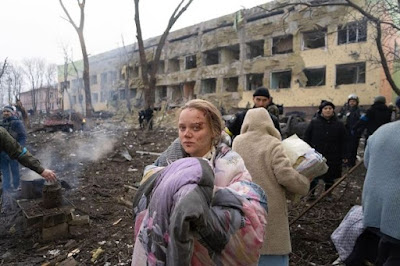
Pregnant women and children were caught in the bombing of the hospital in Mariupol. —The Mirror (UK), March 10, 2022

“Congress of Peoples for Peace" by Frida Kahlo (1952)


Debris, like ticker tape confetti,
still floats in the air, 
as the camera lens captures
a young mother’s silhouette,
protective hand holding her half-moon curve.
I spot the side of her cheek and eyebrow
dotted with streaks of blood,
where shards of glass or wood must have 
swept past her, mercifully missing 
her vulnerable nest within.
 
A Frida Kahlo painting appears on my screen,
while breaking news continues to drone.
Both moon and sun spheres glow on the canvas.
A tree of life, bursting with oranges,
grows before my eyes.
A mother hen sits impossibly on top,
as if keeping eggs warm on the highest branch.
 
The little girl’s song in the shelter 
lingers from last night, 
stays with me, as I walk through the house.
I hear her honeyed, hopeful voice 
even as I fall asleep. 
Her letting go of sound, word, voice, outcome
is the bravest note I have ever heard.
 
We sing ourselves into a new day,
an insistent melody
where sound itself holds the promise
of survival,
proof that beyond the bombs and tanks overhead,
rooted in the cellar of Ukraine’s earth,
is a chorus of people who believe. 


Cristina M. R. Norcross lives in Wisconsin and is the editor of Blue Heron Review. Author of 9 poetry collections, a multiple Pushcart Prize nominee, and an Eric Hoffer Book Award nominee, her most recent collection is The Sound of a Collective Pulse (Kelsay Books, 2021). Cristina’s work appears in: Visual Verse, Your Daily Poem, Poetry Hall, Verse-Virtual, The Ekphrastic Review, and Pirene’s Fountain, among others. Her work also appears in numerous print anthologies. Cristina has helped organize community art/poetry projects, has led writing workshops, and has hosted many open mic readings.  She is the co-founder of Random Acts of Poetry & Art Day.

Tuesday, March 01, 2022

FOUND POEM OF WAR

by Ellen Austin-Li


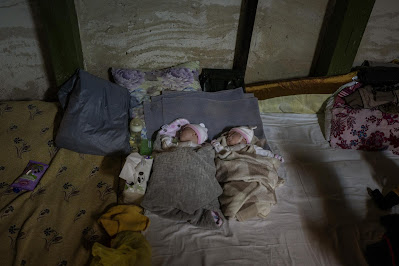
Newborn twin brothers sleep in a basement used as a bomb shelter at the Okhmadet children's hospital in central Kyiv, Ukraine, Monday, Feb. 28, 2022. (AP Photo/Emilio Morenatti)


A line from Yeats’ poem that reverberates
like a bass chord that becomes a strum,
combined with an image of babies 
kept alive in a bomb shelter, underground,
each breath bagged by ambu into tiny lungs.
This hum an undercurrent—under, under, under
my thumb. This rough beast lumbering, a ton,
a hundred years running, but truly thousands before, 
more’s the sum of history in a new poem—not new, 
but old. What crumbling humans, such endless war.
My hands weary as if I’m delivering each breath.
I know what this means—we cannot take a rest
or the children expire. I tire, but the poem is found.
The cannon, the fodder: explosions of sound. 


Ellen Austin-Li’s work has appeared in Artemis, Thimble Literary Magazine, The Maine Review, Pine Mountain Sand & Gravel, Rust + Moth, and other places. Her two chapbooks were published by Finishing Line Press—Firefly (2019) and Lockdown: Scenes From Early in the Pandemic (2021). She is a Best of the Net nominee. A recipient of the Martin B. Bernstein Fellowship, she earned an MFA in Poetry at the Solstice Low-Residency Program. Ellen lives with her husband in a newly empty nest in Cincinnati, Ohio.

Friday, January 29, 2021

MAJOR

by Caitlin M.S. Buxbaum


Joe Biden and Major in 2018, at the Delaware Humane Association. Credit: Stephanie Gomez/Delaware Humane Association, via Associated Press and The New York Times.


the White House
announces
 
its first-ever
pound puppy
 
and I
wonder
 
if this
proclamation
 
is an
indication
 
of more
major
 
changes to
come—
 
that our
president
 
has himself
declared,
 
on America’s
behalf,
 
‘we will
shelter
 
every kind
refugee
 
seeking a
shepherd.’


Caitlin M.S. Buxbaum is a writer and teacher from Wasilla, Alaska. She has published several books through her company, Red Sweater Press, and has work featured in Alaska Women Speak, The Daily Drunk, The Ekphrastic Review, and Verse-Virtual, among others. She currently serves as the Mat-Su Vice President of Alaska Writers Guild.

Wednesday, December 16, 2020

NEW START

by Matt Witt


Photo by Matt Witt


It used to be
that if you walked along Bear Creek
that runs next to town
you could see the stream
only in a few moments
because the view was blocked
by brambles of highly flammable blackberries
and tangles of branches.
 
Then this summer’s inferno
burned everything to ash,
clearing out the old understory
and leaving only a sprinkling of
charred tree trunks,
like ghosts from the past.
 
Now you can walk freely
across cleared black ground
and see how the stream community works,
the side creeks feeding it,
the ducks and coots and geese
finding food and
shelter from predators.
 
It used to be
that if you walked through town
you could see the money stream
only in a few moments
because the view was blocked
by fairy tales about
rugged individuals and
the generosity of the rich
without ever asking
who all that wealth was
taken from.
 
Then the fire burned everything to ash,
leaving those who could least afford it
to scramble for survival
while developers and bankers met
to discuss how they might profit
by grabbing up the close-in valuable land
and moving “their” workers,
many with brown skin,
to the valley’s outskirts,
all in the name of charity.
 
Now you can see
how money and power flow
from bottom to top
filling giant pools for a few
with not much left to trickle down.
 
Along Bear Creek,
just weeks after the fire,
small sprouts of green
bring the possibility of
a new community
better than the old
with each plant and bird and animal
doing its part.
 
In town,
new sprouts of community
are taking root too
as people work together
to make sure everyone has
food and shelter and hope
and to ask what we can do
so what grows back
will be better for all of us,
now that we can see.


Matt Witt is a writer and photographer from Talent, Oregon. 

Friday, May 22, 2020

MICAH IN THE MIDST OF THE PANDEMIC

by Katherine M. Clarke


Micah


Our puppy arrives, six pounds
of squirming golden fluff chirping and burrowing
under my arm, trembling against my breast.

I reach back to my mother’s knee to find
what I’ve forgotten I know, singing
knick-knack paddy whack give the dog a bone

and nestle him into his crate with Mr. Krinkle
whose face he chews off but who still obligingly rustles,
offering rope hands and feet to gnaw on in the night.

As pandemic chaos reigns outside, love grows inside,
my beloved Lily handling and tending this small body
bursting into life, insisting on what he wants and needs

tired or not, frightened or not, a life counting on her.
She walks softly in stocking feet to feel him underfoot
to know when he races over her toes to hide.

Scooped up Micah rides high along her arm,
a pasha attended by his servant.
Firsts abound—sleeping through the night,

tasting snow, eating grass, throwing up.
Accepting a collar and lead as she hustles
him out the side door to the yard.

Victory, cheering, applause. Relief for both.
No need for social distance as the lord of all wriggliness
plays with Delores, a stuffed sheep, and Road-Kill Buzzy,

the flat woodchuck toy. A spiky rubber teething ring
on the shower curtain spread over the living room rug
as if a sphere of the virus had leapt from the television

screen filled with images of tents and stadiums for hospitals
warehouses loaded with coffins, trucks filled with bodies
while we shelter at home, grateful, joy strewn all around.


Katherine M. Clarke is a professor emeritus of Antioch University New England. Her essays and poetry have appeared in Writing it Real, Breath and Shadow, Wordgathering, Oasis, The Sun Magazine, and Northern New England Review.

Sunday, March 05, 2017

TODAY

by Laura Rodley


For you, my grandchildren,
I am saving pine needles in the forest.
For you, my grandchildren
I am hanging up my clothes, saving energy.
For you, my grandchildren,
I am walking the hot sand at East Sandwich.
not flying using fossil fuel, not expanding beyond.
For you my grandchildren,
I am weaving the leafy fronds at Ashfield Lake,
swimming in it, swimming prayers.
For you, my grandchildren,
I drive as little as possible,
work as expeditiously as I can, conserve.
For you, my grandchildren,
I hold my hands over the cool breath
of the snow, so blue, so crisp, so cold,
so I can pat your cheeks with the snow’s breath,
so you can remember the feeling of snow.
For you, my grandchildren, I pray
for the earth’s forgiveness for walking
on her surface, how she holds me suspended
in this time, so close to your future.
For you, I wear sweaters, and burn less oil, no wood,
and send my emissary ghost to Standing Rock.
For you, my grandchildren,
I keep watch for the barred owls that rest
on the hemlocks in our yard.
I’m remembering it all for you:
their wide wingspan, their dark eyes
that hold the future of the long dark night, infinity,
and I tell you this, my grandchildren,
I chose not to be afraid, because I am remembering,
I am remembering all of this to give to you:
the cold breath of the snow, the people
at Standing Rock, the tall hemlocks, the green water
of Ashfield Lake, I am giving you the coldness
to hold onto when the sun bears down
and Massachusetts gets hotter,
I am giving you forests full of hemlocks, ash trees,
beech, canopies of leaves to walk under;
I am giving you the shelter of pines;
this is what I am handing down to you, my legacy.


Laura Rodley's NVN poem “Resurrection” won a Pushcart Prlze and was published in the 2013 edition of the anthology. She was nominated twice before for the Prize as well as for Best of the Net. Her chapbook Rappelling Blue Light, a Mass Book Award nominee, won honorable mention for the New England Poetry Society Jean Pedrick Award. Her second chapbook Your Left Front Wheel is Coming Loose was also nominated for a Mass Book Award and a L.L.Winship/Penn New England Award. Both were published by Finishing Line Press.  Co-curator of the Collected Poets Series, she teaches creative writing and works as contributing writer and photographer for the Daily Hampshire Gazette.  She edited As You Write It, A Franklin County Anthology, Volume I and Volume II.