Guidelines


Submission Guidelines: Send 1-3 unpublished poems in the body of an email (NO ATTACHMENTS) to nvneditor[at]gmail.com. No simultaneous submissions. Use "Verse News Submission" as the subject line. Send a brief bio. No payment. Authors retain all rights after 1st-time appearance here. Scroll down the right sidebar for the fine print.
Showing posts with label tanks. Show all posts

Tuesday, July 08, 2025

THEN THEY WERE MINE

by Corey Weinstein


Witnesses say that the IDF is deliberately killing Palestinians at aid distribution centres in Gaza run by the US- and Israeli-backed Gaza Humanitarian Foundation. Cartoon by Muzaffar Yulchiboev.


Israeli plan for forced transfer of Gaza’s population ‘a blueprint for crimes against humanity’ —The Guardian, July 7, 2025


Hear it right here. The past is now,
but wrong place, wrong people.
Last time they were mine, desperate,
last gasp assault in Spring of ’43.
 
Wrong place, the Mideast, wronged Palestinians.
Is there dignity not victory for a vanquished people?
In ’43 we yelled into the Nazi tornado,
death throes of the Warsaw Ghetto 300,000.
 
Feeble return fire from a vanquished people.
As Gaza starves, the West Bank terrorized,
famine, genocide of Gaza’s ghetto of two million.
Will the end game be the same weak thrust and slaughter?
 
Tanks fire on the hungry, settlers smash homes, olive groves.
In Warsaw they were mine, Jews to the very last bullet.
Will the world let the endgame be the same last bullet,
can our ears bear to hear the past in this terrible now?
 
As for me, I will never forget, Never Again
no matter who, no matter where or when.


Corey Weinstein’s poetry has been published in Haight Asbury Literary Journal, Vistas and Byways, The New Verse News, Our California 2024, The Ekphrastic Review, Forum (City College of San Francisco), California State Poetry Society, Visitant, Abandoned Mine, Speak Poetry of San Mateo County, California State Poetry Society and Jewish Currents, and he wrote and performed a singspiel called Erased: Babi Yar, the SS and Me. He is a retired physician and has been an advocate for prisoner rights, founded California Prison Focus, and he led the American Public Health Association’s Prison Committee for many years. In his free time, he hosts San Francisco OLLI’s Poetry Workshop Circle and plays the clarinet in his local jazz band, Tandem, his synagogue choir and woodwind ensembles.

Saturday, June 14, 2025

WE WANT YOU TO KNOW

by Melanie Choukas-Bradley


While tanks roll through our streets
We want you to know
We are vulnerable and resilient like you
 
This police state wannabe is not us
We are the fish jumping in the Potomac
The magnolia filling the air
 
We are fireflies testing the night
The bullfrog and the cathedral bell
The convergence of rivers
 
As this martial maelstrom
Storms land and sky
Our osprey nestlings hope only to fledge

 
Melanie Choukas-Bradley is a Washington, DC naturalist and author of Wild Walking, A Year in Rock Creek Park, Finding Solace at Theodore Roosevelt Island and City of Trees. Her poems have appeared in The New Verse News, Writing in a Woman’s Voice, and Plenty Magazine.

Friday, February 28, 2025

NOW THERE IS NOTHING NEW

by Eric Nicholson


Keir Starmer has announced that Britain will “fight for peace in Europe” with a generational increase in defence spending paid for by slashing the foreign aid budget. The move, just two days before the prime minister is due to meet Donald Trump, raised immediate concerns that he was pandering to the US president, and fury from aid groups that say it could cost lives in countries that rely on UK support. —The Guardian, February 25, 2025


Now there is nothing new,

The Minister of Fear has spoken,

We are vulnerable, we must meet force with force

And station Destroyers on the Thames.

Now there is nothing new,

We stand naked on the beaches, in the fields, in the hills

As icy gusts of fear whip across the seas.


Now there is nothing new.

Footsoldiers and tanks must protect our shores,

Drones and jets must command our air space,

Battle ships defend our coastline.


Now there is nothing new.  

Factories must go into overdrive,

Re-armament is good for Growth,

Our conveyor belts must convey security,

Fear must be assembled night and day.


Now there is nothing new.

Office windows must be blacked out,

Street lights switched off,

The London Underground prepared.


Now there is nothing new.

Rule Britannia.

Let the younger generation 

Fight the good fight,

MAD is might is right:

Now there is nothing new.


Eric Nicholson is a retired art teacher residing in the UK. He remembers protesting as a member of Campaign for Nuclear Disarmament in his younger years. He does not often write political poetry but in today's climate finds it difficult not to.

Tuesday, February 11, 2025

A FABLE

by Howie Good


AI-generated graphic by NightCafé for The New Verse News.


Someone is shouting, “Freedom!” 
or maybe “Free them!” The shouts
 
echo through gray, empty streets 
and die. I don’t follow the news. 
 
I’m not into politics. I walk down 
a street lined with soldiers and tanks. 
 
I turn up a street named for a tyrant.


Howie Good is a professor emeritus at SUNY New Paltz whose newest poetry book The Dark is available from Sacred Parasite, a Berlin-based publisher.

Thursday, May 05, 2022

WAR, ENDLESS

by Lisa Seidenberg


Tanks in fearsome formation
Slide up her southern flanks 
As troops assemble 
On her outlying appendages
While handheld missile launchers
take precisioned aim
At her twin ovaries
A soft but critical target
The containers of fragile munitions 
When was a woman’s body not a battleground?
Balancing fertility 
With freedom
Since time began
She withstands the exterior onslaught
To her interior 
Again and again
Territories taken and retaken
A war that never ends


Lisa Seidenberg is a filmmaker and writer whose documentary and experimental film work are shown in intern film festivals and arts venues.

Thursday, April 14, 2022

MAP MAKING

by Robin Wright


Draw lines that represent countries.
Go further, pen buildings
whole and firm, houses
with sunflowers, children’s toys
in the yard, bicycle leaning
against a tree, a bench in front
of a library. Populate with people
eating ice cream, strolling the streets.
 
Hold the map close.
 
Soldiers tear it away,
draw guns, tanks,
bodies on the ground
carpeted with blood,
crushed buildings,
landmines meant to erase.
 
Snatch it back,
ink blue sky, yellow sun
above people, buildings,
a child’s future.


Robin Wright lives in Southern Indiana. Her work has appeared in Bombfire Lit, One Art, Young Ravens Literary Review, Olney Magazine, As it Ought to Be, Rat’s Ass Review, Sledgehammer Lit, Muddy River Poetry Review, Sanctuary, and others. She is a Pushcart Prize nominee, and her first chapbook, Ready or Not, was published by Finishing Line Press in October of 2020.

Wednesday, April 06, 2022

THE CONCENTRIC CIRCLES OF WAR

by Katherine West 


“A Room of Memory” by Chiharu Shiota (2009): old wooden windows, group exhibition Hundred Stories about Love, 21st Century Museum of Contemporary Art, Kanazawa, Japan


Inside, there's a memory of neighbors on an evening porch, of burning then warming sun, of a half-feral cat leaving freedom for langurous hours of touch, of cold night then the warmth of a shared bed. 

Inside, there's a fire going and moody jazz in the background, an old watercolor of a Ukrainian boy and girl in traditional clothes. They are on their way to market; seen from behind and one side, their bodies are full of purpose. 

Inside, there's the sound of birds outside; sometimes just wings whooshing back and forth, sometimes a little squawk and chatter. Faraway, a songbird. 

Outside, sun is trying to warm the morning. Outside, clouds are burning off; red ants are waking up, appearing at the door of their mound like holy men dressed in the color of life. 

Outside, the first truck rumbles down the gravel road, kicking up its own cloud. Outside, the crack of target practice, to the south, a helicopter.

Outside, the first shell drops on an apartment building already abandoned by its residents who now live in the subway. The first paratrooper touches down. The first tank goes up in flames. 

Outside, the first wildflowers glow like a small sunrise amongst dry, white grass. Outside, the ravens are mating aloft. 

Inside, is poetry from Ukraine. 

You are the train that will pour
burning wine on the skin,
so that it will blaze
madly
(Natalka Bioltserkivets)

Outside, is poetry from Ukraine, a long line of refugees with bundles, like leafcutter ants carrying off the petals of roses.  


Katherine West lives in Southwest New Mexico, near Silver City. She has written three collections of poetry: The Bone Train, Scimitar Dreams, and Riddle, as well as one novel, Lion Tamer. Her poetry has appeared in journals such as Writing in a Woman's Voice, Lalitamba, Bombay Gin, The New Verse News, Tanka Journal, Splash!, Eucalypt, and Southwest Word FiestaThe New Verse News nominated her poem "And Then the Sky" for a Pushcart Prize in 2019. In addition she has had poetry appear as part of art exhibitions at the Light Art Space gallery in Silver City, New Mexico and at the Windsor Museum in Windsor, Colorado. She is also an artist

Saturday, March 12, 2022

SONGS OF SURVIVAL

by Cristina M. R. Norcross


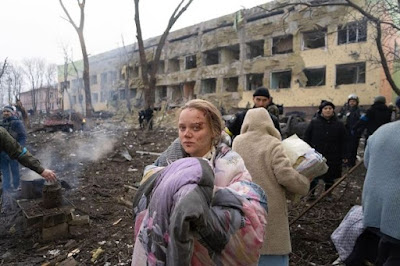
Pregnant women and children were caught in the bombing of the hospital in Mariupol. —The Mirror (UK), March 10, 2022

“Congress of Peoples for Peace" by Frida Kahlo (1952)


Debris, like ticker tape confetti,
still floats in the air, 
as the camera lens captures
a young mother’s silhouette,
protective hand holding her half-moon curve.
I spot the side of her cheek and eyebrow
dotted with streaks of blood,
where shards of glass or wood must have 
swept past her, mercifully missing 
her vulnerable nest within.
 
A Frida Kahlo painting appears on my screen,
while breaking news continues to drone.
Both moon and sun spheres glow on the canvas.
A tree of life, bursting with oranges,
grows before my eyes.
A mother hen sits impossibly on top,
as if keeping eggs warm on the highest branch.
 
The little girl’s song in the shelter 
lingers from last night, 
stays with me, as I walk through the house.
I hear her honeyed, hopeful voice 
even as I fall asleep. 
Her letting go of sound, word, voice, outcome
is the bravest note I have ever heard.
 
We sing ourselves into a new day,
an insistent melody
where sound itself holds the promise
of survival,
proof that beyond the bombs and tanks overhead,
rooted in the cellar of Ukraine’s earth,
is a chorus of people who believe. 


Cristina M. R. Norcross lives in Wisconsin and is the editor of Blue Heron Review. Author of 9 poetry collections, a multiple Pushcart Prize nominee, and an Eric Hoffer Book Award nominee, her most recent collection is The Sound of a Collective Pulse (Kelsay Books, 2021). Cristina’s work appears in: Visual Verse, Your Daily Poem, Poetry Hall, Verse-Virtual, The Ekphrastic Review, and Pirene’s Fountain, among others. Her work also appears in numerous print anthologies. Cristina has helped organize community art/poetry projects, has led writing workshops, and has hosted many open mic readings.  She is the co-founder of Random Acts of Poetry & Art Day.

Wednesday, March 09, 2022

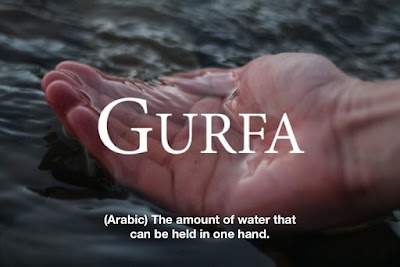
GURFA

by Joan Mazza


From one remaining gallon of water,
precious drops pooled in the palm.
The fighting continues after two long weeks,
the air filled with dust and the stench
of rotting bodies.

Water and electricity have been turned off,
no food and no way to cook any food remaining
in half a house that has been shelled. Next door,
a home on fire, two dogs howling, left behind.
How to escape?

Three children, but only two hands to hold
onto them. Who will carry what they’ll need
wherever they might land? Which way is safe
passage, a welcome waiting from strangers?
How to escape?

Tanks line up for miles, out of gas, ammunition
spent. Phone dead. Each vehicle with a driver,
no more than a trapped boy, his stomach growling,
howling. No water. He cries for his mother, his bed.
How to escape?

Who asked for this war? One man with a few drops
of power he wants to hold. No matter who
suffers, dies. Didn’t other leaders kill millions?
Stalin. Hitler. Pol Pot. He can, too. Confident.
No need to escape.


Joan Mazza has worked as a microbiologist and psychotherapist, and taught workshops  on understanding dreams and nightmares. She is the author of six books, including Dreaming Your Real Self, and her poetry has appeared in Rattle, Valparaiso Poetry Review, Prairie Schooner, Poet Lore, and The Nation. She lives in rural central Virginia.

Tuesday, March 08, 2022

ONCE UPON

a triptych for Ukraine, March 2022

by Lana Hechtman Ayers


I. Shush! Don’t Wake Her
 
See her now,
home from
the cancer ward,
in her own bed
in her own room,
curled around the fuzzy
brown teddy bear nearly
as big as she is at four,
fur of its right ear matted
down from sucking,
emerald neck ribbon frayed,
glossy hazel eyes shining
in the toadstool nightlight’s
amber glow. She sleeps atop the sky
blue coverlet hand embroidered
with sunflowers by her grandmother,
The white nightgown with flourishes
of willow leaves tangles around
her too-thin legs, and one chubby
thumb presses against her lips
that are as rosy as imported
cherries from her last birthday
celebration she dreams of
tasting again. From elsewhere
a clang wakes her and she
reaches for the waning
crescent moon that hangs
in the bedroom window
like one of her mother’s
dangly gold earrings
just as the bombs
begin to fall.
 
 
II. Once Upon a Time
 
Swallow the clatters of war tanks, bullet ratatat's, crashes of broken glass.
Hear to the red smoke as it shrieks down chimneys,
 
around drafty windows into the house, down the hall to the bedrooms.
Inhale the atonal black fire as it incinerates the fairy kingdoms of childhood to ash.
 
This is not the bedtime story any parent hopes to tell their children.
Look out your window.
 
If the night is clear and calm, or
if all that rains down from the sky is water,
 
ask yourself, how can I help parents in far off lands
find a happily ever after for their children
 
this one night
to the next?
 
 
III. Elegy for War
 
After the last bombs exploded,
silence deafened
the world for several decades.
People took to speaking
in gestures,
holding arms out in front
of themselves, wide open,
which led to stepping forward
into more hugs,
led to extravagant foraging
for wild berries.
Vehicles of insurgence
morphed into homes for bats
and rats and only grouchy bears
ever ventured near.
NATO transformed into
a travel agency,
with free week-night stays
across Greenwich Mean.
Everyone everywhere
shared recipes for soup.


Lana Hechtman Ayers has shepherded over eighty poetry collections into the world in her role as managing editor at three small presses. Her poems have appeared online at Rattle, Escape Into Life, Verse Daily, and The Poet’s Café, as well as in print journals and her nine published collections.

Wednesday, March 02, 2022

FUTURE ORIENTATION

by Imogen Arate


Tweet by The Kyiv Independent.


There is talk of war
in the shushing peacetime
desires for cracking 
delineations to self-heal 
without tending

There is talk of utopia 
in the blunt wielding
of firebombs Why not
room for better)

On the bodies of whose
children friends parents
and lovers A question 
suppressed or answered
by the jutting of chins
toward the detested
"Other" 

though history’s fingers
point to mutual others
who have become as
anonymous as the sides 
they took

whose bodies grew
their bones still beg 
for time to reunite
with the consolation
of a soothing soil

There is paradise
in the overtaking 
by tendrils grown
from the dust of war

in the dawning
that we are multitudes
of singular imperfections
who seek out others 
to share our wounds
perchance to heal


Imogen Arate is an award-winning Asian-American poet and writer and the Executive Producer and Host of Poets and Muses, a weekly poetry podcast that won second place at National Federation of Press Women's 2020 Communications Contest. She has written in four languages and published in two. Her poems, “A Declaration of Loyalty” and “Sanctuary” placed Second and Third, respectively, in the 2020 National Federation of Press Women at-Large Communications Contest. Her poetry has appeared in 18 publications on four continents, most recently in I Wanna Be Loved by You: Poems on Marilyn Monroe, Dwell Time, Nude Studio, and dyst.  You can find her @PoetsandMuses on Twitter and Instagram.

Saturday, February 26, 2022

AFTER BOMBS DROP

by Bunkong Tuon


A piercing cry haunts the metro,
In the apartment building, in the dark.
 
Fear is a new word that’s given form in
This cry of a child, in the terrible terror
 
A father must feel when he sees 
Tanks and soldiers on the streets of his childhood,
 
In the hug of a mother, maybe a grandmother
Who holds the child as tightly as she can.
 
What else is there to say?
Everything seems trivial, unwise.
 
I send money through the links on NPR.
I send letters to elected officials.
 
I write poems like this one.
I do what I can to lessen my helplessness,
 
To soften the child’s piercing cry that 
Haunts my days and nights.
 
I hold my kids as tightly as 
They allow me. 


Bunkong Tuon is a Cambodian-American writer and critic. He is the author of Gruel and And So I Was Blessed (both published by NYQ Books), The Doctor Will Fix It (Shabda Press), and Dead Tongue (a chapbook with Joanna C. Valente, Yes Poetry). He teaches at Union College, in Schenectady, NY.

FAMILY DEBATE OVER KIMCHI

by Helen Wilson


We sit in a Korean BBQ restaurant
snipping conversation with tongs,
searing meat with commentary
on the political affairs of the day.
 
“They took pinking shears to
divisive
unworthy
tattered then
abandoned by a wayward man-child.”
 
Tender beef cuts melt
in the mouth while
kimchi sours
like first world ethos
 
only sweeter. We agree,
“Lies leave a nasty taste.”
Bald-faced lies
poison any hope of error. While
 
errors are forgivable
contempt and chilli sauce are not,
staining white flags
indelibly without hope of redress.
 
“Pure heat, not head
nor heart.” I say of
rapid fire policy and 
unfiltered visceral campaigning.
 
“Democracy’s disintegrating,
honour’s unhanded and
self-interest trumps
public good.”
 
“Nothing’s changed,” say the young ones,
as their fingers 
skip across tiny screens
at the speed of light.
 
“Pollies have always snuffled
from the trough
of populism.” 
such is their experience.
 
Defeated,
we wield chopsticks
and pierce the offerings
that we can control.
 
Distracted by 
the crazy patchwork
of dishes and sticks
and tastes and flames as
 
tanks roll across the tundra
and the blanket of peace
under which we hide rolls back.
“So much for perestroika and glasnost.”
 
Who ever really knows?


Helen Wilson is an Australian poet and a professional communicator who has written for magazines, art shows and a pure love of the lyrical. Her passions include ekphrastic poetry, haiku, and dinner with her adult children. She dreams of a world where people will play nicely. 

Tuesday, February 11, 2020

O EGGS, DON'T FIGHT WITH ROCKS

by Aaron Hicks


A protester at a rally in Banda Aceh, Indonesia, in support of ethnic Uighur Muslims in China. Uighurs in China are being forced into “re-education” camps for indoctrination. Credit: European Pressphoto Agency via Shutterstock via The New York Times, January 2, 2019


Even the tiniest pebble has
Many brothers in the valleys of liberation
Despite the distance between them but,
An egg in great numbers whether far or near
is still fragile, still spineless
Still an
egg

Do not fight against the good
People
Whose patience is that of
Stone and passions are ignited
By a garish will comparable to
The sun

What is hidden today, will be
Uncovered tomorrow
and the fragile flesh of censorship
will be gashed in coming time as
the truth bleeds out
bountifully gifting death to
the brawny body of injustice

Your tanks have made you shielded
And your clubs have extended your arms,
And your weapons have armed you
but oh eggs
You will always be just that

As the virus contaminates the news
Let us look closer under the scope
As we keep our eyes on the oppressed and
Give a voice to the silent

Keep your eyes on the mighty
Rocks as they wage war against
The many villainous eggs


Aaron Hicks is a writer from Wilmington, North Carolina. He enjoys well crafted movies, creamy coffee, and standing on the side of those who are oppressed. #FreeChina

Thursday, July 11, 2019

MAYBE IT STARTED WITH A HAMSTER

by Judith Terzi


and maybe the two albino rats
came next. And the rock collection.
Smooth oblong rocks he'd paint
faces on. And maybe shells came
next, and then stamps, though
he hardly knew where the countries
were on his globe. He liked
the biggest stamps the best, ones
with faces on them, faces of men
he could become. And maybe
the aquarium came next––red-tailed
sharks lurking behind rocks in his
bedroom with Jack Dempsey
cichlids and sucker fish. And maybe
the model building came next:
ocean liners with tiny people he'd
wave at, fighter planes with grounded
toy pilots. And tanks with soldiers
he would salute, but who never
saluted back. The tanks––stuck
between his childhood bed, with its
beige striped bedspread, and a shiny
maple highboy where he shoved
all of his desires, all of his heartache.
For later.


Judith Terzi is the author of Museum of Rearranged Objects (Kelsay Books, 2018) as well as of five chapbooks including If You Spot Your Brother Floating By and Casbah (Kattywompus Press). Her poetry appears widely in literary journals and anthologies, has received nominations for Best of the Net and Web, and has been read on the BBC. She holds an M.A. in French Literature and is a former educator who taught high school French for many years as well as English at California State University, Los Angeles, and in Algiers, Algeria.

Saturday, March 26, 2016

SYRIAN LANDSCAPE

by Michael Shorb


Image source: Raqqa Is Being Slaughtered Silently, a campaign launched by a group of non-violent activists in Raqqa to expose the atrocities committed by the regime of Bashar Al-Assad and by the terrorist extremist group ISIS toward the civilian populations if the city.


The dictator’s weak chin
juts from a billboard as
the beady eyes dare
anyone to smirk or throw
rocks and a town
bakes under a silent sun

a tank rumbles on noisy metal treads
past a solitary leaning palm,
scattered bodies thrown
down on desert sand,
washed to the side of city
sidewalks

when the father
punishing his children
goes insane
the sounds
can be heard
for miles.


Michael Shorb was a poet, fiction writer, editor, and children's book author. As an international poet, his poetry has been published in more than 100 magazines and anthologies, including TheNewVerse.News, Michigan Quarterly, The Nation, The Sun, Salzburg Poetry Review, and Kyoto Journal. He was the recipient of a PEN AWARD, won a Merit Award for the Franklin-Christoph Poetry Contest, and was nominated for a Pushcart Prize. He lived in and loved San Francisco. Michael succumbed to GIST, a rare form of cancer in 2012.

Monday, April 22, 2013

HELL NIGHT

by Meaghan Ford


Image source: WBZ (CBS Boston)


I dragged all the blankets into the bath tub, raided my closets for pillows. Someone

told me to stay away from the windows and my bathroom is swallowed by the dark.

The police scanner snarls until I fall asleep, fitful. I dream about explosions and body 

parts walking disjointed through downtown looking for their owners. In the morning,

the only things in my refrigerator are water, eggs, and beer. And I've already had breakfast.


The tanks going by my window look more like a movie when I'm drunk. And I am not drunk.

My stomach is a swarm. The television glows. I'm making bare pasta in my bra, hair wet 

from the shower after the lockdown is lifted. Then, shots fired in Watertown and the city

is screaming again. While the bomber is pinned down in a boat my friends tell me about 

gunshots and flash bangs and how loud their fear is. They talk about blood and his age

while everyone waits for it to be over. And then dancing. The people flood the streets.


I eat all of the Oreos, put my feet up, and open each brown bottle slow, meticulous.


Meaghan Ford is a writer from New Jersey who fell in love with the big city shit. She's a regular at the Boston Poetry Slam at the Cantab Lounge  and has helped organize the National Poetry Slam in both 2011 and 2013. Her work has appeared in Amethyst Arsenic, Phantom Kangaroo, The Legendary, and The Scrambler; she was also a 2012 Write Bloody finalist. Most days she can be found lurking around the local food trucks or taking dystopian photographs in odd places.