Guidelines


Submission Guidelines: Send 1-3 unpublished poems in the body of an email (NO ATTACHMENTS) to nvneditor[at]gmail.com. No simultaneous submissions. Use "Verse News Submission" as the subject line. Send a brief bio. No payment. Authors retain all rights after 1st-time appearance here. Scroll down the right sidebar for the fine print.
Showing posts with label Civil War. Show all posts

Sunday, April 13, 2025

IDIOT YEARS

by Thomas R. Smith


Our Mayan friend Martín says we’re sick with
a collective “unmetabolized grief.”
Civil War, Vietnam, Iraq, the list goes on.
Our response? Build higher psychic dams
to hold the tears. Those dams, ridiculously
expensive, bulge above every town, city,
and farm—few notice the supports straining,
the hairline cracks webbing the concrete poured
by profiteers grown fat on our denial.
Will it be said of us that we did not
possess the curiosity to inquire
what was being done to the world in our name
with our tax dollars? That we also were
mad to allow the mad to lead us?
Mad or, worse, indifferent? Dylan called
us an idiot, babe. When we’ve bombed
the earth to rubble, shall we then bomb
the rubble to sand? There’s beachfront property
for you rich to enjoy in your idiot years
before the dammed tears sweep you away.


Thomas R. Smith’s recent books are a poetry collection Medicine Year (Paris Morning Publications) and a prose work Poetry on the Side of Nature: Writing the Nature Poem as an Act of Survival (Red Dragonfly Press). He lives in western Wisconsin near the Kinnickinnic River.

Tuesday, June 04, 2024

CONVICTION IN XXXIV MOVEMENTS

by Erin Murphy


Altoona, Pennsylvania—May 30, 2024
 
I.
We are sitting in a tavern by the railroad tracks when the verdict is announced.
 
II.
A wave of gasps ushers in a hush as patrons scurry to check their cellphones.
 
III.
Like when a hawk swoops through a copse of trees and all breeds of birds chirp warnings, then fall silent.
 
IV.
Overheard: I’ll bet all the jurors were Democrats.
 
V.
In our town, 2020 election signs are still staked in lawns like tombstones.
 
VI.
When we moved here, people asked Whose house did you buy? Surely they knew the previous owners, went to church with their parents, played football with their brother or cousin.
 
VII.
Overheard: Hot damn! He’ll raise even more money now!
 
VIII.
Here, even the rain moves slowly. Some days it’s pouring in our front yard and dry in the back.
 
IX.
A few evenings ago, two women with clipboards came door-to-door encouraging registered Republicans to vote. Wrong house, I said and urged them to Take the rest of the night off—better yet, the rest of the year.
 
X.
Overheard: He can just pardon himself.
 
XI.
Overheard: I don’t think he can pardon himself for a state crime.
 
XII.
Overheard: When he’s re-elected, he’ll change the law so he can pardon anyone he wants.
 
XIII.
Spitting distance from this bar in 1855, the first spark of the Civil War when two men leapt from a moving train: runaway slave Jacob Green and slavecatcher James Parsons.
 
XIV.
Overheard: He’ll send ’em all back to where they came from.
 
XV.
Overheard: Do not pass go, do not collect $200!
 
XVI.
Overheard: More like $200 million—that’s how much they’re stealing from us.
 
XVII.
Overheard: laughter.
 
XVIII.
Townsfolk confronted Parsons, demanding he prove Green wasn’t a free black, and in the scuffle, Green was able to flee. Parsons was charged with kidnapping, infuriating the South.
 
XIX.
Mason Dixon Line.
 
XX.
Blood line.
 
XXI.
Toe the line.
 
XXII.
Cross the line.
 
XXIII.
Line one’s pockets.
 
XXIV.
Bottom line.
 
XXV.
Flatline.
 
XXVI.
New York Herald headline, Jan. 31, 1856: “Threatened Civil War Between Virginia and Pennsylvania.”
 
XXVII.
From the Herald article: The common courtesies of life, good-neighborhood…should have been sufficient to induce the State of Pennsylvania to aid the people of Virginia to enforce the rights of her citizens to such property.
 
XXVIII.
Earlier this spring, a local middle school cut “Lift Every Voice and Sing” from its choral program after parents complained that the song was “divisive.”
 
XXIX.
Let our rejoicing rise/
 
XXX.
High as the list’ning skies
 
XXXI.
Sing a song full of the faith that the dark past has taught us/
 
XXXII.
Sing a song full of the hope that the present has brought us
 
XXXIII.
Overheard: That judge better have a good bodyguard.
 
XXXIV.
And yet. Last month we landed in L.A. during the solar eclipse. Under the baggage claim atrium, I pulled out the sleeve of eclipse glasses I’d packed just in case. I looked up. There it was: what Wordsworth called something night and day between. Is there a word for the urge I felt to share it with all my fellow travelers? As weary passengers came down the escalator, I offered them glasses, summoning the word sun in every language I knew: sol, soleil, sonne. Some hung back skeptically as others eagerly pressed the dark lenses to their eyes. Flight attendants and pilots from Russia, Korea, Poland, Japan, Tahiti. A man with a handmade ukulele. A maintenance worker with a walkie-talkie. Parents, children, young adults who ran to retrieve their grandparents in wheelchairs. Tio, you have to see this! one teen told her uncle. A boy said Mommy, Mommy—the moon is like Pac-Man taking a bite out of the sun! Even a few skeptical passengers shyly came around. So many ohhhhs. So many smiles. So many faces tilted toward the same sky.


Erin Murphy’s latest book of poetry, Fluent in Blue, was published by Grayson Books in April 2024. She is professor of English at Penn State Altoona and serves as Poetry Editor of The Summerset Review. 

Thursday, January 04, 2024

HALEY'S COMMENT

by Steven Kent


She hems and haws about the cause
   Of War 'tween North and South,
And how absurd: There's just one word
   That should be in her mouth.


Steven Kent is the poetic alter ego of writer, musician, and Oxford comma enthusiast Kent Burnside. His work appears in 251, Asses of Parnassus, Journal of Formal Poetry, Light, Lighten Up Online, New Verse News, Philosophy Now, Pulsebeat Poetry Journal, and Snakeskin. His collection I Tried (And Other Poems, Too) was published in 2023 by Kelsay Books.


Saturday, January 15, 2022

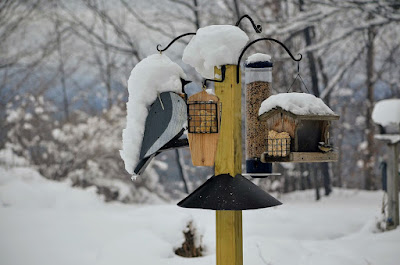
WINTRY MIX

by Tricia Knoll


As a forecast this seems like calling for mayhem
until the front moves in and the silence of snow
licks every branch and sticks to each twig’s gesture. 
 
The goldfinch and nuthatches retreat from the feeder
to unseen hideouts. The dogs yawn, and I succumb
to a sleepiness at odds with the morning news
 
of those who call for civil war, the skyrockets
of corona deaths, projections of costs in trust
and cash. The silence of falling snow deepens
 
inch by inch above the ice slick the rain gave 
first. Slow gather and the flurry of politicians
with papers and proof seeking. Such sad news
 
in accumulations inch by inch by inch. 


Tricia Knoll is living out the series of wintry mixes in Vermont where the forecast calls of windchills of -20 in the next few days. Her new chapbook Let's Hear It For The Horses is available February 1, and the horses outside down the road during the day  are all wearing heavy blankets now.

Monday, February 22, 2021

THE NUN WAS TORTURED

by Karol Nielsen


The nun founded the Torture Abolition and Survivors Support Coalition International (TASSC).


The American nun, who was gang raped and tortured in Guatemala, died of cancer in Washington, DC. She had been helping indigenous Guatemalans when she was captured. The government suspected the indigenous of left wing subversion, with the United States backing the Guatemalan military in its civil war. The nun was burned by cigarettes, exposed to dead bodies and rats, and forced to mutilate another captive with a machete. She jumped out of a car as the man with accented Spanish drove her to a new location. She fled to the United States and struggled to remember her life there. She sued a Guatemalan general who was studying at Harvard. A judge ordered him to pay millions but he escaped to Guatemala. She told a reporter that even though she was Catholic she struggled to forgive.


Karol Nielsen is the author of two memoirs and two poetry chapbooks. Her first memoir was shortlisted for the William Saroyan International Prize for Writing. Her poetry collection was a finalist for the Colorado Prize for Poetry. 

Wednesday, January 06, 2021

CHANCELLORSVILLE

by Rick Mullin


The civil war that everybody fears
will one day bring our guns into the street
has been a virtual reality for years.
We are many battles in, replete
with bloodless disestablishment of norms
equating to the end-stop of a dream,
the downfall of democracy and state.
On Facebook, nobody can hear you scream.
It’s harmless when a friend posts, “Feel the hate”.
We laugh and like it and the hatred storms.
But this year the Epiphany may yield 
at last that dreaded outcome, civil war
with something like real armies in the field
and abject treason on the Senate floor.
With carnage in its more familiar forms.


Rick Mullin's newest poetry collection is Lullaby and Wheel.

Wednesday, July 08, 2020

GHOSTS

by Steven Croft


Syrian pro-government forces and their jihadist opponents flagrantly violated the laws of war during the battle for Idlib province, UN investigators say. Civilians endured "unfathomable suffering" when the Syrian military launched a campaign late last year to retake the area, according to a report. They were subjected to indiscriminate air strikes and ground shelling, as well as arrests, torture and pillaging. Hundreds of civilians were killed before a ceasefire was agreed in March. Almost one million were displaced by the fighting and many were forced to live in dire conditions in overcrowded camps or open fields. Now, the investigators warn, "a perfect storm is in the making" as the war-torn country faces both the coronavirus pandemic and an economic crisis. More than 380,000 people have been killed and 13.2 million others - half of Syria's pre-war population - have been displaced inside and outside the country since an uprising against President Bashar al-Assad began in 2011. —BBC, July 7, 2020


In a Syria that should have died of its wounds
years ago, still, the white noise howl of low-flying jets
bombing the rubble for any survivors

In a basement a mother cradles a child and screams
to the percussive palsy of cold dark stones
The jets pound the ground with deafening fists

Wanting to soothe her crying baby's fear, only screams
slip past her tongue, wails of surrender, she tastes
tears from lips, the corners of her mouth

These screams an echo of others, today's question:
"Who said I must lose this child, who?!"  The demons
of war give, again, yesterday's answer: BAROOOM!!!


Steven Croft lives on a barrier island off the coast of Georgia.  He has recent poems in San Pedro River Review, Red Eft Review, Poets Reading the News, TheNewVerse.News, Synchronized Chaos, Gyroscope Review, Anti-Heroin Chic, and other places.

Sunday, July 28, 2019

A FUGUE

by Martin H. Levinson


is a contrapuntal composition in
which a short argument or fight,
like the one we had on Wednesday
over the meaning of Mueller’s
testimony as to who will get to
govern this great nation that
wasn’t so great for blacks,
women, and gays when I was
growing up in the fifties on
a tree-shaded block close to
Ebbets Field, home of the
Brooklyn Dodgers, a team that
left the borough of churches and
underdogs to watch the McCarthy
hearings on television where a
senator who saw Reds under every
bed got his comeuppance but not
before we took cover under our
desks at school so we wouldn’t
die when the Russians dropped
nuclear bombs on New York City
where short arguments or fights
didn’t stop us from to thinking it

was worse during the Civil War
when instead of quarreling on cable
and social media about whether you
can indict a sitting president or what
constitutes fake news, people were
killing each other, blowing up bridges,
and burning down Atlanta where the
traffic these days makes getting from
one end of town to another a nightmare
in our nation’s history that seems to

some to be coming to an end because
even if a new president is elected the
damage to civil discourse and shared
norms has been so eroded that only
poetry and a knowledge that America
has weathered other crises in its past
will be able to save us, but who these
days is writing poetry or knows much
about our nation’s past?


Martin H. Levinson is a member of the Authors Guild, National Book Critics Circle, PEN America, and the book review editor for ETC: A Review of General Semantics. He has published ten books and numerous articles and poems. He holds a PhD from NYU and lives in Forest Hills, New York.

Saturday, January 12, 2019

LAW RAP

by Ian Patrick Williams


We fought the British army to create a new democracy
But it turned out just to be a lesson in hypocrisy
Instead of having freedom in the new Home of the Brave
All the Founding Fathers got to hold on to their slaves.
So as our brand new nation was then starting to be shaped
African-Americans faced lynching or were raped
Abolitionists did what they could to raise a legal fight
But all the slavers said it was a matter of state’s rights.
Dred Scott escaped into the North and thought that he was free
His owner followed, claiming he was just some property
The Court agreed and sent him back, said he was not a man
And all the racists cheered: it was the Law of the Land.

The population grew and so the pioneers moved West
Looking for whatever land might suit their interests best
Killing all the Native tribes wherever they would go
They found themselves in what was then called Northern Mexico
From Texas, Arizona, all the way to California
They turned their guns on Mexicans and said, “We gotta warn ya
That it’s time for all you brown-skinned folk to cross the Rio Grande.
This is white people country, that’s the Law of the Land.”

The Civil War was fought and won and stopped the South’s secession
But they simply organized a new form of repression
The Jim Crow laws would still repress the black community
But that was not the only form of inequality
Only men would have a say in forming legislation
Women couldn’t vote, though they were half the population.
The Suffragettes went marching, but the men said they were wrong
“Go back into the kitchen; that’s where all of you belong.
To vote requires mental work, you couldn’t understand.
Only men can vote ‘cause that’s the Law of the Land.”

The fight went on for years and years till Civil Rights could pass
We thought we had equality for every single class
But greedy corporations came up with a new solution:
They’d simply buy up all new laws with campaign contributions.
Crush the unions, cut their taxes, only pay low wage
And sure enough they had themselves another Gilded Age
With ever-growing profits, keeping all that they could get
Dumping on us peons twenty trillion dollars debt
The one-percenters cheered themselves and said, “Oh, ain’t it grand
When all us billionaires can buy the Laws of the Land!”

This struggle for control goes on, we’ve seen it all before
Deregulation, planned recessions, Middle Eastern war
All designed to line the pockets of the profiteers
The money-grubbing warmongers who’ve ripped us off for years.
There’s only one way out of living under their command
We have to come together and united, take a stand
We cannot have democracy until we all demand
That only We the People make the Laws of the Land.


Ian Patrick Williams won the Chicago Emmy award for co-authoring the teleplay Bleacher Bums for PBS-TV; the script was later purchased and produced as a M.O.W. by Showtime. He has also written and directed seven One Act plays for young people that toured Los Angeles Unified School District schools through the not-for-profit firm Enrichment Works. His one-act play "Provenance" was produced last year at Ensemble Studio Theater.

Thursday, May 17, 2018

WE BECAME FRAGMENTS

by Tricia Knoll


The video: a Syrian boy, Ibraheem, says he has seen
everything. We come to believe he has. The bombs and skies
blew one of his legs into shriveled tags. His mother died.
His siblings died. He and his father found a way to Canada.

We became fragments. Let me not usurp what it means
to pivot on crutches that carry his thin leg along with him.
Let me not pretend I have suffered as he has. Let me hope
that over time his life will coalesce. He will feel safe.

The bits and pieces of our fractured world are myriad,
scattered across so many continents and living next door.
In this time we must sew, knit, darn, secure, bind, mend,
link, weave, patch together, perhaps heal.


Tricia Knoll is an Oregon writer whose poetry book How I Learned to Be White (an investigation of how white privilege has impacted her life and how she has come to understand it) is now available from Antrim House. 

Friday, March 23, 2018

SHURBAJI'S SHIRT: CARRYING NAMES FROM A SYRIAN PRISON

by Bonnie Naradzay


Mansour Omari smuggled the strips of cloth bearing his fellow-detainees’ names by sewing them into the collar and cuffs of a shirt. Photograph by Miriam Lomaskin / US Holocaust Memorial Museum via The New Yorker.


Omari “said to them, ‘What do you think if we write the names of all the people, since we can’t memorize all of them?’” he told me. “Of course, they said yes.” —“Written in Blood and Rust from a Syrian Prison: ‘Don’t Forget Us’ by Robin Wright, The New Yorker, December 19, 2017


When they called my name, I grabbed Shurbaji’s shirt.
It was blue and white striped. He was saving it
for his wedding as soon as he could get out
but he gave us his shirt to smuggle our names.
The tailor honed a chicken bone for a quill.
Shurbaji, the other journalist, was skilled
at handwriting, so he etched the names on strips
of cloth. We made ink from rust scratched off cell bars,
mixed with blood that Omar slowly collected.
Making the quill a needle now, the tailor
pulled the threads in Shurbaji’s shirt to embed
the strips of names inside the cuffs and collar,
replaced the threads. Omar the tailor is dead.
The first one called out takes the shirt. When I heard
my name I grabbed his blue and white wedding shirt.
They transferred me to another underground
prison and still another. I saved the shirt.
Sweat blurred some names by the time I was released.
My love, we are coming back. Don’t forget us.
Our group of five shared a space of three floor tiles.
Still unfolding in the news, the dead, the names
of all eighty-five of us, sharing space in there.
She learned that Shurbaji died after three years
In prison and terrible beatings. My love,
My love, we are coming back. Shurbaji sang.
He’d kept the shirt in prison for the wedding.
Don’t forget us. My love, see the names. His shirt.


An all-too-truthful mash-up of two photos from Eastern Ghouta, Syria.


Bonnie Naradzay’s poems have appeared in New Letters, Tampa Review, Tar River Poetry, Poet Lore, JAMA, Pinch, Passager, Innisfree, The Guardian, Seminary Ridge Review, Anglican Theological Review, Split This Rock, TheNewVerse.News, and others.

Monday, February 26, 2018

SYRIA

by Cally Conan-Davies


Photograph by Erik Ravelo from his 2013 sequence “Los Intocables” (“The Untouchables) featuring a variety of issues plaguing children around the world. “The right to childhood should be protected,” Ravelo writes.


plaster dust and blood
spattered face

strong words from diplomats
cannot touch or taste

what of us
compared to those

souls with eye-holes


Cally Conan-Davies is a writer who expresses here her rage.

Monday, February 19, 2018

SHE WAS PLEADING WITH HER EYES

by Darrell Petska


Samir Salim is a White Helmets volunteer in Syria's Eastern Ghouta. Already out on a rescue mission when another air strike hit, Samir rushed toward the smoke: a Syrian government air strike had destroyed his house. He saved his infant nephew, sister, sister-in-law and father, but he could not save his mother crushed by the ceiling. He vows to continue his work.


Save the baby, Samir.
Now, fast to the girls.
Your Papa: Take him!
His cries tear my heart.

Samir, my angel,
release my soul
from this burden of being.
Be strong, as I taught you.

I am above you, Samir.
I am all around.
Tell them we are more,
more than paltry flesh.

Inhabit their eyes, my son.
Toward life's supple altar
draw their misspent hearts.
Show them we can fly.


Darrell Petska learned of Samir Salim and his family and felt a great sadness.

Thursday, August 24, 2017

LET'S HEAR IT FOR THE HORSES

by Tricia Knoll


Horse Statue by jellobuster at DeviantArt


One million dead in the Civil War,
if you count the mules.
Which I do.

I say, blowtorch the rebel statue
men off their mounts and keep
the horses striding on their pedestals.

They were not traitors
to their country, showed no sign
of caring who they carried,

black or white, male or
female. Their integrity
is without question.

They did the work
they were asked to do
without a nod at glory.


Tricia Knoll is an Oregon poet with a deep fondness for horses. I can see these statues with newly installed saddles replacing the old white men, perhaps ladders for children to climb up on. 

Wednesday, May 03, 2017

THE DEVIL OF A DILEMMA

by Regina Vitolo
Image by Matt Chase, The New York Times, February 17, 2016.


the mistress of the universe has deigned to immerse us
in the devil of a dilemma
as complex as puppet strings intertwined dancing
on a papier-mâché platform
the planets collide, missiles leave silos, gravity reverses,
earth trembles
nonsense makes the best sense, nonetheless, so say
the pundits of the day
the wrecking ball swings, misses the gringo living yuge
in the capitol—
claims Andrew Jackson could have resolved the Civil War
but for a few facts
be damned, like the Constitution (no longer relevant) and
the NINTH CIRCUIT
to be mission accomplished with a tweet or two or more.


Words fascinate Regina Vitolo and ignorance in a leader shivers her liver. She has been published, but is willing to absorb more.

Tuesday, December 13, 2016

ALEPPO

by George Salamon


Wretched Aleppo,
Bereaved by death
Who grants no audience
To human flesh
As humanity prepares
Another feast for death.
After Auschwitz it  was said
"No more poetry."
After Aleppo, I say
More poetry to instill
Reverence for flesh
Sacrificed for evil vapors and whims.


George Salamon grew up in Europe during the slaughter of World War Two and now, from his home in St. Louis MO, reads about and looks at pictures from man's latest crimes against humanity in Aleppo.

IF THIS IS MY LAST MESSAGE

by Freesia McKee 

To see Ismail Alabdullah's heartbreaking video tweet, go to https://twitter.com/SyriaCivilDef/status/808834482610589697


for Aleppo


if danger crescendos
like a heating tea kettle

jaw of a broken jar
open as the mouth of the moon

if I die
still young

remember that I died
as people have always
died

as you lie

listening

do not remember me for
this last message

remember the song I sang

if you sleep through
what we lived for as it burns

think about my smoke
how when it touched your skin

you turned away


Freesia McKee is a working poet. Her words have appeared in the Huffington Post, Gertrude, Painted Bride Quarterly, Burdock, and Sundress Press's Political Punch anthology. She co-hosts The Subtle Forces, a weekly morning show on Riverwest Radio in Milwaukee.

ALEPPO

by Peleg Held


Source: Twitter, 5:59 AM, December 13, 2016


There is a city.
It is not our city.
Its broken buildings are full of bodies.
They are not our bodies.
In that city syllables are run through and strung
together into long cords of rough names
that, if they were washed clean and laid
end to end, would reach right to our doorstep.
But our names are not rough names like these.

Someone, somewhere behind the wall, is banging on a pipe.
Or are they screaming for help?
We cannot say for sure.
If indeed, there are still words coming
from any body in those broken buildings
they are strange words, not our words
yet.

Source: Twitter, 7:11 AM, December 13, 2016


Peleg Held lives in Portland, Maine with his partner and his dog Emitt. There is also the semi-feral cat, Smudge. And a kid or two. pelegheld(at)gmail.com.

Tuesday, October 11, 2016

HELLO, ALEPPO

by Siham Karami


France has announced it will ask the international criminal court to investigate possible war crimes committed in Syria's Aleppo. Rebel-held eastern Aleppo city, besieged since early September, has been the focus of an intense aerial bombardment campaign by Russian and Syrian fighter jets. For their part, anti-government fighters are trying to break the siege and connect with other rebel-held territories to the west of Aleppo, Syria's second city. "We do not agree with what Russia is doing, bombarding Aleppo. France is committed as never before to saving the population of Aleppo," Jean-Marc Ayrault, the French foreign minister, told France's Inter radio on Monday. —Al Jazeera, October 11, 2016. Image source: Reuters via Al Jazeera.


Aleppo wakes to brute victory nonsense,
another corpse called dawn, pale scar of incense.

This week this family had but stones to eat,
and played with rubble. For Syria? Bashar's two cents.

Put a plan in place. They'll kill food convoys.
Outlaw love. Throw feathers, tar on sense.

Dear Russia, count the children killed for one stuffed scarecrow.
What could your heart, dead now, live for or sense?

They wash up on the shores of everywhere
in waves of family—keep out!!—each pair of eyes, ignored, dissents.

Rag-tag fighters with their cobbled guns
blew the superpower's mind to lower sense.

A father plants impossible red roses, hears bombers
play Beethoven overhead: a brief soaring sense.

I shoot this arrow to the deaf-mute smoke
rising from the shattered core of innocence.


Siham Karami lives in what was the path of Hurricane Matthew, and survived. Recent work can be found in such places as Measure, The Comstock Review, Sukoon Magazine, Mezzo Cammin, Autumn Sky Poetry Daily, The Rotary Dial, Right Hand Pointing, Angle Poetry, Think, and the Ghazal Page. 

Sunday, August 14, 2016

WHAT PASSES FOR PEACE IN ALEPPO

by Cally Conan-Davies


In the war, the play goes on

underground

brother and sister rolled and buried

underground

up above, a gutted building

underground

sacks of jumping children

underground

the dead are staying dead

underground

the war is overhead

underground

is the safest, deepest place

underground

no sound is a dropping sound

(and this is when the courtyard suddenly thunders.)


Cally Conan-Davies is a writer who lives by the sea.