Guidelines


Submission Guidelines: Send 1-3 unpublished poems in the body of an email (NO ATTACHMENTS) to nvneditor[at]gmail.com. No simultaneous submissions. Use "Verse News Submission" as the subject line. Send a brief bio. No payment. Authors retain all rights after 1st-time appearance here. Scroll down the right sidebar for the fine print.
Showing posts with label wounds. Show all posts

Tuesday, March 17, 2026

NO. NO.

by Nan Meneely
 
 
This protest was regional, the work of dedicated leadership in several small Connecticut towns. A group of somewhere between 20 and 30 or 40 people of all stripes, races and ages (and signs) gathered outside a café where three local roads collide, every single Saturday morning from the one directly following Trump's first election for more than four years. Nan's sign read "Honk Against Hatred;" the vigil was supposed to be silent, but she was unable to restrain her shouted thanks for every honk. This is a picture of one of the first meetings, with the central sign that was reproduced after the first and larger one was defaced.


2016
We hold a protest silently with signs 
that welcome all who worship other gods.
A pickup ploughs the shoulder 
where we stand, kicks gravel as it stops.
We back up quiet, listening. A man in camo, 
raging, crying, leans across his passenger 
to scream his epithets: ignorant fuckers,  
we don't know shit of the animals we invite.
Who of us has watched a friend
disintegrate, arms and legs no more
than shrapnel in a blazing Afghan sky?
His mind is full of massacre.
He loved. He hates.

I want to climb in next to him,
hold him in my Nana arms until he stills.
I've heard his wounds before.
My husband keened in nightmare
when he found again among the vines
of Vietnam his comrade's boots
with nothing of his comrade but his feet.
 
I know my luck that I don’t know.
Even as the soldier curses me
in his convulsive bitterness,
I want to love him back 
from where he lives. 

2026
Ignorant fuckers, haven't you learned 
you kill the ones who survive ?

 
Nan Meneely’s first book Letter from Italy, 1944 (Antrim House) was noted by the Hartford Courant as one of thirteen important books by Connecticut writers in 2013. It provided the libretto for an oratorio of the same name, composed by Sarah Meneely-Kyder and performed twice by Connecticut choruses and symphony orchestras. Her second book Simple Absence (Antrim House) was nominated for The National Book Award and placed as a grand prize finalist in The Next Generation Indie Awards and the 2021 Eric Hoffer Award. She has been published and rejected by The New Verse News.

Tuesday, April 01, 2025

COLLEGE WALK

by Philip Kitcher


Students and neighbors are suing the school [Columbia], magnifying the broader complaint that institutions stifle free expression when they restrict access to public spaces following protests. —The New York Times, March 27, 2025
 
 
The locals used to wander through.
No obstacles. They’d pass
the open gates. They’d spend an hour or two
kicking a ball, or lying on the grass.
 
No student ID was required,
no need to fear
they were unwelcome. Young ones were inspired
to think they’d study here.
 
Now it’s a fortress. Honeyed words can’t stem
the nagging fear
that higher education’s not for them:
they are intruders here.
 
Officials at the shuttered gates divide
the privileged from neighbors. Must they feel
that they are destined to remain outside?
Can wounds inflicted daily ever heal?


Philip Kitcher has written too many books about philosophy, a subject which he taught at Columbia for many years. His new book The Rich and the Poor (Polity Press) is all about the costs of abandoning morality in politics and public life. His poems have appeared online in Light, Lighten Up Online, Politics/Letters, Snakeskin, and The Dirigible Balloon; and in print in the Hudson Review.

Thursday, July 11, 2024

SURGEONS OF THE INSECT WORLD

by Martin Elster


Ants in Florida perform life-saving surgery on their peers, scientists have discovered. They are only the second animal in the world known to do this — along with humans.  —Live Science, July 2, 2024. Image by Bart Zjilstra.


The femur of an ant sustains a wound?
No fear! Her friends come round to amputate it.
The injured ant is brave. (They don’t sedate it.)
Her tight-knit colony is super-tuned
to spot all troubles, never apathetic
to nest-mates. Every helper is a hero.
Each one of them, despite receiving zero
training, is a natural-born medic.
They diagnose, see if the wound’s infected
or sterile, and then treat accordingly
(like surgeons you or I might go to see).
Damaged or not, no member is neglected.
They work for forty minutes on her leg
to lop it off. At first, they lick and lick
the wound so clean, no germ will make her sick.
Mouths moving up her limb, she doesn’t beg
her mates to stop. Stoic, calm, collected,
she sits there while the surgeons work intently,
gnawing at her shoulder — far from gently.
With five remaining legs, feeling respected,
she walks off as if nothing is amiss
with feelings of contentment — or even bliss. 
With Primal Instinct as their sole director,
she’s confident her kinfolks will protect her.


The winner of the 2022 Helen Schaible International Sonnet Contest, Martin Elster comes from Hartford, CT, where he studied percussion and composition at the Hartt School of Music and performed with the Hartford Symphony Orchestra. Martin, whose poetry has been strongly influenced by his musical sensibilities, has written two books, the latest of which is Celestial Euphony (Plum White Press, 2019).

Friday, January 19, 2024

SONNET FOR E. JEAN

by Diane Elayne Dees


E. Jean Carroll arrives at Manhattan federal court, Wednesday, Jan. 17, 2024, in New York. Less than a year after convincing a jury that former President Donald Trump sexually abused her decades ago, writer E. Jean Carroll took  the stand again to describe how his verbal attacks affected her after she came forward. (AP Photo/Ted Shaffrey)


E. Jean Carroll spoke for many women—
the victims of each silent, vile assault—
their grandmothers, who lunched in hats and linen,
and convinced themselves that it was all their fault—
their mothers, who knew no one would believe them,
so they blocked it out, convinced they could forget—
their daughters, who can easily deceive them,
and numb their feelings with the Internet.
The first-time date, the boss, the husband’s friend,
the English teacher, long-time neighbor, pastor,
have inflicted wounds that sometimes never mend
on a girl or woman in your life—just ask her.
In speaking, E. Jean found her liberty;
And in doing so, she also spoke for me.


Diane Elayne Dees is the author of the chapbooks, Coronary Truth (Kelsay Books), The Last Time I Saw You (Finishing Line Press), and The Wild Parrots of Marigny (Querencia Press). Diane, who lives in Covington, Louisiana, also publishes Women Who Serve, a blog that delivers news and commentary on women’s professional tennis throughout the world.

Sunday, January 22, 2023

THE WAVE: GUN VIOLENCE IN AMERICA

by Sarah M. Prindle


At Least 10 Killed in Shooting Near L.A. At least 10 others were injured, some of them critically, and the gunman was still at large, the authorities said. The shooting occurred in Monterey Park, Calif., which earlier held festivities on the eve of the Lunar New Year. —The New York Times, January 22, 2023


We never know when the wave
will come crashing down.
There are no tsunami alerts,
we can’t escape to high ground.
The wave could hit any time,
around lunch, in the evening,
on a major holiday.
The wave can strike anywhere,
in a store, in a church,
an elementary school. 
What will be left after
the disastrous swell?
Broken families, broken lives,
shattered bones and lethal wounds.
Fearful survivors, frightened neighbors,
bloodstained floors and bullet holes.
We never know when the wave
will come crashing down
and drown us in our apathy. 


Sarah M. Prindle received an Associates in English from Northampton Community College. She loves reading everything from historical fiction and memoirs to poetry and mysteries. She hopes to someday publish her own novels and poetry collections and has already had her work published in several literary magazines and websites.

Monday, August 08, 2022

BULLETS


by Andrena Zawinski


Marjory Stoneman Douglas High School's 1200 building has been sealed since the massacre on February 14, 2018. On Thursday, jurors in the sentencing phase of the school shooter's trial walked through the undisturbed scene, where the blood of the victims still stains classroom floors. Bullet holes also mark the walls of the Parkland, Florida, school where Nikolas Cruz killed 14 students and three staff members. A lock of dark hair remains on a floor more than four years after the body of a victim was taken away. Valentine's Day gifts and cards are strewn about, as shards of glass crunched beneath of the feet of visitors. These are the unsettling notes from a group of reporters allowed to enter the building after jurors completed their walk-through to provide details to media outlets across the country, including CNN. —CNN, August 5, 2022


Bullets, 
their brassy caps 
glinting golden in the dark
ammo tray tucked under
a student study desk,
more bullets in a bandolier 
crisscrossing the chest, bullets
maneuvered across a screen
in slugs of anger and angst 
in bullet launchers, landmines 
of bullets, bullets of the slain 
in a shooting game.

Bullets,
their powder packed cartridges
of panic and fear, hollow points 
shattering identities, blasts 
sounding in sleep, bullets 
of grief from a spray hate. 

Bullets 
that silence at windows, on lawns, 
on street corners, in schoolrooms, 
supermarkets, factories, churches, 
all turned altars of flowers,
candles, placards, and prayers, 

while bullets 
fill bank accounts
of makers and regulators
dodging bullets whistling by,
shells jingling in pockets 
like loose change spent 
in puddles of blood.

Bullets, 
their full metal jackets 
dug from the corpse 
with its legacy of wounds, 
bullets that pierced the flesh, 
shattered the bone, riddled 
the heart and all the wild in it,
depositing dreams
to urns and coffins
buried in holes in the dirt,
screams smothered, 
breaths sealed.


Andrena Zawinski’s poetry has received accolades for lyricism, form, spirituality, and social concern. It has appeared in Artemis, Blue Collar Review, Progressive Magazine, Aeolian Harp, Rattle, Verse Daily, The New Verse News, and elsewhere. Her latest collection is Landings. She has two previous award winning books: Something About and Traveling in Reflected Light and a fourth collection, Born Under the Influence, forthcoming in 2022.

Wednesday, May 25, 2022

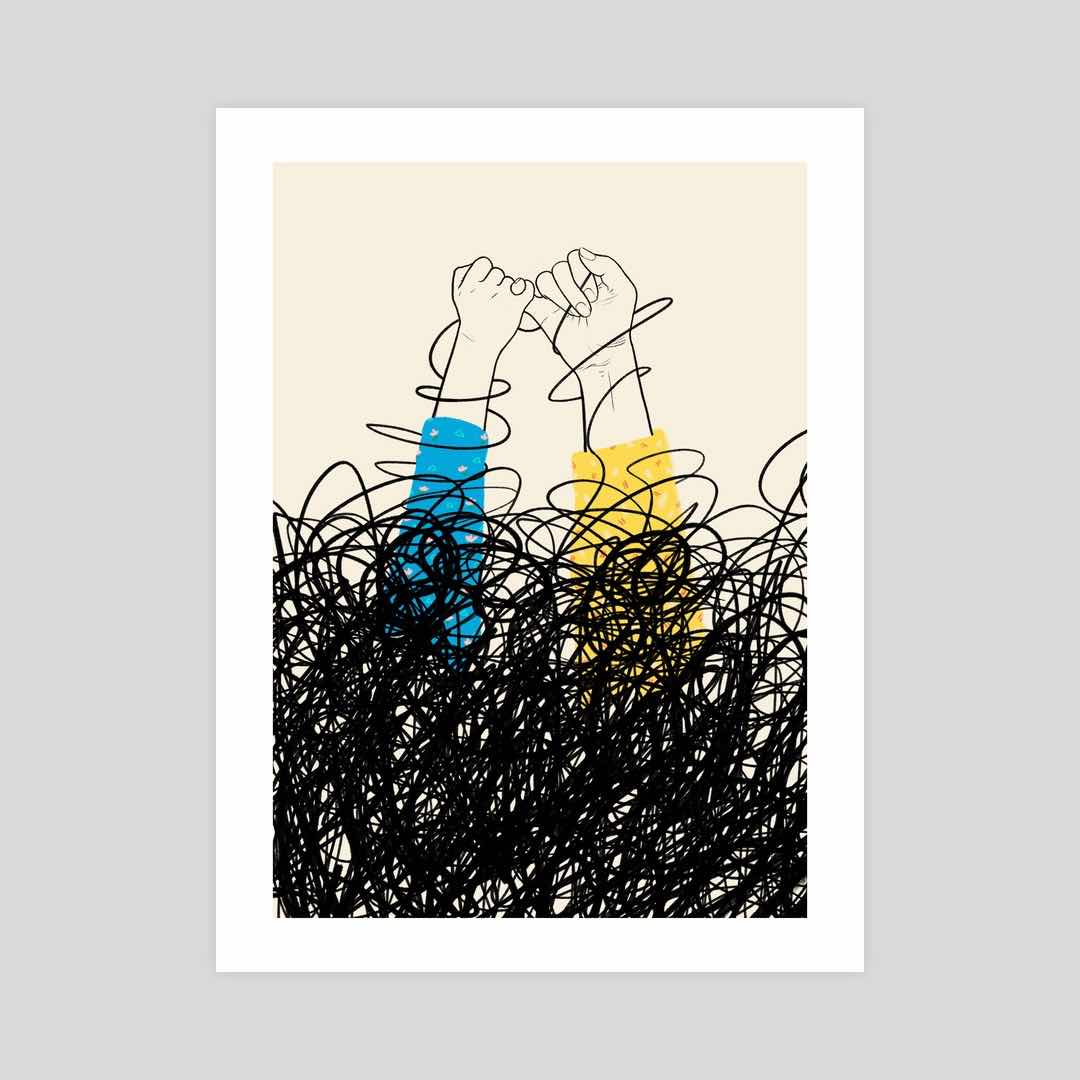
PINKY PROMISES

by Ann E. Wallace


“Pinky Promise” by Joseph Patton


Can you see it?

The shredding of precious 

organs, of slim muscles and growing

bones, of smiles and baby teeth,

of dimples and pinky promises, 

when weapons meant for war

open fire on 40- and 50-pound

children crouching under desks,

hiding behind racks of graded 

readers, and huddling

in the pretend play center.


Can you imagine

what damage has been 

wreaked when a mother must 

recall the neatly pressed 

dress or red striped shirt 

her third grader selected 

for the end of school festivities, 

two days before summer break, 

when a father must swab 

his cheek or offer a vial of blood 

to confirm that the shattered 

remains held in the morgue 

belong to his darling child?


How as a nation 

do we bear that another 

community has been asked 

to be patient, that parents 

were again told to not pick up 

their kids, not yet, when they heard 

the news, so as not to cause chaos—as if

parents’ terror caused this mayhem—

until officials have finished scouring

the brightly colored classrooms 

for small victims, until doctors

have saved those they could

and zipped those they could not 

into oversized body bags, until 

every student has been accounted for,

until nineteen sets of parents 

have learned they will never 

again pick up their children?


How do we justify

that while the devastated 

people of Uvalde have waited 

in desperation for their children 

to be accounted for, 

no one is holding 

our leaders accountable? 


Ann E. Wallace is a poet and essayist from Jersey City, New Jersey. Her published work can be found at AnnWallacePhD. Follow her on Twitter @annwlace409 or on Instagram @annwallacephd.com.

Wednesday, March 02, 2022

FUTURE ORIENTATION

by Imogen Arate


Tweet by The Kyiv Independent.


There is talk of war
in the shushing peacetime
desires for cracking 
delineations to self-heal 
without tending

There is talk of utopia 
in the blunt wielding
of firebombs Why not
room for better)

On the bodies of whose
children friends parents
and lovers A question 
suppressed or answered
by the jutting of chins
toward the detested
"Other" 

though history’s fingers
point to mutual others
who have become as
anonymous as the sides 
they took

whose bodies grew
their bones still beg 
for time to reunite
with the consolation
of a soothing soil

There is paradise
in the overtaking 
by tendrils grown
from the dust of war

in the dawning
that we are multitudes
of singular imperfections
who seek out others 
to share our wounds
perchance to heal


Imogen Arate is an award-winning Asian-American poet and writer and the Executive Producer and Host of Poets and Muses, a weekly poetry podcast that won second place at National Federation of Press Women's 2020 Communications Contest. She has written in four languages and published in two. Her poems, “A Declaration of Loyalty” and “Sanctuary” placed Second and Third, respectively, in the 2020 National Federation of Press Women at-Large Communications Contest. Her poetry has appeared in 18 publications on four continents, most recently in I Wanna Be Loved by You: Poems on Marilyn Monroe, Dwell Time, Nude Studio, and dyst.  You can find her @PoetsandMuses on Twitter and Instagram.

Tuesday, November 23, 2021

NO JUSTICE

by Mary Saracino 


Source: Pinterest


In what pocket of my heart do I shove my grief  
over vigilante white boys being exonerated?
In this land of justice, justice was not served.
The scales of Lady Justice have been upended. 
The blindfold covering her eyes has been torn asunder.
She weeps with outrage.
She wails with sorrow.
She sees the abuse of power.
She calls us to resist.
And for the preservation of humankind
we must act
for love is a verb
and resistance is the antidote
to evil, to fear, to hatred,
the only medicine that
can heal
what festers deepest in the wounds of America's inglorious story.
No shining city on the hill,
a nation founded on unspeakable atrocities
must tourniquet its bleeding limbs
suture its oozing lesions 
nurse its traumatized people back to wholeness.
Together we must embark on this  
beautiful and necessary mending.
Or die trying. 


Mary Saracino is a novelist, memoir writer, and poet. Her most recent novel Heretics: A Love Story (2014) was published by Pearlsong Press. Her novel The Singing of Swans (Pearlsong Press 2006) was named a 2007 Lambda Literary Awards finalist in the Spirituality category.

Friday, October 01, 2021

BURROWING

by Farah Art Griffin


“Into the Void” by DINA D’ARGO, 56, SPRINGFIELD, TENN. Acrylic on canvas via The Washington Post. “‘Into the Void’ symbolizes stepping into the unknown — the idea of life ‘after the pandemic’ and the insecurity of not knowing what lies ahead.” 


still burrowing —
drowning in yesterday's time
past grips us in its palm
wounds
            still wet
            still dripping
memories
            still clear
            still swimming
cave of unforgotten sorrow —
echoes in the dark


Farah Art Griffin is a literary and visual artist. She holds an EdM in Arts in Education from Harvard University. Her work is forthcoming in The American Journal of Poetry.

Tuesday, August 07, 2018

CALIFORNIA STATEWIDE FIRE MAP, AUGUST 2018

by Ron Riekki


Source: CAL FIRE


for Zachary Schomburg and Nick Flynn


“Where the hell is global warming?” —DJT

“The roof, the roof, the roof is on fire” —DJ Rock Master Scott & the Dynamic Three


I used to sit on the shore and watch the waves,
but now the shore is closed and the heat waves

and I’m seeing death in the woods and feeling
death in the air and hearing death on the radio

and knowing death is lurking next to Death so
that there are two deaths everywhere that I look

at all times and the death is the death of booths,
the death of voting booths, the death of all

of the animals near the voting booths and in
the voting booths, except there are no voting

booths anymore, just the rigor mortis of these
electoral colleges that are universities with no

freedom of speech unless you count death
speech, the threats to countries, when we don’t

want to concentrate on the fires, on the air
outside of my apartment right now with its 154

red listing of unhealthy and main pollutant:
atmospheric particulate matter, which really

means death but we can’t say death when we
mean death, and what I mean is the newspapers

are having the headlines of California Ablaze
except that we’re told all media is fake that

death is fake, although here we’ve had more deaths
from forest fires in the last year than in the last

decade combined and we are becoming the last,
with the death taste in my mouth—can you

taste it?—The cereal I had this morning was death
brand.  And the milk was death.  And the bowl

was made out of death and I ran after my death-
bus but missed it so I walked through the forest,

a shortcut, except the deer were on fire and my
head was filled with the particles of death

because death is made up of the little things,
the smallest moments of ignorance, the tiniest

bits of hate, until they pile up and I just read
the graffiti near my apartment: CALIFIRENIA

with dotted capitalized Is in cartoonish flames
and 1.4 million acres is burning in thirteen

states with the third-degree burns of the earth’s
crust, the earth’s nerve endings being destroyed,

its skin swelling, the way these wounds tend to heal
poorly, and the heat is a death and the death is a heat

and this is not theater but rather our lives, my life, your
life


Ron Riekki wrote U.P. and edited The Way North (2014 Michigan Notable Book), Here (2016 Independent Publisher Book Award), And Here: 100 Years of Upper Peninsula Writing (Michigan State University Press, 2017), and Undocumented (with Andrea Scarpino, MSU Press, 2019).

Thursday, February 04, 2016

LOCAL GOVERNMENT

by Roger Stoll


my town council convenes
in suits and dark dresses
up on their dais
far away from us

their voices are soft
speaking through microphones
talking in monotones
one phrase then another

they talk of budgets
fire fighters and police
buildings and zoning
garbage and streets

i know this matters
i know it's important
but i cannot give it
the attention it needs

instead i think
of the planes and the drones
the missiles and bombs
the guns and the soldiers

the rubble of buildings
the dead in the streets
the refugees fleeing
the cities and towns

but the things we do there
to the people in those towns
are not the decision
of anyone here

not the decision
of those in my town
of those on the council
not even the mayor

the things that we do
far away in those places
are decided by others
in chambers like this

in chambers like this one
where some of them sit
on daises much like
the one that is here

their voices are soft
speaking through microphones
talking in monotones
one phrase then another

they too talk of budgets
but for soldiers and guns
for tanks and bombs
and planes and drones

i know this matters
i know it's important
but i cannot give it
the attention it needs

instead i think just
of the fear and the pain
the wounds and the blood
the loss and the grief...

the council adjourns
and everyone smiles
their work for the night
is done...

but i can’t i can’t
keep thinking of fear
and pain and loss
and grief

i know these things matter
i know they’re important
but i cannot give them
the attention they need

perhaps
if the guns
and the bombs
were right here

perhaps
if the planes
and drones
roared above me

perhaps if
the rubble
the dead in the streets
the refugees fleeing
the fear
the pain
the wounds
the blood
the loss
the grief
all came to my town

then perhaps

then perhaps
it would matter

then perhaps
it would matter enough

to give it
the attention
it needs


Roger Stoll is a retired music teacher in San Rafael, California. He has published political verse in the North Bay Progressive Newspaper, the Pacific Sun and TheNewVerse.News, as well as essays in the San Francisco Examiner, ZNet and Counterpunch. He has been arrested numerous times while committing civil disobedience on behalf of numerous causes and is a member of the political affinity group ¡Presente!.