Guidelines


Submission Guidelines: Send 1-3 unpublished poems in the body of an email (NO ATTACHMENTS) to nvneditor[at]gmail.com. No simultaneous submissions. Use "Verse News Submission" as the subject line. Send a brief bio. No payment. Authors retain all rights after 1st-time appearance here. Scroll down the right sidebar for the fine print.
Showing posts with label student. Show all posts

Thursday, February 26, 2026

WE CROSSED

by Zebo Zukhriddinova 


AI-generated graphic by NightCafé for The New Verse News.


I want to speak loud enough for the child who 

packed a suitcase bigger than their arms,

for the teenager who learned the word visa before 

they learned how to drive,

for the mother who ironed hope into a shirt at 3 a.m. before a flight that smelled like goodbye.


I want to speak the way drums speak in a stadium,

the way a voice echoes under bright lights like it refuses to disappear,

the way someone stands at a microphone and 

says:

we are still here.


We did not leave because we hated home.

We left because we loved it too much

to watch it close its doors on our future.


We left because dreams were heavier than fear,

because opportunity whispered louder than 

comfort,

because sometimes survival is not dramatic—

it is paperwork, it is embassy lines, it is a number blinking above a counter

where someone decides if your life may continue.


We learned how to pronounce ourselves again.

We learned that “Where are you from?” can be 

curiosity

or it can be a cage.

We learned to laugh at jokes about our accents

while secretly holding our language like a fragile heirloom

we refuse to drop.


They say immigrant like it is a shadow.

Like it is something that sneaks.

Like it is something that takes.


But we are not shadows—

we are sunrise workers, late-night students,

we are the hands that build and the minds that

 innovate,

we are the children who translate bills at the 

kitchen table

while finishing homework about a history that forgot to mention us.


We crossed oceans, yes—

but mostly we crossed versions of ourselves.

We crossed from who we were told to be

into who we dared to imagine.


And if you ask what we carried,

it was not just luggage.


We carried recipes memorized by heart.

We carried songs our grandmothers hummed 

while sweeping.

We carried photographs folded at the corners

from being opened too often in dorm rooms

where homesickness sounds like silence.


We carried love.


Love stronger than border walls.

Love louder than speeches soaked in fear.

Love stubborn enough to bloom in foreign wintersand call it spring.


Because hate is loud—

it chants, it points, it builds fences out of words —

but love is louder in the long run.

Love studies for exams in a second language.

Love sends money back home.

Love stands in graduation gowns and whispers,

“We made it.”


To the ones who left young—

who traded playgrounds for airports,

who learned currency exchange before algebra,

who grew up between time zones—

this is for you.


You are not “temporary.”

You are not “other.”

You are not a debate.


You are the proof

that hope can pack a suitcase

and still make room for courage.


And one day, when they ask what immigration 

looks like,

tell them it looks like a child refusing to shrink their dream

to fit inside a border.


Tell them it looks like love

walking through customs

with nothing to declare

except a future.


Zebo Zukhriddinova  is an international student currently studying in the United Kingdom.

Tuesday, December 16, 2025

HOLES

by Christine Sikorski


Federal immigration agents tackled and arrested a Somali American man in Minneapolis on Tuesday and detained him for about two hours for no apparent reason other than his ethnicity… Mubashir declined to share his last name out of fear for his and his family’s safety, but he gave a detailed account of the incident to reporters, who also viewed video that city officials shared recorded on a business’ security camera and a bystander’s mobile phone. Mubashir, who moved to the United States as a small boy and became a naturalized American citizen, said that he stepped onto a sidewalk near 4th Street and Cedar Avenue during his lunch break when two masked men approached him. The Cedar-Riverside neighborhood is the heart of the city’s Somali American community. Sensing trouble, he ducked into a restaurant. They followed him inside, dragged him out and forcibly arrested him. The agents handcuffed Mubashir, took him across 4th Street and pushed him onto his knees in the snow. One put him in a choke hold. —Minneapolis Public Radio, December 12, 2025


After the mayoral forum, a candidate and I remain at the table. 

He apologizes for not being “on” today, for not realizing 

his back had been turned to me. He’s tired. New baby. His first. 

Would you like to see a picture? he asks, showing me his phone, 

the stunning infant. I would lose sleep for him always, he says.


My husband kneels on the library floor to better survey 

a shelf of jazz CDs, as a group of preschoolers scuttle around him. 

A small boy approaches, holds out a box of chess pieces, asks

something in Somali. It appears he wants to put the box away 

but doesn’t know where it belongs. A teacher comes to help.


The phlebotomist greets us, speaks to my daughter in a quiet voice, 

assures she is comfortable in the reclining chair. After the blood draw, 

he tells me some people say he should speak more loudly. 

My daughter has been told that all her life, I say, and we talk about 

communicating across cultures, about what signifies humility.


Our US representative leaves a phone message, inviting us to a town hall. 

She wants to hear all of her constituents’ voices. The president calls her

garbage, dreams of throwing her away, along with the candidate, 

the little boy, the phlebotomist. He laughs about shitholes and hellholes— 

his heart, an empty hole.


Christine Sikorski’s work has appeared in WaterstoneLittle Patuxent Review, Quartet, One Art, This Was 2020: Minnesotans Write About Pandemics and Social Justice in a Historic, and elsewhere. Her honors include a Minnesota State Arts Board Grant and Academy of American Poets Prizes. She has taught at two universities, the Loft Literary Center, a homeless shelter, a community center, and other venues. She lives with her family in Minneapolis.

Monday, August 08, 2022

BULLETS


by Andrena Zawinski


Marjory Stoneman Douglas High School's 1200 building has been sealed since the massacre on February 14, 2018. On Thursday, jurors in the sentencing phase of the school shooter's trial walked through the undisturbed scene, where the blood of the victims still stains classroom floors. Bullet holes also mark the walls of the Parkland, Florida, school where Nikolas Cruz killed 14 students and three staff members. A lock of dark hair remains on a floor more than four years after the body of a victim was taken away. Valentine's Day gifts and cards are strewn about, as shards of glass crunched beneath of the feet of visitors. These are the unsettling notes from a group of reporters allowed to enter the building after jurors completed their walk-through to provide details to media outlets across the country, including CNN. —CNN, August 5, 2022


Bullets, 
their brassy caps 
glinting golden in the dark
ammo tray tucked under
a student study desk,
more bullets in a bandolier 
crisscrossing the chest, bullets
maneuvered across a screen
in slugs of anger and angst 
in bullet launchers, landmines 
of bullets, bullets of the slain 
in a shooting game.

Bullets,
their powder packed cartridges
of panic and fear, hollow points 
shattering identities, blasts 
sounding in sleep, bullets 
of grief from a spray hate. 

Bullets 
that silence at windows, on lawns, 
on street corners, in schoolrooms, 
supermarkets, factories, churches, 
all turned altars of flowers,
candles, placards, and prayers, 

while bullets 
fill bank accounts
of makers and regulators
dodging bullets whistling by,
shells jingling in pockets 
like loose change spent 
in puddles of blood.

Bullets, 
their full metal jackets 
dug from the corpse 
with its legacy of wounds, 
bullets that pierced the flesh, 
shattered the bone, riddled 
the heart and all the wild in it,
depositing dreams
to urns and coffins
buried in holes in the dirt,
screams smothered, 
breaths sealed.


Andrena Zawinski’s poetry has received accolades for lyricism, form, spirituality, and social concern. It has appeared in Artemis, Blue Collar Review, Progressive Magazine, Aeolian Harp, Rattle, Verse Daily, The New Verse News, and elsewhere. Her latest collection is Landings. She has two previous award winning books: Something About and Traveling in Reflected Light and a fourth collection, Born Under the Influence, forthcoming in 2022.

Friday, January 28, 2022

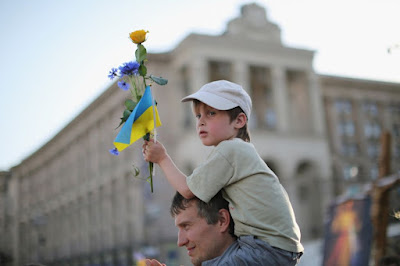
A HEART FROM UKRAINE

by Mel Cápec


BBC Photo January 26, 2022


In a tweet today, poet Ilya Kaminsky reminds us: “People say Ukraine is on the brink of war with Russia. That is not entirely accurate: Ukraine is *already* at war with Russia. Parts of Ukraine are occupied by Russia since 2014. A piece I did at that time might give some context & introduce new poems.”


“Will Russia invade?”
“They better not.”
I now live abroad, far away from the front.
 
They talk about my country,
I try to act calm
I feel like they always forget where I’m from.
 
My classmates are angry,
they say they’re afraid…
I don’t think they get it, it can’t be explained.
 
I’m scared for my friends
who live in Ukraine –
we’re over 18 now, hope they won’t see war terrain.
 
Tensions are rising,
US sends lethal aid.
It’s gonna be bad, my heart is dismayed.


Mel Cápec is an 18-year-old emerging queer writer. She moved to the Czech Republic from Ukraine. She is now a high school student and would like to pursue a degree in journalism.

Thursday, September 24, 2015

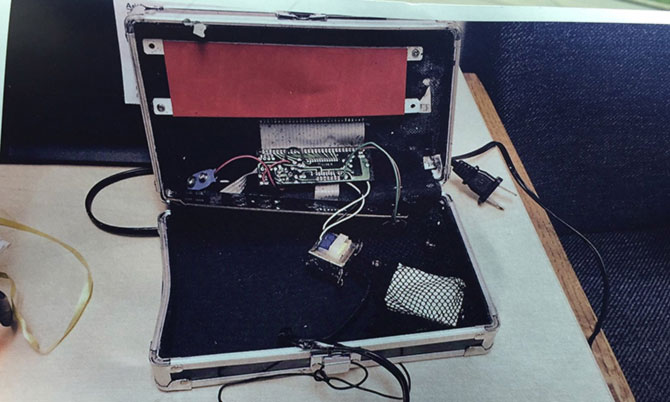
AHMED'S CLOCK

by Catherine Chandler


the main board
links

the seven-segment display
the transformer

the 9-volt interface
for power-outage battery backup  

in a circuit-stuffed
pencil box

clocks
don’t look

like
that

Ahmed makes
the connection


Catherine Chandler is an American poet and translator who currently lives in Canada.

Saturday, November 22, 2014

WE ARE THE FLAMES

by Adrian Ernesto Cepeda


A demonstration to demand authorities find 43 missing college students, in Mexico City, this week. Mexico officially lists more than 22 thousand people as having gone missing since the start of the country's drug war in 2006, and the search for the missing students has turned up other, unrelated mass graves.


Hear us strike our match,
our voices glowing
over this capital—
our lower case demands
will only grow louder,
nuestras voces ponderosas
hear us from your palace,
so much fuel in our voices
your quiet fuels to inspire us—
our marching bellow.
The world welcomes
our fire united we, students
as sisters and brothers,
together— you will hear
our loudest uprising.
Somos la llama de Mexico.
Wrapped in our flags
colors of green, white
and red; spirit of águila’s—
We Are The Flames.
El cielo can feel us—
our spirits uniting?
Your silence
will never divide this city,
our country—
Presidente, you will
remember our names.


Adrian Ernesto Cepeda is an L.A. poet whose work appears in the new True Romance Poems collection, 1000 Tankas for Michael Brown, The Lake Poetry, Edgar Allen Poet Journal # 2, Fukushima Poetry Anthology, San Gabriel Valley Poetry Quarterly, Spilt Ink Poetry, Luna Luna Magazine’s Latino Poetry Project, Love Poetry Lovers, ZO Magazine, Oddball Magazine, The Rain, Party, & Disaster Society, Men's Heartbreak Anthology and in the soon to be released publications: Purrfect Poetry Anthology and Poetry in Motion’s collection Poems to Fuck To. He is currently enrolled in the MFA Graduate program at Antioch University in Los Angeles.

Tuesday, May 20, 2014

THE PROFESSOR SAID

by David Plumb


Image source: UTPA


I teach soldiers
back from war.
I hear so much silence.

I see such glow
pale suchness
pride, a slim yes
a nod, an offset
remark or two.

They sit in when
Muscle-sharp
A pin drop, a cut
A dark brow, a tuft
A quick smile.

Somewhere in the room
I have soldiers who
ask without asking
What now?


David Plumb has worked as a paramedic, cab driver, cook, tour guide, and adjunct professor. 
Writing has appeared in The Washington Post, Outlaw Poetry Network, Sport Literate, Beatitudes 50 Years, 100 Poets Against the War, Salt, Blue Collar review, Gargoyle and One Paycheck Away. The author of ten books, he volunteers for the Alzheimer’s Poetry Project and is past director for a homeless shelter.  Will Rogers said, “Live in such a way that you would not be ashamed to sell your parrot to the town gossip.” Plumb says, “It depends upon the parrot.”