Guidelines


Submission Guidelines: Send 1-3 unpublished poems in the body of an email (NO ATTACHMENTS) to nvneditor[at]gmail.com. No simultaneous submissions. Use "Verse News Submission" as the subject line. Send a brief bio. No payment. Authors retain all rights after 1st-time appearance here. Scroll down the right sidebar for the fine print.
Showing posts with label clock. Show all posts

Saturday, December 07, 2024

MELTING OF ARCTIC SEA ICE

by Ron Shapiro

    a
A polar bear stands on floating sea ice in the Arctic. The bears rely on sea ice to move throughout their hunting grounds. (Image credit: SeppFriedhuber via Getty Images via Live Science.)


'Ominous milestone for the planet': Arctic Ocean's 1st ice-free day could be just 3 years away, alarming study finds —Live Science, December 4, 2024


Another warning,

Red flags up in the scientific

Community, sea ice melting

Faster than an ice cube on

An Arizona day. Polar bears

Shifting their weight on legs

The size of tree trunks while

Balancing on the moving chunks

Of frozen water over a million

Years old. With each piece

Of ice shrinking over time,

How will the polar bear find

Food if he can’t travel far

From his glacier home?


Meanwhile, land torn up,

Only a commodity in a world

Based on capitalism. Imbalance

Between humanity and the earth

Causes the dis/ease of fear, anxiety

And consumerism. What comes

From the ground is a commodity,

Something to sell, to buy, to use up.


The air warms the melting masses

But so far away from here, how can

Anyone care about this? No plans

For the future. Carpe Diem without

The seizing. Brain rot eats away at

Sanity and intention. Useless images

And misinformation to distract, to

Entertain, to confuse. Abstract words

Populate the language resulting in

Generalization, stereotypes, prejudice,

Bias, and ignorance. Not enough time

To think. Only to react. Tik Tok goes

The Earth’s clock. The air polluted,

The breath compromised, the ice melting,

Polar bears weeping in a cold puddle

Of water swishing at their feet.


Ron Shapiroan award-winning teacher, currently mentors college essay writing as well as teaches Memoir Writing through George Mason University. He has published writings in Nova Bards 23 & 24Gatherings, Poets of the Promise, Poetry X HungerMinute Musings, Backchannels, Gezer Kibbutz Gallery, All Your Poems, Paper Cranes Literary Magazine and two chapbooks: Sacred Spaces and Wonderings. He lives with his wife and Shanti the Cat in Reston, Virginia.

Wednesday, March 23, 2022

DON'T TOUCH MY DREAMS

by George Salamon


Illustration by Beppe Giacobbe for Harper’s Magazine


"Can technology shape our dreams?" 
—Michael W. Clune, "Engineering our dreams," Harper's Magazine, April 2022


My dreams are true, because they occur,
they are false, because only I see them.
It's an awe-inspiring arrangement, it
is both darkness and light, it frustrates
and enlightens, it is a human thing.
The heart beats as we sleep, our
eyes write down the stuff of dreams,
dreams remain within and out of our
world.

Our soul is endowed with two eyes,
one watches the passing of hours on
the clock, the other sees through the
the borders of time, until watching
passes into seeing through, and the
dream endures within us.
I don't want technology to tamper with
this burden and gift.


George Salamon is not happy about what technology has done to "engineer" our engaging and communicating with each other and wants it to keep its metallic hands off our dreaming, the happy dreams and nightmares. 

Monday, November 23, 2020

TIME'S UP

by Richard Meyer
Follow the online bot that tweets the elapsed amount of the T***p presidency in 0.1% increments .


Deranged, incompetent, irate,
the loser won’t admit he lost.
Refusing to accept his fate,
he’ll lie and cheat at any cost
and even wreck the ship of state
while claiming he’s been double-crossed.

But he’s defeated, shamed, undone.
The unrelenting countdown clock
keeps dropping digits one by one.
He cannot stop the tick and tock.
He’s out of time. His end has come,
a failure there’s no hiding from.

He’s squeezed inside an hourglass,                 
dissipating grain by grain.
The dwindling moments come and pass,                    
and nothing of him will remain.
His legacy and final brand
will be a little mound of sand.


Richard Meyer’s poems have appeared in various publications, including Able Muse, The Raintown Review, Think, Measure, Light, TheNewVerse.News, Alabama Literary Review, and The Evansville Review. He was awarded the 2012 Robert Frost Farm Prize for his poem “Fieldstone” and was the recipient of the 2014 String Poet Prize for his poem “The Autumn Way.” A book of his collected poems, Orbital Paths, was a silver medalist winner in the 2016 IBPA Benjamin Franklin Awards.

Friday, June 14, 2019

HARDWARE

by Gil Hoy


I’ve no use for
a stainless steel
lightweight

Corrosive resistant
contraption

That encumbers
my wrist
and can’t

Tell me anything
useful anyway.

“There will be time,
there will be time

To prepare a face
to meet the faces
that you meet.”

No, this soul
has no time

For a chronometer

With a full
date display,

Blue dial, rhodium-
plated hands,

And an alligator
strap—

I already know
too much about

Coffee spoons
and sugar spoons

Bus stops,
Trolley stops

Business meetings
and phone calls.

Preparing
for that
special show

A meeting
with the CEO.

And I don’t
want one
in my pocket
either,

Like a mouse.

Tick tock
Tick tock

I grow old
I grow old

My pants
grow mold.

Tell me
something
good–

Surprise me,
It’s my Birthday.

What I really
want to know is:

When will
my kids
grow up;

When will
my heart
stop beating;

And when will
the last
polar bear

step off
the last piece

of melting
Arctic sea ice

and silently
disappear.


Gil Hoy is a Boston poet and semi-retired trial lawyer studying poetry at Boston University through its Evergreen program. Hoy previously received a B.A. in Philosophy and Political Science from Boston University, an M.A. in Government from Georgetown University, and a J.D. from the University of Virginia School of Law. He served as a Brookline, Massachusetts Selectman for four terms. Hoy’s poetry has appeared most recently in Chiron Review, TheNewVerse.News, Ariel Chart, Social Justice Poetry, The Potomac, The Penmen Review and elsewhere.

Tuesday, March 07, 2017

THE NEXT DAY

by James Grabill


So it’s the next day and we’re still alive on the planet where we’ve thrived beyond overflow capacity and immersed ourselves in collective interdependence propped up by long-evolved mineral sense and other species.

With all the fasting and ascension, retooling of Arctic winds for the hog-blinking duration, through certain rains we’ve inherited, amounts of arrogance from before science occur in the underbelly of thought.

And yet this is the chance we were given, to live while the clock hands wheel and numbers vanish along with the sky eventually darkening, where heads of the sunflowers eventually bend heavily toward the ground, as if sizing up where their seeds will fall.

Unfinished presence extends, where mushrooms stake out reclamations.

Stitches Grandma made to dresses on her seamstress bodices I’m sure still exist where they were drawn with attention taut, right for the baby in arms of her mother, in the room behind the door that stays closed.


James Grabill’s recent work is online at the Caliban, Green Mountains Review, Kentucky Review, Elohi Gadugi, Buddhist Poetry Review, Harvard Review, Terrain, Mobius, Calliope, The Oxonian Review, The Toronto Quarterly, Mad Hatter’s Review, Plumwood Mountain, and others. His books include Poem Rising Out of the Earth (1994) and An Indigo Scent after the Rain (2003), both from Lynx House Press. Wordcraft of Oregon has published his new project of environmental prose poems, Sea-Level Nerve: Book One and Book Two. A long-time Oregon resident, he teaches 'systems thinking' and global issues relative to sustainability.

Thursday, September 24, 2015

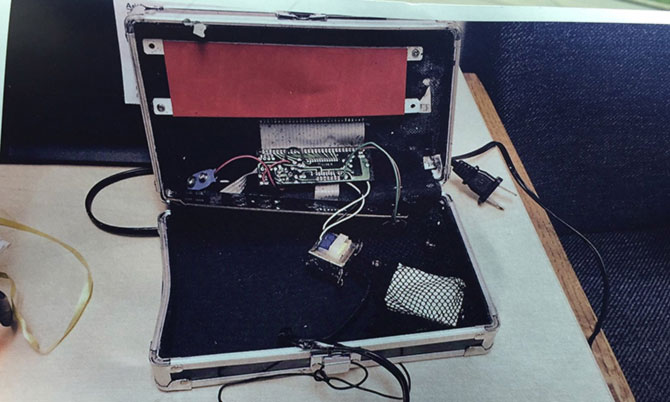
AHMED'S CLOCK

by Catherine Chandler


the main board
links

the seven-segment display
the transformer

the 9-volt interface
for power-outage battery backup  

in a circuit-stuffed
pencil box

clocks
don’t look

like
that

Ahmed makes
the connection


Catherine Chandler is an American poet and translator who currently lives in Canada.

Friday, February 01, 2013

AFTER THE MASSACRE

by Howie Good


Photograph by Phil Armitage


1
January has been mostly absent. No need to look online for what it means. I already know what it means. It means there’s a girl at the door collecting for cancer. Alcohol intensifies the effect. Theology, too. Whoever doesn’t love incongruity doesn’t love me. The clock raises its penciled-in eyebrows. I don’t talk in my sleep; I scream.

2
I wake up to snow drifting down, dry and brittle, like the ashes of murdered six-year-olds. Hey! No problem! the weather girl assures everyone. I have become someone I never wanted to be, the way songs have become their own jingles. Hear it? The cold, dark howls of women giving birth to monsters in attics.


Howie Good, a journalism professor at SUNY New Paltz, is the author of five poetry collections, most recently Cryptic Endearments from Knives Forks & Spoons Press. He has a number of chapbooks forthcoming, including Elephant Gun from Dog on a Chain Press. His poetry has been nominated multiple times for the Pushcart Prize and Best of the Net anthology. goodh51(at)gmail.com.

Saturday, January 05, 2013

FORENSICS

by Tony Brown

Milky Way Clock by Henrik Amberla. Image source: I New Idea Homepage


We have exhausted all leads

as the clock runs out.

People died. Who and what

we should blame is not clear.

If there’s a connecting thread

or line to explain what led to…this,

it remains unseen. It’s not a conspiracy thing;

shit’s just complicated.  Maybe some of it

is about malice, but mostly

it’s about acceptance

of unintended consequences

and ignorance of how to stop

thinking we are so damn omniscient.

We’re not, of course; that’s obvious.

We’re blind little beggars or huge deaf kings.
No one is paying attention,

or paying for us to pay attention.

We’re broke and we’re out of time.

If we want to know who did what,

if we are ever to learn that,

we are going to have to start time again.

Build a world differently — more windows and doors,

fewer walls.  And most of all

we’re going to have to build a better clock.

Something with longer hours, days, years.

Something based on the Mayan model, perhaps,

with lots

of resets.


Tony Brown,  a three time Pushcart Prize nominee,  lives in Worcester, MA, and is one half of the poetry and music duo The Duende Project.