![]() |
| Stingless bees from the Amazon have become the first insects to be granted legal rights anywhere in the world, in a breakthrough supporters hope will be a catalyst for similar moves to protect bees elsewhere. —The Guardian, December 29, 2025 |
Today's News . . . Today's Poem
The New Verse News
presents politically progressive poetry on current events and topical issues.
Guidelines
Submission Guidelines: Send 1-3 unpublished poems in the body of an email (NO ATTACHMENTS) to nvneditor[at]gmail.com. No simultaneous submissions. Use "Verse News Submission" as the subject line. Send a brief bio. No payment. Authors retain all rights after 1st-time appearance here. Scroll down the right sidebar for the fine print.
Monday, January 19, 2026
THE STINGLESS BEE, RECOGNIZED
Thursday, July 11, 2024
SURGEONS OF THE INSECT WORLD
![]() |
Ants in Florida perform life-saving surgery on their peers, scientists have discovered. They are only the second animal in the world known to do this — along with humans. —Live Science, July 2, 2024. Image by Bart Zjilstra. |
No fear! Her friends come round to amputate it.
The injured ant is brave. (They don’t sedate it.)
Her tight-knit colony is super-tuned
to spot all troubles, never apathetic
to nest-mates. Every helper is a hero.
Each one of them, despite receiving zero
training, is a natural-born medic.
They diagnose, see if the wound’s infected
or sterile, and then treat accordingly
(like surgeons you or I might go to see).
Damaged or not, no member is neglected.
They work for forty minutes on her leg
to lop it off. At first, they lick and lick
the wound so clean, no germ will make her sick.
Mouths moving up her limb, she doesn’t beg
her mates to stop. Stoic, calm, collected,
she sits there while the surgeons work intently,
gnawing at her shoulder — far from gently.
With five remaining legs, feeling respected,
she walks off as if nothing is amiss
with feelings of contentment — or even bliss.
With Primal Instinct as their sole director,
Sunday, July 23, 2023
MY DIGS ON DISTANT ENCELADUS
![]() |
| A pair of scientists from the Southwest Research Institute (SwRI) were members of a James Webb Space Telescope (JWST) team that observed a towering plume of water vapor stretching over 6,000 miles — a distance comparable to that between the U.S. and Japan — erupting from the surface of Saturn’s moon, Enceladus. This notable discovery, achieved during NASA JWST’s Cycle 1, has led to Dr. Christopher Glein of SwRI being granted a Cycle 2 allocation to examine both the plume and crucial chemical compounds on the surface, in an effort to better comprehend the possible habitability of this oceanic celestial body. —SciTechDaily, July 20, 2023 With ample geothermal activity, sparkling geysers, and waterways that flow below a glaze of purest H2O, Enceladus is the perfect place for me. Throughout those rows of rage on Mercury, during those catlike spats of spite on Venus, even as a universe grew between us, this speck of dust was waiting just for me. Though much too far from the sun for vitamin D, with monumental subterranean seas and a balmy minus three hundred thirty degrees, this moon’s the ideal hideaway for me. One hundred gushing geysers feed the “E,” the greatest of those radiant rings of Saturn which fashion such a pleasurable pattern, this is the quintessential moon for me. I skate the grooves of Samarkand or ski down Ali Baba and Aladdin, bounce and bounce and bounce as though I weigh an ounce here on this satellite so right for me. Beneath the ice, an awesome panoply of beings surely bathe. It must be so! One way or another I will go beneath the ice. Great exploits wait for me! One that has risen, curled around my knee, my house-trained and obedient caecilian like magic turns from cyan to vermillion, a blind and limbless thing quite fond of me. This moon is much too minuscule to see, although it gleams so loudly, I must wear my sunglasses to tolerate the glare peculiar to this rock just right for me, a home away from home where I am free to shiver like a chickadee from the dearth of warmth on a dismal dot so far from Earth. It’s how I like it. It’s the spot for me! The winner of the 2022 Helen Schaible International Sonnet Contest, Martin Elster comes from Hartford, CT, where he studied percussion and composition at the Hartt School of Music and performed with the Hartford Symphony Orchestra. Martin, whose poetry has been strongly influenced by his musical sensibilities, has written two books, the latest of which is Celestial Euphony (Plum White Press, 2019). |
Thursday, March 09, 2023
ABER-CLAM LINCOLN
![]() |
| Aber-clam Lincoln, a quahog clam believed to be 214 years old found at Alligator Point, was released into the Gulf of Mexico Friday by his caretakers at the Gulf Specimen Marine Lab in Panacea. Americorps member Blaine Parker dug up the two-century old mollusk while collecting shellfish to make chowder. Parker said it is hefty enough to make two servings and has shells large enough to use as bowls to serve it in. “We were just going to eat it, but we thought about it a while and figured it was probably pretty special. So, we didn’t want to kill it,” said Parker. Instead, he took it to the aquarium at the Gulf Specimen Marine Lab where he works as a specimen collector. Photo by Alicia Devine: Marine Blaine Parker releases a quahog clam believed to be 214 years old into the Gulf of Mexico. Parker found the clam he calls "Aber-Clam Lincoln" at Alligator Point. —Tallahassee Democrat, February 26, 2023 |
Wednesday, February 22, 2023
THE CHILENO VALLEY NEWT BRIGADE
![]() |
| For the past four years, volunteers have spent their winter nights shepherding newts across a one-mile stretch of Chileno Valley Road, a winding country road in the hills of Petaluma. They call themselves the Chileno Valley Newt Brigade, and their founder, Sally Gale, says they will keep showing up until the newts no longer need them. —The New York Times, January 24, 2023 |
Thursday, December 30, 2021
GODDESS OF THE UNDERWORLD
| A newfound species of millipede (Eumillipes Persephone) has more legs than any other creature on the planet—a mind-boggling 1,300 of them. The leggy critters live deep below Earth's surface and are the only known millipedes to live up to their name. Image credit: Paul E. Marek, Bruno A. Buzatto, William A. Shear, Jackson C. Means, Dennis G. Black, Mark S. Harvey, Juanita Rodriguez, Scientific Reports via LiveScience, December 16, 2021. |
Tuesday, November 09, 2021
SPOTTED FROM SPACE
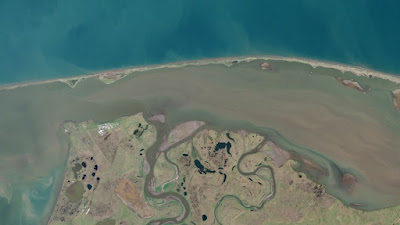
| In recent satellite imagery captured by Planet, which operates the world's largest pack of Earth-observing satellites, large groups of walruses can be seen crowding Earth's coastlines, all the way from space. The image shows ambiguous, "distinctive red-brown" blobs decorating the Alaskan coastline. Previously, walruses would gather in groups of up to many thousands, called "haulouts," on Arctic sea ice far from the shore. But with sea ice melting at rapid speeds due to climate change, they have no choice but to gather on land. —Space.com, November 5, 2021 |
Wednesday, September 08, 2021
GERONIMO THE ALPACA
Friday, August 06, 2021
CONVENIENCE
Thursday, September 03, 2020
COVID-19 LIPOGRAM
![]() |
| Kay Scanlon / Los Angeles Times; Getty Images |
Masking my physiognomy
may blight my glorious bond with you.
Your shroud, part of your armory,
brings to mind this bugaboo
bugging all of us. So now
as you and I chat through our masks,
although your orbs and striking brow
may knit or grin, a ticklish task
awaits us: To concoct a way
to talk with hands, with nods, and know
that you and I can simply say,
“I want you!” though our lips won’t show.
Author's Note: This is a poem without the letter “e."
Saturday, August 17, 2019
WHO OWNS THE EARTH?
![]() |
| From “The Untold Benefits of Climate Change” by Kendra Wells at TheNib. |
Renowned Harvard entomologist E.O. Wilson has said that without insects the rest of life, including humanity, “would mostly disappear from the land. And within a few months.”
—National Geographic, August 6, 2019
We own the earth. We buzz or hug
you in your bed, at times will bug
you when you taste like toothsome prey.
We flit around your cold buffet.
We’re sweat bee, darner, skeeter, slug,
the flea that’s pestering your pug.
We’re everywhere. You might go, “Ugh!”
when centipedes cruise by. Yet, say
we left the earth.
Perhaps you’d shout with glee, or shrug.
But think: no cherry, apple, mug
of honeyed tea, nor silver tray
of leafy greens would come your way.
You see, Big Brain? Don’t be so smug!
We own the earth.
Martin Elster serves as percussionist with the Hartford Symphony Orchestra. His poems have appeared in numerous journals and anthologies. Honors include co-winner of Rhymezone’s 2016 poetry contest, winner of the Thomas Gray Anniversary Poetry Competition 2014, third place in the SFPA’s 2015 poetry contest, and three Pushcart nominations.
Monday, June 17, 2019
A 30-DAY TRIP ON THE INTERNATIONAL SPACE STATION
![]() |
| One day soon, you won't need to be a member of the traditional astronaut corps to visit the International Space Station. But you – or your corporate sponsors – will need very deep pockets. "We are announcing the ability for private astronauts to visit the space station on U.S. vehicles and for companies to engage in commercial profit-making activities," said Jeff DeWit, NASA's chief financial advisor, at a launch event held Friday in at NASDAQ headquarters in New York. Up to two private astronauts – who must meet the same physical requirements as any other NASA astronaut – will be allowed to fly per year and work on behalf of companies. Each seat is expected to cost more than $50 million and the first could launch as soon as 2020. —USA Today, June 7, 2019 |
Far higher than the vultures, cranes and bats
that soar as in some reverie or dream,
for loads of dough, you ride inside the cream
of satellites, race round a world of rats
and angels locking horns like dogs and cats,
observe vast oceans glisten, cities beam,
and feel about to hurl. You start to deem
the whirling washers in the laundromats
of Earth remarkably serene. Somewhat
emboldened by the expedition crew,
you try to take deep breaths. Yet, truth be told,
what’s really making you a sickly sot
are all the greenbacks you’ve just spent, your hue
now paler than a wilting marigold.
Monday, January 07, 2019
THE GREAT WALL OF AMERICA
![]() |
| A family of javelinas encounters the wall on the U.S.-Mexico border near the San Pedro River in southeastern Arizona. (Image credit: Matt Clark / Defenders of Wildlife via Stanford Earth) |
On a planet in a cosmos far away
there’s a USA that’s not the USA,
edged by a wall so ugly, Cooper’s hawks
and vultures will not perch atop it. Flocks
of bats and buntings ram it, while the turtle
and turkey blink and boggle at that hurdle
whose stainless teeth impale the stratosphere,
whose reach makes creatures prisoners all year.
Poets and meditators often wake
with hearts and kidneys missing. A mistake?
or just a program glitch inside a dream
hammered into heads by the regime
which built that barrier? Not the fiercest gale
nor hurricane nor earthquake can upset it.
Even the butterflies, bees, and beetles dread it.
Jumbo jet or Zeppelin or kite—
none dare traverse it. With the appetite
of a thousand whales, it gulps them in a bite.
When master mountaineers attempt to scale
the wall, they fall, or languish in a jail
with all the rest who waste away inside
a country or a cooler and abide
by the common rules in a cosmos far away
where the USA is not the USA.
Tuesday, April 03, 2018
A MESSAGE FROM THE SECOND PLANET
![]() |
| A composite image of the planet Venus as seen by the Japanese probe Akatsuki. The clouds of Venus could have environmental conditions conducive to microbial life. IMAGE FROM THE AKATSUKI ORBITER, BUILT BY INSTITUTE OF SPACE AND ASTRONAUTICAL SCIENCE/JAPAN AEROSPACE EXPLORATION AGENCY via University of Wisconsin-Madison News, March 30, 2018. |
On Friday, astronomers announced a new paper laying out the case for the atmosphere of Venus as a possible niche for extraterrestrial microbial life.—EarthSky, March 31, 2018
We’re microbes in the clouds of Venus
of an otherworldly genus
gobbling CO2 and spitting
out sulfuric acid—fitting
for a life form that can waft
akin to an ocean-going craft
far above the rocks and soil
whose heat will make lead bullets boil.
We’re vitamin D3 gourmets,
drinking ultraviolet rays
as we have done for donkey’s years,
wild about the atmosphere’s
asphyxiating greenhouse gas,
so reflective that your glass
sees only jewel-like radiance.
You scientists are on the fence
on whether there is life on Venus,
but only cause you haven’t seen us
yet. And we don’t want you to,
for if you poke and probe, you’ll strew
our virgin world with noxious matter.
All tranquility will shatter.
Goggle at our planet. Stand
in distant awe. But please don’t land!
Martin Elster is a composer and serves as percussionist with the Hartford Symphony Orchestra. His poetry has appeared in Astropoetica, Autumn Sky Poetry Daily, The Chimaera, and The Road Not Taken, among others, and in anthologies such as Taking Turns: Sonnets from Eratosphere, The 2012 and 2015 Rhysling Anthologies, New Sun Rising: Stories for Japan, and Poems for a Liminal Age.
Wednesday, February 14, 2018
THE SPACE ROADSTER
Elon, you’ve lost one of your cherry cars.
We doubt you miss it, though, for Starman steers it,
piercing the emptiness en route to Mars
and the ring of rocks beyond. What flyer fears it,
the absolute of space? Not this fake pilot!
Its gaze is black as the gaps between the stars,
and yet the worlds and suns seem to beguile it.
Who would have thought that dummies in red cars
could zip into earth orbit and keep going?
They flabbergasted us, your booster rockets
which settled like a pair of sparrows (owing
to bang-up engineering). In your pockets
were all the funds you needed for a test
that bested your most hopeful expectations.
Now car and mannequin are on a quest
to beat our wildest visualizations
as earth recedes with all its blues and whites
as Mars grows closer with its browns and coppers
as space becomes spectacular with lights
as we audacious apes become star-hoppers.
Martin Elster is a composer and serves as percussionist with the Hartford Symphony Orchestra. His poetry has appeared in Astropoetica, Autumn Sky Poetry Daily, The Chimaera, and The Road Not Taken, among others, and in anthologies such as Taking Turns: Sonnets from Eratosphere, The 2012 and 2015 Rhysling Anthologies, New Sun Rising: Stories for Japan, and Poems for a Liminal Age.
Friday, November 03, 2017
LAIKA (1954 - NOVEMBER 3, 1957)
![]() |
| Laika statue outside a research facility in Moscow (AP Photo/RIA-Novosti, Alexei Nikolsky) via Universe Today. |
We pulled you off the windy streets,
crammed you in a windless room,
stuck electrodes to your skin,
then hurled you to your doom.
Black ears alert, brown eyes alarmed,
you fought against the fearsome thrust,
heart overheating, wildly beating,
hanging on to trust.
What was this floating-feather-lightness?
Where was the man whose gentle hand
had stroked you after every test?
When will this bubble land?
Our plan was, after a week in orbit
you’d polish off the poisoned kibble.
(Your air was running out, dear friend,
but you weren’t one to quibble.)
Because of you, men gained the moon,
touched a comet, launched the Hubble.
Yet building a craft that could have brought
you back was too much trouble.
There stands a statue of a rocket,
you atop it, proud and regal.
Small Moscow stray, could you have dreamed
you’d die a wingless eagle?
Friday, March 27, 2015
SPRING PEEPERS
![]() |
| Spring Peeper. Image source: Virginia Herpetological Society |
Spring peepers trill and whistle in between
the avenue (where drivers rush toward shops),
construction site, the woods, the putting green.
No one stops to listen to these drops
of sentience small as buttercups and shrill
as piccolos. They hide amid the stalks
that rise up from a liquid eye as still
as a spyglass pointed at the equinox,
Unblinking for eternity. The first
of April. The environs dance and ring
with notes from frogs who, though they’re unrehearsed,
belt out a song precisely tuned to spring.
These lusty soon-to-be inamoratos,
iconic crooning harbingers, will soon
be silent. You who ride inside your autos,
roll down the windows! Do not wait till June!
Martin Elster, author of There’s a Dog in the Heavens!, is also a composer and serves as percussionist for the Hartford Symphony Orchestra. His poems have appeared in such journals as Astropoetica, The Flea, The Martian Wave, The Rotary Dial, and in the anthologies Taking Turns: Sonnets from Eratosphere, The 2012 Rhysling Anthology, and New Sun Rising: Stories for Japan. Martin’s poem, “Walking With the Birds and the Bones Through Fairview Cemetery” received first prize in the Thomas Gray Anniversary Poetry Competition 2014.
Thursday, January 01, 2015
THE EYE OF EARTH
![]() |
| Image source: NotThatKindofGirl |
The eye of Earth peers, spellbound, through a chink
in melting pond ice, trying not to blink
into the blue enveloping its gaze.
It’s never seen the sun before, whose rays
scatter through the atmosphere, a link
to outer space, where constellations wink
their secrets. Billows take a healthy drink
of water vapor, amble past, amaze
the eye of Earth.
Its habitat now teeters on the brink.
Though trees have bared their limbs, grooves black as ink
crisscross the leaf-strewn liquefying glaze,
whose softening increases with the days.
The gravity of this, though, cannot sink
the eye of Earth.
Martin Elster, author of There’s a Dog in the Heavens!, is also a composer and serves as percussionist for the Hartford Symphony Orchestra. His poems have appeared in such journals as Astropoetica, The Flea, The Martian Wave, The Rotary Dial, and in the anthologies Taking Turns: Sonnets from Eratosphere, The 2012 Rhysling Anthology, and New Sun Rising: Stories for Japan. Martin’s poem, “Walking With the Birds and the Bones Through Fairview Cemetery” received first prize in the Thomas Gray Anniversary Poetry Competition 2014.
Saturday, September 27, 2014
DIHYDROGEN MONOXIDE
![]() |
| This is an illustration of water in our Solar System through time from before the Sun's birth through the creation of the planets. (Image source: Bill Saxton, NSF/AUI/NRAO via Science Daily) “Water was crucial to the rise of life on Earth and is also important to evaluating the possibility of life on other planets. Identifying the original source of Earth's water is key to understanding how life-fostering environments come into being and how likely they are to be found elsewhere. New work from a team including Carnegie's Conel Alexander found that much of our Solar System's water likely originated as ices that formed in interstellar space. Their work is published in Science.” --Science Daily, September 25, 2014 |
The molecules commingling in your glass
Monday, March 24, 2014
SPRING MUSINGS
A hundred thousand million galaxies
in motley clusters rapidly receding
from one another — like a bunch of bees
repelled by tainted nectar they’d been eating —
is a sure sign the cosmos is inflating,
as is the vocal structure of the frog
now calling out across the water, waiting,
as patient as the shadows in this bog.
With every croak, his throat must grow then shrink.
But will that happen to the universe?
Well, you can speculate and muse and think
and theorize and wonder and immerse
your thoughts in such abstract considerations
while I sit listening to frog vibrations.
Martin Elster, author of There’s a Dog in the Heavens!, serves as percussionist for the Hartford Symphony Orchestra and is a composer; his poetry has appeared in numerous literary magazines and anthologies.