Guidelines


Submission Guidelines: Send 1-3 unpublished poems in the body of an email (NO ATTACHMENTS) to nvneditor[at]gmail.com. No simultaneous submissions. Use "Verse News Submission" as the subject line. Send a brief bio. No payment. Authors retain all rights after 1st-time appearance here. Scroll down the right sidebar for the fine print.
Showing posts with label poem. Show all posts

Sunday, June 28, 2026

NOT TELLING IT SLANT

by Margit Berman


AI graphic by Nightcafé for The New Verse News


This poem went to the protest.
This poem went to the protest and was arrested.
It did nothing wrong.
Just stood and told the truth.

This poem has listened all day long to lies.
This poem's own mother called it evil right to its face
and it is not evil
even though sometimes it wishes it was.
This poem heard lies about zines
and the reflecting pool
and whether anyone needed a ride.

This poem is not evil
and always stands and tells the truth
and—tell the truth—that it why you hate it,
isn't it?
That is why they hanged this detained poem
without a trial
from the gallows
in the trees
until the protest signs
slipped from its hands and fell,

until the words convulsed,
ceased
in its broken neck.


Margit Berman is a writer, psychologist, artistic director of Jackson Street Arts in St. Paul, MN, and faculty at the University of Saint Thomas and the Geisel School of Medicine at Dartmouth. Her poetry has been published in If Poetry Magazine, The Quarry at Split This Rock, Foreign Policy in Focus, on the Mississippi Valley Poetry Walk, and in the anthology, Try to Have Your Writing Make Sense, among others. She has won poetry contests including at the Poetry Free for All, Garrison Keillor’s Green Light at the End of the Dock Poetry Festival, and from the League of Minnesota Poets.

Tuesday, April 21, 2026

SAVE YOUR BREATH

by A J Dalton
 
 
AI-generated graphic by NightCafé for The New Verse News.


They    put   tariff    words now
So   ll use 10% less
God help     hyperverbal
–they    probably end    homeless
 
Marketing    all visuals now
Cos   picture paints   1000
Or strange performance pieces
    actions speak louder,      say
 
Some took   vow    silence
There are fewer arguments truly
   , it   wasted breath
Yet   never hear ‘  love you!’
 
  fear     proposed tariff    space next
As immigration needs controlling
This poem   gone    too long though
And cost      flaming fortune!


A J Dalton is a UK-based writer. He’s published the Empire of the Saviours trilogy with Gollancz Orion, The Satanic in Science Fiction and Fantasy with Luna Press, the Dark Woods Rising and Green Man Ascendant poetry collections with Starship Sloane, and other bits and bobs. He lives with his monstrously oppressive cat named Cleopatra.

Tuesday, February 10, 2026

DANCING WITH MR. BUNNY

by Alan Walowitz


Alan Walowitz is a Contributing Editor at Verse-Virtual, an Online Community Journal of Poetry.  His chapbook  Exactly Like Love  comes from Osedax Press.   The Story of the Milkman and Other Poems  is available from Truth Serum Press.  From Arroyo Seco Press,  In the Muddle of the Night, written with poet Betsy Mars.  The chapbook The Poems of the Air is from Red Wolf Editions and is free for downloading. 


Saturday, January 31, 2026

AFTER READING "MINNESOTA BRIEF: THINK OF THE CHILDREN" BY BREE DONOVAN

by Laurie Rosen

this morning i read this poem 

so sad it feels like a stab 

to my heart i think 

maybe this could move 

the right people…

but the ones who need to be moved 

are heartless with nothing to stab

and empty of any passion 

for reading poetry 


"They Are All Responsible" cartoon by Ann Telnaes


Laurie Rosen is a lifelong New Englander. Her poetry has appeared in One Art: a journal of poetry, Gyroscope Review, Oddball Magazine, The New Verse News, Minyan Magazine, The Inquisitive Eater: New School Food, Zig Zag Lit Mag, and elsewhere. Laurie was nominated for a 2025 Pushcart Prize. 

Monday, January 19, 2026

THE STINGLESS BEE, RECOGNIZED

by Martin Elster


Stingless bees from the Amazon have become the first insects to be granted legal rights anywhere in the world, in a breakthrough supporters hope will be a catalyst for similar moves to protect bees elsewhere. —The Guardian, December 29, 2025


We’ve been here since Cretaceous times,
predating all your categories.
Now, as in some horror stories,
killer bees have come with crimes.
 
The forest shrinking, climate drift,
chemicals—how can we cope?
But now your courts declare there’s hope.
We’re “recognized.” A gift—a shift
 
in ethics? We have gained the right
to live. We have our age-old laws,
and we enforce them without flaws.
Will you now do the same to fight
 
and show up for what you regard
as vital, enforce the words you’ve penned
to make sure this is not the end?
Guarding us from yourselves is hard!


The winner of the 2022 Helen Schaible International Sonnet Contest, Martin Elster comes from Hartford, CT, where he studied percussion and composition at the Hartt School of Music and performed with the Hartford Symphony Orchestra. Martin, whose poetry has been strongly influenced by his musical sensibilities, has written two books, the latest of which is From Pawprints to Flight Paths: Animal Lives in Verse (Kelsay Books)..

Tuesday, December 09, 2025

ICE

a Golden Shovel
after Adrienne Rich's  “What Kind of Times Are These”

by Nancy Sobanik


"We support our neighbors and we will stand with our neighbors," Leslie Carlson, a protester, said.


We are born suffused with stardust, not this
armload of crumbling charcoal. Hate isn’t
underground, it feeds on oxygen. A
tinderbox of words erupts like Russian
folk dancers. How quickly a poem
turns to men in black balaclavas. This
is our warning. Fire needs no wind, it is
fed by the pause. The wisp and spark not
stamped, and mouths bare their teeth. Somewhere
another will smother the burning, why else
would we let fire taste our own door?
But—
think of ash, think of diamonds. Grow them here.


A poet and Registered Nurse living in Maine, Nancy Sobanik (her/she) has recent work curated or forthcoming by The Orchards Poetry Journal, Mobius, Chiron Review, Jackdaw Review, Hole in The Head Review and others. A Best of The Net and Pushcart nominee, she is a three-time finalist awarded second and third place in the Maine Postmark Poetry Contest.  A manuscript screener for Alice James Books, her debut chapbook “The Unfolding”will be published by Finishing Line Press in 2026. Bluesky:
nancysobanik.bsky.social

Wednesday, March 26, 2025

SILENCE, A CROW

by Francis Opila


AI-generated graphic by NightCafé for The New Verse News.


Listen
to silence at dawn
the night still holds

you by candlelight
one poem wakes you
compels you to unravel

thread by thread
in breath, out breath
harmony in this moment

your 9 AM appointment
laundry, your next hike
bombs in the Middle East

until from a nearby maple
a crow cackles
arrested for free speech

yet he calls over & over
howls of a distant train
now a dozen crows

in breath, out breath
tapping of gentle rain


Francis Opila is a rain-struck, sun-loving poet who lives in the Pacific Northwest.  His poems have appeared in Willawaw Journal, Wayfinding, Windfall, and other journals. His poetry collection Conference of the Crows was published in 2023. He enjoys performing poetry, combining recitation and playing North American wooden flutes.

Friday, March 21, 2025

MEDEA ALSO KILLED HER CHILDREN

by Kathy Gilbert


I need to write a poem
But
413 people who were alive
Yesterday are dead
 
I need to write a poem…
Bombed without warning
In the night
167 children killed
 
I need to write a poem?
What happened
To the ceasefire?
 
The poem I thought I’d write
Was how yesterday
I saw ravens collecting
Stout twigs and branches
To build and fortify their nests
Home for their future children
 
The poem I thought I’d write
Was about spring and new life
But
It’s winter all over the world
 
I need to write a poem
 
Only love can save us
Love of action. Gathering twigs
To protect new life
Of spring/ offspring
Those babies in Gaza are
our children we have murdered.

 
Kathy Gilbert resides in the Bay Area and received her MFA from SFSU. She is retired, has written two books and practices tai chi.

Sunday, December 29, 2024

DRONES

by Alejandro Escudé


Bright lights over the evening sky near Lebanon, N.J., this month. Federal officials have said that most such sightings were airplanes, helicopters, stars or drones being flown legally. Credit: Trisha Bushey/Trisha Bushey, via Associated Press via The New York Times, December 24, 2024


In a way, I write for the drones.

Those asterisks in the sky—blown about

Over the heads of Americans craning upward,

Awakening from their electronic sleep.

Maybe this poem is a little drone, buzzing

Over the armpits of the city, shadows blending

Like metaphors and allusions pending. 

Oh Triborough night! Sophisticated stars,

Billboards tolling silently like clocks signifying

The end of another lifetime. No one knows

What they are, these drones, and at the same time

Anyone can purchase them online. But we like to say

We don’t know what they are more than the fact

That we know them as our own. Drone, 

The very word conjures up a verse simulacrum,

A swarm of contiguous phraseology, eyes

Like microphones sensing each ironic property.

I’d like to see a drone fly into a cathedral,

Buzz the altar, leaving a trail of alien scripture,

Then blend into the largest fresco, a smudge

In the faded sky, like a wet smooshed cockroach 

The size of a large pizza box. But for now,

Let’s be content to observe these melancholic

Visitors, pointing at their axis, the X and the Y,

Their orange lights bifurcating the moon, each 

Triangulated monster pulsing into the distance,

That otherworldly strangeness we crave.


Alejandro Escudé published his first full-length collection of poems My Earthbound Eye in September 2013. He holds a master’s degree in creative writing from UC Davis and teaches high school English. Originally from Argentina, Alejandro lives in Los Angeles with his wife and two children.

Monday, December 02, 2024

EMAIL ADDRESS?

by Helen Buckingham


AI graphic from NightCafé


Helen Buckingham's work appears in journals and anthologies throughout the world, including Haiku in English: The First Hundred Years (W.W. Norton, 2013). Her most recent collection is Two Haiku Poets (Iron Press, 2023) on which she collaborated with fellow British poet Annie Bachini. It was awarded an Honorable Mention by the Haiku Society of America. 

Sunday, August 25, 2024

KAMALA: A SANSKRIT WORD MEANING LOTUS

by Lana Hechtman Ayers


This morning I realized I was feeling something

I hadn’t in a long time,

though the cedar and spruce may not have noticed me,

themselves dancing in the cool late summer breeze,

nor the robins threading the grass with their beaks,

seeking worms, nor the sky the color of humpback

whale milk, or so I’m told, nor the river that listened

to the plucky birds, but the wind, perhaps, intuited,

suddenly glistening as if the air were filled

with thousands of tiny silver glass beads,

and the robins hopped, 

and that feeling I barely recognized, hope, 

hope rose from the back of my throat

like a love song I wanted to croon to no one in particular,

or to everyone, proclaim that all is not lost,

rain is coming, and more sun, and worms are wiggling

in the ground, some not to be found, living on,

and the lotus continues blooming in our pond,

all is not lost, not lost, not lost,

not even the darkness that holds the stars together

in this glorious poem of a shared cosmos we call home.


Lana Hechtman Ayers, managing editor of three small presses, writes over a garage in coastal Oregon where she lives with her husband and several fur babies. Her latest collection of poems, just released from Fernwood press is The Autobiography of Rain. 

Wednesday, May 15, 2024

DO WE HAVE A DEAL?

by Steven Kent


A billion cash, that oughta do it.

   Regulations? You'll be free.

The sky, the air, the water—screw it!

   What'd they ever do for me?


Steven Kent is the poetic alter ego of writer and musician Kent Burnside. His work appears in 251, Asses of Parnassus, Light, Lighten Up Online, The New Verse News, Philosophy Now, Pulsebeat Poetry Journal, The Road Not Taken: A Journal of Formal Poetry, and Snakeskin. His collection I Tried (And Other Poems, Too) was published in 2023 by Kelsay Books.

Thursday, December 21, 2023

WINTER 2045

by Steve Deutsch


We bought the corner place
on Burroughs Street—
I’m sure you know it—
a stately two story
built when the neighborhood
was only good for grazing cows.
 
It took two years of construction
now that the summer restrictions 
are in force. We replaced the windows,
added insulation and central air—
two bathrooms and a kitchen.
 
Only this week, we found our way 
to the attic. It’s a wonderland.
Skis and snow shovels
and sleds for children and adults.
And in two huge chests
clothing for a winter fashion show
on an air-conditioned stage.
 
It was cold here once—
although the children refuse
to believe it.
It was cold here once—
although I hardly remember.
Ice hung from the trees—
the snow so high
we could barely open our back doors.
 
My parents would go 
south for the winter—
to Florida or coastal Carolina.
To places first scorched then drowned—
to places now as bare 
as the surface of the Moon. 
 

Steve Deutsch is poetry editor of Centered Magazine and is poet in residence at the Bellefonte Art Museum. Steve was nominated three times for the Pushcart Prize. His chapbook Perhaps You Can was published in 2019 by Kelsay Press. His full length books Persistence of Memory; Going, Going, Gone; and Slipping Away were published by Kelsay. His book Brooklyn was awarded the Sinclair Poetry Prize from Evening Street Press and published in 2023.

Sunday, December 25, 2022

CHRISTMAS 1942: MY FIRST POEM EVER

by Susan Terris


I was in kindergarten at a K through 8 school that had an annual Christmas program on the stage in the gym. It always featured students from every grade. I was 5 and the only one from my class chosen. My mother taught me to recite "The Night Before Christmas" (written by Clement Clark Moore) by heart and dressed me up as one of Santa's elves with a pom-pom hat, a brown suit with a red belt, and my brown saddle shoes from Lasky's. When I walked onto the stage holding the book, everyone cheered and laughed, because I was so small. At the front center of the stage, I opened the book, and speaking in a loud voice, I recited it all. Some people in the audience giggled, but I was sure it was because they thought I was cute. After the Christmas program was over, my mother rushed up and leaned forward to whisper in my ear. I was sure she was going to say I had been wonderful. But, instead, she told me quietly that I'd "read" the poem holding the "The Night Before Christmas" upside-down. Yes. So, I can tell you in one short sentence what I found out about books and poetry at five-years-old:
 
YOU’D BETTER LEARN TO READ!


Susan Terris is a freelance editor and the author of 7 books of poetry, 17 chapbooks, 3 artist's books, and 2 plays. Journals include The Southern Review, Georgia Review, Prairie Schooner, Rattle, Denver Quarterly, The New Verse News, and Ploughshares. Poems of hers have appeared in Pushcart Prize and Best American Poetry. Her newest book is Dream Fragments, which won the Swan Scythe Press Award. Ms. Terris is editor emerita of Spillway Magazine and a poetry editor at Pedestal.

Thursday, November 03, 2022

TRIOLET ON A CADENCE FROM ELIZABETH BISHOP

by A. E. Stallings


Arugga AI has created Polly, the first AI-powered pollination robot. It can recognize 97% of all plant specimens.


We’d rather have the robot than the bee 
Although it meant the end of honey 
And honey’s aureate anthology. 
We’d rather have the robot than the bee. 
Greenhouses, hushed, far as the eye can see:
No buzz sweeter than money! 
We’d rather have the robot than the bee, 
Although it meant the end of honey. 


A.E. Stallings is an American-born poet and translator who lives in Greece. Her most recent volume, Like, was a finalist for the Pulitzer Prize. A selected poems, This Afterlife, is forthcoming in December from FSG in the US and Carcanet in the UK.

Friday, July 08, 2022

ENERGY CRISIS

by Robert McParland 


hurry down this poem
this poem is running out of gas
this poem just pulled in and
this poem is low on fuel—it’s fuming
line by line this poem is standing
in a line—this poem is limping
toward the pump this poem is running
out of gas this poem is facing
high inflation reading this poem
wasting your energy this poem
is trembling toward the pump
coughing “Help us, Henry Ford”
damning Detroit and the Arabs
standing on the brake this poem is
braking as it stands this poem has moved
four inches aching toward five-dollars a gallon
this poem is running out of
gas and
this poem is running
out of… this poem
is running out of gas… pph…
gas…pph… this poem is
running out.


Robert McParland is the author of Beyond Gatsby: How Fitzgerald, Hemingway, and Other Writers of the 1920s Shaped America and From Native Son to King's Men: The Literary Landscape of 1940s America. He is a teacher of English, History, and Humanities. 

Tuesday, March 01, 2022

FOUND POEM OF WAR

by Ellen Austin-Li


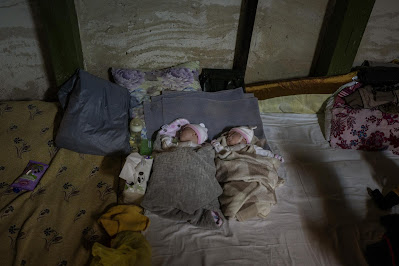
Newborn twin brothers sleep in a basement used as a bomb shelter at the Okhmadet children's hospital in central Kyiv, Ukraine, Monday, Feb. 28, 2022. (AP Photo/Emilio Morenatti)


A line from Yeats’ poem that reverberates
like a bass chord that becomes a strum,
combined with an image of babies 
kept alive in a bomb shelter, underground,
each breath bagged by ambu into tiny lungs.
This hum an undercurrent—under, under, under
my thumb. This rough beast lumbering, a ton,
a hundred years running, but truly thousands before, 
more’s the sum of history in a new poem—not new, 
but old. What crumbling humans, such endless war.
My hands weary as if I’m delivering each breath.
I know what this means—we cannot take a rest
or the children expire. I tire, but the poem is found.
The cannon, the fodder: explosions of sound. 


Ellen Austin-Li’s work has appeared in Artemis, Thimble Literary Magazine, The Maine Review, Pine Mountain Sand & Gravel, Rust + Moth, and other places. Her two chapbooks were published by Finishing Line Press—Firefly (2019) and Lockdown: Scenes From Early in the Pandemic (2021). She is a Best of the Net nominee. A recipient of the Martin B. Bernstein Fellowship, she earned an MFA in Poetry at the Solstice Low-Residency Program. Ellen lives with her husband in a newly empty nest in Cincinnati, Ohio.

Friday, February 25, 2022

POEM FOR A RUSSIAN SOLDIER

by Jesse Dukes

Written on the Eve of the Invasion of Kyiv


A dead Russian soldier in Kharkiv, Ukraine. Credit: Tyler Hicks, The New York Times.


I believe you know right from wrong. Go back.
You polish your boots, oil your gun.
Watch dispatches from your blue-eyed master.
Brew tea with thyme in your uncle’s samovar.
Brought back from Afghanistan, in dead of winter.
Better drink it now, while it’s still warm.
 
It is cold in Donetsk. In your uncle’s house, it’s warm.
Do you think marching west will bring glory back?
Renew a once terrible empire, melt Russian winter?
Will you do something useful with that gun?
Nikita knew to stay close to the samovar
Who is more clever, master or Man?
 
You are a man who needs no master.
Your uncle’s house is already warm .
You have tea, lemon, an ancient samovar.
You have Tolstoy, Checkov, Lermontov. Back
Home, you have a madman.  On your mantle, he’s placed a gun.
He’s sent you to Ukraine in winter

But you are the French at Borodino, fighting the winter.
You are the Germans in Stalingrad, sent by their master.
Too far from home never firing their guns.
Dying forgetting the comfort of warmth.
Ukraine is no enemy. You can still go back
Find your uncle, fire the stove, fill his samovar.
 
You know the story, Vasily leaves the Samovar.
Plunges back into the very teeth of winter.
And when he realizes his danger, it’s too late to turn back.
And what kind of master would leave a man
Stranded in the cold, without a way to stay warm?
Do you mean to kill winter with a gun?
 
You still have a choice. The gun
May yet stay on the mantle. The samovar
May yet fill the house with steam and warmth.
You and your fellow soldiers cannot defeat winter.
But you can defeat your master, just a man.
You still have a choice. Go Back
 
Stay warm despite the winter.
Heat the samovar, heed no master
Take your gun and go back.


Author’s Note: I wrote this over dinner last night, thinking about Tolstoy's Master and Man, and "Checkov's Gun". I love Russian culture, Russian history, and the Russian people I've met, and I hope they'll find their way to the right path. 


Jesse Dukes is a Senior Producer of Podcasts at WBEZ, Chicago Public Media. Twitter: @CuriousDukes

Wednesday, December 29, 2021

BIERSTADT'S CHIMNEY ROCK

by Bill Sullivan

on the anniversary of the Wounded Knee Massacre,
December 29, 1880


From the Collection of Colby College Museum of Art: Albert Bierstadt, "View of Chimney Rock, Ohalilah Sioux Village in the Foreground" (1860).


Eighteen sixty—in his Manhattan studio
Albert Bierstadt studies his year-old photographs
and oil sketches of the Great Plains and foothills
of the Rockies. He then turns to his images of 
the Lakota, the Oglala Sioux and his collection
of their artifacts. He pauses, fills his brush with
oil paint, approaches the board sitting on the easel,
saying silently, "Everything must glow, must shine
like the soft rays of the sun." He adds more dove gray
to the last of the low clouds; steps back, saying, “Yes,
it's all there and more, the luminous amber sky,
the aquamarine river, the lush green bushes
on the bank, the soft shadows, the warmest of suns."
 
And there are the two horsemen in the shallow water,
one with child mounted in front, the other to his right
relaxed, but with a rifle at his side. Far right a woman,
water to her waist, ready to do the morning wash
and on the bank three tepees, shelter for this band
and just beyond another man riding off for the day's
hunt. And all the carefree children and unleashed dogs
scattered about. It is family, clan and tranquility,
life beyond what is and will be and he knows that.
 
Knows that when he includes Chimney Rock—
a storm shaped relic of a violent volcanic past,
a weathered cone that rose some three hundred feet
above the prairie grasses and became a marker for  
the fur traders, Mormons and pioneers tramping a trail
west—to Oregon and California. Knew it when he
and the government surveying team followed the North
Platte River reached the structure, examined the gifts,
messages and drawings left by previous travelers—
determined dreamers who heeded the prophets' call:
"Go west! Our destiny!  God's will! This land, ours from
the Atlantic to the Pacific." Now the creaking oxcart
and wagon, soon the hiss and steam of the locomotive.
 
He places the prominent rocky tower in the distant
background, makes it appear insignificant,
but knows his idyllic world would soon bleed.
He did not conjure up the brutal chapters then—
the butchery, expulsion, internment, deprivation
and suffering. But his life spanned the tale. Yes, he
lived long enough to read the reports of the massacre
at Wounded Knee. Lived long enough to examine
the photos of the corpses—men, women and children—
being tossed into a mass grave—lived long enough
to ponder the photo of Chief Big Foot's frozen body
lying in the blood-soaked snow—his cupped hands
outstretched as if reaching out for his slain followers.
 
And what did Albert say that late December day?
Did he think of that halcyon scene he had painted
thirty years earlier? Did he shrug his shoulders,
conclude that it had to be, or did he weep?       
 
 
Before retiring to Westerly, Rhode Island, Bill Sullivan taught English and American studies at Keene State College, the University System of NH. He has co-authored two studies of twentieth century poetry and co-produced two documentary films. Here Am I, Send Me, The Journey of Jonathan Daniels, aired by numerous PBS stations, streams at PBS.org. His poems have appeared in numerous print and on-line publications. Loon Lore: In Poetry and Prose was published in 2015 by Grove Street Press. 

Sunday, December 26, 2021

INSPIRATION AND EDUCATION
:: FOUND IN & OF BELL HOOKS

An Erasure Poem by Jen Schneider

Derived from "Appalachian Elegy" (Sections 1-6) by bell hooks (1952-2021)


Activist & writer bell hooks (Gloria Jean Watkins) by SMiLE on the wall at Falafel King Restaurant, Boulder, CO (2017).


Appalachian Elegy (Sections 1-6)


1.


hear them cry

the long dead                                 

the long gone

speak to us

from beyond the grave

guide us

that we may learn

all the ways

to hold tender this land

hard clay direct

rock upon rock

charred earth

in time

strong green growth

will rise here

trees back to life

native flowers

pushing the fragrance of hope

the promise of resurrection


2.


such then is beauty

surrendered

against all hope

you are here again

turning slowly

nature as chameleon

all life change

and changing again

awakening hearts

steady moving from

unnamed loss

into fierce deep grief

that can bear all burdens

even the long passage

into a shadowy dark

where no light enters

3.


night moves

through the thick dark

a heavy silence outside

near the front window

a black bear

stamps down plants

pushing back brush

fleeing manmade

confinement

roaming unfettered

confident

any place can become home

strutting down

a steep hill

as though freedom

is all

in the now

no past

no present


4.


earth works

thick brown mud

clinging pulling

a body down

heard wounded earth cry

bequeath to me

the hoe the hope

ancestral rights

to turn the ground over

to shovel and sift

until history

rewritten resurrected

returns to its rightful owners

a past to claim

yet another stone lifted to

throw against the enemy

making way for new endings

random seeds

spreading over the hillside

wild roses

come by fierce wind and hard rain

unleashed furies

here in this touched wood

a dirge a lamentation

for earth to live again

earth that is all at once a grave

a resting place a bed of new beginnings

avalanche of splendor


5.


small horses ride me

carry my dreams

of prairies and frontiers

where once

the first people roamed

claimed union with the earth

no right to own or possess

no sense of territory

all boundaries

placed by unseen ones

here I will give you thunder

shatter your hearts with rain

let snow soothe you

make your healing water

clear sweet

a sacred spring

where the thirsty

may drink

animals all


6.


listen little sister

angels make their hope here

in these hills

follow me

I will guide you

careful now

no trespass

I will guide you

word for word

mouth for mouth

all the holy ones

embracing us

all our kin

making home here

renegade marooned

lawless fugitives

grace these mountains

we have earth to bind us

the covenant

between us

can never be broken

vows to live and let live


Jen Schneider is an educator who lives, writes, and works in small spaces throughout Pennsylvania. She is a Best of the Net nominee, with stories, poems, and essays published in a wide variety of literary and scholarly journals. She is the author of A Collection of Recollections (Next Chapter), Invisible Ink, On Daily Puzzles: (Un)locking Invisibility and On Crossroads and Fill in the Blank Puzzles (forthcoming, Moonstone Press), and Blindfolds, Bruises, and Breakups (forthcoming, Atmosphere Press).