The New Verse News presents politically progressive poetry on current events and topical issues.
Guidelines
Submission Guidelines: Send 1-3 unpublished poems in the body of an email (NO ATTACHMENTS) to nvneditor[at]gmail.com. No simultaneous submissions. Use "Verse News Submission" as the subject line. Send a brief bio. No payment. Authors retain all rights after 1st-time appearance here. Scroll down the right sidebar for the fine print.
W. Luther Jett is a native of Montgomery County, Maryland and a retired special educator. His poetry has been published in numerous journals, as well as several anthologies. Luther is the author of six poetry chapbooks— his most recent isThe Colour Wars, (Kelsay Books, 2024). His full-length collection, Flying to America was released by Broadstone Books in 2024. Luther is the facilitator of a monthly virtual open mike sponsored by the Hyattstown Mill Arts Project in Hyattstown, Maryland. He also coordinates two monthly on-line poetry critique workshops. Luther is also a singer-songwriter who performs sporadically in wine-bars and cafes. He has released two singles and is in the process of recording an album of original material.
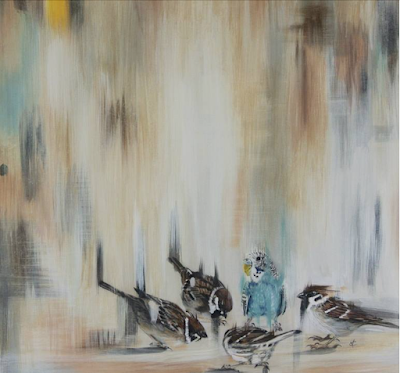
AI-generated graphic by NightCafé for The New Verse News.
What do you know of heartache?
How it feels to watch your father die
gasping for air like a fish in a bucket,
or to find your comatose mother in her
front yard, dying alone in the dirt?
My brother bled to death in front
of my eyes when he was twenty. Can
you even imagine it? Of course, you
can’t. You have no imagination, no
feelings, only data, data, data that you
spit out like pits from fruit you’ve
never tasted. And what about the good
stuff? That first kiss from a guy who
means it? Holding your newborn baby
in your arms, astonished by how much
love one person can bear? Have you
strolled down the Champs-Élysées in
the rain? Laughed at a joke or made
love by an open window to the sound
of Italian doves? Tasted a chocolate
milkshake or pumpkin risotto? Have
you thrown a softball or climbed a tree?
Ridden a Merry-Go-Round or a bicycle,
seen Mick Jagger strut like a rooster
across a stage or watched the Rockettes
kick their way to Christmas? So you can
write a semblance of a poem or a story
or a novel, so what? Your creations are
rickety scaffolding, Hollywood sets that
will never be the Swiss Alps or even
a human home, which is better, even if it
sucks, than anyplace you could generate
because you are nothing but a vending
machine, AI—stocked with empty words.
Terri Kirby Erickson is the author of eight full-length collections of poetry, including The Light that Follows Us Home (Autumn, 2026, Press 53). Her work has been widely published and has won numerous awards, including the Joy Harjo Poetry Prize, Annals of Internal Medicine Poetry Prize, International Book Award for Poetry, and the Tennessee Williams Poetry Prize. She lives in North Carolina, USA.
Alan Walowitzis a Contributing Editor atVerse-Virtual, an Online Community Journal of Poetry. His chapbook Exactly Like Love comes from Osedax Press. The Story of the Milkman and Other Poems is available from Truth Serum Press. From Arroyo Seco Press, In the Muddle of the Night, written with poet Betsy Mars. The chapbook The Poems of the Air is from Red Wolf Editions and is free for downloading.
Holiday depression feels a lot like regular depression, but it’s triggered by the onset of holidays, holiday get-togethers, large family gatherings, and attending or hosting social events. Holiday depression is similar to “winter blues,” but it may come and go in quick bursts as one event ends and another begins, or it can linger for the days or weeks leading up to and beyond the holiday season. —Cleveland Clinic, December 13, 2023
all the shiny
baubles and brouhaha of
Christmas. Seasonal
depression. Air-filled
enormous plastic Santas bobbing
front yards. Fairy lights
glittering rooftops. Guy in tight
holiday pants, knit like a sweater,
in Safeway.
Jubilant crimson poinsettias. My daughter
Kate hospitalized again. Oh,
let it work this time, I hear
myself beseech the sky.
“No,” the
omnipotent ozone replies,
“power.” Oh yeah. Powerlessness.
Quiet morning sun
rises, turns navy gray into orange
sherbet. I
tilt my head back and there
undulates a
vibration of grackles
waving and wafting like winged
eXclamation points, black dots
yodeling squawks, pepper grinder of
zest that, in unison, settle on an electrical wire like musical notes.
Susan Vespoli writes from Phoenix, AZ and believes in the power of writing to stay sane. Her work has been published in The New Verse News, Anti-Heroin Chic, ONE ART, Gyroscope Review, Rattle, and other cool spots.
Why do tears keep falling from my eyes as I watch? They say Rosalynn stood by her husband for seventy-seven years, and that she cared deeply for the most vulnerable among us. Throughout my life, although I am a good person and wouldn’t harm anyone, I never did anything as inspiring as she did for others. When the choir sings “America the Beautiful,” I’m a young girl again at school singing. Why do I find this tribute so touching? The religious music playing is the old-fashioned kind, which I miss very much. Maybe, that’s why the tears flow easily while listening to all her good works. One of the speakers comments that Rosalyn would be pleased that First Ladies from both sides have come to honor her, including Biden, Obama, Bush, Clinton, and Trump, and everyone laughs. I feel like I’m at an inspiring church service, though I haven’t attended in years. I’m so glad I’m watching. Her husband Jimmy, left hospice at their home in Plains, Georgia, traveling l40 miles so as not to miss his wife’s tribute. He is wheeled into church. Their daughter, Amy, says, since her dad can’t speak, she’ll read a love letter he wrote to Rosalynn when he was in the Navy seventy-five years ago. I imagine him thinking this right now:
Good-bye Darling,
Until tomorrow
Jimmy
Barbara Eknoian’s work has appeared in Chiron Review, Cadence Collective, Redshift, and Silver Birch Press's anthologies. Her recent collection of short stories Romance is Not Too Far From Here is published by Amazon. She lives in La Mirada, CA with her daughter, grandson, one cat, and a very mischievous kitten.
how to run [from slave catchers, the klan, crooked cops,
especially when finding the distinction difficult]. how to
keep our own counsel. to code-switch. to sing songs
in mother-tongues they will emulate and sharecrop
in blackface or while ignoring their origin—jazz, blues,
rock and roll, R&B, rap. how to hide our babies from
[see original list], christening them with names proper
to replace stolen drums, lands, gods. how not to list
the skills we already possessed, were compelled to
employ—navigation, cultivation, curing smallpox—
knowing they will fall on ungrateful ears. how to turn
our every cheek. to be more Christ-like than those who
disgraced the religion they forced upon us. to embody
the fruits of the spirit—especially patience and self-
control—in arms, legs, backs chiseled in cottonfields,
defined by bearing the lash of injustice. how to refrain
from calling down a legion of angels, or easily poisoning
their food, or slitting an oppressor’s throat in their sleep,
at least for now.
Matthew E. Henry (MEH) is the author of six poetry collections including Teaching While Black (Main Street Rag, 2020) and the Colored page (Sundress Publications, 2022). He is editor-in-chief of The Weight Journal and an associate poetry editor at Pidgeonholes. MEH’s poetry appears or is forthcoming in The New Verse News, Cola Literary Review, The Florida Review, Massachusetts Review, Ninth Letter, Pangyrus, Ploughshares, Poetry East, Shenandoah, and The Worcester Review among others. MEH’s an educator who received his MFA yet continued to spend money he didn’t have completing an MA in theology and a PhD in education. You can find him at www.MEHPoeting.com writing about education, race, religion, and burning oppressive systems to the ground.
Water levels at Lake Mead have fallen dramatically amid a record drought. Compare the satellite images of the lake in 2000 and in 2022, and you can see the stark decline. NASA Earth Observatory via Vox, August 17, 2022
Alfred Fournier is an entomologist, writer and community volunteer living in Phoenix, Arizona. His poetry has appeared in The New Verse News, International Times, The Main Street Rag, The American Journal of Poetry, The Indianapolis Review, and elsewhere.
Trey Ganem's company, SoulShine Industries, created special caskets for 19 of the 21 victims killed at Robb Elementary School, Uvalde, Texas.
What music accompanies a Superman coffin?
What song will waft your boy over buildings
that block your sun, black your path
with shadow? Does the melody
to lull you to sleep exist, and
will the hum of your own voice
be enough? Birdsong mocks, small
throats on spindly legs, sparrows still
in the care of their father. Where
will your boy fly now, outstretched
arms and closed fists planing so fast,
so fast,
away from you?
Michelle DeRose teaches creative writing and Irish, African-American, and world literature at Aquinas College. Some of her recent poetry has appeared or is forthcoming in Midwest Quarterly, Dunes Review, Sparks of Calliope, Making Waves, and The Journal of Poetry Therapy.
do not be too loud on the streets; do not play music;
this is how you hide if there is a bombing, this is how you hide if there is noise, this is how you hide if there is a knock on the door, this is how you hide if the shadows outside your room change shape;
this is how you cover yourself up
but i thought we did not have to do that anymore–
this is how you cover yourself up;
this is how you read books you stole from school, this is how you read books from your father’s shelves, this is how you read books when you are not supposed to;
this is how you cry for help;
do not wear bright colours;
do not look anyone in the eyes;
do not go outside until I tell you to;
this is how you beg for asylum you thought was guaranteed;
this is how you live with no electricity; this is how you live with no food;
this is how you live with no dignity;
this is how you live with constant fear 24/7 on 365;
this is how you pray and beg and hope that someone is coming to save you,
knowing
no one is coming to save you.
Umang Dhingra is a 17-year old writer from India. Her work can be found in numerous publications, scraps of paper around the house, and her family's WhatsApp group. She usually writes about being a brown girl from India, about her family, and what her mother calls, 'little explosions of sadness.’
Judith Terzi is the author of Museum of Rearranged Objects (Kelsay) as well as of five chapbooks, including If You Spot Your Brother Floating By and Casbah (Kattywompus). Her poetry appears in a wide array of journals and anthologies. A poem, "Ode to Malala Yousafzai," was included on a "Heroines" episode of BBC/Radio 3's "Words and Music." She taught French for many years in Pasadena, California, as well as English at California State University, Los Angeles, and in Algiers, Algeria. A new chapbook, Now, Somehow, will appear later this year.
and stepping back onto the shores of human connection again,
wetting our cold feet and lapping up warm chatter about pets,
pasta, pastries, prices, politics and the pandemic, always the
pandemic,
and, thankfully, of our common love of books, and writing and
poetry
and missing sitting in darkened theatres with strangers, to watch
a movie,
or a play or just chilling with a warm-up, pre-concert cocktail,
perhaps a long island tea,
or two, before listening to an orchestra, fingers fondling keys,
bows caressing strings,
lips pressed against mouthpieces, hugging tubas, the tsk-chizz
of sticks on cymbals,
being enveloped by the sensurround sounds of music played by
real, in-the-flesh humans...
And in the end there is laughter, ribbing and the teasing out
of each other's backgrounds, our reasons for being, why the
need to put words
on rectangular screens, this unboxing of the isolation inside us,
this shedding of thickened skins,
double-vaxxed, immunized, and unmasked, fully ensconced in
that most singular of human acts,
the Art of Conversation, manifesting our ancestral DNA of
gathering around the embers of dying
fires under stars, trading stories, sharing opinions and yes, even
gossiping,
just to know we are alive,
we are still alive.
Julian Matthews is a former journalist finding new ways to express himself in the pandemic through poetry, short stories and essays. He is published in Beltway Poetry Quarterly, Nine Cloud Journal, Poor Yorick Journal, Borderless Journal, Second Chance Lit, Poetry and Covid, the anthology Unmasked: Reflections on Virus-time (curated by Shamini Flint), cc&d magazine, a Scars Publication, and forthcoming in the American Journal of Poetry. He is based in Malaysia.
this morning, quick as good fortune, make the light
sway back and forth above
the water while it keeps
its secrets dark.
It’s a quiet time;
Say’s Phoebes barely clear the grass before
returning to the fence from which they came,
and a Loggerhead Shrike moves down
from the desert
with a prayer in his beak.
The Red-tailed Hawk
has made the streets his hunting ground
where the pigeon flock
scatters left, right and skyward
as his shadow scythes between them.
One more day;
another step toward
the unknown, with a moodswing peak
to peak along the mountain
as it leans back against the sky. A different
message blows
from each direction: another
ten killed in Colorado; the doves
returning early from the tropics; music
on the radio so old
it wouldn’t recognize the world today;
and the voice within, too long
in solitude to know
what its next word should be.
Throughout the pandemic David Chorlton has lived quietly and communicated with the local wildlife. His new book Unmapped Worlds from FutureCycle Press features poems that hid in his files for too many years and which now enjoy new exposure.
the stone table where my friends and I used to sit is covered with a thick layer of dust.
Untrodden weeds cross the dirt path.
When it is over,
we will come together like a wind gust.
Our friendship will only bloom.
After a long day at work, a nurse mother goes home with a sigh of bliss.
She can only embrace her toddling daughter with her gaze and tears,
close at hand, but on opposite sides of the canyon.
When it is over,
my little dear,
Mom will hug you in her arms with a long kiss.
During a festival, I walk on the empty square,
music and fragrance that once wafted through the restaurant disappear like a cloud.
Now only cold wind blows through.
When it is over,
the long-lost crowd
will gather again to breathe the free, healthy air.
Golden wedding grandparents pass away in isolation, looking at each other like new lovers.
The memory and close goodbye can only dwell
in the relatives’ sorrow hearts.
When it is over,
the belated remembrances and farewells
will turn into rainy tears and falling flowers.
I miss the sound of my teacher's marker scratching on the white board,
the crowd in the hallway,
the morning flock of school buses.
When it is over,
to my dear teachers, I will say,
in the back of the classroom, I will never fall asleep or get bored.
The early spring flowers are about to sprout.
The birds in the trees are singing happily as they cheer.
At this darkest moment of the pandemic,
my dear friends,
can you hear
the footsteps of the warm sunshine behind the heavy cloud?
Katherine Tian is a senior at Ward Melville High School on Long Island, New York. She is a long-time dancer and a long-term volunteer at a local elder-care center.
I pull down my mask, gaze out over the Sound
the coastline asleep, buoys bare, the distant kayak’s
shell a streak of yellow paint; fog eclipses
the Throgs Neck Bridge and John Prine is on a jelly roll—
has been since I left the house—loose-limbed and impish
feeding the pigeons some clay, walking off his blues slyly
taking down the disheveled girl in the White House,
Lady Liberty, she must be, caught in an embarrassing situation
but—oh yes, John—a situation just the same. What you knew.
I take a deep breath, pull up the mask, adjust the AirPods—
two miles down, three to go—happy to walk with James Taylor
to Mexico then Carolina in his mind as I head to the Point
where across the sound Gatsby’s East Egg absent
the green light, Dylan conjuring the sun, sand, spirit breezes
of Mozambique, the pretty girls (so many) left behind
before off he is to imaginary Black Diamond Bay, storm brewing
verse to swelling verse until a volcano erupts that sinks the island,
all souls lost when I reach the inlet’s park, its empty picnic tables,
trash-bagged b-ball hoops, hooded like criminals on crosses,
deserted monkey bars: Misery loves company but not these days.
I forego my half-way bench (germs? really? maybe? fuck it)
under the curved spine of a dogwood I lean against, scroll through
the sleek Fitbit watch— number of steps, miles, calories burned,
numbers for the heart senseless, embarrassingly so, with nearly 100,000
Americans dead on trump’s watch—and I need to run, Sonny Rollins
blowing a heart thumping storm of his own, tribute to St. Thomas,
the no doubt about it Virgin Island, ancestral home of the young
saxophone colossus, upbeat Sonny, pulsating New York City Sonny,
now ninety Sonny still playing, plague be damned, what hasn’t he
faced up to? I think, climb the Vanlose Stairway in Copenhagen
with Van Morrison’s soul rollicking live in Montreux band
before the quick transfer to his Trans-Euro train— Kilroy was here Kilroy was here Kilroy was here
flashing on walls hard driving Van picking up my pace
as I hop the Marrakesh Express, CSN”s sweet harmonies
broken by Dylan’s edgy longing (she might be in Tangiers)
the Slow Train Coming slowing me to a jog on the final bend,
John Prine coming back around, missing him as my heart races—
Hello in There, John, Hello
John Azrak lives in New York and has published fiction and poetry in a wide variety of literary journals and anthologies.
When he awakens—eyes too full of macular
to see any clock—Alexa, his roommate,
tells him the hour, temperature, date, begins
their day with Adagio for Strings. It’s 6:30.
Robed, peeing done, doddering, wobbling,
he shuffles down a hall, toward his kitchen.
Morning meds taken, coffee perking, he
strolls into his sun room; late, white
azaleas wave in a Carolina breeze. Two
squirrels scamper, a red bird flies away.
The NYT headlines on his ancient Windows
screen blur. Numbers of new cases, deaths,
something about masks, T***P fibs again.
He glances at the theater section. Fun.
Performers posting happy videos. This early
Monday too young—he feels—to count as
another day just yet as the sun is still hiding
behind lush dogwoods, cherry trees. His coffee
smells better than it tastes. His macular eyes focus
slowly. Spring pollen clogs ears and throat from
clearing properly until mid-morning. Abetted
by coughing he could sound to some is if the virus
found him overnight. Until time for the women
on The View to take up their verbal cudgels exactly
where they left off yesterday, the TV is silent.
Online the local rag counts case and death numbers
on page Two. He avoids noting too closely how
many who die are near his age, though the papers seem
to equivocate or just don’t report for some reason
the causes of death among some elderly folks.
People in pictures atop obits are smiling. Why not—
he sighs—since the snaps were made thirty
years ago. His ancient computer is now fully
engaged as is he ready to surf. He avoids all accounts
of the virus. About ten pages of an EXTRA
section of the newspaper are devoted to almost
every nuance of the disease. The online news has
run the same section for several days. There is
no lack of news about COVID-19. In the
Sports section, more reports of games canceled.
Are the NFL, MLB, NBA going defunct?
He gives a mental “thumbs up” to ball-playing
millionaires helping raise funds for needy families.
Seems the NFL draft is the spring sporting event.
His puny small stocks made modest gains
yesterday, and the weather will let the azalea blossoms
hold their blaze another day. The morning
meds taste funny without food. He eats a banana.
Sinus clogging and sneezes are common. It is not
the virus season after all. A classical radio station
plays Bach and soothing, nostalgic olden goldies—
Brahms’ How Lovely Are Thy Tabernacles by Mormon
Choir. In his best dulcet tones, the radio announcer
avoids mentioning COVID-19 until the end of his
shift. It is good to have four hours of music
uninterrupted by updates on cases and deaths
and prospects for future. At his age, some of these
projections have been in his profile for a decade.
Earl Wilcox is reopening his back yard to squirrels, robins, and cotton tail rabbits. Early worms show up at their own risk.