Guidelines


Submission Guidelines: Send 1-3 unpublished poems in the body of an email (NO ATTACHMENTS) to nvneditor[at]gmail.com. No simultaneous submissions. Use "Verse News Submission" as the subject line. Send a brief bio. No payment. Authors retain all rights after 1st-time appearance here. Scroll down the right sidebar for the fine print.
Showing posts with label run. Show all posts

Sunday, January 04, 2026

OILING THE WHEELS

by Lynn White


Art by Shields


The days of saving

Vietnam from Vietnamese

or Afghanistan from Afghanis,

are here again.

‘We’ will run things

especially

in countries of long words

like Palestine and Venezuela.

Democracy is another of them.

short words like ‘we’, ‘US’ and ‘oil’

will save Venezuela from Venezuelans.

An unelected foreign government

will save Venezuela from elections. 

Oh, the words are getting bigger again,

Venezuela and democracy are very big words

so we must run things there,

to oil the wheels of democracy,

or something like that,

and, with nice short words,

save Venezuela from Venezuelans.


Lynn White lives in north Wales. Her work is influenced by issues of social justice and events, places and people she has known or imagined. She is especially interested in exploring the boundaries of dream, fantasy and reality and writes hoping to find an audience for her musings. She was shortlisted in the Theatre Cloud 'War Poetry for Today' competition and has been nominated for a Pushcart Prize, Best of the Net and a Rhysling Award. Her poetry has appeared in many publications including: Apogee, Firewords, Peach Velvet, Light Journal, and So It Goes.


Wednesday, July 26, 2023

WHEN ASKED WHAT SKILLS WE GAINED FROM SLAVERY

by MEH


how to run [from slave catchers, the klan, crooked cops,
especially when finding the distinction difficult]. how to
keep our own counsel. to code-switch. to sing songs
in mother-tongues they will emulate and sharecrop
in blackface or while ignoring their origin—jazz, blues,
rock and roll, R&B, rap. how to hide our babies from
[see original list], christening them with names proper
to replace stolen drums, lands, gods. how not to list
the skills we already possessed, were compelled to
employ—navigation, cultivation, curing smallpox—
knowing they will fall on ungrateful ears. how to turn
our every cheek. to be more Christ-like than those who
disgraced the religion they forced upon us. to embody
the fruits of the spirit—especially patience and self-
control—in arms, legs, backs chiseled in cottonfields,
defined by bearing the lash of injustice. how to refrain
from calling down a legion of angels, or easily poisoning
their food, or slitting an oppressor’s throat in their sleep,
at least for now.


Matthew E. Henry (MEH) is the author of six poetry collections including Teaching While Black (Main Street Rag, 2020) and the Colored page (Sundress Publications, 2022). He is editor-in-chief of The Weight Journal and an associate poetry editor at Pidgeonholes. MEH’s poetry appears or is forthcoming in The New Verse News, Cola Literary Review, The Florida Review, Massachusetts Review, Ninth Letter, Pangyrus, Ploughshares, Poetry East, Shenandoah, and The Worcester Review among others. MEH’s an educator who received his MFA yet continued to spend money he didn’t have completing an MA in theology and a PhD in education. You can find him at www.MEHPoeting.com writing about education, race, religion, and burning oppressive systems to the ground.

Saturday, March 05, 2022

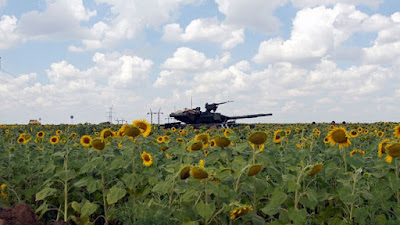
THE BISON, THE PASSENGER PIGEONS, THE FORESTS WARN THE PEOPLE OF UKRAINE

by Cecil Morris


They think these invaders cannot kill us all, will not,
if we stand together, shoulder to shoulder, in ranks
like sunflowers or stalks of corn, benign and unarmed.
They think these invaders will see we are good people.

We know better and would tell them but they don’t listen,
or, if they do listen, they do not comprehend
the languages of destruction, forget the beige
indifference of words and how they camouflage
a red intent. They forget, on both sides, the quiet way
surprise waits in them and their sad myopia.
Still we do try to tell them true. We send the breeze
of our ghost wings over them, the distant rumble
of our ghost hooves spooked across plain and steppe, the sound
of our falling, a whole forest of calamity
that echos around them and they don’t hear. We try.
We try to tell them: no boundaries in the hearts,
the minds of men, no lines limit devastation.

If they don’t want to end up like us, they must run.


Cecil Morris lives in Roseville, California, where he taught high school English for 37 years. In his retirement, he has turned his attention to writing what he once taught students to understand and (maybe) enjoy. He has poems appearing in Cobalt Review, English Journal, Evening Street Review, Hiram Review, Hole in the Head Review, Midwest Quarterly, Poem, Talking River Review, and other literary magazines. He likes ice cream too much and cruciferous vegetables too little for his own good.

Wednesday, May 20, 2020

WHITEWASHED

by Betsy Mars


Ahmaud Arbery falls to the ground after being shot.


When you want a commodity, a spokesman,
team spirit, sales soaring, think fast,
think brawn, think black.

Think pounding pavement. Think
of those hard-earned calves jumping
on command. Think of a casket.

I mean a basket. A hoop, rope
hanging from its neck.
Think of a shot, circling the rim,

going down as the buzzard, I mean
buzzer, ends the game. If you train off-court
or just enjoy a runner's high, I'm sorry.

Be prepared to run, to shoulder the blame—
a steal from behind—as your muscles
strain, push off on defense. Find the hole,

cut inside. Man-to-man or zone, you don't
stand a chance. They've got the big guns,
the refs in their pocket.


Betsy Mars is a prize-winning poet, educator, photographer, and recent publisher whose first release, Unsheathed: 24 Contemporary Poets Take Up the Knife, came out in October 2019. Her work has appeared in Kissing Dynamite, The Blue Nib, Poetry Super Highway, and Rattle (photography), to name a few, as well as in a number of anthologies. Her first chapbook Alinea (Picture Show Press), came out in January 2019. Her father was a professor and her mother was a social worker, and their progressive beliefs as well as her childhood years in Brazil deeply influenced her values. Her passions are language, travel, and animals; the latter two often conflict as her pets prefer she stay at home. 

Sunday, August 02, 2015

ON THE CASE OF CECIL LION VS. POACHER PALMER

by Jen Hinton


Template source: PHOTOS5.com


I donno.
I need a little more information
about this lion first.

What did he do
to make the Poacher shoot him?

Did he look the Poacher in the eye
and roar,
causing him to fear for his life?

After he was shot with a crossbow,
and began bleeding out,

why did he run away?
What did he have to hide?

Perhaps he had some weed
in his system?

And where did he get that fancy mane?
Did he steal it?

My advice to all lions would be this:
Get jobs, start paying taxes;
Take care of your cubs;
Clean up your habitats.

Start showing a little more respect
for authority.

Next time a Poacher approaches you,
remember he might be having a bad day.

He paid 50,000 of his hard-earned money
to shoot you. Stop hassling him.

Stop being a lion.

Try being a lamb.


Jen Hinton is a writer and college administrator living in Chicago, IL. Her previous TheNewVerse.News poem "Something for Harvey" was nominated for a Pushcart Prize.

Sunday, July 14, 2013

FASHION

by Victor D. Infante


                                          For Geraldo Rivera

When I was 17
I bought a leather jacket
at a thrift store, affixed
a pair of handcuffs
to the shoulder,
and adorned the lapel
with pins from punk bands:
The Specials, The Clash,
Stiff Little Fingers.

I bought a tattered black trenchcoat
for $5 on a school trip to New York,
got home and paid a Russian woman
15 bucks to repair the tears. Didn’t mind
when the seams unraveled. Wore jeans
which were more hole than fabric.
Scribbled them with anarchy symbols,
clipped bits with safety pins.

My hair was neglect –
neither short nor long,
sometimes spiked,
briefly blue, except
that its natural darkness
resisted tinting. The dye
faded quickly. My hair
remained midnight.

When I was 17,
I couldn’t surf
but loved the ocean.
My skin was golden brown.

Strangers assumed
I was Mexican. Once
a cop half-jokingly
asked me for an ID
when I sold him Doritos
at the 7-11 where I worked.
I had a driver’s license, although
I didn’t drive. I had a history
of walking because I didn’t
own a car. I had a history
of violence, although I’m sure
the cop couldn’t tell that from
my identification, just shrugged
and returned it, and I never
spoke of it again, until now.

When I was 17, I had a problem
with authority. Had a mouth on me
but I wasn’t stupid.
Didn’t bait cops. In fact,
had sworn off fighting entirely.
Each punch seemed to wear
the seams of whatever it was
that held me together.
I was fraying like worn jeans
and a cheap trenchcoat.
I held myself  together
with pins.

When I bumped the crazy boy
while running to class, I took
his hits and kicks, until a teacher
pulled him off me; She had seen
the attack, and saw I didn’t fight,
so I didn’t get in trouble. The lesson:
Don’t fight. Don’t run.

When a jock took some childhood trauma
out on me by the lockers, I ate each fist until,
bored, he wandered away.
The urge to reply pulsed in my fists.
My legs ached with the urge to run.
I counted the cost
of what I was trying to prove.

I’m a long way from 17, now.
Haven’t faced a fight in years. Don’t
know what I’d do if I did. I’m paunchy,
my skin has paled from indoor living. Still
wear leather and trenchoats, wear
my hair long, but cops don’t look at me
funny anymore. Too old, too white.

I read the news about the boy in Florida
with pockets full of Skittles and iced tea;
who wore a hoodie walking home in the rain;
how the TV bobble-head says the hoodie
is as responsible as the gun,
as if damaged children never jump
those they perceive as weaker.

I wonder what, at 17, I would have done
if I’d faced what that boy did,
what words would have burbled
from that teenage cauldron
of combustion and leather.

I’m afraid I know the answer.
I would not fight. I would not run.

“Go ahead, coward — shoot me.
What the fuck are you afraid of?”


Victor D. Infante is the editor in chief of Radius: Poetry From the Center to the Edge , and the author of City of Insomnia, from Write Bloody Publishing.