Guidelines


Submission Guidelines: Send 1-3 unpublished poems in the body of an email (NO ATTACHMENTS) to nvneditor[at]gmail.com. No simultaneous submissions. Use "Verse News Submission" as the subject line. Send a brief bio. No payment. Authors retain all rights after 1st-time appearance here. Scroll down the right sidebar for the fine print.
Showing posts with label work. Show all posts

Friday, December 19, 2025

MASS SHOOTING #8

600 block of Jackson Ave., Muskegon, MI, Dec 6, 2025


by Ron Riekki

“Sure, this world is full of trouble

I ain't said it ain't.”

—Douglas Malloch, “It’s Fine Today”


They say there are 200 different words for snow
in the Sámi language, like the northern Sámi
 
vahtsa, which is new snow on old snow, which
now is the case, driving a rented car on plowed
road, but then turning onto the street of our latest
 
mass shooting in Michigan and instantly it’s
unplowed, so thick with snow that it scrapes
 
the bottom of the vehicle, yet ice on the tires
so that the car swerves back and forth, with
a realization that I can’t stop, so I drive by
 
a house with caution tape lying in snow, but
it doesn’t look like the photos or videos online
 
of where the shooting happened and I wonder
if it’s another incident, especially since this city—
Muskegon, Michigan—has been plagued with
 
a dozen shootings: 9mm and Glock and “AR-
style rifle” and “stolen pistol” and “handguns”
 
and another shooting on the 1400 block of
Gyrock and a “19-year-old has been arraigned”
and nine killed and eleven injured in Muskegon
 
this year alone, a population of 38,000, and it’s
26 degrees with the wind chill, two months since
 
the last mass shooting; and a Democrat online
tells me it’s due to the cold, and someone else
online says it’s due to astrology, wants to know
 
the alignment of the stars, and I stare at the home
I think where the shooting happened, but I can’t
 
stop, the street empty, absolutely nobody outside,
and the house where it happened looks dead, no
lights on inside, but, later, down the street, I see
 
a window with bright white Christmas decorations,
a snow-colored fake tree elegant in the window,
 
and I swing the car around once there’s plowed
road and go down it again, still not able to stop,
still swerving, windows down, the cold frowning
 
into the car, a church nearby unplowed as well
as if no human has been down this street since
 
the shooting, the feel of abandonment, how that
tends to be the feeling of so many of these sites
of shooting, and I stop at a shop, a garage, closed
 
for the night, a large sign saying BLOOD’S all
in red, all in caps, such an odd name for a “front
 
end clinic,” the address 13-something, and
the building bone-colored; getting my bearings,
I drive, looking for anyone to talk to, but all
 
is winter-quiet, a worker stepping out of a back
exit of a restaurant, wiping sweat off his fore-
 
head with his sleeve, his breath visible, and
then, amidst all these closed stores: a liquor
store, how so many of these mass shootings
 
are near liquor stores and churches, parks
and cannabis dispensaries. A 4-year-old
 
was shot at this mass shooting. A 22-year-
old woman and 25-year-old man killed.
A worker throws out piles of cardboard
 
into a dumpster—no recycling—massive
letters of SAM’S DRINK ALL on the store,
 
such a bizarre name, like a command, and
the worker tells me he has no thoughts on
the shooting, doesn’t want to talk about
 
the shooting, doesn’t want me going into
the store, calls and confirms that I am not
 
allowed into the store, but then teenagers
walk into the liquor store and there seems
to be no problem with this. Seeing two
 
children alone in a car, the mother later
emerging from inside. I talk with a 14-
 
year-old who wanders up, says that his
birthday is tomorrow. He’s with a friend.
I ask how we stop gun violence, if they
 
heard about the shooting. They tell me
they know there’ve been shootings. How
 
do we stop them? One of them walks
away, into the store.  The 14-year-old
remains, saying it’s “parenting” and
 
"finances," that “it gets harder every year,”
that people sell drugs to survive. I ask
 
how he’s avoided it: “work and school
and sports.” Football.  Behind him,
the words liquor – beer – wine – lotto.
 
These liquor stores near mass shootings,
always so busy. The 14-year-old goes inside.


Monday, June 09, 2025

PROVE THAT YOU MATTER

by Paul Burgess 


Centers for Medicare and Medicaid Services Administrator Mehmet Oz defended President Trump’s “big, beautiful bill” over criticism that millions of people could lose health coverage, saying those who would face new work requirements should “prove that you matter.”… Close to 11 million people would lose health insurance coverage if the House Republican tax bill passes in the Senate, mainly due to cuts to Medicaid and the Affordable Care Act, according to analysis from the nonpartisan Congressional Budget Office. —The Hill, June 5, 2025


To prove how much you truly matter, folks,
You might attempt the art of sneaky sales 
And master phrases used to slyly coax
The world to buy a "cure" that always fails.

Perhaps you'll never get a cabinet post 
By selling useless pills on sketchy shows,
But every friendly ratings-chasing host 
Ensures your market value swiftly grows.

So, get to work and earn your Medicaid
By hawking tonics made from oil of snakes 
And pills containing rhino horns and jade
Or tiger kidney anti-aging shakes.

You've been so useless from your journey's start, 
But here's your chance to really do your part. 


Paul Burgess, an emerging poet, is the sole proprietor of a business in Lexington, Kentucky 
that offers ESL classes in addition to English, Japanese, and Spanish-language translation and 
interpretation services. He has recently contributed work to Blue Unicorn, Light, The Orchards, 
The Ekphrastic Review, Pulsebeat, The New Verse News, Lighten Up Online, The Asses of 
Parnassus, and several other publications.

Thursday, May 08, 2025

DISPATCH FROM GAZA AFTER THE CEASE-FIRE CEASED (MAY 2025)

by Carolyn Martin


For your information: 
in Gaza we don't eat vegetables, fruits, 
meat, eggs, fish, milk, cheese. 
And the list goes on.
 
Most people don't have work, flour, sugar, 
ghee, oil, thyme, gas, electricity. 
And the list goes on.

Extermination is a man's plan, but God,
the best Disposer of affairs, is sufficient 
for us to go on.


Author’s note: This poem is based on a message I received from Yasser Abu Rida in Gaza. 
Yasser with his children Youssef, Maria, and Mohammad.


Carolyn Martin is a recovering work addict who’s adopted the Spanish proverb, “It is beautiful to do nothing and rest afterwards” as her daily mantra. She is blissfully retired—and resting–– in Clackamas, Oregon. Her poems have appeared in more than 200 publications throughout North America., Europe, and Australia.


Wednesday, March 08, 2023

WHEN MY GRANDSON LEARNS ABOUT JIMMY CARTER

by Jane Patten


But for a photo

Neither of you will remember

That day in front of Maranatha Baptist Church—

He, because he had held so many babies,

And you were one of many in 

Such a long and layered life. 

And you, because you were so new

That your life was in the moment.

But we others there rejoiced

How he reached out to hold you,

The aged hands against your soft ones,

His white hair in contrast to your brown,

His wide smile at your

Wide eyes.


You did not know then

How we traveled down the Georgia roads

Of open fields and flatter ground

Just to hear him teach 

And to shake his hand,

Or that that this elder holding you

Had made each numbered day

In a long life count—

Sage, peacemaker, 

Man of the earth,

Man of the people,

Who rolled up his sleeves

To work.


A little later, just a little later,

You will learn more about the man who

Showed the world how to live:

Use knowledge.

Have compassion.

Give.

Be present.

Be fair.

Have courage.

Care.


And with a photo we will begin:

There you are.

You’re with him.


After retiring and moving to Huntsville, Jane Patten decided to write about her adventures, including growing up in Delaware and her career as a teacher in rural Georgia. Her writings have been published in Out Loud HSV: A Year in Review anthologies, The New Verse News, and Reckon.

Sunday, November 27, 2022

FAR FROM HIM I WATCH A UKRAINIAN SURVIVOR ON THE NEWS

by Therése Halscheid


A man carries water bottles as he crosses a destroyed bridge in the frontline town of Bakhmut, in eastern Ukraine's Donetsk region, on Oct. 27, 2022, amid Russia's invasion of Ukraine. —VOA


He has stopped fearing the sirens, stopped running for shelter,
is now carrying a pail to a crater a Russian missile made.

The crater has filled with muddied water. 
You see him fetching a pail’s worth from the blown out earth.

See him lugging it along the road to Odessa, on the road to Odessa 
you see his back hunched, his legs barely hurrying. 

You do not see any other, only ruins and stacked tires
as well as anti-tank hedgehogs barricading the street.

I want to say to him: the wind knows your face.
It carries the look of others, it has knowledge, the wind does, 

and power enough to change his fate, want to share 
the wind is the bringer of things he cannot imagine 

it is the collector of thoughts and blows them
tirelessly about the world.

Want to say the air wears our collective consciousness
even if hardly anyone believes this can be. 

Whatever is given to the wind the wind willingly carries. 
I want to tell him: work with the wind. 

The softest touch is the finger of wind, feel its peace
at work, for it is our work, what we have been sending. 


Therése Halscheid's poetry and lyric essays have won awards and have been published in several magazines, among them The Gettysburg Review, Tampa Review, Sou’wester, South Loop. Her poetry collection Frozen Latitudes (Press 53) received an Eric Hoffer Book Award. Other collections include Uncommon Geography, Without Home, and a Pudding House Press Greatest Hits chapbook.

Saturday, August 20, 2022

THE HEARTS NEAR TROUBLESOME CREEK

by Sarah Mackey Kirby


Eastern Kentucky has long been neglected. After recent floods, locals are relying on each other yet again. —CNN, August 9, 2022


beat loss,
beat wood slat rubble,
beat morning Appalachia.
 
It’s patch-up and fix-up
and clean-up and move-on
time again. The mountains
know these folks. The ones
in old boats, still combing
flooded neighborhoods
with their own homes in shambles.
Teachers without classrooms and
workers taking charge throughout the night.
 
Sorting clothes and preparing supply
boxes in shelters. Manning the grills.
Handing out water bottles.
Somehow landing on their feet
 
as they know to do. The coal mine jobs
lost but the sickness those wrought.
The lack of work to replace them.
The stubborn terrain. Two parties that’ve
fought to be the one who gets to use them.
Same generations of neglect. Different name.
Humble people, caricatured through time,
whose character shows despite their pain.
 
Nurses care for patients. Art and music bring
the light. The breeze blows through soaring pines.
And when the world tires and the cameras leave
and the mud dries and the current-event poems
become current only for them, they’ll keep asking
their neighbors, “Y’all need somethin’?”
Talking distinct Eastern Kentucky, offering help.
Saying, “Bless your heart” to those who’ve never
once tried to understand. Picking up what’s left of
family pictures and damaged front porch swings.
Together. Always rebuilding.


Sarah Mackey Kirby grew up in Louisville, Kentucky. She is the author of the poetry collection The Taste of Your Music (Impspired, 2021). Her work appears in Chiron Review, Impspired Magazine, Muddy River Poetry Review, The New Verse News, Ploughshares, Third Wednesday Magazine, and elsewhere. She holds an MA in Teaching and a BA in Political Science from the University of Louisville. She and her husband spend their time in Kentucky and Ohio.

Thursday, January 27, 2022

HAMMER

by Bonnie Proudfoot


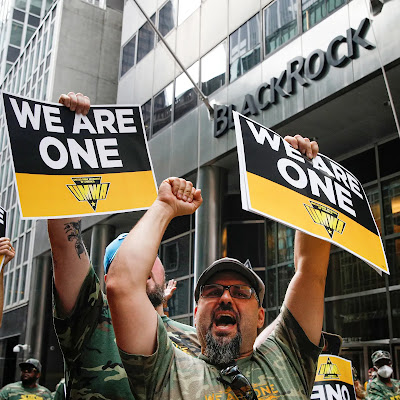
Members of United Mine Workers of America (UMWA) picket outside the BlackRock headquarters in New York City. Photo: Brendan McDermid/Reuters via New York Magazine, January 20, 2022.


Unionization efforts involving some of the most recognizable names in business have dominated headlines across the United States in recent months. Starbucks workers in Buffalo and Amazon employees in Bessemer, Ala., and on Staten Island have recently moved to unionize, as have workers at an REI store in Manhattan last week. Successful strikes at John Deere and Kellogg have drawn new attention to the state of the labor movement as well. —The New York Times, January 25, 2022


The first tool I ever bought was a hammer
at Western Auto in the Central Park Plaza,
in Buffalo, in 1974. I liked the feel of it,
not too light, not too heavy, oak handle,
a pretty grain. I liked the idea of having
a tool. I wanted to hang posters, to fix things,
a stuck window that needed a tap, a carpet runner
that curled on a stair tread. I liked how the metal head
went tink, tink, tonk as a nail sunk deeper 
into wood. It said power, power, power.
These days, the handle still fits my palm,
the wood has darkened, smooth as skin,
tough as bone, like the forearm of my grandfather,
a union man, steady and tanned, a guy
who’d drop everything to lend a hand
to anyone. When he died, I chose his scroll-saw
and drill, some chisels with steel blades that
I’ve used well and misused, too, by whacking them
instead of tapping, by going against the grain. Nothing
can fix everything, though sometimes I want to be a hammer,
to use extra force to make emphatic the connection
between mind and thing. Sometimes one hit
is not enough, I want to hear a chorus of power, power.
I want to be a chisel, too, a sharp one. A union
can be a hammer, a contract can be a nail,
collective bargaining, shared governance, chisels.
Ideas can be hammered on until they strengthen,
nailed down, or shaved and honed. Power, power.
I’m twenty years older than my Western Auto hammer.
I’m still learning what to try to fix, what tool to choose.
I know the task is the real teacher. When I look out
at this broken world, I still see my grandfather,
his steady arm, his sure aim, how right it sounds
when it all comes together, when it all works. 


Bonnie Proudfoot lives in Athens, Ohio. She has belonged to several unions in her life, most recently the Ohio Education Association. Her poetry and short stories have appeared in online and print journals, and her novel Goshen Road (Swallow Press, 2020) was Longlisted for the PEN/Hemingway Award for Debut Fiction in 2021.

Sunday, February 07, 2021

LOOKING FOR AMERICA

by George Salamon 


I looked for the American character,
and I saw the contours fading, the
words to sing of it sour or drab, I
seek refuge in old photo albums, 
capturing dignity and pride, coming
together in many kinds of work and
fulfillment, revealing what we had or
what we thought we had, now that
we're seeking the causes of our loss
as if our minds had shut down and our
hands and feet were bound, yet no
cause is so deep it cannot be found.

George Salamon live in the heartland of America, St. Louis, MO, and contributes to The Asses of Parnassus, One Sentence Poems, and The New Verse News.

Tuesday, October 20, 2020

SUBURBAN WOMEN

 by Laura Winkelspecht


Suburban women wake up early to exercise,
load the dishwasher while brushing their teeth,
and dress their kids on the way out the door.
 
Suburban women drive to office jobs
in late model crossover vehicles
and pick up overpriced coffee on the way.
 
Suburban women schedule family vacations,
manage doctor appointments and oil changes,
and plan pregnancies in between potty training.
 
Suburban women attend soccer games,
take turns at carpooling to school,
and organize fundraisers and family reunions.  
 
Suburban women decorate for each holiday,
nurture their prized sourdough starter,
and sew masks for everyone in their family.
 
Suburban women host socially distant barbeques
with their brown neighbors two doors over
and promise play dates with genuine smiles.
 
Suburban women tolerate condescension
with tight-lipped smiles and long memories. 
They register voters on the weekend.


Laura Winkelspecht is a poet and writer from Wisconsin who writes with the hope of finding lightning among the lightning bugs. She has been published in Anti-Heroin Chic, One Sentence Poems, Rat’s Ass Review, Poets Reading the News, and others. She is a Pushcart Prize nominee.

Thursday, July 02, 2020

MASK WORK

by Alejandro Escudé


Why Aren’t You Wearing a Mask? by Jen Sorensen at The Nib


T***p “sprays a mask on his face every day for vanity. But an actual mask that would protect other people, that, that, he just can’t do” –Anderson Cooper


Pull yourself up by your mask straps!
I work hard to keep myself and others safe,
but sometimes I too hate to have to reach up
for a mask hung like a hat on a makeshift
mask-rack in my entryway. I feel a strange
sweaty anxiety in needing to “muzzle”
myself, as you call it, and crave the feel
of fresh air on my face, unbridled breath.
But you of all people should understand
the logic of labor, the idea of work, you
who often block “entitlements,” who see
the world simply as divided between
those who can succeed and those who
cannot. I put on my mask of success!
I put on my mask and it is work to do so,
like raising a shovel, like crunching
the numbers, like mowing, like sewing
seeds, like picking stocks. I do my mask-
work because my kids depend on me
surviving and on their grandparents
surviving so that we can continue to work.
And I too am with you, I too put on my
mask and feel its claws dig into my skull.
I too rise in the morning to greet the sun-
disease for yet another day. But I mask.
And I wear my good work on my face.


Alejandro Escudé published his first full-length collection of poems My Earthbound Eye in September 2013. He holds a master’s degree in creative writing from UC Davis and teaches high school English. Originally from Argentina, Alejandro lives in Los Angeles with his wife and two children.

Monday, May 18, 2020

A COMMUNITY OF TWO

by Earl J Wilcox


Early this morning just after the sun
begins its day in our neighborhood

two elderly men arrive in their
little white truck, its bed hauling

shovels, axes, a pick or two, wheel-
barrow, assorted rakes—and their

little black boom box. They are here
to whale away at a big patch of wild

weeds and grass I need defeated from
my front yard. I sit on my porch step,

not to oversee because they have known
for all their lives how to work against

weeds and other stubborn growth.
The pandemic is no match for these

two whose social distancing may not
suit the virus gurus. As they dig and

rake and haul away their talk animates,
fills the air—hardy laughs, grunts

accompany tugs against tough grass.
pauses to wipe a brow, massaging

a calloused hand, back stretching.
In their galaxy today, the antibody

is talk mixed with dollops of country
music, occasional arias of southern

gospel plus a local car salesman still
hawking the best deals in town.


Earl Wilcox is reopening his back yard to squirrels, robins, and cotton tail rabbits. Early worms show up at their own risk.

Friday, March 06, 2020

WORTH

by Pepper Trail


The New York Times, March 5, 2020:

“Elizabeth Warren, Once a Front-Runner, Drops Out of Presidential Race”

“If American women earned minimum wage for the unpaid work they do around the house and caring for relatives, they would have made $1.5 trillion last year.”


In front of the bright lights
You carry a lifetime of learning
Lightly—for you it must be lightly
When you try, you are given nothing
When you succeed, you earn—fear

In the dark silent hours
Your cool hand comforting the feverish child
Your words calming the confused grandfather
What you have to give is taken
What is demanded of you is – more

Visible, invisible, there is no place of safety
To be loved, be silent
To be listened to, be quiet
When you ask, the answer is no
When you do not ask, there is no answer

In front of the lights, in the dark hours
Hold fast to your worth
Someday, rocks will crack
Someday, a wave will rise
Someday.  Someday.  Someday.


Pepper Trail is a poet and naturalist based in Ashland, Oregon. His poetry has appeared in Rattle, Atlanta Review, Spillway, Kyoto Journal, Cascadia Review, and other publications, and has been nominated for Pushcart and Best of the Net awards. His collection Cascade-Siskiyou was a finalist for the 2016 Oregon Book Award in Poetry.

Thursday, March 09, 2017

MOTHER-DAUGHTER

by Mary McEwen


My mother was successful.
She grew up in a small valley town
In Evergreen Colorado,
Born to an Italian father and Scottish mother
Who immigrated to New York just before
She was born. She went to a local college
And majored in English. Then she got a job
working in communications.
She was only one of three women working
For the company.
She worked there for over twenty years.
After year thirteen she married my father
And they decided to start a family. I would
Come along a bit later.
My mom used to tell me this story over and over:
An example of how much she loved me.

My mom was proud of her career.
She worked hard.
She was one of the first people to have a cellular
Phone installed in her car.
At the end of every year,
Her boss would make every employee in the office
A performance list, a list of goods and bads,
What employees were doing well, how they improved…
But that year my mother got her performance letter
From her boss and her heart sank.
It was not a complimentary letter like usual.
It had a few things on the “good” list,
Like she was always “punctual” and “organized”,
But nothing really notable.
And then there was the “bad” list.
Only one word.
My name.

The choice to have a child was selfish, unthinkable.
If a woman wanted to have a career then
She couldn’t possibly be a mother and housewife as well.
It was inconvenient timing, he said, it would affect her job performance.
She would have to take time off. She would be distracted.
I wasn’t even born yet. I was a little speck in her womb.
And she stood up for me.
My mother defended me.

Maybe because she and my dad were trying to start a family,
Or maybe because she refused to be threatened,
Or because she didn’t consider it a valid reason to leave her career,
But my mom continued to work there.
And after I was born, she took a few weeks off
For maternity leave. And then she went right back
To work, and took her with me.
I had a little corner in her office with a crib and toys.
I would sit in silence in board meetings,
Wide-eyed and attentive, seated across from her boss
At the other end of the table.
I wasn’t a bullet point on a list anymore.

I was a person.


Mary McEwen lives in Colorado Springs, CO and is a English and Poetry major at Colorado College. She published her first book of poetry in 2014.

Monday, December 05, 2016

RESISTANCE IS NOT FUTILE

by Howie Good


Genevieve Griesau sat at Chapel of the Chimes, an Oakland funeral home, after the Oakland warehouse fire that killed more than thirty people. Credit: Jim Wilson/The New York Times, December 4, 2016


All it takes is that one guy asking,
“What if there is a fire?”
And now that room is on fire.

We will be here for days and days
to come. Give me some gloves.
I’ve got work shoes. I’m ready.


Howie Good is the recipient of the 2015 Press Americana Prize for Poetry for his new collection Dangerous Acts Starring Unstable Elements.

Friday, November 11, 2016

CALIFORNIA THE MORNING AFTER


Simon Hunt’s first collection of poems Lesser Magi will be published by Hummingbird Press in 2018. He was born in Rhodesia (now Zimbabwe) and raised in England and the United States.  His poems have appeared or are forthcoming in Homestead Review, Light Quarterly, Measure, Poetry Quarterly, The Raintown Review, The Seventh Quarry, The Sewanee Review, and other journals—as well as in the online publications 14 X 14, Garo, and The Chimaera.  He teaches in Monterey, California, where he lives with his wife and two children.  He is a member of the Board of the Robinson Jeffers Tor House Foundation, where he has served as a volunteer docent for more than a decade.