Guidelines


Submission Guidelines: Send 1-3 unpublished poems in the body of an email (NO ATTACHMENTS) to nvneditor[at]gmail.com. No simultaneous submissions. Use "Verse News Submission" as the subject line. Send a brief bio. No payment. Authors retain all rights after 1st-time appearance here. Scroll down the right sidebar for the fine print.
Showing posts with label tools. Show all posts

Tuesday, January 27, 2026

VERONIKA

by Frank Conahan


Scientists have been forced to rethink the intelligence of cattle after an Austrian cow named Veronika displayed an impressive—and until now undocumented—knack for tool use. Photo: Veronika scratching her back with a stick. Photographer: Antonio J Osuna Mascaró —The Guardian, January 19, 2026


I was reading that
A cow in Austria is
Using a stick to

Scratch various parts of her
Body. She holds it
Differently in her mouth to

Reach her itchy parts. 
This is news because she's not
A chimp. They do stuff

Like this all the time, it seems. 
Animals who have
Intelligence of different 

Degrees use tools with
Different sophistication. 
Dogs and cats play with

Toys, slippers, sticks, and corpses.
Ravens manipulate
Stones. Chimps employ weaponry.

Why are we surprised?
Intelligent animals 
Use tools, look at us.

We're practically destroying 
The planet with ours.
(Intelligence is... complex.)

I hope the cow is
Enjoying celebrity.
She could be dinner soon.


Frank Conahan lives in reclusive retirement outside of Baltimore, Maryland. He follows current events with trepidation and copes by writing verse. He has recently published poems with Bards of Maryland. His collection Nothing Is Coming will be published this spring.

Wednesday, December 27, 2023

THE DEATH OF A POET

by Roxanne Doty


These are the poets and writers who have been killed in Gaza. —Literary Hub, December 21, 2023


Before they were bombed from the sky 

warheads raining on their crucified city

littered with the bones of winter

and blood of children

they were a poet and a teacher

a mother and father who understood 

the hope of words, the way they slipped 

through walls and checkpoints

couldn’t be stopped by soldiers 

or guns, how they empowered

defied the laws of physics

and occupation and oppression


To the secretaries of war who murdered the poet

words were sterile instruments, tools

like wrenches and screwdrivers, hammers

from the hardware store, like bunker buster bombs 

and hellfire missiles from a rich country

with democracy and security on its lips

and complicity on its hands, to these priests

of destruction, the poet was a calculation

the result of collateral damage equations

estimates of death rankings of acceptable levels 

of slaughter


The poet was killed in their home 

and in a school and a hospital and a UN shelter

and a refugee camp and on a war-torn street

and waving a white flag

before they died the poet had asked

When shall this pass?


The poet understood that words are fragile

even with their power could crumble and die

they need an audience to listen

to absorb to act and the poet knew 

that all the children of Gaza 

are poets too


Roxanne Doty lives in Tempe, Arizona. Her debut novel Out Stealing Water was published by Regal House Press, August 30. 2022.  Her first poetry collection will be published by Kelsay Books in the spring of 2024. Her short story “Turbulence” (Ocotillo Review) was nominated for the 2019 Pushcart prize for short fiction. Other stories and poems have appeared in Third Wednesday, Quibble LitSuperstition Review, Forge, I70 Review, Soundings Review, Four Chambers Literary Magazine, Lascaux Review, Lunaris Review, Journal of Microliterature, The New Verse News, Saranac Review,Gateway Review and Reunion-The Dallas Review.

Thursday, May 05, 2022

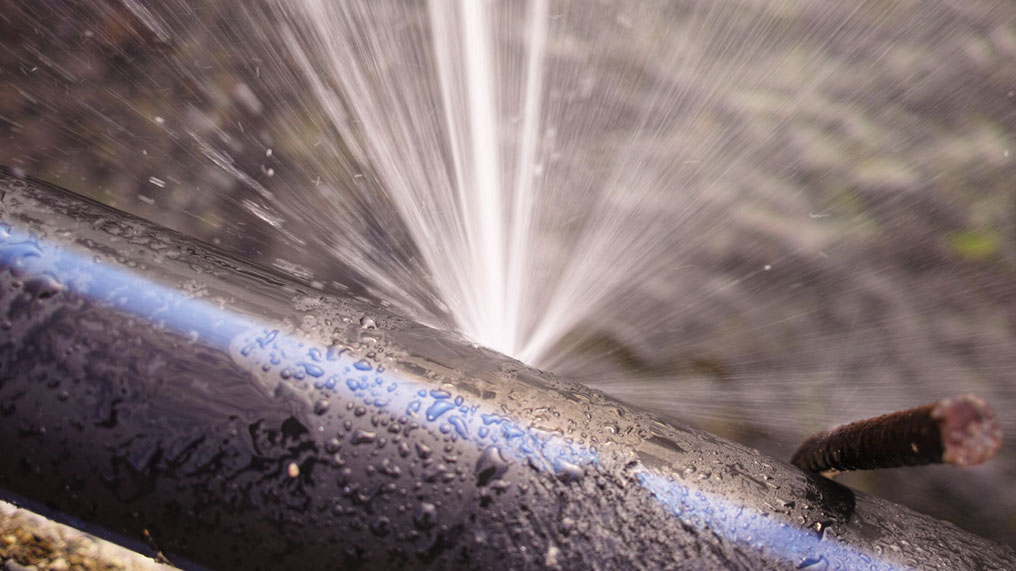
HOW TO HANDLE A LEAK

by Ann E. Wallace


My daughters and I live in a leaky 
old house. The three of us have 
learned how to handle a plumbing 
emergency, to spring into action, 
sop up the mess, cut the water lines,
track the source, mend the seams.
 
This is what women do.
We live in bodies that bleed,
are vulnerable, that give life 
but also betray, and we have 
passed down the fortitude 
to handle leaks and other messes. 
There is wisdom in our living, 
and we know how to act 
when a leak is sprung, exposing 
the ill intentions of those 
who do not live in our bodies, 
those who spout 
outrage at the egregious 
betrayal—as if they know 
what betrayal is—of being 
caught with the pipe cutters 
in their bloody hands.
 
As they sputter and point fingers, 
we—the women—are gathering 
our tools, our rage, and our ballots, 
like we have so many times before, 
ready to fight for our freedom.


Ann E. Wallace is a poet and essayist from Jersey City, New Jersey. Follow her on Twitter @annwlace409 or on Instagram @annwallacephd.com.

Thursday, January 27, 2022

HAMMER

by Bonnie Proudfoot


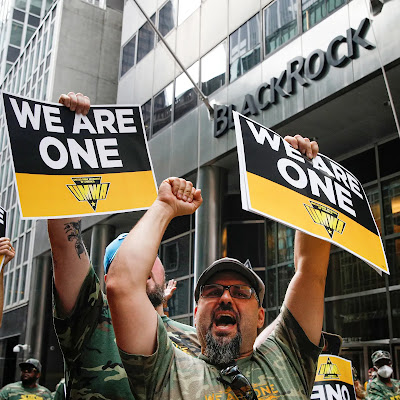
Members of United Mine Workers of America (UMWA) picket outside the BlackRock headquarters in New York City. Photo: Brendan McDermid/Reuters via New York Magazine, January 20, 2022.


Unionization efforts involving some of the most recognizable names in business have dominated headlines across the United States in recent months. Starbucks workers in Buffalo and Amazon employees in Bessemer, Ala., and on Staten Island have recently moved to unionize, as have workers at an REI store in Manhattan last week. Successful strikes at John Deere and Kellogg have drawn new attention to the state of the labor movement as well. —The New York Times, January 25, 2022


The first tool I ever bought was a hammer
at Western Auto in the Central Park Plaza,
in Buffalo, in 1974. I liked the feel of it,
not too light, not too heavy, oak handle,
a pretty grain. I liked the idea of having
a tool. I wanted to hang posters, to fix things,
a stuck window that needed a tap, a carpet runner
that curled on a stair tread. I liked how the metal head
went tink, tink, tonk as a nail sunk deeper 
into wood. It said power, power, power.
These days, the handle still fits my palm,
the wood has darkened, smooth as skin,
tough as bone, like the forearm of my grandfather,
a union man, steady and tanned, a guy
who’d drop everything to lend a hand
to anyone. When he died, I chose his scroll-saw
and drill, some chisels with steel blades that
I’ve used well and misused, too, by whacking them
instead of tapping, by going against the grain. Nothing
can fix everything, though sometimes I want to be a hammer,
to use extra force to make emphatic the connection
between mind and thing. Sometimes one hit
is not enough, I want to hear a chorus of power, power.
I want to be a chisel, too, a sharp one. A union
can be a hammer, a contract can be a nail,
collective bargaining, shared governance, chisels.
Ideas can be hammered on until they strengthen,
nailed down, or shaved and honed. Power, power.
I’m twenty years older than my Western Auto hammer.
I’m still learning what to try to fix, what tool to choose.
I know the task is the real teacher. When I look out
at this broken world, I still see my grandfather,
his steady arm, his sure aim, how right it sounds
when it all comes together, when it all works. 


Bonnie Proudfoot lives in Athens, Ohio. She has belonged to several unions in her life, most recently the Ohio Education Association. Her poetry and short stories have appeared in online and print journals, and her novel Goshen Road (Swallow Press, 2020) was Longlisted for the PEN/Hemingway Award for Debut Fiction in 2021.