Guidelines


Submission Guidelines: Send 1-3 unpublished poems in the body of an email (NO ATTACHMENTS) to nvneditor[at]gmail.com. No simultaneous submissions. Use "Verse News Submission" as the subject line. Send a brief bio. No payment. Authors retain all rights after 1st-time appearance here. Scroll down the right sidebar for the fine print.
Showing posts with label human. Show all posts

Monday, March 03, 2025

THE WORLD AFTER MORALITY

by Philip Kitcher

Cartoon by Zez Vaz


In honor of his troops, he comes in black.
To save his shattered nation he needs aid.
He’s desperate.  The last defense may crack.
Their only interest: to be obeyed.
 
No ghost from Bucha whispers in this room,
a precinct where the truth is not allowed.
He craves security.  They talk of doom.
He asks for help.  They offer him a shroud.
 
Their callous lips mouth platitudes of peace,
heedless of all the wounds his people feel.
Their “gift”: an interval for war to cease—
and, in exchange, demand that he should kneel.
 
More than a nation’s honor’s left for dead;
they do more than encourage future strife;
the damage wreaked within this room will shred
the moral fabric that sustains our life.
 
What are these creatures in their costly suits,
obsessed with vulgar thoughts of squalid gain?
Do they know what divides us from the brutes?
We’re fully human as we are humane.
 
Indifferent to their or others’ crimes,
to any words a moralist might pen:
what foul distemper has convulsed our times
to vomit forth such parodies of men?


Philip Kitcher has written too many books about philosophy, a subject which he taught at Columbia for many years. His new book The Rich and the Poor (Polity Press) is all about the costs of abandoning morality in politics and public life. His poems have appeared online in Light, Lighten Up Online, Politics/Letters, Snakeskin, and The Dirigible Balloon; and in print in the Hudson Review.

Thursday, September 12, 2024

POST MORTEM: THE SIXTH EXTINCTION

The history of a planet in sixteen lines
by Greg McClelland


Source: Mail Online


It all began when a molten mass,
boiling within,
battered from without,
barreled through a gaping void.
 
Peaks of solidity surfaced;
tectonic hands and burning digits
designed antediluvian bone:
basalt, sandstone, granite, schist.
 
Through five hundred million years,
from Ordovician to Cretaceous,
our mother birthed and killed five litters
of living tissue.
 
Then she birthed a sixth,
which brewed its own poisons—
digital, solid, nuclear, microscopic—
leading to the first synthetic holocaust.


Greg McClelland is a retired government ethics attorney. He has published poetry in Ancient Paths, The Road Not Taken, All Around the Mulberry Bush, and his college alma mater newsletter. Besides writing poetry, he spends his retirement working in political activism, helping to ensure that Trump will never see the inside of the White House again.

Saturday, June 03, 2023

NOT IN OUR STAR…

by Phyllis Frakt


The distant death throes of a star—

entire worlds gassed, doomed, 

consumed in its stellar belly.


They say our sun will do the same

and swallow the Earth in the “deep future”

five billion years from now.


While we wait, let’s celebrate spring,

a season in love with the sun,

carefree and heedless of remote catastrophe.


But humans bring peril five billion years early

Our planet gobbled up, not from afar,

but from us, under our benevolent star.


Phyllis Frakt began writing poems in 2021. Her previous poems in The New Verse News are "Teach to the Test" and "Caught in Between." She lives in New Jersey.

Saturday, December 11, 2021

DELIVERED

by Julian Matthews


“Dinner With Friends” Painting by Victoria Coleman


A poem on our first meeting after being in a writing workshop on Zoom for six weeks, and in various lockdowns for a year and ten months.


And so we sit at the table partaking of a meal,
the home-made, home-cooked, home-delivered
a gathering of friends, new and old,
unmuted, unzoomed, live, in-person, fully embodied,
greeting each other like refugees
meeting on the dock, our boats having survived
the treacherous crossing of middle class suburbia
and stepping back onto the shores of human connection again, 
wetting our cold feet and lapping up warm chatter about pets, 
pasta, pastries, prices, politics and the pandemic, always the 
     pandemic,
and, thankfully, of our common love of books, and writing and 
     poetry
and missing sitting in darkened theatres with strangers, to watch 
     a movie,
or a play or just chilling with a warm-up, pre-concert cocktail, 
     perhaps a long island tea, 
or two, before listening to an orchestra, fingers fondling keys, 
     bows caressing strings,
lips pressed against mouthpieces, hugging tubas, the tsk-chizz 
     of sticks on cymbals, 
being enveloped by the sensurround sounds of music played by 
     real, in-the-flesh humans...

And in the end there is laughter, ribbing and the teasing out
of each other's backgrounds, our reasons for being, why the 
     need to put words
on rectangular screens, this unboxing of the isolation inside us, 
     this shedding of thickened skins,
double-vaxxed, immunized, and unmasked, fully ensconced in 
     that most singular of human acts,
the Art of Conversation, manifesting our ancestral DNA of 
     gathering around the embers of dying
fires under stars, trading stories, sharing opinions and yes, even 
     gossiping,
just to know we are alive, 
we are still alive.


Julian Matthews is a former journalist finding new ways to express himself in the pandemic through poetry, short stories and essays. He is published in Beltway Poetry Quarterly, Nine Cloud Journal, Poor Yorick Journal, Borderless Journal, Second Chance Lit, Poetry and Covid, the anthology Unmasked: Reflections on Virus-time (curated by Shamini Flint), cc&d magazine, a Scars Publication, and forthcoming in the American Journal of Poetry. He is based in Malaysia.

Sunday, November 29, 2020

POST-THANKSGIVING 2020

by Barbara Schweitzer


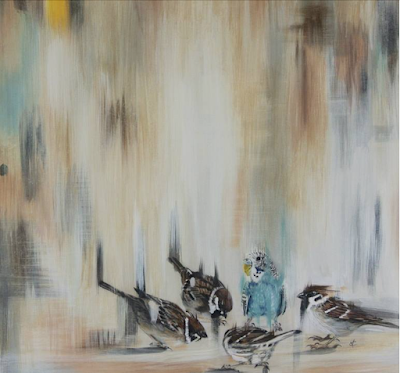
“Only Human,” painting by Judith Dawson.


We are such little twisty things
protoplasm and cell productions
who eat turkey in November
and hotdogs in July
who love intensely our neighbor-in-bed
then plot coups with the Deplorables.
We are unthinkable most times
and dumb the rest
yet we climb and hope
and endure so that we might
not cascade into the smarmy oceans
we have made. We pick our way
so that we might reach an alp
and spread our small intelligences
like faraway stars into a universe.
We are just enough bare-boned and starving
to go on and on and on though we remain
still closer to slime than to god.


Barbara Schweitzer is still writing poems and plays and Cyjoe Barker mysteries in upstate RI.

Saturday, January 02, 2016

THE MONKEYS PUT US IN OUR PLACE

by Michael Mark


The latest rankings are out
Human beings are third in intelligence
Last in courage
But 43rd in good looks — an uptick due to an extinction
All agree and of course the humans most heartily support
We are keenest in imagination
Now if we can get our names off the endangered species list
But the monkeys say that we’re not smart enough
The lions say we’re not brave enough
The elephants say we’re not kind enough
The waters say we’re not strong enough


Michael Mark’s poetry has appeared or is forthcoming in Gargoyle Magazine, Paterson Literary Review, Poet Lore, Rattle, Spillway, The Sow’s Ear Poetry Review, Sugar House Review, Tar River Poetry, TheNewVerse.News and other nice places. His poetry has been nominated for three Pushcart Prizes and the 2015 Best of the Net.