Guidelines


Submission Guidelines: Send 1-3 unpublished poems in the body of an email (NO ATTACHMENTS) to nvneditor[at]gmail.com. No simultaneous submissions. Use "Verse News Submission" as the subject line. Send a brief bio. No payment. Authors retain all rights after 1st-time appearance here. Scroll down the right sidebar for the fine print.
Showing posts with label nuclear. Show all posts

Friday, November 21, 2025

THE BOMB FACTORY DOWN THE BLOCK

by Dick Altman


Photo by Dick Altman.


The aging Los Alamos lab at the center of America’s nuclear overhaul: Contamination incidents, work outages and declining infrastructure have plagued the site, but the lab remains the linchpin in an effort to modernize the nation’s nuclear weapons. —High Country News, October 28, 2025


Northern New Mexico


When I settle here,

overlooking

Rio Grande’s

historic valley,

the Jemez 

mountains,

ranging

across

the entire

western skyline,

hold me

spellbound.


Daybreak 

brings them

brilliantly

alive,

to be worshipped

by Puebloans,

beyond memory.

Nightfall                         

turns them

into a stage,

where

piercingly

magenta skies,

unllike any 

I‘ve ever seen,

welcome 

high desert’s

glowing

obsidian

dark.


I can only

imagine

how

Puebloans

revere yet

what they

call

their sacred

peaks.

I’m tempted 

to call it

sacrilege,  

when I realize,

high on 

a promontory

looms

Los Alamos,

cradle

of the nuclear

age.


For me,

the site

is anything

but an artifact.

Friends

work there.

I’ve passed

through it

many times.

Hiked the hills

embracing it.

My ridge aligns

with Mount

Redondo,

a few minutes

south of the lab.

It overlooks
Valles Caldera
said to be
remants
of one
the largest
explosions
ever to rock
the planet.

I often wonder

if Oppenheimer

chose Los Alamos,

for its intimate

proximity

to the caldera.

I can almost

hear him

spurring on

his atom-splitting

cohorts: 

“We may never

match that

volcanic

cataclysm.

But I believe

we have

the minds 

to create

a weapon

of such power,

unlike any 

in human history,

to stop in its tracks,

the war.”


For those

like myself,

who call

this majestic

geoscape home,

his era,

to my disbelief,

is far from over.

Just weeks ago,

containers

leaking

nuclear

waste,

of the Cold War, 

were allowed 

to vent

into the air.

The winds,

I dread to say,

prevail from

the west—

towards

my ridge.


But what

of the Pueblos,

under which

a lethal chemical

flare in the soil,

originating

at the lab,

slowly worms

its way toward

tribal

ground water?


So far,

no amount

of science

or money 

can stop it.

No,

to me,

Los Alamos

lives neither

as just another

spot

on the map.

Nor anything

resembling

history’s 

tomb.


.

Dick Altman writes in the thin, magical air of Old West’s high desert plains, where, at 7,000 feet, reality and imagination often blur. He is published in the American Journal of Poetry, Santa Fe Literary Review, Fredericksburg Literary Review, Foliate Oak, Landing Zone, Cathexis Northwest Press, Humana Obscura, Haunted Waters Press, Split Rock Review, The Ravens Perch, and others here and abroad. His work also appears in the first edition of The New Mexico Anthology of Poetry, published by the New Mexico Museum Press. Pushcart Prize nominee and poetry winner of Santa Fe New Mexican’s annual literary competition, he has authored over 280 poems, published on four continents.

Thursday, September 12, 2024

POST MORTEM: THE SIXTH EXTINCTION

The history of a planet in sixteen lines
by Greg McClelland


Source: Mail Online


It all began when a molten mass,
boiling within,
battered from without,
barreled through a gaping void.
 
Peaks of solidity surfaced;
tectonic hands and burning digits
designed antediluvian bone:
basalt, sandstone, granite, schist.
 
Through five hundred million years,
from Ordovician to Cretaceous,
our mother birthed and killed five litters
of living tissue.
 
Then she birthed a sixth,
which brewed its own poisons—
digital, solid, nuclear, microscopic—
leading to the first synthetic holocaust.


Greg McClelland is a retired government ethics attorney. He has published poetry in Ancient Paths, The Road Not Taken, All Around the Mulberry Bush, and his college alma mater newsletter. Besides writing poetry, he spends his retirement working in political activism, helping to ensure that Trump will never see the inside of the White House again.

Sunday, March 06, 2022

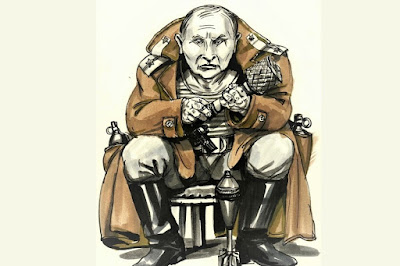
VLAD THE BAD

by Richard Schiffman


His most execrable excellency,
Czar Vlad the Bad, 
a pint-sized Napoleon wannabe in a Gucci suit
decreed ten thousand widows,
and so they were before the cock crowed twice, 
on the morning he deemed cancelled
in the city he called dust.
Just your standard issue human madness.
Of course, of course. A monomaniacal error.
A payback for fanciful slights.

The psycho-historians will have a field day
while the citizenry sleep in the subway,
or pack the next train out.
But how to get away from that feverish brain,
that heart of burning petrol?
There isn’t a bunker deep enough to hide in.
Bankers on six continents dole out the pain.
No SWIFT Code for the codeless.
Oligarchs go yachtless. The ruble is rubble.
Meanwhile, the nuclear finger twitches.
A shudder ripples down nine billion spines.

The spineless despot preens for the cameras,
shows off his cadaverous abs. 
It’s flesh and blood 
below the tailored shirt, for sure, for sure,
fresh meat for a million gurneys.
Dead man walking pale as a crematorium
holds court in a palace of white marble. 
One nation huddles in the basement.
Another weeps and hides its face.


Richard Schiffman is an environmental journalist, poet and author of two biographies. His poems have been published in The New Verse News, Alaska Quarterly, Rattle, The New Ohio Review, The Christian Science Monitor, The New York Times, Writer’s Almanac, This American Life in Poetry, Verse Daily, and other publications. His first poetry collection What the Dust Doesn't Know was published in 2017 by Salmon Poetry. 

Friday, November 24, 2017

LET US NOW PRAISE SMALL THINGS

by George Salamon


Video illustrates the November 16, 2017 New York Times article ”Downing North Korean Missiles is Hard. So the US is Experimenting In-Depth."


On an idle afternoon
In my apartment
I see by the kitchen sink
A letter for me.
I haven't read it.

The radio tells me
Of rocket launches
And anti-rocket rockets
Of wars that never end,
Of a war not yet started.

All I see on this
Idle afternoon
Is my woven bread basket,
A few drops of olive oil spilt
On the bamboo cutting board.

It doesn't matter
About you and me.


George Salamon lives and writes in St. Louis, MO.

Saturday, September 21, 2013

INK THREATS

by B.Z. Niditch


A series of demonstrations concerning the anti-fascist hip-hop artist, Pavlos Fyssas’ murder by Giorgos Roupakias, supporter of the Greek political neo-Nazi party Golden Dawn, are organized in European capitals by Greek immigrants and local left-winged organizations and students. - Greek Reporter         Meanwhile, mass protests against police abuses have resumed in the Turkish city of Istanbul, as well as in Ankara, the national capital, and in Antakya province on the Syrian border. The latest country-wide demonstrations began after the death on September 10 of Ahmet Atakan, a male aged 22, in Antakya. -- Gatestone Institute


Because poems
touch your faraway eye
and dictators
flee from word memory
silence cannot conceal us
from any occupying justice
our initials in blood
rise on city graffiti walls
over roofs and presses
others are written
with bark of hundred years
on old trees,
whether in Turkey or Greece
or anywhere on headlines
we hear impure speech
of the general staffs
who wage war
against people
even in nuclear times
only with ink threats
of our pens
can fascism be exposed
and die off.


B.Z. Niditch is a poet, playwright, fiction writer and teacher. His work is widely published in journals and magazines throughout the world, including: Columbia: A Magazine of Poetry and Art; The Literary Review; Denver Quarterly; Hawaii Review; LeGuepard (France); Kadmos (France); Prism International; Jejune (Czech Republic); Leopold Bloom (Budapest); Antioch Review; and Prairie Schooner, among others. He lives in Brookline, Massachusetts.