Guidelines


Submission Guidelines: Send 1-3 unpublished poems in the body of an email (NO ATTACHMENTS) to nvneditor[at]gmail.com. No simultaneous submissions. Use "Verse News Submission" as the subject line. Send a brief bio. No payment. Authors retain all rights after 1st-time appearance here. Scroll down the right sidebar for the fine print.
Showing posts with label rockets. Show all posts

Friday, April 10, 2026

OVER THE MOON: A GOLDEN SHOVEL

by Liam Boyle


Now’s a time to celebrate, drink

a toast with best French wine,

gather friends to break bread and 

sing patriotic anthems. Look

into the eyes of your guests, smile at

the thought of what’s been done, the 

great news, a return to the Moon.


Before radio silence, and

across 250,000 miles, the astronauts think 

of love—of our love for them, of

their love for us—“we love you” and all

that love is on the dark side of the 

moon, while back on Earth civilisations


are dying, rockets carry destruction; the 

truth is, we can no longer see the moon

as benign. This coincidence of time has 

undone all lyric, all hope. We have seen

the darkness passing

overhead. It will not go by.


Liam Boyle lives in Galway, Ireland. His work has been published in various journals in Ireland and internationally. He was a featured reader in the New Writing Showcase at Galway's Cúirt International Festival of Literature 2025.  

Wednesday, June 19, 2024

BLOOD ISLAND

by Sheikha A.


Mohammed Hajjar/Associated Press


''The [US-sponsored proposal for a] ceasefire would evolve into a permanent end to hostilities and the release of all hostages in a second phase. A final stage would see the launch of a major reconstruction effort.'' —The Guardian, June 12, 2024


This planet will become a museum;
the future nodes of our past karma
will live in corridors without walls, 
where displayed in liquid sunsets 
will be an imagined version of blood 
because it will no longer exist: extinct 
artefact impossible to save for relic. 
Humans will be dissolved vapour 
from a combustion that was meant 
to enforce power; and, neutralists 
chose to write words to write-off
histories. Our veins will be draped
like decorative tinsel over our future. 
The dominant climate being eternal 
outrage, and no one to alter the code 
to turn back time to halt the rockets 
in the skies. Ahlan wa Sahlan, we 
greeted ourselves into their homes, 
and then eviscerated. Ma’afi mushkela
we will now help rebuild it from scratch.


Sheikha A. is from Pakistan and United Arab Emirates. Her work appears in a variety of literary venues, both print and online, including several anthologies by different presses. Her poetry has been translated into Spanish, Vietnamese, Greek, Arabic, Polish, Italian, Albanian and Persian.

Sunday, November 19, 2023

HAIL, MARY

by Maria Lisella


Buon giorno, buen dia Maria

Full of grace and wisdom and power

The Lord may be with thee, and you

May be Blessed among women but


What about the children? Not the one

In the womb that has been consecrated

As the son of God, but God, your god,

My god has many sons, daughters all


Around the world. They are not all blessed

Some are cursed and lost and under a pile

Of rubble in Ukraine, Yemen, Israel, Palestine, Gaza;

Others live in the darkness of the blind, are


Plagued by hallucinations, cursed with spasms

Of a mind that plays tricks on them all day, all

Night. Imagine a predator behind you, in your

Shadow, silent, stealthy, looking over your shoulder


Or under your bed. You cannot see but you know

They are there and they mean you harm for no

Other reason than you are where you find yourself

Not for an act you perpetrated on someone else,


Just for being who you are. The luck of the draw?

And Holy Mary, Mother of God, do you pray for

The innocent as well as the sinners? The pilots,

The soldiers firing artillery rockets, are they too


Prayed for? Rockets with ranges of 30-50 miles, fired

In barrages for the most effect, the most damage.

Are they too in your prayers to god and which god

Might that be? What does that God look like, what


Does that god think, plan, why does that god never

intervene? Humans shooting hate and rockets blindly

into Ashkelon, Beersheba, under the eyes of Israeli 

drones … range is crucial for rockets, for prayers too.


Pray for us sinners and for the innocent, for my own son

Living in a world plagued with demons he cannot see

or touch or hear but knows they are there, so music

and words come to him as if a shaft of light in day


Or night, raises his voice above the din in his brain, to

Feel the lift above the iron dome of paranoia, the upsurge

Of spirits that haunt, and fly, and invade his small cot in an

Institution with cinder block walls, netted windows he can’t


See but knows they are there: the limitations, the lack

Of liberty, the outside in; the other sons and daughters

in Gaza, or Yemen or Ukraine are bombarded with a panoply

of air power used in a steadily escalating series of attacks.


What I wish for my own son is comfort, warmth, knowing

There is a meal, a roof over his head, a dog at his feet, a

Sun he can feel but not see… Mother of God, what do you

Wish for your sons, your daughters now and at the hour


Of their deaths? When will your god hear your pleas or

Have the mothers and daughters been silenced to the

Tunnels, the basements, the streets, have they lost their

Voices, their powers to heal, now and at the hour of now?


Maria Lisella is the sixth Queens Poet Laureate and an American Academy Fellow; her work includes Thieves in the Family (NYQ Books), Amore on Hope Street (Finishing Line Press) and Two Naked Feet (Poets Wear Prada). She is a member of the Thursday Morning Poets, Brevitas and co-curates the Italian American Writers Assoc. literary readings.

Monday, August 01, 2022

WOKE UP THINKING ABOUT THE PEOPLE OF UKRAINE

by Bunkong Tuon


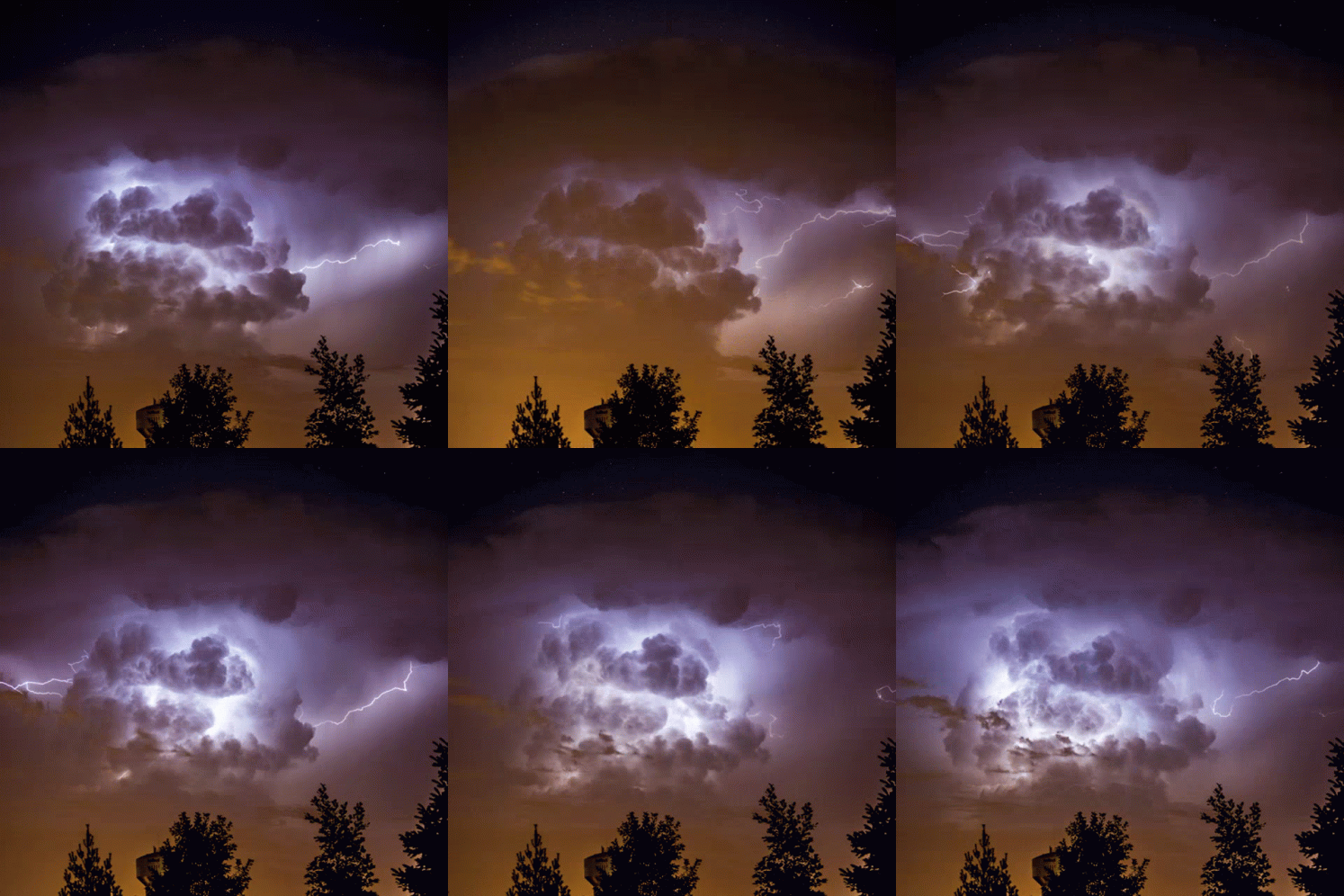
Lightning lit up the night sky
Thunder crashing the world.
My bedroom walls shook.
Windows felt like they were about to explode.
And my foundation crumbled.
I was again back in the jungles.
The fighting happened mostly at night.
The moon hid behind the smoke and branches.
Trees stood still. Everything was quiet but the sounds
Of rifles and rocket launchers and the screaming 
Streaming out of the mouths of children and parents.
There are no winners and losers in war.
There are only civilians who didn’t ask for any of it.


Bunkong Tuon is a Cambodian-American writer and critic. He is the author of three poetry collections and a chapbook. His prose and poetry have appeared or are forthcoming in New York Quarterly, Copper Nickel, Lowell Review, Massachusetts Review, The American Journal of Poetry, carte blanche, among others. He teaches at Union College, in Schenectady, NY.

Monday, July 04, 2022

FREEDOM ON FIRE

by Emily Jo Scalzo


Let the flag fly inverted on our 
so-called Independence Day,
a message from the newly chained:
we cannot abide these treasons—
rampart rockets set to kindle
a drought-wracked nation
aflame with hate and greed,
and all the rest no longer 
free to flee conflagration
in the twilight of justice. 


Emily Jo Scalzo holds an MFA in fiction from California State University-Fresno and is currently an assistant teaching professor teaching research and creative writing at Ball State University in Muncie, Indiana. Their work has appeared in various magazines including Midwestern Gothic, Mobius: The Journal of Social Change, Blue Collar Review, The New Verse News. Their first chapbook The Politics of Division (2017) was awarded honorable mention in the Eric Hoffer Book Awards in 2018.

Sunday, March 13, 2022

TIME OUT

by Marc Swan


Photo by Nadia Povalinska "who recently fled her home in Ukraine. It is from before the war, just a few weeks and a lifetime ago." —Heather Cox Richardson, Letters From an American, March 11, 2022.


In the photo, her back is to us.
She holds a scarlet red umbrella,
perhaps a harbinger of spring
or an unknowing portent 
of things to come,
that shields her head, 
catches snow 
falling from nearby trees
in a quiet park 
away from busy streets.
Late winter leaves 
glow cinnamon 
on snow-covered branches.
There are tracks, 
but she walks alone
in a small city in Ukraine.
The way life was before 
bombs and rockets fell,
hospitals, churches, clinics fell,
museums, homes, restaurants fell, 
and people—
defending their way of life
now buried in mass graves.
just outside Kyiv.


Marc Swan, a retired vocational rehabilitation counselor, lives in coastal Maine. His fifth collection, all it would take, was published in 2020 by tall-lighthouse (UK).

Thursday, November 18, 2021

TO BE IN EARTH'S ORBIT

by Rémy Dambron


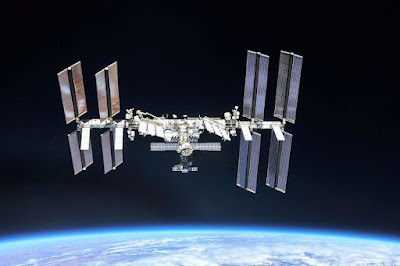
The US has condemned Russia for conducting a "dangerous and irresponsible" missile test that it says endangered the crew aboard the International Space Station (ISS). The test blew up one of Russia's own satellites, creating debris that forced the ISS crew to shelter in capsules. Astronauts on the ISS are increasingly having to take precautionary measures when fragments from old satellites and rockets come close. —BBC News, November 17, 2021


how far we’ve come

since our primitive wheels first rolled on dirt roads
and expanded our means of transit 

since our sails first met the unyielding winds of the sea 
sending us over entire oceans in search of new worlds

since we built the first railroads to journey across continents 
along iron paths only humans could pave

since our mechanical wings first presented us 
with the gift of flight
 
momentarily freeing us from the grounding force 
of earth’s gravitational pull

lifting us into lower skies to tour our globe and glide 
soaring beyond what the eye could see

since our first expedition to the moon 
launched by the thrusts of internal combustion

rockets powerful enough to achieve escape velocity 
and break through the comforts of our planet’s atmosphere 

propelling us into the perils of space 
where no soul had previously traveled 

merely dreamed...

how far we’ve come only to have become 
the very perils we feared

the very menaces we strived 
to mitigate

pieces of ourselves  
unapologetically returning to haunt us

unhesitant to disrupt our lives 
unsympathetic to our vulnerabilities 

our persistent flaws 
our stubborn mortality

an unmerciful reminder of our physiological limits
and the little chance they stand against our cerebral endlessness


Author’s note: To me this story was about more than the handful of lives that were put in harm's way as a direct result of typically destructive human behaviors. While I am relieved that the crew aboard the ISS is safe, this story was a sobering reminder that mankind remains its own greatest threat. We’ve entered a very dangerous era in our brief history as a species, where, in addition to our hazardous nature here on Earth, we have somehow managed to make space.. that cold and dark place with no water, no air, and no life, even more dangerous than it was before we got there. Where do we draw the line? When will we have gone too far?


Rémy Dambron is an English teacher and poet whose writing focuses on denouncing political corruption and advocating for social/environmental justice. With the help of his chief editor and loving wife, his works have appeared in What Rough Beast, Poets Reading the News, Writers Resist, Society of Classical Poets, Robot Butt, and The New Verse News

Friday, May 21, 2021

A BRIEF GEOGRAPHY OF GOODBYES

by Mary K O'Melveny


"Red Composition" by Jackson Pollock


Everyone who knows grief as it settles onto chests,
humid as a jungle, thick as fog on a heath,
understands that goodbyes can be a gift. A brief
cushion to ease the long emptiness ahead.
 
As I write this, my friend’s husband is dying
in hospice care in New York. He surrendered
after waging a fierce battle with leukemia that,
for a merciful time, he seemed to be winning.
 
Each arc of loss beams wider than celestial skies
on clear summer nights. His young grandchildren
gather at a grassy hospital garden to say goodbye.
Siblings fly from far-flung homes to do the same.
 
My sister and I stood at our mother’s bedside
watching lights on monitors fade and fizzle out.
Without evidence of audibility, we still sang to her,
believing emigration is aided by a sound track.

In Gaza, bereaved households are less blessed.
A fine whine of rockets the only warning before
a family’s cardamom tea and künefe splatters
like a Pollock canvas across living room walls.
 
In Delhi, breaths come to a close after failed searches
for oxygen – it seems there is no price that can be paid
for air though grieving loved ones would mortgage
their own lung capacities if currencies allowed.
 
In North Carolina, police kill a man as he tries
to drive away from death. His story forms a pattern
recurrent as an Escher etching. Each morning’s only
question – will this day mark memory’s final day.
 
COVID focused attention toward microscopic gestures –
the tensile strength of touch, the graceful creases
of a laugh line, the thrill of whispered thank yous.
Such gifts may allow us to survive our diminishments.


Mary K O'Melveny is a recently retired labor rights attorney who lives in Washington DC and Woodstock NY.  Her work has appeared in various print and on-line journals. Her first poetry chapbook A Woman of a Certain Age is available from Finishing Line Press. Mary’s poetry collection Merging Star Hypotheses was published by Finishing Line Press in January, 2020.

Saturday, May 15, 2021

PEACE WILL ALWAYS SOUND BETTER

by Joseph Hope


“peace” by Shahid Atiq at toonpool.


The body would prefer perfume to real bullets.
Prefer water to tear gas.
Prefer flowers to rockets.
Prefer anything that will not kill it 
to what can.
Ask the dead!
Brokering peace is better than taking a side.
Whether it's 
Palestine vs Israel or
Allah vs Jesus or 
White vs Black or 
Jews vs non-Jews
peace will still remain the only cure to conflicts.


Joseph Hope is writing from Nigeria, a student of Usman Danfodio University. His works are either forthcoming or already published in Reckoning Press, Evening Street Press, Zoetic Press,  The New Verse News, Praxis Magazine, Gemini Spice Magazine, Spillwords, SprinNG, Writers Space Africa, Nthanda Magazine, 5th Chinua Achebe Anthology, Ariel Chart, Best "New" African Poets 2019 Anthology, and many more. He's a young man running away from his name. How absurd! He tweets @ItzJoe9

Sunday, May 31, 2020

MISSION

by Wendy Hoffman


Credit: Doug Mills/The New York Times, May 29, 2020.


The moon lifts its holy head like a sanctified queen.
Humans should not be there or leave bent over, backwards, reverent.
But competitive men are curious which they believe gives them the right.
This country, which turned away victims but
invited defeated Nazi scientists,
rips the untouchable veil from the bottom up
and ejects transparent astronauts,
stooges, sacrificed heroes.
A large striped boot print tattoos crevasses, crevices,
craters.


When I was four playing outside, a neighborhood boy twice my age or more
wanted to see me down there. He pointed his skinny finger. I squeezed my thighs
together but already trained never to say no, I watched my cotton undies fall to
my turned in ankles. The curious boy who rode his bicycle through hilly blocks
pretended to be a scientist. He inspected and had a good look.


They have a good photographic look while jobless people
on earth look up and remain hungry.
I watch rockets on TV,
hide my reddened face from our irreverence.


Wendy Hoffman had amnesia for most of her life. When she regained memory late in life, she wrote books about what she had forgotten. Karnac Books, London, published two of her memoirs in 2014 and 2015, as well as her first book of poetry in 2016. She co-authored a book of essays in 2018 for Routledge. Her third memoir is forthcoming from Aeon Books. Hoffman has a MFA and lives on the Olympic Peninsula with her little dog.

Wednesday, April 17, 2019

WATCHING THE BURNING OF NOTRE-DAME CATHEDRAL ON MSNBC WORLD NEWS

by Alan Catlin


The day after
Palm Sunday

in Paris is now
Black Monday.

The flames
oddly beautiful
at night

like fire fight
mad minute
tracer rounds
in the jungle

or the rockets
Wilfred Owen
was transfixed by

in the trenches
of a no man’s land
during World War 1.

The Nazis were
supposed to burn
the city as they left

but disobeyed
high command
orders.

When asked
Is Paris Burning?

There was no
answer.

Paris is burning now.


Alan Catlin has published dozens of chapbooks and full-length books, most recently the chapbook Three Farmers on the Way to a Dance (Presa Press), a series of ekphrastic poems responding to the work of German photographer August Sander who did portraits of Germans before, during, and after both World Wars.

Friday, November 24, 2017

LET US NOW PRAISE SMALL THINGS

by George Salamon


Video illustrates the November 16, 2017 New York Times article ”Downing North Korean Missiles is Hard. So the US is Experimenting In-Depth."


On an idle afternoon
In my apartment
I see by the kitchen sink
A letter for me.
I haven't read it.

The radio tells me
Of rocket launches
And anti-rocket rockets
Of wars that never end,
Of a war not yet started.

All I see on this
Idle afternoon
Is my woven bread basket,
A few drops of olive oil spilt
On the bamboo cutting board.

It doesn't matter
About you and me.


George Salamon lives and writes in St. Louis, MO.

Monday, July 14, 2014

BALANCE

by Carol Alexander

KHAN YUNIS, Gaza Strip -- The Al Haj family never heard it coming: An Israeli missile smashed into their home in the middle of the night, destroying the structure and killing eight relatives in a matter of seconds. A survivor said all the dead were civilians. --CTV News, July 10, 2014


You write, this is not fun. Two rockets arc above Tel Aviv
and in the streets, sirens and rubble. I forget you for weeks at a time
until you write about a trip to Mount Hebron, bellflowers, mignonette,
the grandchild's bit of tooth, a logy rock agama in the sun.

I hope you're getting a balanced view. There are bodies in red rags,
pensive cups of coffee after dawn, the drawing heat of the day.
Ordinary death proceeds with its modest civilities, prayers in shul.
In Khan Younis, a family shatters like a crystal cup; no prayer
will bind flesh to soul, no cool wind tame the burning of the coast.

Tell how it is for you, a garden with tall weeds, a son in the hills.
On your land, figs are slowly ripening despite the spider mites,
despite the lack of rain, the sirens louder than a mullah's call.
Heat underlies the very ground where traders shook out silk.

You hope the dusty rocks and rags will be reported truthfully.
You hope, worried by tomato rot, to grow old.


A writer for trade and educational publishing, Carol Alexander has authored numerous children’s books, served as a ghostwriter for radio and trade publishing, and taught at colleges around the metropolitan area. In 2011-2012, her poetry appears—or is scheduled to appear-- in literary journals and anthologies published by Avocet, Boyne Berries (UK), Chiron Review, Cave Moon Press, The Canary, Danse Macabre, Earthspeak, Eunoia Review, Fade Poetry Journal (UK), Fat Daddy’s Farm Press, Fried Chicken and Coffee, The Mad Hatter’s Review, Mobius, Numinous, OVS, Red Poppy Review, Red River Review, River Poets Journal, Sleeping Cat Books, The Whistling Fire, and Write Wing Publishing.

Friday, July 11, 2014

BREAKING NEWS

by Richard Schnap


Image source: AOL


I watch rockets burn
Across a desert sky
As a murder of crows
Cries upon the wind

And men in masks
Execute their enemies
As a pair of dogs
Howl as they pass

And children cling
To their parents corpses
As a kitten calls
For its mother to come

And wonder if man
Is the mirror of nature
Or if it’s really
The other way around


Richard Schnap is a poet, songwriter and collagist living in Pittsburgh, Pennsylvania. His poems have most recently appeared locally, nationally and overseas in a variety of print and online publications.

Monday, November 19, 2012

FOR BOTH: TWO HAIKU

by Mary Krane Derr


Image source:   EPA/MOHAMMED SABER in The Telegraph


Israel, Gaza:
same panic rockets over
next-of-kin faces.

Parents dash to shield
children with their bodies though
bodies can't suffice.


Mary Krane Derr is a poet, writer, musician, and nonviolence activist from the South Side of Chicago. Her poems "Rubble Dream,", "At This Address," "Prevents Conception/By Her Very Own Choice,"   and "Transit of Venus?" all previously appeared in The New Verse News"Transit of Venus?" has been nominated for a Pushcart Prize.