Guidelines


Submission Guidelines: Send 1-3 unpublished poems in the body of an email (NO ATTACHMENTS) to nvneditor[at]gmail.com. No simultaneous submissions. Use "Verse News Submission" as the subject line. Send a brief bio. No payment. Authors retain all rights after 1st-time appearance here. Scroll down the right sidebar for the fine print.
Showing posts with label Cambodia. Show all posts

Monday, August 01, 2022

WOKE UP THINKING ABOUT THE PEOPLE OF UKRAINE

by Bunkong Tuon


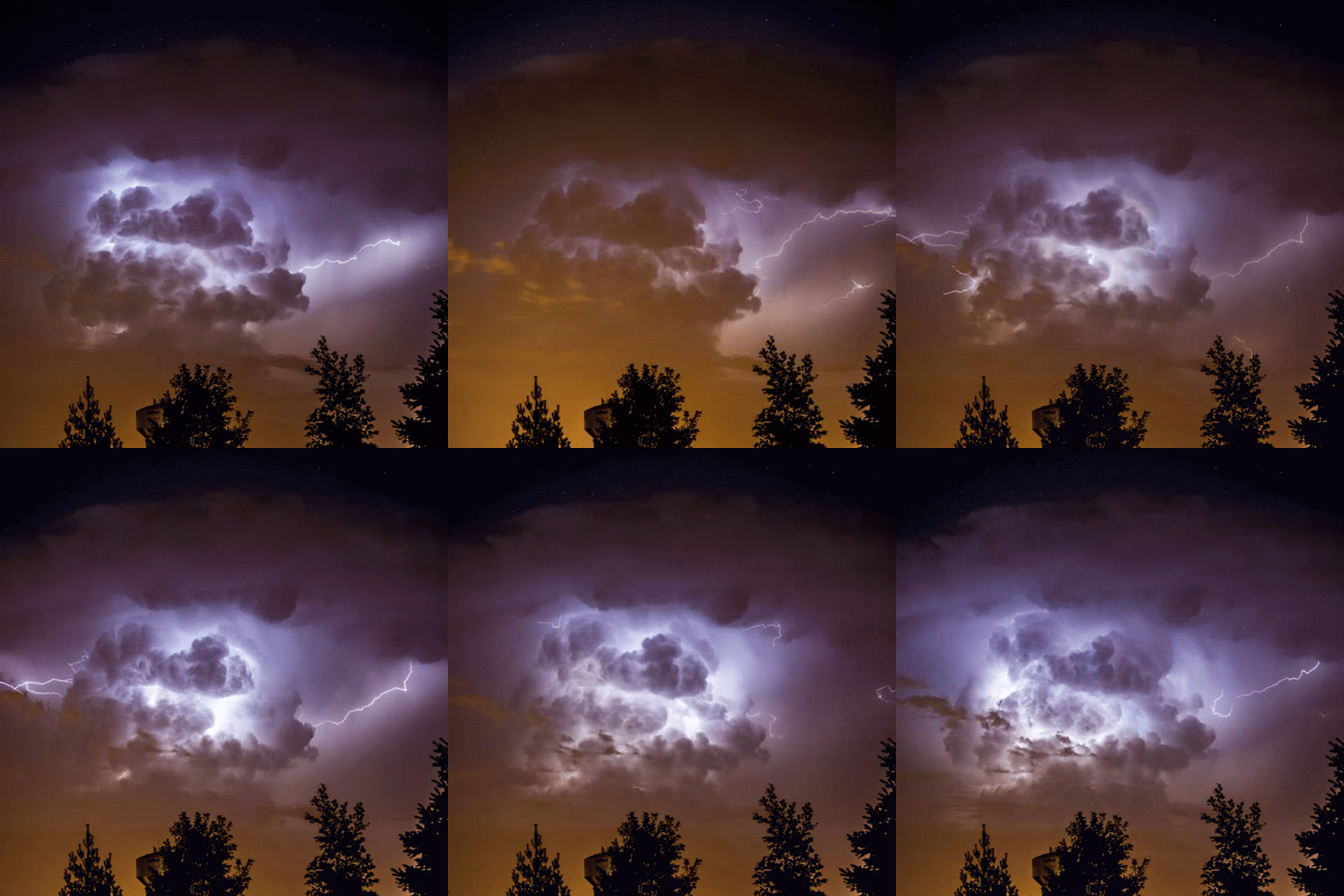
Lightning lit up the night sky
Thunder crashing the world.
My bedroom walls shook.
Windows felt like they were about to explode.
And my foundation crumbled.
I was again back in the jungles.
The fighting happened mostly at night.
The moon hid behind the smoke and branches.
Trees stood still. Everything was quiet but the sounds
Of rifles and rocket launchers and the screaming 
Streaming out of the mouths of children and parents.
There are no winners and losers in war.
There are only civilians who didn’t ask for any of it.


Bunkong Tuon is a Cambodian-American writer and critic. He is the author of three poetry collections and a chapbook. His prose and poetry have appeared or are forthcoming in New York Quarterly, Copper Nickel, Lowell Review, Massachusetts Review, The American Journal of Poetry, carte blanche, among others. He teaches at Union College, in Schenectady, NY.

Sunday, January 10, 2021

ANIMAL FARM 2021:
3. MEGAWA, THE HERO RAT

 by Tricia Knoll


HeroRAT Magawa has been awarded the PDSA (The People's Dispensary for Sick Animals) Gold Medal for life-saving bravery. Magawa is based in Cambodia and supports APOPO's efforts to rid Cambodia of the deadly legacy of landmines. Magawa is an African giant pouched rat that was born in Tanzania in November 2014. He grew up at APOPO's Training and Research center in Tanzania where he learned how to detect the smell of explosives using his nose. Under the loving guidance of his human rat trainer,s he fully completed his training in 9 months and began to prepare to leave for the field. Magawa moved to Siem Reap in Cambodia in 2016 where he met his new handler Malen and began his successful career. To date he has found 39 landmines and 28 items of unexploded ordnance, making him APOPO’s most successful HeroRAT. Over the past 4 years he has helped clear over 141,000 square metres of land, allowing local communities to live, work and play without fear of losing life or limb. (APOPO is an acronym from Dutch which stands for "Anti-Persoonsmijnen Ontmijnende Product Ontwikkeling", or in English, Anti-Personnel Landmines Detection Product Development.)


wears a gold medal around his neck. 
Plain gray hero rat trained to stand up
on his back feet. He smells landmines;
more than sixty pieces of unexploded mayhem
in Cambodia. He alerts and gets banana. 
 
This acknowledgement comes grudgingly
from this woman with a rat trap in her garage
who has smelled rat urine on the lid of a steamer
in her pantry, who wiped up weeks of rat shit
under an antique cherry sideboard. Who when 
danger looms flinches from dream rodents
that scurry where walls meets floors. 
 
Today you asked me to find one reason for hope. 
You rescue orchids in discarded pots and coax
them into bloom. What I offer you after insurrection
and death in the Capitol is this: I give one rat
his due. 
 

Tricia Knoll recently spent more time watching events unfold in the Capitol than she did binge watching The Queen's Gambit. She is a Vermont poet looking forward to introducing a new collection of poetry this spring called Checkered Mates.

Saturday, May 23, 2020

CLOSING THE BOOK ON GEORGE FELL

by Jimmy Pappas


Source: Vietnam Veterans Memorial Fund


Because of this I will weep and wail; I will go about barefoot and naked. I will howl like a jackal and moan like an owl. —Micah 1:8


1.

the page of a book
            can be a leaf
                        can be a butterfly wing

a book in a college dormitory
            on a Saturday night
                        with a young man studying

can be a starting line
            can be a point of departure
                        can be a loaded gun

2.

closing a book
            on a young man studying
                        can be a wormhole

to travel across
            the United States
                         to California

to Vietnam
            to Cambodia
                        to death

3.

I closed the book
on a young man
studying.

A bit of light air
grazed my cheek,
pushed me along.

The weight of air
at sea level is 14.7
pounds per square inch,

but what is
            the weight of air
                         with friendship?

4.

How does a young man studying plead?

Like this: Please, guys, I'm in trouble.
I'm gonna flunk out. I need to study.
Please let me do this.

How does a young man ignore his friend's plea?

Like this: Come on, Man. It's Saturday night.
We're going to party. You can study tomorrow.
There's always time.

5.

How do you close a book on a friend who is studying?
Do what I did: Just take the cover and flip it over.

6.

What makes a breeze?
            The warm air of friendship rises.
            The cold air of ignorance settles.

7.

The breeze moved us through an evening of drinking,
through a day of lounging around until thinking became
exhaustion, became another day of forgetting
until you left us and we forgot about what we did.

8.

pages of a book are many butterfly wings

9.

a chance encounter in a Greyhound bus station

you had the smell
            of fear and death

my friend told you not to go
but you were not one to stir a breeze

10.

On May 23rd, 1970, I saw a giant beetle
lying in a Saigon gutter on its back
struggling with its legs to turn over.

That evening I made love to my girl friend
while you were humping the boonies in Cambodia.

11.

I don't know what the breeze told me that night,
but I did know it would always be there at my back.

It whispered in my ear,

            remember
                        butterfly wings are leaves

            remember
                        leaves of a book are butterfly wings

Something happened. I didn't know what it was.

12.

When I learned about your death,
I could not understand one thing:

How could anyone
            have expected you
                        to kill another human?

13.

I wear my military jacket to get in the mood.
I find your name on the Wall.

I place my
            right knee
            on the ground
I place my
            left arm on
            my left knee

In my right hand I hold a piece of paper
with a handwritten couplet on it:

Over the distance of 10,000 miles I heard your cry
of how very very much you did not want to die.

I set the paper down at the base of the Wall.
I rested my forehead on my arms. I could not pray.
I wanted to cry, but I was unable to.
Instead, I looked up and stared at my reflection.
I placed two fingers against your name on the Wall.

Behind me, elementary school children on field trips
ran through the grass laughing. They have not yet learned
that the world they see today will not be the same world
tomorrow. A breeze will blow and carry them along.
Today they do not understand, tomorrow they will.
They will feel the breeze and understand the butterfly.

One young boy who hangs back,
            frightened
                        by all the noise,
reminds me of George Fell,
            who must have been
            the gentlest soldier
            who ever lived.


Jimmy Pappas served in South Vietnam during the war as an English instructor with South Vietnamese soldiers in helicopter training. At the same time, George Fell, his friend from college, died in the incursion into Cambodia on May 23, 1970. On that day, commanders announced the death of 190 American soldiers, 500 South Vietnamese soldiers, and 8,000 "enemy troops" in what was described as a "success." One day, several years before that, Jimmy and his friends closed a book on George while he was studying one Saturday night. George flunked out of school, and their paths went in different directions. To this day, George's college friends still love him.
Thursday, August 23, 2018

OH YES HE'S THE GREAT NEGOTIATOR

by George Salamon


"'We Didn’t Really Want to Weigh In:' An author defends his decision to write a new book celebrating Henry Kissinger."
—Slate, August 15, 2018

“Oh yes I'm the great pretender / I seem to be what I'm not (you see)”
—“The Great Pretender” by Buck Ram, recorded by The Platters, 1955


Let's celebrate the new and
Forget the old Henry Kissinger.
Never mind the coup in Chile,
Too bad about the slaughter
In Vietnam, Cambodia and Laos,
Who remembers those
Tortured bodies in Indochina?
Henry was the great negotiator,
Negotiating the best deal for
Democracy, Mom and Cherry Pie.
So all you hothead moralists,
You professors of American flaws,
It's time rethink the role of
Henry Kissinger, to reevaluate,
And to revise, but not, I urge you,
To regurgitate.


George Salamon respects Henry Kissinger for never dropping that German accent. Would anybody have listened to him if he had?

Thursday, May 19, 2016

A KISSINGER IS STILL A KISSINGER

by George Salamon


You must remember this
As our government bestows a kiss.
It's still the same old story
For a warmonger seeking glory.
We forget the sins of the past:
Russian Jews? Let 'em be gassed.
Cambodian women and children?
Bomb 'em by the million.
The democratic government of Chile?
We'll overthrow 'em in a jiffy.
Henry faithfully served Richard Nixon,
To whom he felt intellectually superior,
But owes his career to being up Tricky's posterior.


George Salamon has followed the exploits of Kissinger since the days both spent time in Cambridge, MA.

Thursday, September 05, 2013

UNCLE SHAM

by The Bangkok Bards 
Saknarin Chinayote & Charles Frederickson


   Decades of incessant bullyrag meddling
    Dysfunctional US versus THEM universals
    Imposing patriotic homeland socialized insecurity
    Anti-communism anti-terrorism anti-violence anti-clockwise rotation
    
    Having rained napalm white phosphorous
    Agent Orange misty bunker busters
    Misguided drone missiles peed upon
    Raging bonfires burning themselves out
    
    Contrived false truths catastrophic consequences
    Innocent Vietnamese Cambodians Iraqis Afghanis
    Pakistanis Yemenis Serbs Somalis Libyans
    Prejudged guilty debunking good intentions
    
    Bloated Cold War machine should’ve
    Been dismantled demobilized long ago
    Collateral damage exceeding exaggerated threats
    Spymeister propaganda bamboozling public awareness
    
    Taxpayer loot morally bankrupt squandered
    Faceless faded greenback Monopoly revenue
    Funding well-greased assembly line productivity
    Chancy condemned Boardwalk private property
    
    Thousands of minors major challenge
    Overburdened underage deprived of childhood
    Dispossessed ghosts haunting boogeyman nightmares
    Brainless etchings permanent indelible tattoos


No Holds Bard Dr. Charles Frederickson and Mr. Saknarin Chinayote proudly present YouTube mini-movies @ YouTube – CharlesThai1 .

Monday, December 17, 2012

DECEMBER ONCE AGAIN

by Diana Woodcock


"Jazz Beat" painting by Debra Hurd


What can I write to shed light
on this dark December night?
A Connecticut town grieves for
twenty-six dead—victims of the latest
school shooting.  Tibetans are setting
themselves on fire for freedom,
ninety-five since February, 2009.
Listening to musicians walking the bass,
feathering the line, I let the blues take me,
wrap me in the Great Mystery.

All are one, meant to sing and sway
together, to love.  The blues is all about
love, longing, loss, listening,
improvising, sharing our stories and
struggles, recognizing each other
as sister and brother.

Look into the faces around you
moved by music—see how they
seem familiar?  What better way
to pray for justice, an end to violence,
than to sway to the swing of jazz?

A Pakistani girl shot in the head
because the Taliban cannot understand
her hunger and yearning for higher
learning; they do not recognize
she is their sister.  Let the blues take me.
shape my prayer for peace, lead me
to transcend nihilism, alienation.

Listening to the blues, to the sounds of
migrant workers in this oil-rich desert town.
Thinking about blood diamonds,
underground railroads, women and girls
sold into the sex trade.

This is Advent season, time
for preparing for the light.
Long dark December nights.
Listen to the blues.  Gaza.  Aleppo.
Keep listening.  The call to prayer
mid-day, the mosque.  Revisionist
Zionist leaders.  Jihad.  Refugees.
Cambodian children amputees
still playing among landmines.

Dear jazz drummer, please
keep feathering the line.


Diana Woodcock’s first full-length collection, Swaying on the Elephant’s Shoulders—nominated for a Kate Tufts Discovery Award—won the 2010 Vernice Quebodeaux International Poetry Prize for Women and was published by Little Red Tree Publishing in 2011.  Her chapbooks are In the Shade of the Sidra Tree (Finishing Line Press), Mandala (Foothills Publishing), and Travels of a Gwai Lo—the title poem of which was nominated for a Pushcart Prize.  She has been teaching at Virginia Commonwealth University in Qatar since 2004.  Prior to that, she lived and worked in Tibet, Macau and Thailand.

Friday, June 12, 2009

TO KAING GUEK EAV

by Ann Malaspina

Kang Kek Iew (Comrade Duch) at the age of about 17Comrade Duch at age 17. Image via Wikipedia


PHNOM PENH, Cambodia – Khmer Rouge guards killed babies by battering them against trees under an official policy to ensure the children of the brutal Cambodian regime's victims could never take revenge for their parents' deaths, the group's chief jailer testified Monday. Kaing Guek Eav, alias Duch (pronounced Doik), said he was to blame for the brutal killing of infants as the commander of the Khmer Rouge's notorious S-21 prison in Phnom Penh during the 1970s. - Associated Press Writer Sopheng Cheang, June 8, 2009


You thought what is gone
can’t come back for revenge
and you were right,
but haunting is still possible.
Deep in the night
they appear like new bamboo
shooting up from black soil
in the swamp --
so pale, you see each vein
and muscle, brave bones
and beating hearts.
So strong, they will
grow high as the sun
and not bow to wind
or drought. Their voices
rise up, a soaring chorus
impossible not to hear.
They'll never leave you;
and still you speak
of them by day
as if you have no shame.


Ann Malaspina is a former newspaper reporter and children's book author living in Northern New Jersey.
__________________________________________________
Reblog this post [with Zemanta]