Guidelines


Submission Guidelines: Send 1-3 unpublished poems in the body of an email (NO ATTACHMENTS) to nvneditor[at]gmail.com. No simultaneous submissions. Use "Verse News Submission" as the subject line. Send a brief bio. No payment. Authors retain all rights after 1st-time appearance here. Scroll down the right sidebar for the fine print.
Showing posts with label veterans. Show all posts

Tuesday, November 04, 2025

INTO THE DARKNESS

by Karen Marker


AI-generated graphic by NightCafé for The New Verse News.


If this isn’t the end, I don’t know what is.

I didn’t always wake up feeling this weary, 

feeling the pain of the wound in my chest

like I held a dead child. Like someone 

had stolen my sword and the light

of the grail was gone. I used to sleep 

through the night, trusted the widening gyre 

was leading me out of the dark.


If this isn’t the end, I don’t know what is 

after he flat out said he’s sending the military 

into our cities because he’s sick of the mentally ill, 

addicted, disabled, veterans, the hungry, unhoused, 

that he’s sick of those who come in needing shelter, 

jobs, a better life, that he’s sick of protestors.


I didn’t always wake up this worried

that if the Department of War blows up ships 

in the Caribbean they say are carrying drugs,  

ignoring all laws, it won’t be long before 

they’re waging war on us to make the world safer 

for the billionaires, sending off the unwanted

to concentration camps in the desert.


If this isn’t the end, I don’t know what is 

after the government shut down goes on and on

while the thugs on the streets get paid

to carry out “the Lords’ work.”


If this isn’t the end, I don’t know what is

except a comet coming straight at the Earth 

and all of it exploding.


Karen Marker is an Oakland, CA. poet activist who has committed to  writing a poem a day of protest and hope in response  to current events. Her first poetry book Beneath the Blue Umbrella came out recently with Finishing Line Press and explores family mental illness, stigma and healing. 

Saturday, August 31, 2024

ALTERCATION IN ARLINGTON NATIONAL CEMETERY

by Jerome Betts


The war-time dead, thanks be, sleep sound
Where laid to rest in hallowed ground
Immune to campaign cheers and boos
Or use by self-obsessed yahoos.


Jerome Betts lives in Devon, England, where he edits the quarterly Lighten Up Online.

Saturday, May 23, 2020

CLOSING THE BOOK ON GEORGE FELL

by Jimmy Pappas


Source: Vietnam Veterans Memorial Fund


Because of this I will weep and wail; I will go about barefoot and naked. I will howl like a jackal and moan like an owl. —Micah 1:8


1.

the page of a book
            can be a leaf
                        can be a butterfly wing

a book in a college dormitory
            on a Saturday night
                        with a young man studying

can be a starting line
            can be a point of departure
                        can be a loaded gun

2.

closing a book
            on a young man studying
                        can be a wormhole

to travel across
            the United States
                         to California

to Vietnam
            to Cambodia
                        to death

3.

I closed the book
on a young man
studying.

A bit of light air
grazed my cheek,
pushed me along.

The weight of air
at sea level is 14.7
pounds per square inch,

but what is
            the weight of air
                         with friendship?

4.

How does a young man studying plead?

Like this: Please, guys, I'm in trouble.
I'm gonna flunk out. I need to study.
Please let me do this.

How does a young man ignore his friend's plea?

Like this: Come on, Man. It's Saturday night.
We're going to party. You can study tomorrow.
There's always time.

5.

How do you close a book on a friend who is studying?
Do what I did: Just take the cover and flip it over.

6.

What makes a breeze?
            The warm air of friendship rises.
            The cold air of ignorance settles.

7.

The breeze moved us through an evening of drinking,
through a day of lounging around until thinking became
exhaustion, became another day of forgetting
until you left us and we forgot about what we did.

8.

pages of a book are many butterfly wings

9.

a chance encounter in a Greyhound bus station

you had the smell
            of fear and death

my friend told you not to go
but you were not one to stir a breeze

10.

On May 23rd, 1970, I saw a giant beetle
lying in a Saigon gutter on its back
struggling with its legs to turn over.

That evening I made love to my girl friend
while you were humping the boonies in Cambodia.

11.

I don't know what the breeze told me that night,
but I did know it would always be there at my back.

It whispered in my ear,

            remember
                        butterfly wings are leaves

            remember
                        leaves of a book are butterfly wings

Something happened. I didn't know what it was.

12.

When I learned about your death,
I could not understand one thing:

How could anyone
            have expected you
                        to kill another human?

13.

I wear my military jacket to get in the mood.
I find your name on the Wall.

I place my
            right knee
            on the ground
I place my
            left arm on
            my left knee

In my right hand I hold a piece of paper
with a handwritten couplet on it:

Over the distance of 10,000 miles I heard your cry
of how very very much you did not want to die.

I set the paper down at the base of the Wall.
I rested my forehead on my arms. I could not pray.
I wanted to cry, but I was unable to.
Instead, I looked up and stared at my reflection.
I placed two fingers against your name on the Wall.

Behind me, elementary school children on field trips
ran through the grass laughing. They have not yet learned
that the world they see today will not be the same world
tomorrow. A breeze will blow and carry them along.
Today they do not understand, tomorrow they will.
They will feel the breeze and understand the butterfly.

One young boy who hangs back,
            frightened
                        by all the noise,
reminds me of George Fell,
            who must have been
            the gentlest soldier
            who ever lived.


Jimmy Pappas served in South Vietnam during the war as an English instructor with South Vietnamese soldiers in helicopter training. At the same time, George Fell, his friend from college, died in the incursion into Cambodia on May 23, 1970. On that day, commanders announced the death of 190 American soldiers, 500 South Vietnamese soldiers, and 8,000 "enemy troops" in what was described as a "success." One day, several years before that, Jimmy and his friends closed a book on George while he was studying one Saturday night. George flunked out of school, and their paths went in different directions. To this day, George's college friends still love him.

Thursday, May 14, 2020

THE SAME RULES APPLY

by Sam Barbee


Ruddy scar protracts the kept
thatch. Rusty shovels propped
as the backhoe heaves beside
the Common Grave: so many
paupers, so many people.

Pine box as caress, no time
for a tight-lipped benediction.
Spray of silt for mantles of boroughs,
and heights and neighborhoods.
No time for individual petitions.

No last kiss, or cross. Veterans
without flags or rifles on this
drab afternoon of a drab dawn.
Trees along the river, quiet field
where pigeons do not bother.

Death’s centrifugal angst plotted
within the City’s adaptable aura.
Time to seal today’s thawing dead.
The diesel throttles up. PPE-clad
laborers, leather palms tight.

Topsoil chokes off creeds, and
rings and rosaries, worry beads.
Distant tugboats sail the Hudson.
Gulls spiral behind their churning
murk, below pinwheels of gray clouds.


Sam Barbee’s poems have appeared Poetry South, The NC Literary Review, Crucible, Asheville Poetry Review, The Southern Poetry Anthology VII: North Carolina.  His second poetry collection That Rain We Needed (2016, Press 53) was a nominee for the Roanoke-Chowan Award as one of North Carolina’s best poetry collections of 2016.

Friday, August 23, 2019

YOU DON'T

by Laura Rodley


The roll call of deceased unit members, which included 10 men killed in action, was an emotional time for Vietnam veterans who reunited in Berea, Ohio on August 9, 2019. "Even though we have had some sleepless nights, some dreams we want to forget, the remembrance of PTSD, and Agent Orange that just won't let go, we continue to be grateful and to stand for our flag," said the Chaplain. Photo credit: Beth Mlady/Special to cleveland.com, August 17, 2019


You don’t know him, he doesn’t
ask to be known, he won
a bronze star for valor
in Vietnam, he shops
on senior discount Tuesdays
at Big Y, at least he used to.
He doesn’t go out anymore,
even outside. You wouldn’t
recognize him, he’s just an
average Joe in a linen shirt,
rhythm of helicopters whirring
in his head. The Fourth of July,
Friday night fireworks in Ocean Park?
He’s seen enough fireworks, mortar
shell explosions, lights exploding,
himself exploding, he doesn’t want
any reminders. But ask for recognition,
no, valor of Vietnam vets unspoken,
stationed in Da Nang, ground zero for Agent Orange,
his early heart attack just a fluke
the doctor said, hearing loss due to age.
He slept next to a mortar shell field.
They blew up all the time.
He’s not asking anything
from his country that he served,
just to be left alone.

He only has to be as tall
as the ceiling of his livingroom,
where he chomps Fritos, swallows Cokes,
he doesn’t have to see behind him,
beside him, below him as the chopper
brings him base to base to allocate
and release funds, he doesn’t
have to see through forests, they
were denuded by Agent Orange,
someone could drop down on him
from above, but not while
he’s in front of the T.V. The front
door is locked, a cheap remedy
against machine gun fire.
He only has to manage the space
of the couch, the clicker, even
the screened-in porch reveals
too much green, someone could
be hiding in those maples, oaks,
kudzu, and that’s not paranoia,
it was real for him for two tours,
someone hiding to do him harm,
annihilate him and nothing but
his dog tags to know his name.
He would not call this being afraid,
nor is he: he is aware, hyper-aware
of leave rustle, door closing, pop-top
of the can breaking open, the fizzle
of foam. Everything he does saves
his life and those of the men he
served with- not one of them taught
to act alone but as a unit, always
aware of his buddy, aware of combat
boots squishing in the mud of rice paddies
beside him. Hyper-aware of
everything outside of him to save
them all, but nothing but his finessed reaction
for shooting or readiness to bail out of the chopper
of his own internal life. He
lived outside himself, his body, and
having survived when so many
he knew did not, he brought
it all home with him, where
it breathes in the livingroom
with him, he can’t close his eyes,
it’s inside him now, it won’t get out,
won’t let him go.


Laura Rodley, Pushcart Prize winner is a quintuple Pushcart Prize nominee, and quintuple Best of Net nominee. Publisher Finishing Line Press nominated her Your Left Front Wheel Is Coming Loose for a PEN L.L.Winship Award and Mass Book Award. FLP also nominated her Rappelling Blue Light for a Mass Book Award. Former co-curator of the Collected Poets Series, Rodley teaches the As You Write It memoir class and has edited and published As You Write It, A Franklin County Anthology volumes I-VI, also nominated for a Mass Book Award. She was accepted at Martha’s Vineyard’s NOEPC and has been a participant in the 30 poems in November fundraiser for the Literacy Project of the Center for New Americans. Latest books: Turn Left at Normal by Big Table Publishing and Counter Point by Prolific Press.

Wednesday, July 03, 2019

THE COMMISSIONER OF TRANQUILITY

by William Aarnes 


from the 2019 Independence Day speech


What’s troubling shouldn’t trouble us.  Whatever the news,
only the seditious believe the caging of refugee children

will go on too long.  Maybe, in some subversives’ imaginations,
addicts will keep overdosing.  Maybe storms will devastate

the islands where we vacation.  Maybe dictators will stay
in power in some foreign countries, countries where the rich

can count on the police but the poor can’t.   Maybe
in the once murky past hard-working laborers couldn’t pay

their rent—but never in this land of promise, never
in the comfort of our time.  We’re blessed we can focus

on the inspiring resolve of those families rebuilding
their burned-out homes. We’re lucky we can relish

hearing a decorated veteran belt out our national anthem
as if she’s cured of her PTSD, the athletes singing along,

all of them with hands on their hearts.  And aren’t we charmed
by the fourth-grade teacher who’s earned a raise

by bringing a gun to school?  Why give a moment’s thought
to hardships suffered by people who deserve them?

Didn’t our parents say, “Look on the bright side”?
Only those who belong elsewhere would deny that life

in our beloved country is the epitome of the bright side.
Why should we put up with any doubt?   Everyone’s happy

that what’s happening can never happen to us.


William Aarnes lives in South Carolina.

Monday, June 10, 2019

HISTORY

by Howard Winn


A D-Day commemoration on the beach of Arromanches in France on June 6, 2019, marking the 75th anniversary of the Allied landings in Normandy in World War II. (Joel Saget/Getty-AFP via Chicago Tribune)


of D Day by genetic fate
there is no escape
is where I find myself
with only three percent left
it seems The Greatest Generation
labeled by that newsman who
needed a catchy concept to draw
his audience for the news of the day
when other networks stood ready 
to step in to alter the ratings so
he found the catchy concept for
the mostly children drafted some 
out of high school to be the new
war heroes even though the survivors
kept quiet about their sacrifices 
often with loss of limbs
they were as voiceless as the bodies
buried in those field of crosses in
France where the living might 
have found them selves if they
were as unlucky as those who
survived to become portrayed in
the films of the next life leaving
today only the three percent who
movies seem to give permission to
recount the history they had kept
secret about until the later wars
involving their children gave some
permission to reveal fears and cruelty
for those survivors once silent veterans 
of that conflict between the dead and 
the emotionally quiet and silent for
history to become reality not just story


Howard Winn publishes widely in literary journals such as the Hiram Poetry Review and Valley Voices Journal. His novel has been published by Propertius Press.

Monday, May 27, 2019

DEATH IS NOT THE ULTIMATE SACRIFICE

by j.lewis


although it puts what seems to be
a ragged stamp of finality
on unstarted and unfinished dreams

we mourn and we remember those
who took one for the team
for a vaguely defined cause
that slips our grasp like crude

"they died for our freedom"
is the standard line, and holds
true for very few of the conflicts
america has so willfully embraced

no one dares recite a line like this:
"they died to make a corporation richer"
or "we honor them with every tank of gas"
because to proclaim the emperor's nakedness
can get you a lot of hassle these days

and certainly, no one wants to ponder
the sacrifice of those left alive
the daily waking up dying
from loneliness, poverty, insecurity
children to carry on shoulders
already rounded with the weight
of grief, of love's candle snuffed

no, the ultimate sacrifice is not death
but living, pushing through the darkness
finding strength beyond self, and still
in spite of it all, believing
that this imperfect country
is the greatest place on earth


j.lewis has an irritating habit of asking about the collateral damage of war: the families of slain soldiers, and how they manage to keep on keeping on. His first collection of poetry, paired with his own photography, is available from Amazon.

Wednesday, May 30, 2018

ANOTHER MEMORIAL DAY

by Howard Winn

NORWALK, CT — While stationed in northeast India during World War II, Nick Samodel repaired cargo planes that hauled supplies over the towering Himalaya Mountains to allied soldiers fighting the Japanese. “We had five airbases close to the mountains,” said Samodel, who served as an aircraft mechanic in the U.S. Army Air Corps. “We had to change the engines and fix oil leaks — that was a big problem because at high altitudes the oil leaks out through the seals. It takes a lot of maintenance. We lost some planes. They found one 10 years ago on the side of a mountain.” On Monday, Samodel, 97, of Norwalk,  served as grand marshal in the 2018 Memorial Day Parade. —The Hour, May 26, 2018


Summer begins
and the ice cream shop
on the corner
opens for the season
while the families
gather on the corner
of Route 77 and Shore
Road to applaud
the earnest children
in the high school band
marching by led by the
grizzled World War II
survivor wearing his
old uniform which he
must preserve in a clothes
bag at the back of a closet
to remember once a year
the deaths in the Battle
of the Bulge or the killings
in the Western Pacific or
perhaps just service in Army
Supply in New Jersey where
heroes not quite lurked in view of
the sea and vacation beaches
and waited for discharge
while spending time being
entertained by the young
women volunteering for
time to party in the USO
so war could be forgotten
for a social moment to be
resurrected each year on
Memorial Day dedicated to
the waste of war even good ones
for patriotism is both the flaw
and the consequence of nationalism
even when reduced to jingoism


Howard Winn's novel Acropolis is published by Propertius Press. He has poems in the Pennsylvania Literary Journal and in Evening Street Magazine.

Friday, June 30, 2017

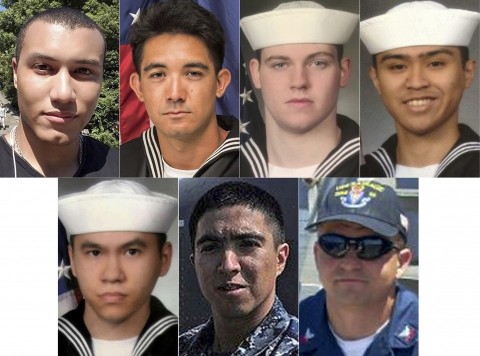
SEVEN SAILORS

by Eric Weil


TOP, FROM LEFT: Xavier Alec Martin, 24; Shingo Alexander Douglass, 25; Dakota Kyle Rigsby, 19; Carlos Victor Ganzon Sibayan, 23. BOTTOM, FROM LEFT: Ngoc Truong Huynh, 25; Noe Hernandez, 26; and Gary Leo Rehm Jr., 37. (U.S. Navy via AP via The Washington Post, June 19, 2017.) Their snapshot stories from the AP can be read in The Star-Tribune.


The president disparages immigrants.
My great grandfather Bernat stepped off the boat
about 1880 with no papers, before Ellis Island.
Seven US sailors died when a container ship

T-boned their missile destroyer. Bernat fled
southwest Germany’s pogroms, local tornados
to the future’s hurricane named Holocaust.
Seven sailors bunked in friendly seas. Bernat

sold shoes. The seven ring the watch-bell
of America’s immigrant present and past:
Douglass, Hernandez, Huynh, Martin, Rehm,
Rigsby, Sabayan. Bernat raised a son

drafted for WWI, who raised a son drafted
for WWII, who raised a son whose number
just missed Vietnam. The seven volunteered.
Bernat’s citizenship paper, dated 1885, adorns

our guest room. Photos of the seven line
America’s front pages and will hang
as memorials in seven American homes
while the president disparages immigrants.


Eric Weil teaches at Elizabeth City State University, in North Carolina.  His poems have appeared in journals ranging from American Scholar to Poetry and from Dead Mule to Sow's Ear.

Monday, May 30, 2016

MEMORIAL DAY

by William Cullen Jr.


Relative places flowers at one of the tombstones in the Los Angeles National Cemetery (then the Sawtelle Veterans Cemetery), where flags were posted for Memorial Day, 1940. This photo was published in the May 30, 1977 Los Angeles Times.


We walk down the rows
in a Civil War cemetery
like we were inspecting the troops
looking for one particularly
outstanding soldier
to pin a medal onto
instead of laying down flowers
in the pouring rain
on a great-great uncle whose name
escapes both us and his headstone.


William Cullen Jr. is a veteran and works at a social services non-profit in Brooklyn, NY. His poetry has appeared in *82Review, Canary, Gulf Stream, Right Hand Pointing, Spillway and Written River: A Journal of Eco-Poetics.

Tuesday, March 15, 2016

REQUIESCAT IN PACE

by Joseph Powell


Let’s have a moment of silence,
for the end of civility
as we know it;
maybe even,
for the end of civilization;
let the trumpet sound, ‘Taps’
for all this talk about progress;
about how we’ve come so far,
only to turn it around,
and retreat backwards
into oblivion,
into, what was it all about, Alfie?
I hear blood crying from the ground;
I hear the rumble of bodies
turning over in their graves;
the screams of
“This is not what we died for!”
too loud for me to think.
I know they can’t rest in peace,
because we haven’t learned
to live in peace.
And the rain continues to fall
on the just,
while the unjust live in denial,
believing that they alone,
own the sun.
And God cries,
Damn it!
over the U.S. of A.
because
how can He bless
this mess?

It’s too much to take,
sensory overload and such;
I simply want to close my eyes
and ears,
and rest in peace;
but there will be no peace,
while chaos is the order of the day,
and the inmates are running the asylum.

All I can do,
is keep eyes wide open;
with pen in right hand,
and left fist,
held defiantly in air;
say a prayer,
as I march into battle,
clothed with little more
than the truth,
to fight
yet another day.


Joseph Powell is a poet and writer and the author of three collections of poetry: Joby, Uninterrupted: Bittersweet Symphonies and Bohemian Rhapsodies (1989-2009), Poetry Man, and The Writing’s On The Wall.  He is also the creator and author of the blog The Joby Chronicle. Originally from Chicago, Illinois, he relocated last year to Nashville, Tennessee from Burbank, California. He holds a Bachelor of Arts in Communications from Greenville College in Illinois. He has performed at a number of venues around the country including the Austin International Poetry Festival and, most recently, the Tucson Festival of Books. His work has been featured in a variety of print and online journals, including the Nashville-based Calliope magazine. He cites James Baldwin and Maya Angelou as his primary influences and credits his girlfriend, Cindi, and stepdaughter, Santi, as his motivating forces.

Thursday, January 21, 2016

THE YOUNG SOLDIERS OF GUANTANAMO

written on January 11, 2016, the fourteenth anniversary of the opening of Guantanamo Bay detention camp

by Buff Whitman-Bradley


Image source: Amnesty International: Guantanamo’s Poetry


I try to imagine the young soldiers
Given the job of interrogating
The prisoners of Guantanamo

I try to imagine them being repulsed
By what they were ordered to do
But afraid to disobey

I try to imagine the moral crises
They may have undergone
And the collateral damage to their souls

I try to imagine surreptitious rebellions of kindness
A smuggled pencil a friendly word a bit of extra food
A hand reaching out from the wreckage of the self

I try to imagine the nightmares of cruelty
Those young men carry with them
Into their civilian lives

For generations we have filled the haunted streets
With the discarded veterans
Of our perverse wars

For generations we have practiced the art
Of mangling the spirits
Of foe and friend alike

I try to imagine a world nearly here
Where torturers and tortured
Look as equals into each other's eyes

Where the young soldiers of Guantanamo
Come to realize they have more in common
With those they tortured than with those giving orders

Where the brutalized and debased and shattered
May howl their pain and rage
And their tormentors will not turn away

Where both will become healed and whole
From what was done to them and what they did
And will walk among us with great tenderness


Buff Whitman-Bradley's poetry has appeared in many print and online journals, including Atlanta Review, Bryant Literary Review, Concho River Review, Crannog, december, Hawai'i Review, Pinyon, Rockhurst Review, Solstice, Third Wednesday and others. He has published several collections of poems, most recently, To Get Our Bearings in this Wheeling World. His interviews with soldiers who refused to fight in Iraq and Afghanistan became the book About Face: Military Resisters Turn Against War. He lives in northern California with his wife Cynthia.

Wednesday, July 09, 2014

IT IS BROKEN

by Janet Leahy


Because the veterans are waiting
their names on a list at V A hospitals.

Because we don’t know the stories
of the men and women who return from war.

Because we do not ask, do not visit
do not reach out.

Because the truth is illusive
and we stumble with language.

Because care is delayed
records falsified.

Because appointments are canceled
calls not returned.

Because when names fall from the wait list
someone receives a bonus.


Janet Leahy writes poetry in New Berlin, Wisconsin.  A member of the Wisconsin Fellowship of Poets, she has two collections of poetry, The Storm, Poems of War, Iraq and Not My Mother’s Classroom.

Sunday, May 25, 2014

MEMORIAL DAY 2014

by George Held


These (mostly) young men and women
Have fought and died for our freedom –
Nasty business, but someone has to do it –
So the least we can do is honor them
Once a year on Memorial Day, which,
Sadly, fell on May 31st, making
A floating holiday, so in our wisdom,
And eternal quest for convenience, we
Fixed it on the last Monday in May, this year
The 26th, leaving the 31st to end
The month on Saturday. So on the 26th
Let us march in or watch a parade
To honor our (mostly) young at-the-time-
Of-their-death veterans of our wars. Amen.


An occasional contributor to The New Verse News, George Held occasionally blogs at www.georgeheld.blogspot.com

Tuesday, December 17, 2013

WORLD APART

by Kit Zak


Here in this world apart
from Syria’s shoeless kids freezing in Lebanon’s snow
we recheck our Santa’s list
detailed requests from our children
who track every advance in I-phones.

Here in this world apart
from tent cities not just in Bekaa Valley
but in our own hometowns
we push the thermostat up two degrees
then rush to our waiting car.

Here is this world apart
from the country and cities of Syria
where the slaughter does not cease
one hundred and ten thousand and counting
we plan our holiday entertainment.

Here in this world apart
eyes shut to our hungry and sick
and the sixty thousand vets searching shelter
we close our minds to thoughts of oligarchy
believing still in a country with justice for all.


Kit Zak lives with her husband in Lewes,  DE. She has most recently had poems published in an anthology about motherhood as well as in the following journals: Avocet: A Nature Journal, The Blue Collar  Review,  and A Time of Singing.

Tuesday, December 03, 2013

BASTARD GHAZAL FOR THE DEATH OF SNAP

by Lauren Schmidt


Photo by James Mollison, via NPR,  from his book Where Children Sleep: Portraits From Around The World. Alyssa, an only child, lives with her parents in Kentucky, in Appalachia — a beautiful, mountainous region that is also one of the poorest parts of America. Their small, shabby house, heated only by a wooden stove, is falling apart. Alyssa's grandmother, uncle and orphaned cousin live close by.


At the start of [November 2013], low income recipients of SNAP throughout the country experienced a reduction in their SNAP benefits due to the expiration of a temporary increase provided through the American Recovery and Reinvestment Act (ARRA) to help families through a difficult economic period. A family of four saw their SNAP benefits fall by $36 a month, or 5 percent, as a result of this change. All SNAP recipients were affected, including nearly 22 million children (10 million of whom live in “deep poverty,” with family incomes below half of the poverty line) and 9 million people who are elderly or have a disability. Additionally, nearly 900,000 veterans and 5,000 active duty service members experienced benefit reductions, according to estimates by the Center on Budget and Policy
Priorities. --- White House Report, November 2013

Without the Recovery Act’s boost, SNAP benefits will average less than $1.40 per person per meal in 2014.”

                                                —Center on Budget and Policy Priorities, August 2, 2013


The sound a whip makes on the hide of a steed—SNAP!—
to keep the needy in need, enough to believe: SNAP.

They just changed the name, “Food Stamps” to “Assistance.”
An Act renamed to stay the same. The “reconceived” SNAP.

Not Recover as in restore, but cover again.
Not Act as in action, but as in make-believe: SNAP.

To remove all the shame, the stigma of need.
To say no blood in bleeding when skin has been cleaved: SNAP.

Instead of stamps, plastic cards, what the public sees,
but separate bundles at the checkout, the public is peeved: SNAP.

Because EBTs don’t cover diapers or cleaners,
or soaps or toilet paper or Christmas Eve: SNAP.

In 2014, only $1.40 per mouth per meal.
A heavy burden for young mothers to heave: SNAP.

This is a poet’s plea to Senator Reid.
Benefits will bleed.  It’s time we all grieve the SNAP.


Lauren Schmidt is the author of three collections of poetry: Two Black Eyes and a Patch of Hair Missing; The Voodoo Doll Parade, selected for the Main Street Rag Author’s Choice Chapbook Series; and Psalms of The Dining Room, a sequence of poems about her volunteer experience at a soup kitchen in Eugene, Oregon. Her work has appeared or is forthcoming in journals such as North American Review, Alaska Quarterly Review, Rattle, Nimrod, Fifth Wednesday Journal, New York Quarterly, Bellevue Literary Review and The Progressive.  Her awards include the So to Speak Poetry Prize, the Neil Postman Prize for Metaphor, and the Bellevue Literary Review’s Vilcek Prize for Poetry. Schmidt is an Instructor of Development Reading and Writing at Passaic County Community College and she volunteer teaches creative writing at a transitional house for homeless mothers.

Monday, May 27, 2013

STRANGERS IN WAR

by Howard Winn


Image source: Wodu Media: Inspired By Design


Comrades in arms says the convention,
through thick and thin, fire and ice,
bonding in the mud or the flak filled skies,
singing arm and arm through alcoholic haze
with your buddies because Uncle Same Wants View,
to see what can we say if we walk away
over dead meat, pulpy in decay,
from those who do not make it.
None of them are authentic friends, I am afraid,
the sort from your home town, perhaps,
grown up with,
who know your past.
Party-goers, guests, visitors
to the same happening, passing through,
but friends? I guess not.
Fellow victims of the same old men
with political ambitions,
perhaps.
Even years later, if some connection is made,
there is discovery of disassociation,
or we talk in different languages
even when the subject matter is the same.
The schools we went to are not the same,
nor is the curriculum, official and unofficial.
We are not friends although we survive
the great accidents concurrently.
Players of pinochle or poker together,
or observers of smoke and blaze,
even the illusion of buddyhood
in the stories of common encounters,
does not create friendship.
We do leave the dead behind,
whatever the code,
even if we scoop up the detritus
of life left behind.
I speak from experience.


Most recently Howard Winn has had poems and fiction published in Dalhousie Review, Descant (Canada), Cactus Heart, Main Street Rag, Caduceus, Burning Word,  Pennsylvania Literary Journal. Southern Humanities Review, Cutting Edgz, Borderlands, and The Hiram Poetry Review. His B. A. is from Vassar College. His graduate degree in creative writing is from the Writing Program at Stanford University. His doctoral work was done at New York University and University of California San Francisco. Howard Winn was a psychiatric social worker in California and also taught there for three years. Currently, he is a State University of New York faculty member.

Saturday, May 18, 2013

ENLIGHTENMENT

by B.Z. Niditch


Image source: http://www.stopthesewars.org/


From his base
after Jack enlisted
he changed his mind
to be war resistant
trying to forget
the sand in his breath
and a thousand images
in a state of death,
What am I here for
he would ask
feeling out of breath
as Jack was handed
his appalling gas mask,
pulling his own weight
now hidden with his friend
Jackie in a trench
watching for an enemy
to what fateful end,
yet they became grateful
here on this park bench
when T.V. interviewed
even when AWOL
they called for peace,
their mind was renewed
and the world made sense
when all wars could cease
and they would make
a difference.


B.Z. Niditch is a poet, playwright, fiction writer and teacher. His work is widely published in journals and magazines throughout the world, including Columbia: A Magazine of Poetry and Art, The Literary Review, Denver Quarterly, Hawaii Review, Le Guepard (France), Kadmos (France), Prism International, Jejune (Czech Republic), Leopold Bloom (Budapest), Antioch Review, and Prairie Schooner.  He lives in Brookline, Massachusetts.

Friday, January 04, 2013

ON A CITY BENCH

by B.Z. Niditch


Rinsing dollops
of rain shadows
on a city bench
before the new year
through a foreign
body of thoughtful
reflection,
with his dark glasses
and unshaved manner
in veteran overalls
from another era
since the cold war
of another season
took a few years
off him,
wearied from exile
homeless,
yet still marching
for peace
now with a walker
on rubble
of pavements
pacing near
the back waters
on your city bench
exhausted
in stretched
out fatigues.


B.Z. Niditch is a poet, playwright, fiction writer and teacher. His work is widely published in journals and magazines throughout the world, including: Columbia: A Magazine of Poetry and Art; The Literary Review; Denver Quarterly; Hawaii Review; Le Guepard (France); Kadmos (France); Prism International; Jejune (Czech Republic); Leopold Bloom (Budapest);  Antioch Review; and Prairie Schooner, among others.  He lives in Brookline, Massachusetts.