Guidelines


Submission Guidelines: Send 1-3 unpublished poems in the body of an email (NO ATTACHMENTS) to nvneditor[at]gmail.com. No simultaneous submissions. Use "Verse News Submission" as the subject line. Send a brief bio. No payment. Authors retain all rights after 1st-time appearance here. Scroll down the right sidebar for the fine print.
Showing posts with label city. Show all posts

Saturday, February 14, 2026

A VALENTINE FOR MINNEAPOLIS

by Lisa Shulman


I love the crunch of your boots in the icy streets,
the rhythmic beat of your mittened hands,
the steam of your breath and the heat of your words 
in this brutal cold and ice-clapped world.
I love the chapped red of your cheeks, your dripping nose
the ice crystals on your eyebrows, your hair,
as you carry signs and bags of food and offer your arm
to that woman on the ground.
I love the street medics with their packs,
the rolling neighborhood patrols,
and the cafes open for free soup and coffee.
I love your cousins in Chicago, Portland, L.A.
I love the way you bang on drums, on cans and dumpsters,
your raucous all-night singing,
your harmonies as you kneel on frozen sidewalks,
your whistles and car horns.
I love your walking school buses,
your inflatable frogs, and knit red hats.
I love the warm and flowing river of your bodies
pouring through your city—
blood pulsing through its veins.
I love your courage that ignites our own,
fire melting ice.
I love your heart.


Lisa Shulman is a poet, children’s book author, and teacher. Her poetry has appeared in Sheila-na-gig, About Place, Anacapa Review, Inkfish, Kitchen Table Quarterly, New Verse News, and elsewhere. Her new chapbook is Fragile Bones, Fierce Heart. A Pushcart nominee, Lisa teaches poetry with California Poets in the Schools, and workshops for women in recovery.

Wednesday, August 20, 2025

THE SOUND OF THE WELL

by Shirin Jabalameli


Beneath a cracked and ancient dome,
the wind slips through fissures,
circling the hull of a stranded ship.

Coffee grows cold upon the table,
and the Sufi, in quiet prayer,
speaks to the blackness of a crow.

From the dragon’s mouth
a rope of light leaps forth
onto masks that melt, one by one,
their cracking faces ringing
like a forgotten church bell
through the air of poverty’s hell.

The city,
a fractured mirror,
sees its own face in a thousand shattered pieces
and screams.

The broken tick-tock of a clock
scratches the latch of time’s doors,
and from a silent well
the voice of a child rises,
still remembering the name of their mother.

The crow spreads its wings,
and the wind carries the scent of stale bread.
The Sufi stirs the coffee in a whirlpool
and with a sip drinks the world anew.


Shirin Jabalameli is a multifaceted Iranian artist, poet, painter, photographer, and writer. She has authored books including Crows Rarely Laugh, Apranik, and 101 Moments. Her latest work, an illustrated poetry collection titled 25 Fell from the Frame was recently published. Her poems have appeared in international journals such as Braided Way Magazine (USA), The Lake (UK), and The New Verse News (USA).


Shirin’s poem in its original Persian follows:

صدای چاه

زیر گنبدی ترک‌خورده
باد از شکاف‌ها عبور می‌کند
و بر شانه‌ی کشتی به گل‌نشسته می‌چرخد.

قهوه روی میز سرد شده است
و صوفی در سکوت
با سیاهی یک کلاغ مناجات می‌کند.

از دهان اژدها
ریسمان نور می‌جهد
بر ماسک‌هایی که یکی‌یکی
ذوب می‌شوند،
و صدای ترک‌خوردن چهره‌ها
چون ناقوس کلیسای فراموش‌شده
در هوای جهنم می‌پیچد.

شهر،
چون آینه‌ای ترک‌خورده،
چهره‌اش را در هزار پاره‌ی مخدوش می‌بیند
و جیغ می‌کشد.

تیک‌تاکِ از کارافتاده‌ی ساعت
کلون درهای زمان را می‌خراشد
و در چاهی خاموش،
صدای کودکی می‌پیچد
که هنوز نام مادرش را از یاد نبرده است.

کلاغ بال‌هایش را باز می‌کند
و باد بوی نمِ نانِ کهنه را می‌برد.
صوفی قهوه را در گرداب می‌چرخاند
و با جرعه‌ای جهان را دوباره می‌نوشد.

Tuesday, June 10, 2025

PAGES OF LIGHT (IN DARK TIMES)

by David Chorlton


(1)

Hard to tell

whether the wind 

last night was social unrest

or coyotes’ dreams as darkness flowing.

The lightness of touch suggested

nature whispering

                                 in the face of human discord

yet in the absence of a moon

and with so few stars

to give direction there were only the neighborhood palms

leaning on the moment

                                            as if time

had taken solid form and claimed

the desert underneath

the city as its first

and only home.


(2)

Stone-bright the way ahead

runs true to course, rising by the step

to a view of all things possible

and some

                 forever out of reach. All those things

that never change come what may

are out there, stubborn and holding their ground

through traffic jams and newscasts,

analyses and polls, discussions

that take truth

                           away just as the sun

has stripped first the outer skin

of the saguaro lying

where it fell two summers back

                                                            and subsequently

dried its flesh revealing the core

connecting tip to root, the inner life

revealed in code, an alphabet

surviving after language ends.


(3)

The peaks and dips along the ridge

rest easily this morning

against clouds too closely packed

for news to pass

                               from worlds beyond our own. 

Grey light, pigeon feathers

scattering from the rooftop cooling unit at house

four-three-four-seven

where a hawk endures a mockingbird’s attention

until he stretches out

                                        and eases into day’s grey light.

Nothing exists outside

his range of vision, he’s the headline and the story

circling higher than opinion columns

reach. Doesn’t need words

to know what he knows. Leaves emptiness alone

because the entire sky

                                          isn’t worth

the area he’s taken for a home.


(4)

A bright and tranquil morning

on the way around the pond where red-

eared sliders and secrets

move just beneath the sky

that floats across the surface to the reeds

at the farthest edge.

                                      A Black phoebe picks flies

and rumors from the air.

None are too fast for him,

neither the latest out of Hollywood

nor royalty’s ongoing

struggle to be important. What is true tastes no different

from what is not; he keeps dipping

and swerving

                         through politics, finance

and all the way down

to the feathers and bones left on the ground

still with a glaze of moonlight.


(5)

Arroyo walk, sidestepping the facts and

speculating whether

the boulder resting on the slope just past

where the trail dips came

to be exactly in position after

falling through space

                                        or was coughed out of the Earth.

Some facts are immoveable, too heavy

to be argued about. But someone’s always

naming parts, allocating

numbers, holding science

to the light and insisting explanations

matter more

                       than the experience

of stopping every time

to contemplate the mystery

that built the world before there was

a truth

             to lie about, when

only the stars kept records. 


(6)

Darkness left, light straight

ahead, the first sky of the day can’t decide

which mood to promise. The clouds

are carrying concealed, the sun’s

a lonely heart just waking up. 

One day looks

                          much like another, give or take

the shadows and the low high

in the forecast, rain

this afternoon on a street

for all weathers where showers dance

on asphalt,

                    heat soaks in

and wishes for a better world

go barefoot, once around the cul-de-sac

and back, beyond the visible, beyond

reality, beyond what even

                                                 the hawk can see

from his throne of wind.


David Chorlton lives in Phoenix with a view of a desert mountain and more interesting local bird life than many people expect in a city. The desert still teaches him about poetry in a way academies can never do.

Sunday, December 29, 2024

DRONES

by Alejandro Escudé


Bright lights over the evening sky near Lebanon, N.J., this month. Federal officials have said that most such sightings were airplanes, helicopters, stars or drones being flown legally. Credit: Trisha Bushey/Trisha Bushey, via Associated Press via The New York Times, December 24, 2024


In a way, I write for the drones.

Those asterisks in the sky—blown about

Over the heads of Americans craning upward,

Awakening from their electronic sleep.

Maybe this poem is a little drone, buzzing

Over the armpits of the city, shadows blending

Like metaphors and allusions pending. 

Oh Triborough night! Sophisticated stars,

Billboards tolling silently like clocks signifying

The end of another lifetime. No one knows

What they are, these drones, and at the same time

Anyone can purchase them online. But we like to say

We don’t know what they are more than the fact

That we know them as our own. Drone, 

The very word conjures up a verse simulacrum,

A swarm of contiguous phraseology, eyes

Like microphones sensing each ironic property.

I’d like to see a drone fly into a cathedral,

Buzz the altar, leaving a trail of alien scripture,

Then blend into the largest fresco, a smudge

In the faded sky, like a wet smooshed cockroach 

The size of a large pizza box. But for now,

Let’s be content to observe these melancholic

Visitors, pointing at their axis, the X and the Y,

Their orange lights bifurcating the moon, each 

Triangulated monster pulsing into the distance,

That otherworldly strangeness we crave.


Alejandro Escudé published his first full-length collection of poems My Earthbound Eye in September 2013. He holds a master’s degree in creative writing from UC Davis and teaches high school English. Originally from Argentina, Alejandro lives in Los Angeles with his wife and two children.

Friday, December 29, 2023

WHAT GROWS

by D. Dina Friedman


“Rising Cairn” by Celeste Roberge


from grief, the prickled ball in my heart

The tank imprinting the sands in Gaza.

The baby on the kibbutz, snatched from its mother’s arms.

Grief as breath and breath as grief

pictures of the dead, the missing

slapped on our bland screens. We might know

this child, his laugh. This teen. She worked for peace.

Grief for the plume of smoke outside the window

of the hospital, for the doctor, searching her pockets

as if she might have stashed a pill she’d forgotten,

that could save the life of a patient, writhing, dying. 

Grief, the crevice in the land split by the river

where you think you might walk down and disappear. 

Grief, a drained lake, a parched throat, a bombed city, 

a soldier singing O Sole Mio in the desert at night

because, sometimes, there’s nothing else to do 

but raise your head to the moon 

and sing as if your life depended on it.


D. Dina Friedman has published in over a hundred literary journals and anthologies (including Rattle, The Sun, Calyx, Lilith, Negative Capability, Chautauqua Literary JournalThe Ekphrastic Review, and Rhino) and received four Pushcart Prize nominationsShe is the author of two young adult novels: Escaping Into the Night (Simon and Schuster) and Playing Dad’s Song (Farrar, Straus, Giroux), a short-story collection: Immigrants(Creators Press), and two  chapbooks: Wolf in the Suitcase (Finishing Line Press) and Here in Sanctuary—Whirling (Querencia Press). 

Thursday, December 23, 2021

CATARINA

by Ruby Rodriguez


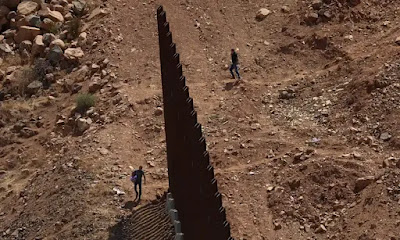
The climate crisis is killing migrants trying to cross the US border, study finds. Many undocumented migrants trying to cross the Sonoran desert into the US from Mexico are dying of dehydration and organ failure. Photo: A group of migrants cross the US-Mexico border in Otay Mesa, California. Photograph: AFP/Getty Images via The Guardian, December 16, 2021


a catarina sits like a cardinal
in a black and white movie
       on my window 
in front of a city of concrete 
       and metal and one giant 
intersection, this city
is nothing but grey cars and roads.

barbed wire is also grey,
morally, physically, 
metaphysically,
       it exists only in the brown
of the Sonora desert dirt
and in the brown of our faces,
       white faces have fences
       brown faces have walls.

but the catarina is too red
the roses in tia’s garden are too 
red
the jalapeños in my fridge are too 
red
     realize
all faces bleed catarina red.


Ruby Rodriguez is a bilingual transgender Latina writer from San Antonio, Texas. Her work has been previously published in La Prensa Texas, at the America Library of Poetry, at the McNay Art Museum, and she is the winner of the Best Poem in Spanish in the second Aline B. Carter Poetry Contest (all under the name of Ricardo, however). She is the poetry and Spanish editor of the digital literary magazine, The Bunker Review.

Saturday, October 03, 2020

IN THE QUIET OF COVID THE WHITE-CROWNED SPARROWS

by Hayley Mitchell Haugen


A new study found that sparrows in San Francisco altered their birdsong to sound more appealing to mates after the COVID-19 pandemic shut down the city. When the pandemic hit—and vehicle traffic slowed down—researchers found that noise levels in San Francisco and other urban parts of the Bay Area reduced by nearly 50%. The shutdown, they wrote, effectively reversed "more than a half-century rise in noise pollution." The birds, as a result, began singing more quietly, hitting lower notes and improving their vocal performance. Elizabeth Derryberry, a behavioral ecologist at the University of Tennessee, told Agence France-Presse that the birds "sounded better, they sounded sexier" to mates. —USA Today, September 25, 2020


In the quiet of Covid the white-crowned sparrows
are tweeting more softly—three times less loud—
than before their urban streets cleared
of the morning mayhem, the rush and tumble
of the human lives they once pitched
their calls above to be heard. Suddenly,
the airwaves unpolluted, their songs’
distance double, clarify, elevating their health,
attracting new mates. Why is it so quiet,
the people say. Where are all the birds?
Listen, they are still here with us, changing,
as we have, singing a new tune.


Hayley Mitchell Haugen is a professor of English at Ohio University Southern in southeastern Ohio. Light & Shadow, Shadow & Light from Main Street Rag Publishing Company (2018) is her first full-length poetry collection, and her chapbook, What the Grimm Girl Looks Forward To is from Finishing Line Press (2016). She edits Sheila-Na-Gig online and Sheila-Na-Gig Editions.

Wednesday, November 06, 2019

TONIGHT IN PORTLAND

by Penelope Scambly Schott


Winds gust.
Rain slashes.
Douglas firs bend.
Pine cones pound my metal roof.
Have I mentioned how much I love my roof?

Have I described cardboard under sleeping bags?
Shopping carts heaped with wet collections?
The meager windscreen of a dumpster?
A wet dog under the only blanket?
Did I say how cold this rain?

In our whole liberal city
there is not enough
hot soup.


Penelope Scambly Schott is a past recipient of the Oregon Book Award for Poetry. Recent books are House of the Cardamon Seed and November Quilt.

Friday, March 31, 2017

SNOW

by Mimi German


A Portland baby is dead after being found last week in freezing temperatures with his homeless mother in a bus stop along Southeast Powell Boulevard. The infant, found Jan. 9, marks the fifth death on Portland's streets during the cold weather this year. Four homeless people died of exposure in the first 10 days of 2017. A week after the baby was found, it's still unclear whether he died of exposure hours after being born outdoors or was stillborn. But the circumstances of the child's death illustrate that much of the tragedy on Portland's streets involves untreated mental illness. Photo of Portland snow on January 11, 2017 by Joe Riedl. —Nigel Jaquiss, Williamette Week, January 11, 2017


I took a shovel to the ice

before the thaw
would bring the rains
before the rains
would bring the flood
before the flood
would raise the worms
before the worms
could feed the birds
before the birds
could shit upon

frozen people
lying dead
in sleeping bags
on the sidewalks
of this City.


Mimi German is a Poet and Activist/Organizer and free radical for change in Portland, OR.

Friday, May 08, 2015

DRIVE-BYS AND OTHER DARK TRAGEDIES

by Sister Lou Ella Hickman


Back in 2008, NPR reported about a 10-year-old fireball pitcher from Connecticut named Jericho Scott. His 40 mile an hour pitches were so good that one youth league decided he shouldn't be allowed to pitch. The story went flying around the Internet faster than Jericho's fastball. Last month, the 16-year old was killed in a drive-by shooting in New Haven. —NPR, May 6, 2015


1 injured in Greenfield (CA) drive-by shooting. 
KSBW, May 6, 2015

Man wounded in North Oakland drive-by shooting. 
—Contra Costa Times, May 6, 2015

A man is recovering after he was shot in the leg during a drive-by shooting Tuesday in Jacksonville. 
—The Florida Times-Union, May 6, 2015

Two Men Arrested In Suspected Drive-By Shooting. 
CBS7 (West Texas), May 6, 2015

Police arrested a man Tuesday night suspected of a drive-by shooting last week in Tacoma.  
News Tribune, May 5, 2015

The father of a toddler who was fatally shot in a drive-by shooting in Kent says he’s not a gang member, despite the contention of police that the shooting was related to a feud between gangs. 
—The Seattle Times, May 4, 2015 

Two men were wounded in a drive-by shooting in North Hollywood Saturday night, police said. 
ABC7 (Los Angeles), May 3, 2015


what words of tenderness
for the young mother who heard the window shatter
and the bullet stain her five year old daughter’s black skin
what words of solace
for the grandmother who still mourns a teenager
pimped till she died
what will we say to the single mom family on welfare
who watches and watches story after story on tv
river after river called rage and riot
theirs, too, is the massive ache for justice
and it trickles down dark faces
for their child, their children
for every child
because the ghosts of all children
walk among the flames of another city of rage
                             
                             
Sister Lou Ella Hickman is a member of the Sisters of the Incarnate Word and Blessed Sacrament. She has been a teacher on all levels and she has worked in two libraries.  Presently she is a freelance writer as well as a spiritual director. Her poems and articles have been published in numerous magazines as well as a poem in After Shocks: Poetry of Recovery for Life-Shattering Events edited by Tom Lombardo and a poem to be published in Down the Dark River edited by Philp Kolin.  Her first book of poetry, she: robed and wordless, published by Press 53, will be released in the fall.

Friday, January 04, 2013

ON A CITY BENCH

by B.Z. Niditch


Rinsing dollops
of rain shadows
on a city bench
before the new year
through a foreign
body of thoughtful
reflection,
with his dark glasses
and unshaved manner
in veteran overalls
from another era
since the cold war
of another season
took a few years
off him,
wearied from exile
homeless,
yet still marching
for peace
now with a walker
on rubble
of pavements
pacing near
the back waters
on your city bench
exhausted
in stretched
out fatigues.


B.Z. Niditch is a poet, playwright, fiction writer and teacher. His work is widely published in journals and magazines throughout the world, including: Columbia: A Magazine of Poetry and Art; The Literary Review; Denver Quarterly; Hawaii Review; Le Guepard (France); Kadmos (France); Prism International; Jejune (Czech Republic); Leopold Bloom (Budapest);  Antioch Review; and Prairie Schooner, among others.  He lives in Brookline, Massachusetts.