Guidelines


Submission Guidelines: Send 1-3 unpublished poems in the body of an email (NO ATTACHMENTS) to nvneditor[at]gmail.com. No simultaneous submissions. Use "Verse News Submission" as the subject line. Send a brief bio. No payment. Authors retain all rights after 1st-time appearance here. Scroll down the right sidebar for the fine print.
Showing posts with label garden. Show all posts

Sunday, October 12, 2025

2025

by Susan Vespoli

It was the year the garden
wouldn’t grow. Only a few cupped 
palms of sour tomatoes, never red. 
Lettuce leaves limp and bug laden. 
It was the year my ocotillo cracked in half, 
crashed to the ground with a thud. The year 
the U.S. seemed to follow suit. The year of no 
sunflowers in the long rectangular bed stretched 
beneath my office window, (okay, one spindly 
stalk sprouted, then leaned over and croaked), 
the plot where the previous year’s crop had risen 
basketball-player high, a community of petaled 
faces so prolific, neighbors would stroll their babies
past to point and smile. It was the year I bought five
packets of vinca seeds and a big bag of rich mulch,
spread and sprinkled everything over the barren earth, 
and every couple days, through hell-hot summer temps 
and nightly nightmare news, I dragged the hose to the dry
dirt, drenched it until little green arms poked through. 
And the arms grew bodies topped with buds folded
first like origami stars, then unfurled into coral, 
purple, and fuchsia 1960’s-peacenik flower-power 
blossoms that bushed out and flourished like hope.


Susan Vespoli writes from Phoenix, AZ and believes in the power of poetry to stay sane. Her poems have been published in The New Verse News, ONE ART: a journal of poetry, Gyroscope Review, Rattle, and other cool spots.

Saturday, August 19, 2023

AUGUST

by Juditha Dowd


This evening it occurs to me I ought to call my mom and dad
because it’s been a while. And for a moment they are not
gone some fifteen and thirty-six years, but still at the house 
where I left them, the first of their children to depart.
It’s summer and steamy and all the windows are open wide.
She’s on the porch working the Sunday crossword.
He’s out back picking tomatoes or wielding some tool—
lawnmower, drill, or paint brush. For what they may lack 
in talents or skill they substitute perseverance.  
Today I took tomatoes from the garden we extended again
in this post-pandemic summer, the leaves already mottled 
with a virus that will kill the plant but doesn’t harm us. 
Here too it’s hot and humid, like that year my twin brothers 
caught polio, from swimming at a public pool some said.
The same August our younger brother almost drowned 
in the deep end and our country joined the Korean war,
though my father was too old to fight in that one. 
If only my phone could find them tonight, I’d assure them 
I’ll get another booster. Or bemoan the endless shootings,
the forest fires, the latest wars… Or instead I might say 
It’s 100° and I’m making a tomato sandwich. 
Maybe leave it at that. They’d know what I mean.
 
 
Juditha Dowd’s fifth book of poetry, Audubon’s Sparrow, is a lyric biography in the voice of Lucy Bakewell Audubon (Rose Metal Press). She was a 2022 finalist for the Adrienne Rich Award and has contributed poems to Beloit Poetry Journal, Cider Press Review, Florida Review, Poet Lore, Poetry Daily, and elsewhere.

Sunday, August 13, 2023

SHISHI-ODOSHI IN THE CONSTITUTION GARDEN

by Richard L. Matta 


A bamboo pipe
sun-bleached to parchment paper white
trickles water like truth
makes deliveries to a receiver pipe,  
and when it’s had enough, it doesn’t lie still 
but sounds an alert. 

Big red dragonflies 
alight on the pipe, as if to refute the value
of the water, and all the while 
little blue dashers 
zigzag for attention. The lower rocker pipe 
fills and pivots and spills 
and smacks a rock and
who should stay in place 
but the big red dragonflies. 

The device is like a gavel for everyone to hear
but despite the crack 
it’s become background static.
Not even a deer or boar
would hesitate to spy and steal 
and disrupt the plentiful garden 
where a shishi-odoshi 
is just an artful design. 


Richard L. Matta grew up in New York and now lives in San Diego. Some of his work is found in Ancient Paths, Dewdrop, San Pedro River Review, Third Wednesday, Gyroscope, and many international haiku journals. 

Thursday, December 23, 2021

CATARINA

by Ruby Rodriguez


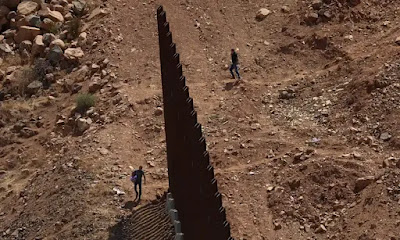
The climate crisis is killing migrants trying to cross the US border, study finds. Many undocumented migrants trying to cross the Sonoran desert into the US from Mexico are dying of dehydration and organ failure. Photo: A group of migrants cross the US-Mexico border in Otay Mesa, California. Photograph: AFP/Getty Images via The Guardian, December 16, 2021


a catarina sits like a cardinal
in a black and white movie
       on my window 
in front of a city of concrete 
       and metal and one giant 
intersection, this city
is nothing but grey cars and roads.

barbed wire is also grey,
morally, physically, 
metaphysically,
       it exists only in the brown
of the Sonora desert dirt
and in the brown of our faces,
       white faces have fences
       brown faces have walls.

but the catarina is too red
the roses in tia’s garden are too 
red
the jalapeños in my fridge are too 
red
     realize
all faces bleed catarina red.


Ruby Rodriguez is a bilingual transgender Latina writer from San Antonio, Texas. Her work has been previously published in La Prensa Texas, at the America Library of Poetry, at the McNay Art Museum, and she is the winner of the Best Poem in Spanish in the second Aline B. Carter Poetry Contest (all under the name of Ricardo, however). She is the poetry and Spanish editor of the digital literary magazine, The Bunker Review.

Friday, September 03, 2021

COMPOS[T]ING MYSELF

by Barbara Simmons 


Washington state became the first state to legalize natural organic reduction in May 2019; Colorado followed suit in May 2021; and Oregon became the third state to sanction human composting in June 2021. —Treehugger, August 24, 2021. "The powerful [California] Senate Appropriations Committee has held a bill that would legalize the composting of human remains. The bill, AB 501, was authored by Assemblywoman Cristina Garcia, D-Bell Gardens, and had sailed through the Assembly with a unanimous vote.... Garcia said in a statement. 'This is another sad reminder that we must legalize a more environmentally friendly option like Natural Organic Reduction (NOR) as soon as possible. AB 501 will provide an additional option for California residents that is more environmentally-friendly and gives them another choice for burial.'” —Sacramernto Bee, August 30, 2021. Photo from Recompose, "a public benefit corporation powered by people who believe in changing the current death care paradigm."


I remember times when soil smelled rich,
a kind of coffee bean rich, a kind
of patchouli rich, a rich that flared my nostrils 
scenting the air with inhale more. 
The time we worked our garden soil 
composting it, the elements of peat and perlite
caking fingernails, our prepping
beds for rows and rows of plants
yearning for elements beyond clay. We dreamt
of growing foxglove, ferns and fuchsias,
entwining them with flowers mixing other letters
into soil with pansies, daffodils, impatiens.  
But it was always soil, prepared, that led to color,
soil inhabiting our very blood and bones, 
a deep affinity for dust to dust we have within,
rich dark coffee-colored soil, aromas lifting up and
taking us to early earth when scientists say the smell
was more like rotten eggs, rich with H2S. This richness lives
within me, my body’s future with the possibility of
decomposing into one cubic yard of soil,
along with wood, alfalfa, even straw, all
assisting me along the way to my new form, 
my inert self reduced to fragrant future supplements
for growing flowers after I have gone.
Something to think about, while legislators ponder laws
to handle soil that’s human-sourced. Right now, it’s not
Assembly Bill 501 I’m thinking of; I’m smelling soil, the
rich rich soil that flowers hunger for, the soil that’s fed
my soul, the gardening days when turning over dirt
was very much like leafing through a sacred text, 
when I’ve translated who I’ve been into the earth
from which I’ve come.


Barbara Simmons is a poet who celebrates the many worlds she inhabits using language to explore the ways we remember and envision. A graduate of Wellesley College, she received an MA in The Writing Seminars from Johns Hopkins. As a secondary school English teacher, she revisited texts with students who inspired her thinking about communication's diversity. Retired, she savors smaller parts of life and language, exploring the world's stories in her poetry. Publications have included Santa Clara Review, Hartskill Review, Boston Accent,  The New Verse News, Soul-Lit, Writing it Real Anthologies, Capsule Stories Anthologies, and the Journal of Expressive Writing.  Her book of poetry Offertories: Exclamations and Disequilbriums will appear in 2022.

Wednesday, August 18, 2021

PILGRIMAGE TO EMILY DICKINSON'S HOUSE ON NINETY-TWO DEGREE SUMMER DAY

by Laura Rodley


What would Emily say? The driveway to her brother Edward’s home
is gated, the property surrounded with orange crisscrossed plastic
fencing, plastic not yet invented in her time, nor the cure for her kidney
ailments. Today her condition would have been aggravated by the chlorine
and other astringent agents the town uses to clean the water pumped
to the homes. She would have drunk water from an artesian well
in her Victorian home, writing poems at two a.m., loving someone
she could not have, not from the future, but from her own time period.
Was she ever pregnant as some suggest? Was she virginal as her white
dresses? Did she actually suffer from hypertension? Was she able
to see the future? Her poems crossed realms of time and space.
Would she have cut the crisscrossed orange fence, crushed it down,
or felt more secure to be enclosed, secure in her hermitage
peopled with family, cooks, and Irish workmen, six of whom carried
her casket to her grave in West Cemetery, where she walked in the evenings.
She was nourished by a garden that is no longer open to the public
due to Covid. A garden that fed her, kept her poetry
alive, already passed through the gates into other’s hands through letters.


Laura Rodley, Pushcart Prize winner, is a quintuple Pushcart Prize nominee and quintuple Best of Net nominee. Latest books: Turn Left at Normal by Big Table Publishing, Counter Point by Prolific Press, and As You Write It Lucky Lucky 7, a collection of 11 writers' work.

Friday, October 09, 2020

WE CAN STILL DREAM

by Katherine West


American Dream, mixed media in resin artwork by Raphael Mazzucco.


            "I have a dream... we will be able to transform the jangling discords of our nation into a beautiful symphony of brotherhood."  —Dr. Martin Luther King Jr., 1963


Last night I dreamed of rain
It overflowed the culverts 
It washed out the road in waves 
Like a sea in the desert 

It filled the arroyos like a lover 
Or the tide before love the opening 
Before the opening the flower 
Dreaming of the bee dreaming 

Of pollen generations of honey 
The wealth of the hive 
And the queen humming 
Her birth song of infinite flight 

Over a globe of no boundaries 
One garden all colors 
A palette of rainy territories 
Mixing new shades forgetting borders 


Katherine West is the author of three collections of poetry and one novel: Scimitar Dreams, The Bone Train, Riddle, and Lion Tamer, respectively.  She has had poetry published in Bombay Gin, Lalitamba, Tanka Journal, Writing in a Woman’s Voice, and TheNewVerse.News who nominated her poem "And Then the Sky" for a Pushcart Prize in 2019.  She lives in the mountains outside of Silver City, New Mexico where she translates Mexican revolutionary poetry and creates custom, hand-made poetry chapbooks.

Thursday, April 16, 2020

KARMA PLUS

by David Radavich


See what pure narcissism
brings forth: a great rot
in the communal apple.

The body politic
spoils top to bottom
and back again.

Every inequity
becomes deadly
as a snake.

We have long since
been thrown out
of the garden.

We roam streets
like zombies
in search of medicine
and care.

How can we be
one family

and not hug
our neighbors
as ourselves?

Pathogens know
our vulnerabilities
and strike
with clear knives.

In the dark night

we become
what we do
for one another.


David Radavich's latest narrative collection is America Abroad: An Epic of Discovery (2019), companion volume to his earlier America Bound: An Epic for Our Time (2007). Recent lyric collections are Middle-East Mezze (2011) and The Countries We Live In (2014). His plays have been performed across the U.S. and in Europe.

Saturday, March 28, 2020

COVID-19

by Gary Lark


Here we are
waiting for the world to end.
Enough stuff to last a month
and angst hanging outside
waiting to gobble us up.

I go out back
to the garden
plant spring seeds
in an eight-year plot
and collect some vitamin D
for the long haul.

Sheltering in place,
seeing even less people
than I usually do.
A neighbor turns out her little dog,
we wave. I check the rat traps,
some of the bait is gone.
They lose a few every day.


Gary Lark’s work includes Ordinary Gravity (Airlie Press); River of Solace (Editor's Choice Chapbook Award from Turtle Island Quarterly); In the House of Memory (BatCat Press); Without a Map (Wellstone Press); Getting By (Holland Prize from Logan House Press). Daybreak on the Water is forthcoming from Flowstone Press. His poetry has appeared in Beloit Poetry Journal, Catamaran, Hubbub, Poet Lore, ZYZZYVA, and others.

Saturday, January 25, 2020

IMPEACHMENT DIARY

by David Chorlton


'Maybe the White House Meant “Take Her Out” and “Your Head Will Be on a Pike” in an Innocent Way?' —Slate, January 24, 2020


The usually sharp
contour of the mountain is swathed
in cloud today. When the telephone rings
it sounds as though a lonely voice
is trapped inside, but is still
best ignored
considering the robocalls from Florida
intent on coaxing
information from the innocent
among us. History, meanwhile,
is cobbled together
from statements and rebuttals
while a Costa’s hummingbird
rests on a stem
in slow falling rain and truth
slips back into the underworld with a nervous
twitch in its tail.

The chaplain’s blessing scatters
as each word spreads its wings to fly
to God and back. Such chastening
language doesn’t stand
a chance at noon beneath the western
sky when it’s strength
in numbers for the pigeon flock
startled into
the pieces of a broken prayer.

Before daylight: the streetlamps still on duty
and the trash bins lined obediently
waiting to be emptied. A first
muffled walker passes the house
with her opinions bound tight around her.
An unspoken fact hangs
in the air, and darkness parts
for the truck to pass through
that will carry away
all blind spots.

From the garden swing seat, everything
appears relaxed: there is no
rancor in the mountain,
no arguments pull to have the palm trees
lean unnaturally, and the evergreens
soak up the winter sun
whose warmth comes democratically
to Earth. But there’s a chill
between the sunbeams as the threads
that bind deception to
high office come untied, and the Red-tailed
hawk claims executive privilege
when he comes down to the rooftops.

After dawn, the sky becomes divided
along party lines. The early birds dissect
yesterday’s words on the grass. Peck, peck, they
take the vowels and leave
consonants in their shells among the remnants
of opening arguments. Here are echoes
from a vicious time: Let’s see
what he can do he’s not
a politician he’s a businessman he says what
he thinks and so on and
so on. Listen till it hurts.


David Chorlton was born in Austria, grew up in Manchester, England, and lived in Vienna before moving to Phoenix in 1978. The Bitter Oleander Press published Shatter the Bell in my Ear, translations of poems by Austrian poet Christine Lavant. Reading T. S. Eliot to a Bird is from Hoot ‘n Waddle, in Phoenix, and a long poem Speech Scroll comes from Cholla Needles Arts & Literary Library.

Tuesday, November 24, 2015

COULD BE MORE TRAMPLED BY THE FEET

by Jim Gustafson


Schools and subways remain closed in Belgium today, with the nation’s threat level at the highest possible. —NY Times, Nov. 23, 2015; Reuters photo via BBC.


Could more be trampled by the feet
of beasts who walk the garden?
Could there be other nights that mourn
the passing of the graves?
It is not new dusk that wraps the world
It is the same rolled paper of the past,
pulled and torn and rolled tight again.
The pendulum digs a rut in time,
from open hand to fist. Duck the swing,
wait for knuckles to grow tired of bruises,
then you may grip, shake, and exchange
names. Until that time, let the unknown
push you deep within the cave
where only shadows of yourself dance.


Jim Gustafson teaches at Florida Gulf Coast University and Florida Southwestern State College. His first book of poems Driving Home was published by Aldrich Press in 2013. He live in Fort Myers, Florida, where he reads, writes and pulls weeds.

Tuesday, September 08, 2015

MAKE AMERICA GREAT AGAIN

by Judith Terzi


Not the Grand Canyon
California oak  
sycamore
Not the city park
the swings  
the dandelion
Not the baseball  
the G-O-A-L
Not the community garden
the harbor  
anchor of vessel
Not the daisy  
the buttercup
the Mojave
Not the poet
the potter
Not the artist
the artist
Not the walls
of books
allure of fireflies
walls of museums
Not the grasshopper
on a tea rose
a tea rose
Not Beethoven
under summer stars
And not the Venezuelan
who conducts him
Not the steel of Disney Hall
Not the wind of steel
the cut of space
Not the waterfall
the wildflower
the thickness of skin.


An educator and poet living in Southern California, Judith Terzi's poems have appeared in journals and anthologies including Caesura, Myrrh, Mothwing, Smoke: Erotic Poems (Tupelo), Raintown Review, Times They Were A-Changing: Women Remember the 60s & 70s (She Writes), Unsplendid, and Wide Awake: The Poets of Los Angeles and Beyond (Beyond Baroque). Her most recent chapbook, If You Spot Your Brother Floating By, is a collection of memoir poems from Kattywompus Press.

Sunday, November 23, 2014

GROUND RULE

by Esther Greenleaf Murer


The common or garden good is a weed
strayed from a Communist plot.
Don’t believe those who loudly proclaim that we need
the common or garden good; it’s a weed
that threatens to crowd out the flowers of greed
by claiming our gains are ill-got.
So root out that noisome and noxious weed—
send it back to its commie plot.


Esther Greenleaf Murer is a relic of the 20th century. She lives in Philadelphia.

Monday, November 12, 2012

THE FRAGONARDS PLAY A HOME GAME

by M. A. Schaffner

Image source: Pébéo


Through all my life I’ve grown up just enough
to step back through the looking glass and sing
nonsense songs while shaving.  You know the tunes.
Context has everything to do with death,
and that changes constantly, so today
I’ll settle for a six pack and a game
of football or Scrabble.  Let small dogs watch
as we wrestle with ambition and win
one more time, because we know its weak points.
Last night there was a moon.  There will be again
long after we uncork our last bottle.
We solved the world’s problems.  It will have more,
but I don’t need to work them any more
than will finches nesting over the grill,
or their neighbors, the squirrels, or the cats
hunting stupidly, garden to garden.


M. A. Schaffner has work recently published or forthcoming in The Hollins Critic, Magma, Tulane Review, Gargoyle, and Skirmish Magazine.  Other writings include the poetry collection The Good Opinion of Squirrels, and the novel War Boys.  Schaffner used to work as a civil servant, but now serves civil pugs.