Guidelines


Submission Guidelines: Send 1-3 unpublished poems in the body of an email (NO ATTACHMENTS) to nvneditor[at]gmail.com. No simultaneous submissions. Use "Verse News Submission" as the subject line. Send a brief bio. No payment. Authors retain all rights after 1st-time appearance here. Scroll down the right sidebar for the fine print.
Showing posts with label virus. Show all posts

Monday, November 04, 2024

MESSENGER RNA

by Claudia Gary


AI-generated graphic by Shutterstock for The New Verse News.


Vaccine doing its work

sent signals overriding

emotion, music, words,

hunger, desire—but only for

one day, that messenger.


Soon there would be sunset 

with orange hues to mark

the hours that made up

a day of gratitude—

vaccine, then first-day voting—


two gifts! Will I recall

such joy? And will the volume

of voting be sufficient

to stop that other virus?


Claudia Gary teaches workshops on Villanelle, Sonnet, Meter, Poetry vs. Trauma, etc., at The Writer’s Center and privately, currently via Zoom. Author of Humor Me (2006) and chapbooks including Genetic Revisionism (2019), she is also a health/science writer, visual artist, composer of tonal songs and chamber music, and an advisory editor of New Verse Review. Her 2022 article on setting poems to music is online.

Tuesday, February 13, 2024

NEW ORLEANS MARDI GRAS

WEIRD WORLD OF JOY AND PAIN


by Mostofa Sarwar


AI-generated graphic for The New Verse News by Shutterstock


I rode the Captain’s Float in Endymion
I saw the frolicking crowd
I enjoyed the rainbow of merriment
undulating its mesmerizing wings,
sprinkling its magical potions
over the revelers

The scintillating curves of human flesh
under the thin veneer of fabrics

The vile sound of the Second Amendment
flashing snippets of life

The dead crawling the crowded streets

I saw the specter of Paul Verlaine
over Saint Charles Avenue
He was catching beads
Was he happy?
He was wearing an MP3 player
Was he listening to Debussy’s incarnation
of his ‘Claire du Lune’?

Or was eternal pain eating his flesh
Like a deadly virus

I saw
Under the veil of merriment
New Orleans, like Bergamo,
hiding
the suffering, 
and poverty, violence, injustice

Let me have a jug of absinthe
And forget this weird world of pain and joy

 
Dr. Mostofa Sarwar is professor emeritus and former associate provost at the University of New Orleans, dean and ex-vice-chancellor and provost of Delgado Community College. His opinion essays were published in The Daily Star and Bdnews24.com of Bangladesh, The Strait Times of Singapore, The Statesman of India, Phuket News of Thailand, The Times Picayune of New Orleans, The Advocate of Baton Rouge, The Acadiana Advocate of Lafayette, The Daily Advent and The Opera News of New York. Recently, his English poems were published in Sangam Literary Magazine and The Seattle Star Magazine. Sarwar published three books of Bengali poems. He frequently appears in Bengali talk shows at cable TV channels (broadcast out of New York, Washington, DC, and Dhaka).

Saturday, September 09, 2023

NEXT WEEK—DEO VOLANTE

by Joan Leotta


I’m supposed to drive to Raleigh,

2.5 hours from here and stay 

in a hotel alongside a creek

that sometimes floods

(as does the creek behind my house), 

to immerse myself in 

a sea of poety.


All of these plans could 

be swept away by the winds

and water of the pending hurricane.


So, why do I still plan?

Life had  taught me

all can change sooner than

the weatherman predicts,

sooner than my doctor thinks.

In an instant, crossing the street,

or stumbling on a sidewalk crack,

a new virus,

waiting at a bus stop

shopping in my favorite grocery

Someone’s car, my clumsiness,

germs, someone’s gun fueled anger,

all of these can take me

to the “other side.”

I know because my son

was hit by a car on a night 

he had plans,

so as I plan, I add, God Willing,
Deo Volante, to my notes,

knowing all could end now

but not worrying because once I step

to that other side, there will 

be loved ones who await me there.


Joan Leotta. Author, Story Performer

Saturday, August 19, 2023

AUGUST

by Juditha Dowd


This evening it occurs to me I ought to call my mom and dad
because it’s been a while. And for a moment they are not
gone some fifteen and thirty-six years, but still at the house 
where I left them, the first of their children to depart.
It’s summer and steamy and all the windows are open wide.
She’s on the porch working the Sunday crossword.
He’s out back picking tomatoes or wielding some tool—
lawnmower, drill, or paint brush. For what they may lack 
in talents or skill they substitute perseverance.  
Today I took tomatoes from the garden we extended again
in this post-pandemic summer, the leaves already mottled 
with a virus that will kill the plant but doesn’t harm us. 
Here too it’s hot and humid, like that year my twin brothers 
caught polio, from swimming at a public pool some said.
The same August our younger brother almost drowned 
in the deep end and our country joined the Korean war,
though my father was too old to fight in that one. 
If only my phone could find them tonight, I’d assure them 
I’ll get another booster. Or bemoan the endless shootings,
the forest fires, the latest wars… Or instead I might say 
It’s 100° and I’m making a tomato sandwich. 
Maybe leave it at that. They’d know what I mean.
 
 
Juditha Dowd’s fifth book of poetry, Audubon’s Sparrow, is a lyric biography in the voice of Lucy Bakewell Audubon (Rose Metal Press). She was a 2022 finalist for the Adrienne Rich Award and has contributed poems to Beloit Poetry Journal, Cider Press Review, Florida Review, Poet Lore, Poetry Daily, and elsewhere.

Saturday, April 15, 2023

THE NEW PANDEMIC

by Ralph Dranow


poster available at amazon


A new pandemic is sweeping the world.
Scientists speculate it started last month
with a six-year-old girl in Indonesia,
a precocious child,
who transmitted it to her parents,
who passed it on to others.
Now it's spreading throughout the country
and other places as well.
The virus surges through the bloodstream,
infiltrating the heart and third eye,
causing people to love one another.
Politicians, CEOs of corporations, and Republicans
are furiously working to contain the virus,
claiming it's bad for business,
suggesting people wear masks and social distance.

But it might be too late.
The virus is very powerful,
seeping through even the strongest mask,
dancing through the bloodstream,
like an ecstatic child.


Ralph Dranow works as an editor, ghostwriter, and writing coach. His poems and articles have been widely published.

Monday, January 31, 2022

NUCLEAR WASTE

by Charles Rammelkamp


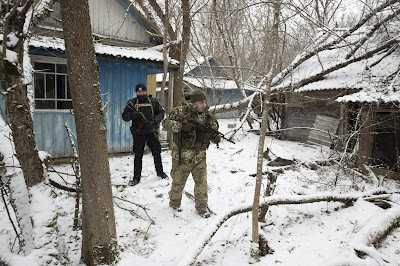
Ukraine has initiated a defensive strategy for the Chernobyl Exclusion Zone, one of the most radioactive places on Earth, which lies on the shortest path between Russia and Ukraine’s capital, Kyiv. Photo: A Ukrainian border guard on a joint patrol with the Ukrainian police inside the Chernobyl Exclusion Zone. —The New York Times, January 22, 2022


“It doesn’t matter if it’s contaminated,
or if nobody lives here,” Yuri declared,
responding to the unspoken skepticism 
in the sheen of the reporter’s dark eyes.
“It’s our territory, our country,
and we have to defend it.”
Shouldering his Kalashnikov, Yuri patrolled 
the snowy fields of the Chernobyl zone;
winter in northern Ukraine.

“I remember reading about the Soviets
parading the children on May Day 
through the swirl of radioactive dust
right after the accident 
to try to make us—and the world—believe 
nothing serious had happened.
Thank goodness I wasn’t alive then.

“Pripyat’s a ghost town now;
used to be the biggest city in the area.
You can still see the old Soviet propaganda –
a sign extolling the virtues of nuclear energy.
‘Let the atom be a worker, not a soldier.’”

Hunching his shoulders, as if to toss away his anger,
shifting the rifle, Yuri went on:
“Now we don’t know 
what will kill us first,
the virus, radiation, or Putin’s bombs.”
 

Charles Rammelkamp is Prose Editor for BrickHouse Books in Baltimore, where he lives with his wife Abby. He contributes a monthly book review to North of Oxford and is a frequent reviewer for The Lake, London Grip, Misfit Magazine, and The Compulsive Reader. A poetry chapbook, Mortal Coil, was published in 2021 by Clare Songbirds Publishing and another, Sparring Partners, by Moonstone Press. A full-length collection, The Field of Happiness, will be published in 2022 by Kelsay Books.

Friday, November 05, 2021

PANDEMIC PANTOUM

by Catherine McGuire


KALISPELL, Montana — The October death by suicide of the ninth local teenager in 16 months prompted offers of counseling, training for teachers and visits from national suicide prevention experts. But it also whiplashed into partisan recriminations, as residents lashed out in public forums against the superintendent of schools for failing to impose dress codes and discipline, against parents for not securing their plentiful firearms — used in several suicides — and against the supporters of masks and other pandemic restrictions for stifling teenagers. An issue the valley might have rallied around, in another time, risked dividing it yet again. Photo: The Flathead Republican Party float drives on Main Street in Kalispell. (Tony Bynum) —The Washington Post, October 25, 2021


It started in panic, pulling in—
closed doors, empty roads,
huddling—unseen killer abroad!
Whole towns went still.
 
Closed doors, empty roads,
displayed by drones, at first.
Whole towns went still with
the novelty of crisis
 
displayed by drones, at first.
We drank in urgent news,
the novelty of crisis,
but weeks smudged together.
 
And we drank, as urgent news
became the same old: needles into arms.
The novelty of crisis
morphed to anger at refuseniks.
 
And now the same old needles into arms
became a rallying cry,
morphed to anger at refuseniks:
“How dare you endanger me?”
 
The same rallying cry,
spread like a virus on both sides:
“How dare you endanger me?”
revealing a comorbidity
 
that spread like a virus on both sides:
or like a wildfire flaring from a spark
to reveal a morbid comity:
we’re right; no sympathy for them!
 
And like a wildfire flaring from a spark
that falls on parched, unhealthy ground
this drought of sympathy for “them”
ravages communities more than virus did.
 
Self-absorption is parched, unhealthy ground.
How will we explain to grandkids that what
ravaged our towns more than virus did
was the climate that turned townsfolk into enemy?

How will we explain to grandkids that what
had us huddling—unseen killer abroad!
was the inner climate that turned townsfolk into enemy?
It starts in panic, pulling in.


Catherine McGuire is a writer and artist with a deep concern for our planet's future. She has four decades of published poetry, four poetry chapbooks, a full-length poetry book Elegy for the 21st Century (FutureCycle Press), a SF novel Lifeline, and book of short stories The Dream Hunt and Other Tales (Founders House Publishing).

Wednesday, March 17, 2021

ELIMINATING TEMPTATIONS

by Imogen Arate


Shootings at Atlanta-area massage parlors have left eight people dead, most of them Asian women. In this photo, former Washington Governor and former US Ambassador to China Gary Locke holds a sign reading "Hate is a Virus" as he speaks during the "We Are Not Silent" rally against anti-Asian hate in response to recent anti-Asian crime in the Chinatown-International District of Seattle, Washington on March 13, 2021. Photo: JASON REDMOND / AFP/GETTY via Newsweek


Yes, something is horribly wrong with a person who kills to “eliminate” temptation. … But, that does not mean we can dismiss places where this illness festered. … Women are not the source of temptation in need of elimination. Women are made in the image of God and worthy of dignity and respect. Asian women are not objects of fetishized desire for the racialized gaze of men. So, let’s pray for the victims' families that the Lord may grant them peace in the midst of such tragedy. Let’s stand up and alongside our Asian brothers and sisters. Let’s work against twisted and unhealthy theology that maligns and distorts the image of God in women (and men). —Ed Setzer, Christianity Today: The Exchange, March 17, 2021


I tell my mom not to visit the accountant’s office
Rona’s run amuck suffocating freedom of movement


The walls of my apartment wrap me like a protective cloak*
whose porousness admits the chilling draft of side-eye glares

I scrub myself clean of my heritage but my eyes my cheeks
my nose tell another story that doesn’t allow a really bad day

to end in a murder spree that’s for a paler lot than us
Someone told me I’m the wrong shade to opine

then flashed the peace sign because V fingers
can scissor away the pangs of exclusionary acts

when I’m standing at the back of the BIPOC line
I tell my mom there’s only so much I can do to protect her


*This line was inspired by lines 13 and 14 of "Lounging on the Couch on My 39th Birthday in Pink Flannel Donut Pajamasby Julie Danho


Imogen Arate is an award-winning Asian-American poet and writer, the Executive Producer and Host of the weekly poetry podcast Poets and Muses and co-founder of the Pan Poetry Project. She has written in four languages and published in two. Her work was most recently featured in The New Verse News, the Love Letters to 2020 anthology, the Global Poemic, and Rigorous.

Friday, January 15, 2021

NOW THE DYING WHO ARE ALMOST DEAD, ARE DEAD

by DeWitt Clinton


“The end of the earth,” acrylic painting by Tobi Star Abrams


The end?  Well, we could hardly call it that, as if
Whatever just happened, isn’t found in an old
Paper thin tome nobody’s read for a zillion years,
Instead, the end, or The End, just keeps blistering
The heck out of nearly everyone, though some
Are immune, and will never know when any End
Is just around, looking for hopeless dopes like most
Of us are now, prayers done with, floors mopped
With Clorox, as if that would scare anyone away,
But the Bugs like that deep inhalation we take when
We walk into any room, like sniffing lighter fluid
Right into the lungs where it plans to stay and stay
Until all of us are turned over onto our stomachs
By the kindest of medical staff, hoping the deep
Breaths will pull us out, but most of us have already
Died, and had no clue anything was like The End as
So many are whispering about now, as if Breaking
News isn’t about a new political cataclysm, but rather
Breaking the hearts of so many in so many hugely
Different parts of our world, everywhere even in
Antarctica, and who brought the Bugs in to such a
Pristine, icy world anyway?  ICU’s are now in gift
Shops, chapels, parking lots with unique tenting
Materials and refrigerator trucks behind and out
Of sight, keeping all the dead quite cool until we
Find a place that will prepare the dead without
Ending up as the prepared dead.  That’s our new
World with the best hopes of looking ahead nearly
Two or three years out, and even then, new varieties
Will awaken all of us again, those who aren’t quite
Living any more, but just waiting, you know for what
Don’t you, call it what you want but here, it’s The End.


Recent poems by DeWitt Clinton have appeared in Lowestoft Chronicle, The New Reader Review, The Bezine, The Poet by Day, Verse-Virtual, Poetry Hall, Muddy River Poetry Review, Across the Margin, Art + Literature Lab, One Magazine, Fudoki Magazine (England), and The New Verse News.  He has two poetry collections from New Rivers Press; a recent collection, At the End of the War; and By a Lake Near a Moon: Fishing with the Chinese Masters, poetic adaptations of Kenneth Rexroth’s 100 Poems from the Chinese.  He is Professor Emeritus at the University of Wisconsin—Whitewater, and lives in Shorewood, Wisconsin.

Monday, January 04, 2021

A REQUIEM FOR OUR WORLD

by Janet Leahy


For more information about the Boccaccio Project, please click here.


How will our story be told, a world
in mourning for the millions who have died.
Who will write the score for the new
requiem, our sense of loss overwhelms,
day by day we feel the dread of what 
may come next.  How will a new symphony
hold the pain of pandemic, will the cello
anchor the gravitas with a call to prayer,
will strings of violins rage against
the virus, will the oboe conjure healing 
in the slow low notes of a minor key.  
Is a musician at her piano today, 
arranging chords to evoke
the pain of isolation, the fear of Covid.
Does she know her music will save us,
will redeem our lapses into despair.
I think of composers from the past… 
will a new Mozart, Verdi, Dvorak, arrange
dissonant chords to tell this story,
a Requiem Mass for Our World.


Janet Leahy is a member of the Wisconsin Fellowship of Poets. Her poems have recently been published in Halfway to the North Pole, the Wisconsin Poets’ Calendar 2021, and Art in so Many Words.  She has published two collections of poetry.

Monday, December 14, 2020

FOR THIS RELIEF, MUCH THANKS

by Jerome Betts


The UK is the first country in the world to start using the Pfizer vaccine after regulators approved its use last week. Second in line for the jab at University Hospital in Coventry was 81-year-old William Shakespeare from Warwickshire. —BBC, December 10, 2020
 

Virus malign, the clock is ticking,
Don’t try to dodge the needle’s pricking
   That can end pandemic woes.
Spread no further, start retreating,
Journey’s end is Covid’s beating
   Mr  William Shakespeare knows.
 

Jerome Betts lives in Devon, England, and edits the verse quarterly Lighten Up On Line. His work has appeared in a wide variety of British magazines and anthologies as well as UK, European, and North American web publications such as Amsterdam Quarterly, Autumn Sky Poetry Daily, The Asses of Parnassus, Better Than Starbucks, The Hypertexts, Light, The New Verse News, and Snakeskin.

Saturday, October 03, 2020

AS THE ANGELS PASS

by Alejandro Escudé
The coronavirus builds a far-reaching ladder-like apparatus from core helical amino acids (green) in its spike protein that latch on to its host cell, leading to infection. A computer model is simulating these dynamics on Longhorn, the subsystem of the Frontera supercomputer at the Texas Advanced Computing Center (TACC). Credit: Numan Oezguen, Texas Children's Hospital and Baylor College of Medicine. —Phys.Org


I’ve been trying to write you, Covid-19.
The suddenness of the tree is more tree-like
after you and yesterday a woman told me
she preferred taking the elevator alone. 
I didn’t look her way when she said that, 
too tired to acknowledge the statement. 
The CDC says that the air is a ladder full 
of virus, but I already knew that, having 
climbed it like Jacob up to heaven and 
having seen the angels traveling up and 
down it wearing white satin masks, six feet 
apart from one another as they pass, the ladder
wide enough to allow for their wingspans.
I tried not to look at their eyes, furrowed
brows like their human counterparts, a bottle
of sanitizer at the base of the shaky steps.
I’ve been trying to write you, Covid-19.
Write you into the day after tomorrow
and write you into yesterday, when I found
myself in an auditorium with teacher
colleagues listening to the priest lead us 
through a mass as the rain fell and no one 
knew the sequestered work that lay ahead, 
how our hands would turn into hearts, 
sweaty, red, pulsing, our minds become 
oceans of solitude. I’ve been trying 
to write you, Covid-19. Letters afloat 
in the air like germs, words freshened 
by fear. If I write fast enough Covid-19, 
I figure maybe I can stay ahead of you 
as you swim the air, aloft, riding our 
anxious breaths, the teeth-life of humor, 
the tongue-bond of our historic griefs.
I’ve been trying to write you, Covid-19,
as you scrape clean our liminal spaces, 
wicked seed, atomic salt pillar, icepick.


Alejandro Escudé published his first full-length collection of poems My Earthbound Eye in September 2013. He holds a master’s degree in creative writing from UC Davis and teaches high school English. Originally from Argentina, Alejandro lives in Los Angeles with his wife and two children.

Tuesday, July 07, 2020

WHAT IS THE AIR?

by Ralph James Savarese


Source: The New York Times archive


An elderly person said, “What is the air?” gasping as much
     with her arms as with her lungs.
How could I answer this woman? I do not know what it is
     any more than she.

I guess it must be a mother feeding her babes little morsels
     of oxygen. A clear, blue bib.

Or I guess it’s the wind taking a nap, the clouds a comforter
     letting dreams rain down.

Or I guess the air is itself an elderly person, death’s new
     confidante. What has it heard?

Or maybe it’s a commuter on the breathing Tube. (The rasping
     sounds like medieval German.)
“Stand away from the doors.”

Stand away from each other! The virus is sprouting in broad
     zones and narrow zones, growing among black folks
     as among white (more among black folks).
“I give them the same, I receive them the same,” a super-
     spreader says.

Perhaps the air is a bathhouse for lungs. All the panting they
     could want!
The Right once denounced promiscuous mingling yet now
     promiscuously mingles itself.

The air, madam, is an unregistered weapon. In America
     everyone carries.


Ralph James Savarese is the author of two books of prose, Reasonable People and See It Feelingly, and one collection of poetry, Republican Fathers, due out in October.

Tuesday, May 05, 2020

BEFORE CORONA, THE CORONA

by Charles Harvey


Junkyard Find: 1968 Toyota Corona


Before the Corona
Was a virus, it was a car,
Carrying us like
The wind to Woodstock,
Berkeley, Kent State,
Selma, Detroit, Watts—
All them hotspots.

Six of us piled in.
Inches apart was a luxury.
We didn’t give a duck,
Coziness roused our hormones
And made us want to fuck.
Our long hair tangled in the seats.
Our ‘fros flattened and sweated
To the rhythm of soul beats.

Before the Corona
Was a virus, it was a car,
Traveling all around the world
Spawning revolutions,
Liberal ideologies,
And X-gen babies.

Before the Corona was a virus
Before T***p was a virus
Before social media was a virus
Before Fox News was a virus
Before the Republican Party was a virus
The Corona was a car, baby!


Charles Harvey is a native Houstonian. His work has appeared on TheNewVerse.News over the years. He recently published Rough Cut Until I Bleed

Thursday, April 30, 2020

PERSPECTIVE

by José A. Alcántara


The bud, newly broken,
does not care.

The virus, freely spreading,
does not care.

Each of them opens
into blossom,

trying to replicate,
as we do.

What is crisis to us,
is to them being.

The black spider
on the pale rock

hunts for blood.
That is what it does.


José A. Alcántara lives in Western Colorado. He has worked as a bookseller, mailman, commercial fisherman, baker, carpenter, studio photographer, door-to-door salesman, and math teacher. His poems have appeared in Poetry Daily, The Southern Review, Beloit Poetry Journal, Spillway, Rattle, and the anthologies, 99 Poems for the 99%, and America, We Call Your Name: Poems of Resistance and Resilience.

Wednesday, April 29, 2020

DOUBLE TRITINA ON THE DEATH OF EAVAN BOLAND DURING A WORLDWIDE PANDEMIC

by Jenna Le


In Eavan Boland’s poem “Quarantine,”
there’s much to be admired: how she rhymes
slant, rhyming 1847 with woman,

say, or how the perished man and woman
in the three lines that start with line 18
are dignified, like headstones touched with rime,

by strict iambic beats. The point that rhymes
most richly with me, living as a woman
in a world starved gray by quarantine

in this year of our Lord COVID-19,
however, is the way that Boland’s rhymes
affirm love’s primacy: I’m not the woman

her poem describes, the starving Irish woman
whose feet, for lack of shoes of soft sateen,
molded themselves against her husband’s grime-

dark chest; yet Boland’s poem reminds me I’m
a member of the cult of man and woman,
built like a virus from the same protein.


Jenna Le is the author of Six Rivers (NYQ Books, 2011) and A History of the Cetacean American Diaspora (Indolent Books, 2017), a Second Place winner in the Elgin Awards. She was selected by Marilyn Nelson as winner of Poetry By The Sea’s inaugural sonnet competition and by Julie Kane as winner of Poetry By The Sea’s sonnet crown competition the following year. Her poetry appears or is forthcoming in AGNI, Denver Quarterly, Los Angeles Review, Massachusetts Review, Michigan Quarterly Review, Pleiades, Poet Lore, and West Branch

Friday, April 17, 2020

BELOVED

by Doug Bolling


North wind just off the sea
Heavy freighters out there now
Slowing toward a final turn
To harbor and rest against an
Unforgiving roil and smash of
Moon bent wave.

Rest I think rest.
What does it bring to we the
Toilers whether far out or
Crouching beside the door
Of a virus caught loved one.
No answer that holds, no
Roseate bloom out of the
Shadows of a dirt laden
Tomb.

We have buried two and soon
The third.
John in his artificial sleep
Barely visible through the
Frosted window, single
Portal between death
And life,
So narrow the difference.

Only a month ago I stood as
John the mariner of seas
Of thought in endless books
And beyond paused in a
New York street to embrace
A begging man in thin coat
And desperate mien.

I believe money passed
Between two sets of eyes
Locked in some version

Of eternity. I witnessed
Hugs and tears in those
Sudden moments and the
Brief silence that speaks
Of a more, more, some
Mystery perhaps outside
The rumble and screech
Of profit driven days.

Eternity or not an old man
Trapped in an unseeing
Wasteland holds his stance
Winter or spring and the best
Friend I will ever have waits
For his final breath below
Clang and clatter of a
Temporary grace.


Doug Bolling’s poems have appeared in Posit, Basalt, Blue Collar Review, Kestrel, The Missing Slate (with interview), and Writers Resist among others. He lives in the outlands of Chicago.

THAT BEAUTIFUL OBJECT NEXT DOOR?

by D.B. Goman


When the world started to end
the other day there was still
a glass of water the soup on
the gas stove the bills delivered
to laptop the car to pick up
meds the warm lamp by a bed
for novels and monthly mags
the vents with cool air the plane
ticket to Tobago hot on fridge
the spin of dryer the stupid
tv talk-show hosts the friends
inside a phone happy to shoot
every thing made or about to be
     conceived

I also was a lover before now
before the imagination’s other
half grew strong clouds in eyes
before the virus killed all I knew
as love walking in nature wanting
more when my hand was held
and a river sang with us as trees
on guard let us laugh with birds
in nest and we took for granted
blossoms and I thought I knew
myself because we did try so
hard to know each other then
before I learned the world wasn't
ours and things stopped working

How long is long this simply goes
on with the fear of just beyond
the door I don’t know who’s next
door right now is there someone
next door I don’t hear a thing
I don’t speak anymore I don’t
dare the old dreams are there in
the shadows at upstairs window
across the yard I want it there
I don’t can’t want it so beautiful
a picture of arms knees hair
neck wrists ears thighs shoulder
blades unprocessed I can’t be
sure a chip in glass and whatever

isn’t there isn’t thinking this too


D.B. Goman continues to be upset that he wasn't born with real wings. And a stinger. For penance, many of his poems and essays have been published in a variety of journals including Ditch, Quarry, Eye Magazine, 2River View, Jones Av., Travel Mag, The Literary Bohemian, 2 Bridges Review. A collection of poems is forthcoming this autumn.

Wednesday, April 15, 2020

DETACHED

by Mark Ward


There’s that meme of James Franco ‘bout to be
hanged. He smiles, asks “First Time?” The text reads “Gays:”

as if they’re asking the straights now with them
(and of course it’s him, confused peacocking),

referring to both of the viruses
I’m scared of. Their first time to be ignored,

to feel helpless and, literally, alone.
First time kept out of the hospital room,

to be told they have died, second-hand.
It’s not the same though. The world didn’t stop

for us. The summer sun showed thinned-out prides,
detached eyes staring. Now, we’re all locked down,

look at how the world has come together,
look at all we could have achieved back then.


Mark Ward is the author of Circumference (Finishing Line Press, 2018) and Carcass (Seven Kitchens Press), as well as a full-length collection, Nightlight (Salmon Poetry, 2022). He is the founding editor of Impossible Archetype, an international journal of LGBTQ+ poetry, now in its fourth year.

Tuesday, April 07, 2020

CONTRABAND

by Gary Rainford


Winterberry  Heights

“Good morning from isolation,” an angel from Winterberry
Heights PMs the caption and a pic of Bobbi because memory
care is locked down; residents are not testing positive for

Covin-19, so they want to keep the curve flat. “Laughter
is the best medicine,” captions the next pic, a few days later,
Bobbi laughing, hugging herself. After forty five minutes

on hold with the CDC, a caffeinated operator reads the same
script I had already read from their website. Did I answer your
questions, sir? she asks. Nope, I reply. What do you mean,

sir? She sounds hurt and offended. I asked for guidelines
about compassionate care visits at assisted living facilities, but
you read a soap opera about how the blahblahblah spreads

and the importance of blahblahblahing in place, which to me
translates as, Go fuck yourself. “Your mother is just fine,” says
the latest caption from Bobbi’s quarantined studio while her

toothless smirk remembers the 1950s, polio pandemic: sore
throats, fevers, headaches, respiratory infections, beaked face    
masks, nausea, fatigue, and fear spreading like the virus.


Author's Note: Maine Governor Janet Mills, like many governors across the country this week, ordered Shelter-in-Place measures for all non-essential activities.  My mother Bobbi is under hospice care, receiving doses of morphine daily, and now she will likely die without me, her only local family, at her side.


Author of Salty Liquor and Liner Notes Gary Rainford lives year-round on Swan's Island, Maine, with his wife and daughter. Gary's third book in progress is a verse novel that tells the story of his mother's dementia and Alzheimer's disease.