Guidelines


Submission Guidelines: Send 1-3 unpublished poems in the body of an email (NO ATTACHMENTS) to nvneditor[at]gmail.com. No simultaneous submissions. Use "Verse News Submission" as the subject line. Send a brief bio. No payment. Authors retain all rights after 1st-time appearance here. Scroll down the right sidebar for the fine print.
Showing posts with label plague. Show all posts

Tuesday, August 12, 2025

AIR QUALITY ALERT

by Elizabeth Kerlikowske


The National Weather Service has issued an air quality alert for Aug. 11-12 for multiple northern Michigan counties because of smoke drifting south from Canadian wildfires. —Lansing State Journal, August 10, 2025


We’re in charge of so little. Less than an acre; a cat. Clearing debris from the street drain. The few things we control are so inconsequential, no one cares. Not even us. Take my lungs. Please. Take Canadian wildfire smoke. Their wilderness makes civilization  hard. Even deer here in Michigan wear masks. How do they get them on?  Last week, we found out we were made of plastic. Today particulate matter is coating our lungs with Teflon. Silver Beach is like the bottom of an ashtray half full of gin. Haze, the weather man says, trying to fool the tourists. Maple/bacon smoke rolls in, a plague from the Northwest, but we are so far gone, its smell only makes us hungry.


Elizabeth Kerlikowske’latest chapbook is Falling Women, with painter Mary Hatch.

Friday, December 27, 2024

SADLY, NO ONE HAS NOTICED

by Sister Lou Ella Hickman


AI-generated graphic by NightCafé for The New Verse News.


during this past terrible season of pain
with its headlines and news stories
of voice gun metal cacophony

the screams
becoming louder and longer
            
the plague of words
feeding on each other
a frenzy of fear…

sadly, no one has noticed
hope’s sacred pity
as she kneels weeping
amid the carnage


Sister Lou Ella Hickman, OVISS is a former teacher and librarian whose writing appeared in numerous magazines and anthologies. Her first published book of poetry is she: robed and wordless (Press 53, 2015) and her second, Writing the Stars (Press 53, 2024). She was nominated for the Pushcart Prize in 2017 and in 2020. Using five poems from her first book, James Lee III composed “Chavah’s Daughters Speak” first performed at 92Y in New York City.

Saturday, May 18, 2024

GRAB-'EM-BY-THE-PUSSY ℞: AN AMERICAN TRAGEDY

by Steven Shankman


The former guy and a detail of “Oedipus and the Sphinx” by Jean-Auguste-Dominique Ingres, part of the collection at the Louvre in Paris. (Trump photo by Mark Wilson/Getty Images; “Oedipus” image by Fine Art Images/Heritage Images/Getty Images via The Los Angeles Times


King Oedipus was certain he alone
Could fix it. When he heard his Thebans groan,
Then die en masse, he offered his expert
Advice. Blame Creon, blame the seer! Hurt
By the grim news, he vowed to find the cause
Of the great plague, to act at once, not pause
To look within himself. It soon was clear
He was himself the cause, his pride, his fear
Of self-examination. Sophocles
Saw Oedipus as Athens, her disease
A plague of arrogance. Our former leader
(Unlike King Oedipus), a bottom-feeder,
Has none of the ancient king’s nobility
But like King Oedipus he fails to see
He is the plague. Devoid of empathy,
Obsessed with money and celebrity,
He feeds red hats to haters. USA!
USA first! We’re winners, led the way
In COVID-19 deaths! The plague will stay
Until the voters make it go away. 
 

Steven Shankman holds the UNESCO Chair in Transcultural Studies, Interreligious Dialogue, and Peace at the University of Oregon, where he is Distinguished Professor of English and Classics Emeritus. His poems have appeared in a number of journals including Sewanee Review, Literary Imagination, Tikkun, Literary Matters, and Poetica Magazine. He is one of the co-editors of The World of Literature (1999), an anthology of world literature from a global perspective that contains some of his own poetic translations from Chinese, Greek, and Latin. His Penguin edition of Alexander Pope’s translation of the Iliad appeared in 1996. His chapbook of poems Kindred Verses was published in 2000. His book of poems Talmudic Verses (Finishing Line Press) appeared in 2023. He is the author of many scholarly books, including Other Others: Levinas, Literature, Transcultural Studies (SUNY Press, 2010), which contains some of his own original poetry, and Turned Inside Out: Reading the Russian Novel in Prison (Northwestern UP, 2017).

Monday, March 20, 2023

THE TALE OF THE HORSE'S ASS

by Samantha Pious


In times of old (but not so old

as Greece or Rome, nor yet, I’m told,

so recent as the Renaissance)

disaster struck the realm of France:

war with England, war with Flanders,

the king’s own family prone to scandals,

mounting deficits, inflation,

civil strife, unjust taxation,

the summary burning at the stake

of enemies of church and state,

the persecution of the Jews... 

in short, the usual abuse.

But, worst of all, the royal court

was currying favor with—a horse!

This horse’s coat, it’s strange to say,

was neither chestnut, brown, nor bay,

sorrel, black, white, brindled, gray,

nor any color known today

in France or the U. S. of A.

From head to hoof, this horse was orange.

Most people viewed it with abhorrence

but some decided (whether they

grew foolish or were born that way)

to fatten it on oats and hay,

to pander to its every neigh, 

to stroke its coat with brush and comb,

to let it make itself at home 

behind the lofty palace walls,

to clean its hooves, muck out its stall... 

all in the hopes that it would give

its friends a handout. Which it did!

Sporadically, it would provide

good luck in spades. It also lied.
It lied about the coming plague.

It promised it would never raise

our taxes. It would drain the swamp.

With utmost circumstance and pomp,

it would transform mice into men.

The nation would be great again.

Ah, what a gallant, noble steed!

And it was lying through its teeth.

This orange horse (of yellow mane)—

tell us, Muse, what was its name?

Was it Fauvel, the word for “fable”?

Was there a placard for the stable

genius? Come Judgment Day,

when every horse is called to pay

its debts, say, when they sound the trump,

who will be driven by the rump

down to the fiery pits of Hell?

Say, who but Tr——I mean, Fauvel?


Samantha Pious is a poet, translator, editor, and medievalist with a PhD in Comparative Literature from the University of Pennsylvania. "The Tale of the Horse's Ass" is inspired by a  14th-century French and Latin satire, the Roman de Fauvel, which really does feature an orange horse as its anti-hero.

Tuesday, June 14, 2022

MY CANNOTS

by Kim Malinowski


I cannot say ban guns 


I cannot say ban assault rifles 

when the Uzi I fired at eight still thrums 

its song through my veins, the recoil still smacking muscle 

rifle stabled on rusty hood 

merging in fierce moment with those before me 

deep in warrior chant. 


I cannot cannot say ban assault rifles 

the morgue has seen enough mangled 

enough loved ones pointing at shirts that should be muddy 

not tie-dyed with blood. 


I cannot cannot cannot watch faces line up  

as if on the milk carton shelf 

rows of parents, rows of children, wives, lovers, husbands, police 

panic the pledge of allegiance 


I cannot cannot cannot 


cannot see plague 


when I prime flintlock, inherit ancestors’  

gunpowder  

  savor gritty aftertaste  


Kim Malinowski is a lover of words. Her collection Home was published by Kelsay Books and her chapbook Death: A Love Story was published by Flutter Press. She has three forthcoming verse novels. Her work has appeared in War, Literature, and the Arts, BOMBFIRE, S/tick, Mookychick, and others. Her work dictated that she become a political science defined rebel, advocating for listening and understanding of our individual and collective history and bringing it to the page. She writes because the alternative is unthinkable. 

Monday, February 28, 2022

DOOMED

by Richard Meyer


a sandwich board pessimist proclaims the apocalypse


the blighted land, a globe on fire,                     
the sludgy oceans rising higher,
the sky an ashen winding sheet

no place to run, nowhere to hide,
a species bent on suicide,
extinction on a dead-end street

maybe a plague, or flood, or war
or greedy scoundrels gulping more
on a planet wrecked, made obsolete

or tumbling toward us through the void
a stone and iron asteroid
the size of old Minoan Crete

no matter what the fatal blow,            
from up above or down below
no refuge in our self-deceit

it’s doom and doom and doom from here
the die is cast, the end is near,
a final reckoning complete


Richard Meyer, recipient of the 2012 Robert Frost Farm Prize, lives in Mankato, MN. His book of poetry Orbital Paths was a silver medalist winner in the 2016 IBPA Benjamin Franklin Awards.

Wednesday, May 05, 2021

WHAT THE PANDEMIC TAUGHT AMERICA

by George Salamon


"In the Great Recession more than a decade ago, big tech companies hit rough patches just like everyone else. Now they have become unquestioned winners of the pandemic economy," in "A perfect positive storm: Bonkers dollars for Big Tech," The New York Times, April 29, 2021


Every plague has 
its silver lining:
the people suffer,
high tech profits,
those who have
much, receive more,
next time around
I'll come back as
a Silicon Valley CEO
and avoid the rabble's
usual woe.


George Salamon, who lives and writes in St. Louis, MO, thinks "nice guys finish last in high tech" is what the great Yogi Berra might have said about this.

Friday, February 26, 2021

THE AMERICAN VARIANT

by Pepper Trail


It has always circulated among us
We know that, and we know
Mutations happen all the time
So what makes this so virulent
So easily transmitted
Neighbor to neighbor, father to son?
 
It is airborne, that is clear
Transmitted on the breath
On the words carried on the breath
Capable of crossing great distances
Broadcast on the seething turbulence
Filling our air, our airwaves
 
Experts speak of it with awe
The terrible beauty of its design
How it targets our vulnerabilities
Binds to our fears
Produces an inflammation
Disorderly and wild
 
There are treatments
Not painless but effective
But the problem is this:
The genius of this variant
Its most deadly symptom
Is denial of the disease itself
 
And so the epidemic rages
The world waits for the crisis
For the fever to break
To burn itself out
Or to infect every last one of us
Burn everything up, at last


Pepper Trail is a poet and naturalist based in Ashland, Oregon. His poetry has appeared in Rattle, Atlanta Review, Spillway, Kyoto Journal, Cascadia Review, and other publications, and has been nominated for Pushcart and Best of the Net awards. His collection Cascade-Siskiyou was a finalist for the 2016 Oregon Book Award in Poetry.

Wednesday, January 20, 2021

DEAR FLAVIA

 by Paul Smith


Today I saw a guy on TV
about my age
a little older, white-haired
who put his hand on a Bible
and took an oath
to uphold democracy
build national trust & unity
etc., etc.
it was a nice speech
he also said something about us
being able to take whatever fate throws at us
I liked this part
it didn’t sound like
it was written by a speechwriter
and it made me think of what
fate has thrown at us
more at you than me
so, although you are not here today
you might smile a bit
knowing
that people like you
you know
skin the color of a lunch bag
who came from far away
who became citizens of this land
supposedly made for you and me
but also a land visited by a terrible plague
that took you away from me
maybe, after smiling that sly tropical smile
you’ll worry less about us
and enjoy whatever was prepared for you
by the One you’re with
on that other faraway shore
with the One we say
sheds His grace on us


Paul Smith is a civil engineer who has worked in the construction racket for many years. He has traveled all over the place and met lots of people. Some have enriched his life. Others made him wish he or they were all dead. He likes writing poetry and fiction. He also likes Newcastle Brown Ale. If you see him, buy him one. His poetry and fiction have been published in Convergence, Packingtown Review, Literary Orphans, TheNewVerse.News, and other lit mags.

Sunday, December 27, 2020

PARDON ME

by Michel Steven Krug


Mike Luckovich / Atlanta Journal-Constitution


We cross a bridge of shadows
when perjury is presumed forgiven
by a nation fighting for its lives,
this faintly boastful oligarch
who asked us to spritz Lysol like Binaca
to kill unwary opponents on contact.
 
He urges his confederates:
scatter the statistics, turn the numerals
Roman, so the national news reports the
toll like snowflakes in Viet Nam.
Say: the fraud is in the mail, in the
machines, then the rule of loyalty prevails.
 
The oval office birthed an infection
the careless insistence like shells on furlough
Flynn no longer in jeopardy.
He’s given a mask to take wherever it’s needed
the plague of Turkey behind him,
a reserved suite in Fort Mar-A Lago awaits.
 
Coerced truth is just a ploy,
Another plea for alchemy answered,
sent at the highest twitch:
the pardon has come, Papadopoulos,
the pardon is coming, Manafort,
resonance for an imperfect union.
 
We live in an era of broken pleas and oaths.
We cross a bridge of shadows tonight
While others debate a return to openness.
Who waits on the other side,
Reveals the bobbing
of a constitution on the margin.
 

Michel Steven Krug is a Minneapolis poet, fiction writer, former print journalist and Johns Hopkins Writing Seminars graduate. He’s Managing Editor for Poets Reading the News (PRTN) literary magazine. He also litigates. His poems have appeared in North Dakota Quarterly, Eclectica, Writers Resist, Sheepshead, Mizmor Anthology, 2019, PRTN, Ginosko, Door Is A Jar, Raven's Perch, Poetry24, Main Street Rag, the Brooklyn Review, and others. 

Thursday, October 22, 2020

IN LOVE AND POETRY

by Indran Amirthanayagam


“Hope,” a painting (1886) by George Frederic Watts and assistants.


Call it now. Out loud.
Without shame. By
its name. Call it

this morning on waking
in the still dark. Call it
reading last night

your words on the screen.
Call it banishing sleep.
There is no energy

more sweet that sustains.
Call it for the one
who corrects these verses.

Call it on streets of
suburb and city,
in the fields. Call it

in front of the Capitol
on top of Mount Baldy
on Waikiki Beach,

by Lake Superior.
We are going far my dear
and we are walking back

home for Thanksgiving
Let us invite Kamala
and Joe to the table.

Let us boil sweet potatoes,
serve elderberry jam,
make a bean and onion stuffing,

let our friends know
the meal will not involve
killing a turkey

or any other fowl.
Let us give thanks God
for this vitamin flowering

in the early dark, guiding
our fingers as we write,
saying call it now.

in the day, at night,
to friends and enemies
alike. In love and poetry

we are going to make
table and bed, and
we are going to write

our songs in these days
of the plague until
we see light come up

above the trees on fire,
the befogged clouds,
until the back of beyond.


Indran Amirthanayagam writes in English, Spanish, French, Portuguese and Haitian Creole. He has 19 poetry books, including The Migrant States (Hanging Loose Press, 2020) and Sur l'île nostalgique (L'Harmattan, 2020). In music, he recorded Rankont Dout. He edits The Beltway Poetry Quarterly, is a columnist for Haiti en Marchewon the Paterson Prize, and is a 2020 Foundation for the Contemporary Arts fellow.

Friday, August 14, 2020

NOBODY SAID FLEAS

by Wendy Taylor Carlisle


Could America’s pandemic response be any more medieval? 
—Dana Milbank, The Washington Post, June 30, 2020


The Great Mortality produced, when it came,
a five-year torment for the Gothic mind.
Wise men—there were not wise women then—
proposed these causes: conjunct planets, corruption,
close-by swamps, over-consumption of fruit, dung.
Further, they condemned corpses rotting in ditches
or in makeshift graveyards. Folk understood their murrain
as the footprint of God’s fury, a penalty for their lapses.
Nobody said fleas. Nobody said rats.
If a citizen sprouted buboes there were nostrums:
banishing foul “vapors,” balancing ill “humors,”
drinking urine, yours or others’, holding a dead snake
or a live hen against your afflicted skin, burning spices,
using potions: Unicorn or theriac, Four Thieves Vinegar
or if you were well off, powdered emeralds.
The pious tottered along scourging themselves.
Most cures contained a fair amount of opium.
To stop the spread of plague without a remedy,
the Fourteenth Century would separate the sick from well
for 30, then for 40 days under the law of quarantine.
The US tried isolation for a month or two, then gave it up.
Despite the pestilence, news from the government was
they were on it, but since it exploded as a novel virus,
what could they promise? After that, they faked the data,
muzzled experts, gas-lit, spread the blame, and when their
constituents asked, without a remedy, how do we survive
contagion? Their answer was, wear masks, stay home
or keep six feet apart. However puzzled, folk understood
they must persist in using the regime's meager directions,
or perish en masse. Proving our regime no more advanced
than our forefathers, salvation just past what politicians
can imagine, just past their careless, medieval reach.


Wendy Taylor Carlisle lives and writes in the Arkansas Ozarks. She is the author of four books and five chapbooks. Her poems have appeared on line and in anthologies.

Sunday, July 12, 2020

HOW TO

by Bonnie Naradzay


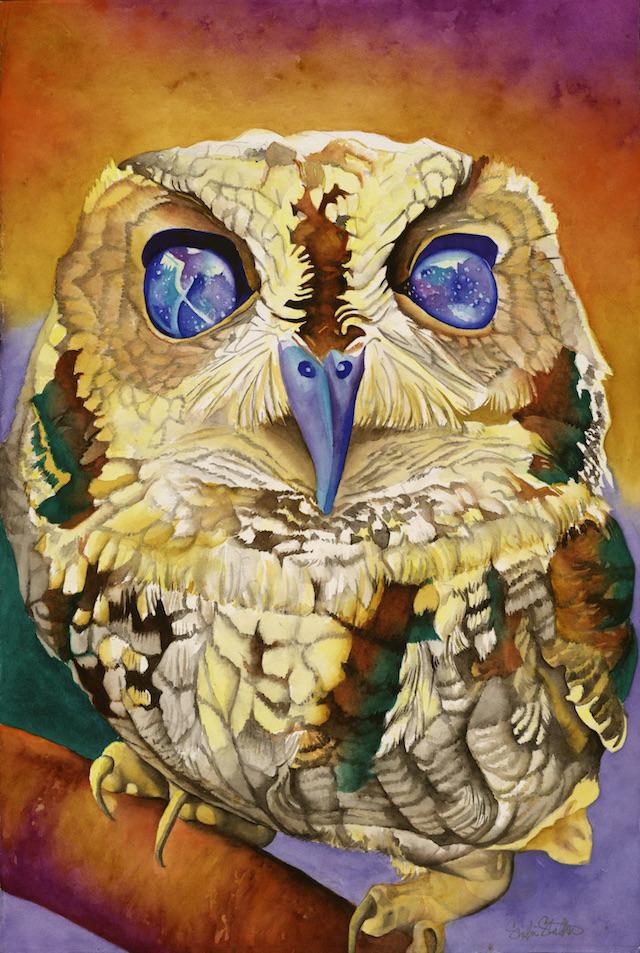
"Zeus the Blind Owl" The original watercolor painting is by Artist Sinclair Stratton.


This morning we loaded cardboard boxes of vegetables
into the trunks of cars. In each box, we put a card:
"How to: Broccoli," in tiny print, one side in Spanish.
How to choose fresh broccoli. But it had been chosen.

Families stayed in cars for hours in July's fierce heat.
In church we have prayed for the virus to go away.
You can buy human remains pouches on Amazon.
The zipper locks are guaranteed to keep the liquid in.

A man in the car line going up the hill stood outside,
bent over his battered Dodge Caravan, hood up, trunk held
in place with Bungee cords. Steam rose from the radiator.
The Great Pretender said he'd save the statue of Christ in Rio.

Last week, no form, no advice on Broccoli. Today,
to receive the USDA box, they must fill out a form:
name, address, the number in each family group.
The rule: one box per family, no matter how many.

How to eat it raw with a dip, how to stir fry, steam.
But we have seven in our family, one man pleaded.
Our group gave him two. A small boy waved at us
from the back seat.  I saw the careful handwriting,

apartments disclosed, streets, so painstakingly done,
 all for a box of surplus white mushrooms, broccoli,
head of iceberg lettuce.... Some boxes sagged.
There’s a Gaelic name for victims of bubonic plague

entombed in an Irish burial mound.  A plague hill.
Who sees the forms? One woman said, "We are illegal.
We don't want to put our names down on anything."
The young man in the passenger seat looked ahead.

In church we now regard the virus as a wake-up call.
I nodded, put two boxes in the trunk of her small blue car
that sputtered, set to break down.  Mute me on Zoom.
The Pharisees held out for handwashing, we were told.

The virus wants our lungs. Hart Island is our Potters Field.
Camus said we are owls blinded by too much light.
She told us the truth, and the truth will set us free.
Then my eyes stung; I could hardly see.


Bonnie Naradzay’s poems have appeared most recently in American Journal of Poetry, New Letters (Pushcart nomination), Kenyon Review Online, RHINO, EPOCH, The Tampa Review, Tar River Poetry, TheNewVerse.News, Ekphrastic Review, One; and poems are slated to appear later this year in AGNI and others.  In 2017 she graduated from St John’s College (the Graduate Institute), in Annapolis, Maryland.  For many years she has led poetry workshops at a day shelter for the homeless (Miriam’s Kitchen) and at a retirement center, both in Washington, DC.

Friday, July 03, 2020

RED FLAG DAY

by Buff Whitman-Bradley


With the first wail of the siren
A seismic gasp
Shudders up and down the streets
Of our little town
Here at the base of the forested mountain
Where all the trees
Are named kindling,
Where all the trees are named tinder,
Where all the trees
Are named fire.
So in the midst of a rampaging pandemic
We must worry now
About this too,
That an errant spark
From an ill-maintained power line
Will ignite a rampaging conflagration
Leaving devastation and death
In its wake.

Access is closed to many of the trails
In the watershed
Until the high winds die down
And temperatures drop.
Not long ago
Access was closed
Due to the coronavirus.
Too many people in the woods?
What a thought!
When we could enter again
A few weeks ago
We headed to a favorite spot
On a wooded lakeside trail
Where we could espy an osprey nest
At the very top of a dead Douglas fir
And see if last year’s inhabitants
Had returned during our pandemical hiatus.
And when we found that the pair
Was back home
Our viral gloom briefly lifted
And our spirits did a little jig or two.

The osprey couple will soon be caring
For hatchlings
Who will raise a right old ruckus
Every waking moment
Demanding food from mom and dad
Until one day
Obeying a mysterious call,
An ancient hearkening,
They will perch on the very edge of the nest
Or on the diving board limb
Extending several feet out
Above the water
And after a great deal of fussing
After a great deal of high-pitched pleading
For further instructions,
They will surrender their anxiety
To the primeval urge
And step off into air.

The winds have died down,
There have been no more sirens,
But the red flag will remain hoisted
Until tonight at 10 PM—
And how many more times this summer and fall
Will the scarlet banner snap in the wind
Before the rains return?
The headlines say that COVID 19
Has killed half a million people worldwide
And is showing no signs
Of abating.
We are all exhausted and demoralized
By the constant threat of plague and inferno
But we manage to muster up a little hope
When we picture those young osprey
Dropping straight down toward the water
Then in a transformative instant
Finding their wings and flaring upwards
Into the shimmering day.


Buff Whitman-Bradley's poems have appeared in many print and online journals. His most recent books are To Get Our Bearings in this Wheeling World and Cancer Cantata. With his wife Cynthia, he produced the award-winning documentary film Outside In and, with the MIRC film collective, made the film Por Que Venimos. His interviews with soldiers refusing to fight in Iraq and Afghanistan were made into the book About Face: Military Resisters Turn Against War. He lives in northern California. He podcasts at: thirdactpoems.podbean.com .

Tuesday, June 09, 2020

IN THE CONTEXT

by George Held


When long waves roll in at Napeague and roil the tidal pools, I feel nature’s force and nature’s balm soothing my wounded body and my troubled mind,

All in the context of Covid-19, the plague upon all houses...

Ah, “coronavirus,” that beautiful poetical word, amphibrach + trochee, a perfect word for free verse, a word that can break any meter the way the virus can break down any human organ—

“Coronavirus” - caress its divine sonic details on the tongue, in the pharynx, the miraculous voice box,

As you murmur the all-consuming word—
coronavirus,
coronavirus,
coronavirus


George Held, a longtime contributor to TheNewVerse.News, is sheltering in Eastern Long Island.

Saturday, June 06, 2020

2020, THE FALL OF THE HOUSE OF RODNEY USHER

by Bob Bradshaw


I noticed a condemned property
posting on his door

when I rang his doorbell
but my old friend's appearance

jolted me more.
What's wrong?  I demanded.

"I can't sleep, I'm as restless
as a storm’s waves.”

He grabbed his chest.
A tightness was gripping him

like a vine's hold
on a rotten wall.

“Heart failure—
from that damn virus.”

His doctors had dismissed his worries.
There is no virus, I assured him.

It vanished in the spring.    
May even have been a hoax.  

He was manic.  He was sweating.
“It’s the coronavirus.”  His breathing

was heavy, choppy like surf.
“It’s gotten inside.”

Relax, I told him.  The plague
has vanished.  Gone.

You can leave your house now.
“Still, I can't help worrying:

at times my heart's
a wild flapping

like an osprey tangled
in fishing line.  The more I fight it,
     
the tighter my chest
becomes.”

Is your house safe?  
I noticed a crack splitting

the front wall. "This house,"
he sighed, "teeters on a sea cliff

that's crumbling.
Erosion causes the cracks."

Why don't you leave?
He shuddered. "I can't.

Outside isn’t safe.” Nonsense.
Sure, tests once showed

people were sick. But praise be
there are no more tests.

So, no more sick people!
It’s common sense.     

You’re just behind the times.
Time to go back to work, my friend.

But you should get a handyman
to fix up this house.

“No kidding,” Rodney says.
“At night the joists crack,

and my sense of balance
falters as the house leans.

I slip like a man on wet pavers,
my heart a bird thrashing

its wings against its cage." I nodded.
Clearly he couldn’t face

the “new normal,” a world
safe again.

He was hopeless.  
What could I do but go home?

I had business to attend to.
I could no more persuade him

to leave his sanctuary
than I could have convinced

a starfish to loosen its grip
on a rotten pier.

His last letters show
a man crazed, damned

by inexplicable fears,
slipping over the edge

like his mansion
which broke apart tumbling

into the Pacific—
nothing in the end

for my friend to hang onto,
even the sea washing
its hands of him.


Bob Bradshaw is a retired programmer living in California.  He is looking for the perfect hammock for his retirement.  Recent work of his can be found at Dodging the Rain, Eclectica, and Ekphrastic Review.

Saturday, April 25, 2020

LINES

by Bonnie Naradzay


Sculpture depicting a Great Depression breadline at the Franklin Delano Roosevelt Memorial, Washington, D.C.


This has been done before, standing in line for a long time.        
Think of Soviet women who queued for hours for bread.              
And I have learned about the lines of the Great Depression:        
men lined up for mind-numbing jobs at assembly lines.                

Think of Soviet women who stood for hours for bread                
or Akhmatova outside the prison waiting for news of her son.    
Here, men lined up for mind-numbing jobs at assembly lines.    
These days some have it easy – food deliveries, yoga online.        

Akhmatova outside the prison waited with women for news        
and the chance to send a loaf of bread, or a note, inside.              
These days some have it easy – food deliveries, yoga online.        
Still, Camus said the plague is within us, here to stay.                

I have learned about the lines of the Great Depression                
where hope envisions a loaf of bread, a note from inside.              
Camus wrote that the plague is within us, here to stay,                
as it has always done: waiting in line for a long time.      


Bonnie Naradzay’s poems have appeared most recently in American Journal of Poetry, New Letters (Pushcart nomination), RHINO, EPOCH, the Tampa Review, Tar River Poetry, and Ekphrastic Review and are slated to appear in Kenyon Review Online, AGNI, and others.  For many years she has led poetry workshops at a day shelter for the homeless and at a retirement center, both in Washington, DC. 

Wednesday, April 15, 2020

DETACHED

by Mark Ward


There’s that meme of James Franco ‘bout to be
hanged. He smiles, asks “First Time?” The text reads “Gays:”

as if they’re asking the straights now with them
(and of course it’s him, confused peacocking),

referring to both of the viruses
I’m scared of. Their first time to be ignored,

to feel helpless and, literally, alone.
First time kept out of the hospital room,

to be told they have died, second-hand.
It’s not the same though. The world didn’t stop

for us. The summer sun showed thinned-out prides,
detached eyes staring. Now, we’re all locked down,

look at how the world has come together,
look at all we could have achieved back then.


Mark Ward is the author of Circumference (Finishing Line Press, 2018) and Carcass (Seven Kitchens Press), as well as a full-length collection, Nightlight (Salmon Poetry, 2022). He is the founding editor of Impossible Archetype, an international journal of LGBTQ+ poetry, now in its fourth year.

Thursday, April 09, 2020

SHOPPING AT THE SUPERMARKET

by Gil Hoy


Shoppers appear to be lined up six feet apart outside a Market Basket in Chelsea, Massachusetts, on April 2, 2020, as the grocery store chain implements new social distancing guidelines. —nbc Boston


You don't want to be there, but your family has to eat.
Which is just the two of us now. I'm waiting and walking
in lines made from rope. Like the roped-off lines
we used to see on a busy day at Disney World
with the kids. Today's anticipation is different.
Just hungering for the food you need to survive.

It's my son's birthday today. He's studying to become a doctor.
Sitting in his room in a suddenly faraway State. He's learning
human anatomy on a computer. The half-dissected cadaver
in his school laboratory will simply have to wait. I worry about
him sitting there all alone.

A police officer is cautioning customers to stay at least
six feet apart. I clean my hands with one of those sanitizer
things before going in. I'm proud I've not bought
any toilet paper yet. Can it really be caught
through the air like a plague?

I've never spent so much time alone with my wife.
Is she worried I'm getting bored with her?
I wonder if she's getting bored with me. No one
can be entertaining for this long. Such expectations
are unrealistic. I sense her panic as she watches
the news.  She's still able to connect with other
real estate brokers from her office for an hour a day
on her computer. They talk about the best ways
to sell homes at a distance.

Most everyone inside the supermarket is wearing
a blue or white mask. They look like shabby doctors
and nurses. I pick out some chicken and put it
in my cart with a box of strawberries. A lady
standing too close to me has a distant stare. As if
she's half-dead. I suspect she has no family or friends.

Just a few weeks ago, my street-smart son was serving
us oysters, fish and wine for dinner at a fancy restaurant.
Like he did every Sunday. They won't let him work now
so he and his girlfriend are barely getting by on one-half
of their pay from the government. We ordered dinner
delivered to them the other night and they seemed
appreciative. And happy for a while. My daughter
and her husband are holed up in Palo Alto
doing computer and engineering work. They're
still getting paid and still drive their new Tesla.
She likes to read my poetry these days.

I see there are still live lobsters for sale
in the seafood section. Their number is depleted
from what they once were. They're subdued and sullen.
They're not moving in their tank. I wonder
how long they have to live.

My father won't stop texting me on my cell phone
and messaging me on Facebook. We haven't spoken
in 20 years. Old high school friends want to travel
down memory lane, over and over again. Texting
and messaging me until my eyes are ready
to bug out of my head. Everyone is trying to settle
old scores and pay off their debts. I'm sorry to see
there's no beer left in the cooler for purchase
as I head towards the cashier to pay.


Gil Hoy is a Boston poet and semi-retired trial lawyer who studied poetry at Boston University through its Evergreen program. He previously received a B.A. in Philosophy and Political Science from Boston University, an M.A. in Government from Georgetown University, and a J.D. from the University of Virginia School of Law. Hoy served as a Brookline, Massachusetts Selectman for four terms. His poetry has appeared, or will be appearing, most recently in Tipton Poetry Journal, Chiron Review, TheNewVerse.News, Right Hand Pointing, MisfitMagazine, Mobius: Journal of Social Change, Ariel Chart and The Penmen Review.

Thursday, March 05, 2020

DECAMERON FOR A NEW PLAGUE

by Joan Leotta


Photo of Fiesole by Sailko at visittuscany.com


Boccaccio and his friends
escaped to the hills of Fiesole,
well above miasma of air
of Florence, for even her beauty
could not hold back the plague.
At last, among his friends
breathing the clean air of country living,
these friends staved off
even fear of infection
with stories—
Decameron.
Now, who will gather up little ones
from the close quarters of their cages?
Who will hold them close,
breathe light and love to clear
the air in their tight spaces?
Who will write a Decameron
to stave off
their fears and tears?


Joan Leotta plays with words on page and stage. Her poems have been published in the Ekprhastic Review, Pinesong, Anti-Heroin Chic, Ovunque Siamo, Fourth River,  Silver Birch, and many others. She performs personal and folk tales of food, family, and strong women. Her first chapbook is out from Finishing Line Press: Languid Lusciousness with Lemon.