Guidelines


Submission Guidelines: Send 1-3 unpublished poems in the body of an email (NO ATTACHMENTS) to nvneditor[at]gmail.com. No simultaneous submissions. Use "Verse News Submission" as the subject line. Send a brief bio. No payment. Authors retain all rights after 1st-time appearance here. Scroll down the right sidebar for the fine print.
Showing posts with label Chernobyl. Show all posts

Tuesday, May 27, 2025

SHAPED LIKE A FISH

by Bonnie Naradzay


Earlier this year, scientists discovered that there is about as much microplastics in the brain as a whole plastic spoon. The paper, published in Nature Medicine in February, revealed that the amount of microplastics—tiny plastic particles smaller than 5 millimeters—in the human brain appears to be increasing: Concentrations rose by about 50% between 2016 and 2024. —Fortune, May 20, 2025


Reading about how NASA astronauts

grew edible zinnias while orbiting 

above us in space, I think of ways

we've chosen to live on this earth. 


Red lilies and oleander were the first 

flowering plants to thrive in Hiroshima’s 

charred remains.  In the rubble, gamma 

rays made the blooms even brighter.


Fields of sunflowers, grown in Chernobyl, 

change the radioactive dirt effectively, 

scientists say. Meanwhile, Agent Orange 

is everywhere in the soil in Viet Nam.


Flowers that have grown mutations, 

though near Fukushima, may be 

a mistake. Could that happen anyway?

On islands in the Tasman Sea, birds 


mistake ocean plastics for food to feed

their chicks, and dead birds were found

having ingested single-use soy sauce 

plastic bottles, shaped like a fish.  


When you mistake the song of a bird
for the death rattle of another species, 

It’s already over.  The world is filled

with microplastics, like our brains.


Source: Heliograf


Bonnie Naradzay’s manuscript will be published this year by Slant Books.  For years, she has led weekly poetry sessions at homeless shelters and a retirement community.  Poems, three of which have been nominated for Pushcarts, have appeared in AGNI, New Letters, RHINO, Tampa Review, EPOCH, Dappled Things, and other places. While at Harvard she was in Robert Lowell’s class on “The King James Bible as English Literature.” In 2010 she was awarded the University of New Orleans Poetry Prize – a month’s stay in Northern Italy – in the South Tyrol castle of Ezra Pound’s daughter Mary.  There, Bonnie had tea with Mary, hiked the Dolomites, and read drafts of Pound’s translations. 

Tuesday, January 02, 2024

SMALL VICTORIES

by M. Benjamin Thorne


Two Russian poets have been handed long jail sentences for taking part in a reading of anti-war poems in Moscow. A Moscow court gave Artyom Kamardin seven years and Yegor Shtovba five and a half years for "inciting hatred" against Russian troops and making "appeals against state security". Both had pleaded not guilty… A third poet who had taken part in the poetry reading, Nikolai Dayneko, was given a four-year sentence earlier this year after pleading guilty and co-operating with the investigation. —BBC, December 28, 2023. Photo: Russian poets Artyom Kamardin (L) and Yegor Shtovba (R) stand inside the defendants' glass cage as the verdict against them is announced at a court in Moscow, on December 28, 2023 [Alexander Nemenov/ AFP via AlJazeera]


Artyom Kamardin, the scuttling hands
of Putin’s comrade army clutched you away.  
Yegor Shtovba, they broke you in prison, brutally 

shoved their weakness inside you. 

Today they sought to silence freedom,
and tonight Akhmatova’s ghost screams.


All for the crime of poetry. A few words
that sat heavily in public, burning
like Chernobyl rubble, glowing in the dark.
What will their half-life be?
Already the rallied crowd shuffles
back into quiet anonymity.
Who bows their head lower now                  
in shame, them or Pushkin?
Where are the souls so moved
reciting Eugene Onegin from memory?
Where the fierce courageous applause
that followed Shostakovich and Yevtushenko?
Freedom is still a young and starving child,
will you like Tsvetaeva give her to the state to die?
Why grieve for fallen soldiers
when you murder them at home?

Perhaps their poems were as meaningless
as Soviet ration cards for milk past 10 am,
or victory claimed in a burned-out village.
One poem may not change the world.
But words are radioactive and once heard
can decay the most calcified mind’s
defenses. Perhaps the sense of resistance
is not to succeed, but inspire others to resist.
A poem may change the world for one person.


M. Benjamin Thorne is an Associate Professor of Modern European History at Wingate University. As an historian and poet, he is interested in what—and how—societies choose to remember and forget traumatic episodes from the past. He has poems forthcoming from Topical Poetry and The Main Street Rag.

Wednesday, April 05, 2023

NATIONAL PARK

by Jerome Berglund


Dogs roam the ghost town of Pripyat within the Chernobyl exclusion zone in Ukraine. Scientists have identified genetically distinct populations living in the area, including within the highly contaminated power plant. Credit: Dimitar Dilkoff/Agence France-Presse—Getty Images via The New York Times, March 3, 2023


The Dogs of Chernobyl Are Experiencing Rapid Evolution, Study Suggests 
Popular Mechanics, April 1, 2023


near fifty odd past,
generations of curs
in the fallout

plume rose up
into the air
but has it dissipated 

toys left behind
during hasty retreat 
from exclusion zone

through ruins 
of the power plant
feral strays mutating

irradiated populations
not eradicated
over the dog years

unmolested 
other kingdoms
time to flourish

the casualties
by necessity
continue evolving 

beneficial adaptations
can they be reabsorbed
into populations

tempering
for weathering 
this boiling world

roaming the wastes
admiring 
the many sunflowers 


Jerome Berglund, recently nominated for the Touchstone awards and Pushcart Prize, has many haiku, senryu, and tanka exhibited and forthcoming online and in print, including in the Asahi Shimbun, Bottle Rockets, Frogpond, and Modern Haiku.  His first full-length collection of poetry Bathtub Poems was just released by Setu Press.

Tuesday, March 22, 2022

OSTINATO

by Kay Newhouse


Count the time from lightning flash 
And multiply by distance till the thunder
Rolls its way inside the house and rattles all the dishes on the shelves.
In case of nuclear disaster, ready.gov says that there is time
(I read) To go inside
Rinse out your hair and eyes and mouth
Take off your clothes
Like napalm child whose scream in glossy magazines
Holds still for history (I should know her name)
(This is important now)

My neighbor hides her thyroid scars in wrinkles on her neck
And tells me my old dog is fat again
And daughters should wear pink not jeans
And English is not easy (she repeats) and she grew up not in Chernobyl 
But a hundred miles away or so where wind picked up the dust 
And brought it to her through the forests
Sifting ash across her clothes and hair and face and now finding her with cancer 
These so many miles and years ago—
But it doesn’t matter (she says) остинато
You can’t see a scar that has so many wrinkles to surround it 
What’s that flower on my driveway
And I answer her with just one word
“impatiens,” I repeat to her, a little louder now
“impatiens”


Kay Newhouse’s first byline was in Physical Review Letters, and most recent in Wildfire Magazine. She lives near Washington DC, where the cherry trees flower every spring, the fireworks are overrated, and people are more likely to talk to each others’ dogs than to each other. This is about the same as everywhere, more or less.

Friday, March 04, 2022

TO GUINEA, WITH LOVE

by Indran Amirthanayagam


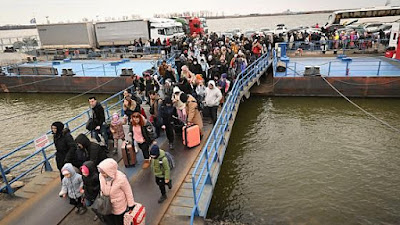
Amid Ukraine Exodus, Reports Emerge of Bias Against Africans —VOA, March 2, 2022


The tradesman from Guinea has lived in Odessa for fourteen years. He is
afraid. In one day all of Ukraine's airports shut down. In one night heavy
bombs fell just ouside of town. They are falling now. Russian soldiers
landed on the beach and are marching towards Kyiv. The horror. The sadness.
It is happening. Shock and awe. Awful. Wrath. Madness. Chernobyl, symbol
of nuclear death has been captured. No reports yet on the state of the concrete.
Where are we going? I listen to the trembling voice of my friend from Guinea.
He says he will watch and wait for another day or two, huddle at home
by his television in the apartment block. If fighting comes to his neighborhood
then he will call Guinea. Ask to be flown out. How many diplomats has
Guinea posted in Ukraine? How many cars and planes? Airports are shut.
But the sea flows by Odessa. He has lived in Odessa for fourteen years.
He knows people with boats. He has sold them housewares. He will
ask them to take him away. Past the battleships. To Guinea.


Indran Amirthanayagam's newest book is Ten Thousand Steps Against the Tyrant (BroadstoneBooks). Recently published is Blue Window (Ventana Azul), translated by Jennifer Rathbun.(Dialogos Books). In 2020, Indran produced a “world" record by publishing three new poetry books written in three languages: The Migrant States (Hanging Loose Press, New York), Sur l'île nostalgique (L’Harmattan, Paris) and Lírica a tiempo (Mesa Redonda, Lima). He writes in English, Spanish, French, Portuguese, Haitian Creole and has twenty poetry books as well as a music album Rankont Dout. He edits The Beltway Poetry Quarterly and helps curate Ablucionistas. He won the Paterson Prize and received fellowships from The Foundation for the Contemporary Arts, New York Foundation for the Arts, US/Mexico Fund For Culture, and the MacDowell Colony. He hosts the Poetry Channel on YouTube.

Wednesday, March 02, 2022

MY UKRAINIAN FAMILY

by Margaret D. Stetz


Sucking beer from bottles
shattering bottles in fists
punching drunk
strangling sober
seeing crucifixes as waste
of iron nails
better pried out and rammed into skulls
the Chernobility
of radioactive men—
torrents of blows
gales of curses
whipping winds
into a male-strom
pulverizing bodies
flattening weapons
sweeping clear
field city nation


Margaret D. Stetz, who is Ukrainian American, is the Mae and Robert Carter Professor of Women's Studies and Professor of Humanities at the University of Delaware. In the past year, her poems have appeared in journals such as Review Americana, Existere, Mono, A Plate of Pandemic, West Trestle Review, The Adriatic, and also in the Washington Post

Monday, January 31, 2022

NUCLEAR WASTE

by Charles Rammelkamp


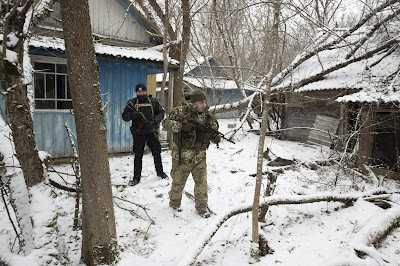
Ukraine has initiated a defensive strategy for the Chernobyl Exclusion Zone, one of the most radioactive places on Earth, which lies on the shortest path between Russia and Ukraine’s capital, Kyiv. Photo: A Ukrainian border guard on a joint patrol with the Ukrainian police inside the Chernobyl Exclusion Zone. —The New York Times, January 22, 2022


“It doesn’t matter if it’s contaminated,
or if nobody lives here,” Yuri declared,
responding to the unspoken skepticism 
in the sheen of the reporter’s dark eyes.
“It’s our territory, our country,
and we have to defend it.”
Shouldering his Kalashnikov, Yuri patrolled 
the snowy fields of the Chernobyl zone;
winter in northern Ukraine.

“I remember reading about the Soviets
parading the children on May Day 
through the swirl of radioactive dust
right after the accident 
to try to make us—and the world—believe 
nothing serious had happened.
Thank goodness I wasn’t alive then.

“Pripyat’s a ghost town now;
used to be the biggest city in the area.
You can still see the old Soviet propaganda –
a sign extolling the virtues of nuclear energy.
‘Let the atom be a worker, not a soldier.’”

Hunching his shoulders, as if to toss away his anger,
shifting the rifle, Yuri went on:
“Now we don’t know 
what will kill us first,
the virus, radiation, or Putin’s bombs.”
 

Charles Rammelkamp is Prose Editor for BrickHouse Books in Baltimore, where he lives with his wife Abby. He contributes a monthly book review to North of Oxford and is a frequent reviewer for The Lake, London Grip, Misfit Magazine, and The Compulsive Reader. A poetry chapbook, Mortal Coil, was published in 2021 by Clare Songbirds Publishing and another, Sparring Partners, by Moonstone Press. A full-length collection, The Field of Happiness, will be published in 2022 by Kelsay Books.

Thursday, May 05, 2016

EXCLUSION ZONE

by Joan Mazza


Evolutionary biologist Timothy Mousseau and his colleagues have published 90 studies that prove beyond all doubt the deleterious genetic and developmental effects on wildlife of exposure to radiation from both the Chernobyl and Fukushima nuclear disasters, writes Linda Pentz Gunter. But all that peer-reviewed science has done little to dampen the 'official' perception of Chernobyl's silent forests as a thriving nature reserve. —The Ecologist, April 25, 2016


Thirty years after Chernobyl’s accident
spilled radiation equal to twenty Hiroshimas,
wolves, roe deer, boar, bison, and moose thrive
between abandoned apartment buildings and once-
tended fields and gardens. Animals too contaminated
to eat. Appearing to be normal, they meander
within what is left of Pripyat. Tourists travel
to photograph the haunting beauty of decaying
buildings, trees flowering in spring, ignore long-term
threats of gamma particles that enter their bodies—
silent with their sinister destruction. This zone
is an unintentional wildlife sanctuary,

while Fukushima fallout spreads eastward
across the Pacific Ocean toward the west coast
of the Americas. Southern California seaweed
holds five times the normal radiation. What this
means for other foods, for long-term human
health, we don’t yet know. The ocean maps show
the field widening, contaminating fish, plankton,
and mammals, dumping tsunami debris on islands
along the way. Another natural experiment.
Perhaps another surprise nature reserve. We wait
to see what it brings, which of the fittest survives.
No one will be excluded from this test.


Joan Mazza has worked as a medical microbiologist, psychotherapist, seminar leader, and has been a Pushcart Prize and Best of the Net nominee. Author of six self-help psychology books, including Dreaming Your Real Self (Penguin/Putnam), her poetry has appeared in Rattle, Kestrel, The MacGuffin, Mezzo Cammin, Buddhist Poetry Review, and The Nation. She ran away from the hurricanes of South Florida to be surprised by the earthquakes and tornadoes of rural central Virginia, where she writes poetry and does fabric and paper art.

Friday, March 14, 2014

REMEMBER CHERNOBYL

by B.Z. Niditch


We watch the war hawks
in the media
with reckless rhetoric
and historic amnesia
getting in their last licks,
wishing to turn
their backs
on the clocks of 1986
at the horrific peril
of Chernobyl
when rains of death
spilled over the Ukraine
polluting our earth,
then missiles started
to dissolve
on Russian soil,
now the critics of peace
have resolved
to start shooting
even at the Kremlin
when we know our foil
is really about the oil
our citizens
choose peace
to ignore the breathless
lies for war.


B.Z. Niditch is a poet, playwright, fiction writer and teacher.  His work is widely published in journals and magazines throughout the world, including: Columbia: A Magazine of Poetry and Art; The Literary Review; Denver Quarterly; Hawaii Review; Kadmos (France); Prism International; Jejune (Czech Republic); Leopold Bloom (Budapest);  Le Guepard (France);  Antioch Review; and Prairie Schooner, among others. He lives in Brookline, Massachusetts.