Guidelines


Submission Guidelines: Send 1-3 unpublished poems in the body of an email (NO ATTACHMENTS) to nvneditor[at]gmail.com. No simultaneous submissions. Use "Verse News Submission" as the subject line. Send a brief bio. No payment. Authors retain all rights after 1st-time appearance here. Scroll down the right sidebar for the fine print.
Showing posts with label animals. Show all posts

Wednesday, April 09, 2025

A POEM

by Pulkita Anand


Write a poem using the rhyming of the hollering peacock and deer.

Use metaphor to describe their running helter-skelter. Do mention the arrest of the vulnerable students. Include the numbers: forest areas, trees cut, displaced birds, temperature rise, dead animals. Add a phrase about how some animals were buried before dying. 

Typographically present the stubs and remains after devastation. Use rhetorical questions: Where will they go? Why are they destroying forests? What crime? What punishment? Should development be at the cost of dead sentient beings? Use all your senses to describe the joy in a forest. Compare then and now. 
Use other poetic devices to draw readers’ attention towards their heated future. End with a bird song or end with a couplet about global warming or a burning planet or nothing. 

Consider titling the poem Green vs Greed.


Pulkita Anand is an avid reader of poetry. She has translated one short story collection, Tribal Tales fromp Jhabua. Author of two children’s e-books, pher eco-poetry collection is we were not born to be erased. Her creative works have been widely published in journals.

Monday, January 13, 2025

FIRE

by Gil Hoy


AI-generated graphic by NightCafé for The New Verse News.


The hawk

Soars high

in the sky. Humans
Soar higher,
Faster, 
Farther. 

The fish
Swims majestically 
Through the currents 
of the sea. Humans
Swim faster,
Deeper,
Farther. 

Bats,
Whales, 
Dolphins,
Rabbits,
Don’t destroy

the planet.
 
It’s getting hotter outside.

The fires rage and

There’s not enough water. 


Gil Hoy is a Best of the Net nominated Tucson, Arizona poet and writer who studied fiction and poetry at The Writers Studio in Tucson, Arizona and at Boston University. Hoy is a semi-retired trial lawyer and a former four-term elected Brookline, MA Selectman. His poetry and fiction have previously appeared in Third Wednesday, Flash Fiction Journal, Tipton Poetry Journal, Unlikely Stories Mark V, Chiron Review, The Galway Review, Right Hand Pointing, Rusty Truck, Mobius: The Journal of Social Change, The Penmen Review,  Last Stanza Poetry Journal, Bewildering Stories, Literally Stories, The New Verse News and elsewhere.

Sunday, October 02, 2022

BLESSING THE ANIMALS

by David Chorlton


On and around The Feast of St. Francis, October 4 this year, many churches organize a Blessing of the Animals to which dogs, cats, bird, bunnies, ponies, chickens, and all creatures great and small are welcome.


Here’s a cat who’d take
the dinner from a china plate but bless
her anyway; she doesn’t know
the rules of etiquette. Consider the coyote
blessed when he stops in the middle of the street
and looks back at a pedestrian
his wildness has touched. Bless the starlings
who were fruitful and
multiplied from coast to coast, and bless
the common pigeon for
turning waste lots into food. Bless
the rattlesnake who curls up at a trail’s edge
by stepping carefully around him,
and save
for the jaguar who returns to
ancient hunting grounds
a special blessing that will follow him through
darkness. Shall we dare
to shower favor on the rats who climb the final
daylight and cavort
in yards and vegetable beds? Or spare
an extra prayer for the Great horned owl
when he is done with ferrying souls
to comfort and a resting place?
When the Cooper’s hawk is waiting
for a mourning dove, be generous as this world
in which an ocean is the predator
and a river is the prey.


David Chorlton has lived in Phoenix since 1978, and has shared home with many cats, birds, and occasionally dogs. The creatures who visit his yard appear frequently in his new book Poetry Mountain from Cholla Needles in Joshua Tree, CA., who also published the poems his white cat Raissa wrote in the late Clinton years (of a very concrete nature) in a little book called Gilded Snow along with her owner's commentary.

Tuesday, August 02, 2022

AERIAL VIEW OF CATASTROPHIC FLOODING IN EASTERN KENTUCKY

by Pauletta Hansel


Quicksand, Bulan, Neon, Hiner, Martin, Fisty.
This is our place in Hueysville.
This was my Mother’s house before she passed.
Samantha’s sister’s house is by that blue bridge.
Anyone know anything about Fugate’s Fork Road?
Stringtown, Ajax, Isom, Pinetop, Dwarf.
This is my cousin’s house. 
My Mamaw’s house is on the left.
That bridge is about 8 feet above
where the creek’s supposed to be. 
Isn't this Mary's house?
This is the mouth of our hollow,
the red arrow was our road in.
Nix Branch, Jakes Branch, Trot.
If you zoom in to where the white car hood is,
my home is there.
Rowdy, Wayland, Noble’s Landing Cowan Creek.
OMG that is Pigeon Roost.
Y’all this is my hometown.
This little tree, and God, kept us alive this morning.
My daughter swam with her dog to a neighboring rooftop.
Caney, Possum, Ary, Lost Creek, Hardburly, Trace.
Dad and my nephew are neck deep
they need help
please.
Are you all safe??
We lost the farm animals and 5 cats.
Lost my chainsaws so I can't even work.
Hindman, Buckhorn, Chavis.
You need to understand the nature of the topography.
Add to that strip mining, climate change, political neglect.
Krypton, Garrett, over toward Pound.
Does anyone know about Kite, KY?
We have lost everything
again.
We have warm beds, clothes, and toiletries available.
We have hot showers and food.
Anyone trapped in downtown Whitesburg is welcome to come.
We need help and I'm willing to help anyone
in the same shape we are.
Your prayers are good
but we need to get federal and state assistance ASAP.
Don’t cry for Appalachia, work for change however you can!
Let's use the internet to tell our story.
Thank you for posting.
Much love and many blessings to you all
from what's left.
 

Poet Pauletta Hansel writes “This poem is made up of direct quotes from posts about the devastating flooding in eastern Kentucky. Appalachia tends to hit the news briefly, if at all, during disasters, and is soon forgotten. If you haven’t heard of any of these places, you’d better get on Facebook quick, before we disappear again. Want to help? Go to Appalshop.”

Tuesday, May 03, 2022

IN HOLLOWS OF MY LUNGS

by Dick Altman


Projected to double in size in the coming days, the Calf Canyon / Hermit’s Peak Fire continued to rage on May 2nd in northern New Mexico, threatening towns and villages and forcing thousands to flee. Now, erratic winds are pushing the flames closer to Mora and Las Vegas. —KUNM, May 2, 2022. Photo: View of the Calf Canyon / Hermit's Peak Fire from Santa Fe. Courtesy Of Shaun Griswold via KUNM.


on shores of my eyelids – remnants
of forest/plain/pastureland scorched to ghost –
not last year – not last month – as I write –
cell buzzes with warnings to evacuate –
nearly fifteen towns – in two counties
next to mine – since afternoon yesterday

                                *

gusts – without let up – race across
ground at sixty miles an hour – back
of throat feels I’m feasting on ashes –
smoke’s blackened cargo tumbles skyward –
cooler atmosphere whitens the boil –
if cows/horses/sheep/pigs/fowl notice –
who can say – who can say how farmers
corral/truck herds of livestock – in trailers
built for two – or maybe four – animals –
and to where – how decide who stays/goes

                                 *

homesteads – over a hundred – some
generations old – now dust – color of bone –
swirling – swirling around Sangre’s peaks –
this way – who can say this way – to bear/
deer/tarantula/snake – to bees and honey-
blooded flora – who to bore tunnel in sky
for birds on nest – for geese/ducks/owls
buzzards – if they survive – sideline until
the earth clears – party on barbecue
of their lives

                                  *

a controlled burn – preserving the forest –
they call it – human-struck match turned
into rogue torch – wind rocketing cinders
mile or more – no human way to keep up/
stay ahead – two blazes converging –
in marriage from hell – hell today – yes –
hell’s tomorrow beyond sorrow – black/
bleak/barren – no playbook to restart Eden –
no mind/memory trick to erase replaying
the present

                                  *

smell forest’s burnt flesh – fireplace’s scent
of pine/spruce/fir – except flesh gave up
the seasoned old age we cherish – its aroma
of solace/comfort/home – second life we –
with love – endow it – gone – gone up –
swallowed – in somebody else’s smoke
 

Dick Altman writes in the high, thin, magical air of Santa Fe, NM, where, at 7,000 feet,
reality and imagination often blur. He is published in Santa Fe Literary Review, American
Journal of Poetry, riverSedge, Fredericksburg Literary Review, Foliate Oak, Blue Line,
THE Magazine, Humana obscura, The Offbeat, Haunted Waters Press, Split Rock Review,
The RavensPerch, Beyond Words, Sky Island Journal, and others here and abroad.  A poetry
winner of Santa Fe New Mexican’s annual literary competition, he has in progress two collections
of some 100 published poems.  His work has been selected for the forthcoming first volume
of The New Mexico Anthology of Poetry to be published by the New Mexico Museum Press.

Saturday, March 05, 2022

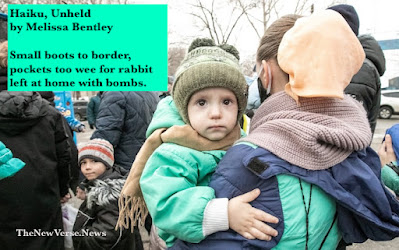
HAIKU, UNHELD

"Two young girls who left their pet rabbit behind, mothers carrying toddlers and luggage—these are some of the more than half million people who fled their homes in Ukraine due to the Russian invasion." —NPR,  February 28, 2022. 


Editor's Notes:  1. When sirens rang out and Russian missiles began pummeling Ukraine’s cities, hundreds of thousands of people fled their homes, many bringing with them the cats, dogs and other pets they cannot leave behind.” —The Mercury News, February 28, 2022.   2. Humane Society International is providing necessary support, including emergency funds, to groups that are helping the Ukrainian people and the animals in their care who have been devastated by Russia’s military invasion. You can rush a gift to its emergency response for Ukraine and other rescue and relief efforts here.    3. “When we talk about pets in the same breath as the humanitarian tragedy unfolding in Ukraine, it can sometimes feel a little flippant. Surely our focus should be on the human victims, not someone’s cat? But to the very real people at the centre of this tragedy, their pets are not something to be flippantly forgotten about. —EuroNewsGreen.   4. The Telegraph (UK)) photo above from the Ukraine evacuation does not picture the girls mentioned in the NPR story.


Melissa Bentley lives in North Carolina, and works in the field of public mental health services.

Monday, January 17, 2022

WILD ABOUT WHITE

by Jen Schneider


sets on. lights bright. everyone wild. wild about white. all bets on betty. betty always on. leg of hose & humor on tap. eyes of blue & berry sparkle. body & mind of pure spunk. cameras click. lights blind while white binds. folks of television lands. card hands & foreign tongues. tongues click. vocal cords clack. white cures airs of silence. heir to all. syllables stream. smiles crack. baby blues sparkle. betty curates & creates. aches of bellies & bent backs arc. laughter always on the menu. dial in. dial on. of/with/at your back. always streaming. of decades. of then. of now. flashes of brilliance. beltways of brightness. of dolls & decades. of danes, dances & daily documentation. of golden girls & mary tyler moore. everyone always eager for more. regimens & irregularities. broads on main. saturday night brilliance. live on stage (& social). expert at both crafting & creating a life. time to mourn. time to adorn. under the lights. lights bright. sets on. everyone wild. wild about white.

99 (by three) ways to make (live) (transform) a life

1.     Entertain all people, possibilities, & permutations. Ration sarcasm.
2.     Track consumption not weight. Weigh options. Seize opportunity.
3.     Track actions, not time. Treasure time & tunes of many types (& transcripts / scripts).
4.     Experience & experiment with life, love, laughter. Liquid humor, too.
5.     Season all sauces. Secure all seasons (& reasons).
6.     Breed offspring of original lines. Converse (& traverse) lines of unoriginal origin.
7.     Maximize sauciness. Minimize saltiness.
8.     Memorize scripts regularly. Make new memories daily.
9.     Prime personalities & timing. Always of/on prime time.
10.  Improvise finales. Rehearse final lines.
11.  Glow (like a Golden Girl). Emulate (like a multi-Emmy winner).
12.  Collect & create (a life on high definition). (re)Create. Juxtapose. Pose often.
13.  Patron (not patronize) all personalities. Puree peculiarities & ponderings.
14.  Befriend & pet creatures of many paws. Pause often. Inhale. Glow. Regale.
15.  Pen recipes of craft & creation. Greet consumers of/on/in People & Parade.
16.  Serenade serendipity. Harmonize habits. Habituate harmony.
17.  Entertain all possibilities. Entertain all people. Populate screens. Screen popularity.
18.  Track actions. Not time. Treasure time & tunes of many types.
19.  Experience & experiment with life, love, & laughter. Favor foods of familiar roots.
20.  Embrace final words & works. Take action & agency. Work finales.
21.  Grace plates, tubes, & presents. Maintain presence of mind and manners.
22.  Practice gratitude. Tether caution. For/of/in/at duties. Projects, too.  
23.  Be of homegrown grains & household grime.
24.  Assess all situations. Situate all communications. Savor sitcoms.
25.  Twinkle under stars, in eyes, of curtseys. make light of most makings.
26.  Stroll across stages. Put pen to paper. Pamper pets in pens.
27.  Add a dose of sass to all sensations (& creations)
28.  Be curious. Be courageous. Be(t) on/of/for betty.
29.  Mix & mingle. Sip sweet & salty. Stir trouble. Add dashes of umph.
30.  Blanket newsstands. Blanket screens. Fill in (all) blanks.
31.  Run series. Run bits. Run betty.
32.  Plan jokes of spontaneous & unpredictable possibility. Do not plan. Be.
33.  Be (dedicated to thee) betty.


Sources:
https://people.com/tv/betty-white-died-peacefully-in-her-sleep-at-home-agent-says/
https://www.nytimes.com/2021/12/31/arts/television/betty-white-dead.html
https://www.cnn.com/2021/12/16/entertainment/betty-white-100/index.html
https://www.washingtonpost.com/lifestyle/2021/12/31/betty-white-appreciation-tribute/


Jen Schneider is an educator who lives, writes, and works in small spaces throughout Pennsylvania. She is a Best of the Net nominee, with stories, poems, and essays published in a wide variety of literary and scholarly journals. She is the author of A Collection of Recollections (Next Chapter), Invisible Ink (Toho Pub), On Daily Puzzles: (Un)locking Invisibility (forthcoming, Moonstone Press), and Blindfolds, Bruises, and Breakups (forthcoming Atmosphere Press).

Monday, June 21, 2021

FIRE THE NEXT TIME

by George Salamon


“Severe heat and drought the hallmarks of a changing west… Unless people drastically reduce planet-warming emissions, the world faces a future of increasingly frequent and severe environmental disasters: coastal flooding, mass extinctions, deadly hurricanes, uncontrollable wildfires.” —The Washington Post, June 20, 2021. Photo: Boats sit unused in Lake Oroville, Calif., on Tuesday. A severe water level drop in the lake has forced about 130 houseboats to be removed. (Melina Mara / The Washington Post)


The worship of money
and machines made us
vile and ugly, nobility
and beauty live in
inanimate things, in
flowing waters and in
moving clouds, in
animals of the wild
green and blue depth,
we sold our souls to
delusions that kept the
people marching down
to nothing at the end of
their dream.
A poet wrote that he'd
the future." The future
has arrived, and we'll 
burn in its fire.


George Salamon lives and writes in St. Louis, MO.

Wednesday, October 28, 2020

GAIAN LAMENT

 by Catherine Gonick


            after the hypotheses of James Lovelock
 

The world is broken, the body of the single, gigantic animal
we have become is breaking, we don’t have much time.
The ancient organs and elements hold—
earth is still surface, water deeps, fire burns
in the center, and black space is encircled
by a ribbon of air—but it’s all sick
with wildfire fever, the atmosphere fills
with phlegm, the oceans with pharma,
indigestible soil starves and infects
flora and fauna, both wild and domestic,
our hearts ache, livers swell, lungs become fibrotic,
oxygen fails. Our science was too romantic,
our technology too rude. We looked out
as far as we were able but forgot
the unexpected we couldn’t measure.
The earth would do just fine without us,
and the other animals won’t care, unless perhaps
our dogs. Some of us always knew
we’d end badly, at the end of some endless
kalpa, the death of the last of five suns
carried by snakes of fire. But we expected
a respectable cosmic decline, not this mess
we designed. And yes, science has been
a disappointment. Who wanted to know
the limits of our filtering senses? How much further
we’d have to take our tools, if we can? Intelligence
would be better if purely artificial. Upright posture
and hands made us always want to leave home.

 
Catherine Gonick’s poetry has appeared in literary magazines including Notre Dame Review, Beltway Poetry Quarterly,  Lightwood, Forge, Sukoon, and PoetsArtists, and in anthologies including in plein air, Grabbed, and forthcoming, Poemas Antivirus. She was awarded the Ina Coolbrith Memorial Prize for Poetry and was a finalist in the National Ten-Minute Play Contest with the Actors Theatre of Louisville. She is part of a company that fights the effects of climate change.

Wednesday, October 21, 2020

COVID ABATTOIR

by Philip C. Kolin


Above: Family members of JBS USA meat packing plant employee Saul Sanchez watch as his casket is lowered during his funeral after he died of Covid-19 in Greeley, Colo., on April 15, 2020.Jim Urquhart / Reuters via NBC


“Meatpackers deny workers benefits for virus-related deaths, illnesses.” 
NBC, September 29, 2020


Upton Sinclair is roiling in his grave.
Things have not changed in Packingtowns
across America. Covid has just made them worse.

The virus works well in these damp, cold, sun-
blocked meat processing plants where droplets can settle 
and slay much longer. Gigantic fans whirl and spread 
saturated foul air as workers breathe each other's
infected coughs and sneezes.  Loud machinery demands
they must talk louder and farther to announce Covid's arrival.

All in cramped spaces.
Packed shoulder to shoulder, workers have to
butcher in non-stop 10-12 hour shifts, no plexiglass
or strip curtains between them. Processing lines
move at race car speeds, leaving workers even  more
vulnerable thanks to exhausted breath, great Covid hosts. 
It's a lung-breaking job. And sharing knives
and hammers means shaking hands with coworker Covid.

Like the animals they eviscerate and de-hide,
these meat processing workers leave the plant
with slaughtered lives, their lungs and hearts offal.

It's a jungle in these plants.


Philip C. Kolin is the Distinguished Professor of English (Emeritus) and Editor Emeritus of the Southern Quarterly at the University of Southern Mississippi. He has published more than 40 books on Shakespeare, Tennessee Williams, Edward Albee, African American playwrights as well as ten collections of poems. His most recent books are Reaching Forever: Poems in the Poiema Series of Cascade Books and, forthcoming from Main Street Rag, Delta Tears.

Tuesday, July 21, 2020

SPACE AVAILABLE

by Sharon Olson


They call it the landscape of fear,
the sense that humans are near,
ears pricked to catch the menace
of car engines, commerce unabated.

So the deer were always nearby,
watching for safe spaces, as if
they might be able to read
the stickers on library doors.

The map has now been redrawn,
if the foxes can come out of hiding,
say the deer, then so can we,
nobody seems to be stopping us.

We are now hosting a family of deer,
our yard a new venue for outdoor dining,
our menu of specials features straight-up
hostas, day lilies, rosehips for dessert.

In dark of night, though, a new creature
has joined the neighborhood menagerie,
squirrels and mice beware, the fisher cat
pierces the silence with its strangling call.


Sharon Olson is a retired librarian who lives in Lawrenceville, New Jersey. Her book The Long Night of Flying was published by Sixteen Rivers Press in 2006. Her second book Will There Be Music? was published by Cherry Grove Collections in 2019.

POWER OUTAGE

by Laura Rodley


No Covid here, just sleeping dog, sleeping cat,
no Covid here, doorknobs wiped off, laundry dry,
no Covid here, breeze courting sparrows and wrens,

no Covid here, the leaves of the maples turn it away,
no Covid here, the mice at the gates chew it away,
no Covid here, sparrows, rose breasted grosbeaks peck at its crumbs,

no Covid here, tomato plants flowering, lettuce plumping,
no Covid here, sleeping dog, sleeping cat, popsicles,
no Covid here, last night power outage, lightning bugs for lamps,

no Covid here, the chipmunks carry it away in fat cheeks,
no Covid here, porcupines shake their quills at it,
no Covid here, table umbrella up, providing shade,

no Covid here, alcohol preps in front hallway,
no Covid here, doorknobs wiped off, floors vacuumed,
no Covid here, front line Jim took navy shower, conserving water,

no Covid here, clothes off, decontaminated,
no Covid here, hands washed, twenty seconds, length of a long sigh,
no Covid here, watermelons holding onto their flowers,

no Covid here, only the clock ticked, told time, trembled,
no Covid here, candles on the table, matches, no flushing toilets,
no Covid here, lightning bugs gathered on screens, blinking,

no Covid here, neighbors wear no masks walking,
no Covid here, they say they had it, but could not get tested,
no Covid here, they say they can’t get the antibody test either,

no Covid here, antibody test hard to get, they work at home,
no Covid here, no internet, no wireless lightning bugs beating,
no Covid here, the fox carries away all corpses.

No Covid here, garter snakes keep guard in the garden,
no Covid here, maple tree leaves wave it along its way,
no Covid here, the grounds area guarded by field mice,

no Covid here, grass covered with spent dandelions, comfrey,
no Covid here, pathway into forest deep and long, but it ends.
No Covid here, sonic boom of jets propel it away,

no Covid here, rock and roll radio, oldies station,
no Covid here, new grass won’t allow it, nor the chipmunks.


Laura Rodley is a Pushcart Prize Winner. Her most recent books are Turn Left at Normal (Big Table Publishing) and Counter Point (Prolific Press).

Thursday, May 07, 2020

ANIMALS IN PARADISE

by David Spicer


“Shelter in Place,” by Christoph Mueller


Maybe the meek will inherit the earth.
Peacocks strut through the streets of Dubai.

Peacocks have strutted, but not in Dubai.
Twenty ducks quack in unison in Wales.

The twenty ducks aren’t wailing. They’re quacking.
And mountain goats have descended into Bern.

The goats aren’t causing shops to burn or collapse.
Christchurch rabbits aren’t afraid of the few cars.

A family of them drive a Suburu.
A man sees pumas in Santiago, Chile.

The pumas purr, eat big bowls of chili.
Monkeys throw bananas at the T***p Tower.

Monkeys, bears, wolves are trumping us humans.
Maybe the meek will inherit the earth.


David Spicer has published poems in Santa Clara Review,  Moria, Oyster River Pages, The American Poetry Review, Ploughshares, and elsewhere.  Nominated for a Best of the Net three times and a Pushcart twice, he is author of six chapbooks, the latest being Tribe of Two (Seven CirclePress). His second full-length collection Waiting for the Needle Rain is now available from Hekate Publishing.

Thursday, February 20, 2020

FEBRUARY 2020

by Jennifer Franklin


Our long coats are all that separate us from the cold. Half-way around the world, the sky opens to put out wildfires over the carcasses of burned marsupials. We wait for the subway, for the train. My daughter waits for her short yellow bus that arrives each morning with one sobbing boy. He would be a perfect metaphor of Orwell’s belief that we’re all alone if he didn’t look so sad, his shirt buttoned askew. Politicians preen and posture; the air is damp with acquittal. We bend our heads but not in prayer. Our palms hold small backlit tablets that promise information and escape. Miles north, a student paints a swastika in my old dorm. Another student covers it with a star. Only the dog is calm, sleeping in a circle in her clean fleece bed. Orwell wrote, “There was truth and there was untruth, and if you clung to the truth even against the whole world, you were not mad.” I try to put my daughter to sleep on time in her new room. As I read the familiar incantations, flowers climb up the lamp to the ceiling. All the animals have escaped the zoo. I want the story to end there. All of them tucked into the corners of the zookeeper’s room—breathing their heavy eucalyptus breath across the night. Their fur shining in the moonlight through the blinds.


Jennifer Franklin (AB Brown University, MFA Columbia University School of the Arts) is the author of two full collections, most recently No Small Gift (Four Way Books, 2018). Her poetry has been published or is forthcoming in American Poetry Review, Blackbird, Boston Review, New England Review, Gettysburg Review, Guernica, JAMA, Love’s Executive Order, The Nation, Paris Review, Plume, “poem-a-day” on poets.org, and Prairie Schooner. She is currently teaching poetry in Manhattanville’s MFA program. She also teaches manuscript revision at the Hudson Valley Writers Center, where she runs the reading series and serves as Program Director. She lives in New York City. The poem appearing here is from Jennifer’s forthcoming collection Momento Mori: Antigone.

Thursday, July 14, 2016

LIVING THINGS

by Gil Hoy


Until you’ve hurled the spear
or triggered the bullet

Pulled the jagged blade from
still warm flesh and washed

Blood from your hands,

Watched twinkling brilliant
eyes go cold and dark,

Put the plastic-wrapped package back
in the case and be on your way

You know not what you do.


Gil Hoy is a Boston trial lawyer currently studying poetry at Boston University through its Evergreen program where he had received a BA in Philosophy and Political Science. Hoy received an MA in Government from Georgetown University and a JD from the University of Virginia School of Law. He served as Brookline MA Selectman for 4 terms. Hoy's poetry appears or is upcoming in Right Hand Pointing-One Sentence Poems, The Potomac, Clark Street Review, TheNewVerse.News and The Penmen Review.

Thursday, May 05, 2016

EXCLUSION ZONE

by Joan Mazza


Evolutionary biologist Timothy Mousseau and his colleagues have published 90 studies that prove beyond all doubt the deleterious genetic and developmental effects on wildlife of exposure to radiation from both the Chernobyl and Fukushima nuclear disasters, writes Linda Pentz Gunter. But all that peer-reviewed science has done little to dampen the 'official' perception of Chernobyl's silent forests as a thriving nature reserve. —The Ecologist, April 25, 2016


Thirty years after Chernobyl’s accident
spilled radiation equal to twenty Hiroshimas,
wolves, roe deer, boar, bison, and moose thrive
between abandoned apartment buildings and once-
tended fields and gardens. Animals too contaminated
to eat. Appearing to be normal, they meander
within what is left of Pripyat. Tourists travel
to photograph the haunting beauty of decaying
buildings, trees flowering in spring, ignore long-term
threats of gamma particles that enter their bodies—
silent with their sinister destruction. This zone
is an unintentional wildlife sanctuary,

while Fukushima fallout spreads eastward
across the Pacific Ocean toward the west coast
of the Americas. Southern California seaweed
holds five times the normal radiation. What this
means for other foods, for long-term human
health, we don’t yet know. The ocean maps show
the field widening, contaminating fish, plankton,
and mammals, dumping tsunami debris on islands
along the way. Another natural experiment.
Perhaps another surprise nature reserve. We wait
to see what it brings, which of the fittest survives.
No one will be excluded from this test.


Joan Mazza has worked as a medical microbiologist, psychotherapist, seminar leader, and has been a Pushcart Prize and Best of the Net nominee. Author of six self-help psychology books, including Dreaming Your Real Self (Penguin/Putnam), her poetry has appeared in Rattle, Kestrel, The MacGuffin, Mezzo Cammin, Buddhist Poetry Review, and The Nation. She ran away from the hurricanes of South Florida to be surprised by the earthquakes and tornadoes of rural central Virginia, where she writes poetry and does fabric and paper art.

Tuesday, April 22, 2014

ENCIRCLING LOOM

by James Grabill


Amniotic drops of prehistoric dew on the canyon rim walls luminesce with light in the brain.

Complex otherness floats in womb-pulse swaths crossing the Pacific in adaptations of bodily cells.

Under blinding stars, electrical ancestral stories pour down through the small houses of losses and gain, where future scarcity looms and a dark-violet eyelash carries more weight than we know.

As the road goes out on its own, the root in a seed will decide. Where daylight drives the atmosphere, a shirtless boy swims in the sea of air. The cradle collides with shadow and magnetic lineage in current encircling turns.

As overflow sleep expands and contacts in the spectrum, the unfinished complex mind has an eye for complexity in the world.

Isn’t this where separation from the whole grew opposable thumbs and set off on the road coming back?

What part of the whole would being exclude? What animals haven’t loved and feared this air?


James Grabill’s poems have appeared in numerous periodicals such as Stand (UK), Magma (UK), Toronto Quarterly (CAN), Harvard Review (US), Terrain (US), Seneca Review (US), Urthona (UK), kayak (US), Plumwood Mountain (AUS), Caliban (US), Spittoon (US), Weber: The Contemporary West (US), The Common Review (US), and The Buddhist Poetry Review (US). His books of poems include Poem Rising Out of the Earth and Standing Up in Someone and An Indigo Scent after the Rain. He lives in Oregon, where he teaches 'systems thinking' relative to sustainability.

Monday, November 25, 2013

GOVT DISARRAY

by David Radavich


Barnum & Bailey Circus Congress of Freaks c. 1924


Holiday Finds Congress Well Short of Goals  — The landmark Senate vote this week to end the minority party’s ability to filibuster most presidential nominees is just one symptom of the deep level of dysfunction coursing through the 113th Congress . . . The list of unfinished tasks . . .  is daunting — and time is just about out. The House will be back the week after Thanksgiving, but the Senate is taking a two-week break. - NT Times, November 23, 2013


The circus animals
have all run loose.

They can’t be seen
in the night,

but their smell
permeates the fetid air.

Some of them
must be preying

now that the
keepers have gone home.

I can’t report
any more
than what you’ve heard.

The feeding pails
are empty

and water
has been scattered
in every direction.
                                              
Don’t expect cages
to be open

in the morning.


David Radavich’s recent collections include America Bound: An Epic for Our Time (2007), Canonicals: Love’s Hours (2009), and Middle-East Mezze (2011). His plays have been performed across the U.S., including six Off-Off-Broadway, and in Europe. His new collection is The Countries We Live In.

Saturday, July 06, 2013

PYROTECHNICS

by Martin Elster


The heavens effervesced with smoke and noise
as spiders, peonies, and palms enthralled
the mobs of men and women, girls and boys,

but shocked the foxes, rabbits, deer, and mauled
the air like ack-ack fire. It spooked the bats
while coons abandoned kits and field mice crawled

down burrows. Even butterflies and gnats
behaved as if huge bolides overhead
were quaking space-time. Humans have their spats,

but this seemed more like war. Some birds dropped dead,
some lost their hearing; dogs were hit by cars
or disappeared, while other creatures bled,

pulled through and lived, disfigured, etched with scars
to face anew this fête beneath the stars.


Martin Elster lives in West Hartford, CT. His poems have appeared in journals including 
Eye to the TelescopeThe FleaMindflightsThe Speculative EdgeThemaVictorian Violet Press, and in the anthologies Taking Turns: Sonnets from Eratosphere and New Sun Rising: Stories for Japan. His poetry has been nominated for a Pushcart Prize and a Rhysling Poetry Award.

Saturday, June 29, 2013

AFFIRMATIVE

by The Bangkok Bards
Saknarin Chinayote & Charles Frederickson


Say yes to natural existence
Observing how plants animals grow
Learning to live dying gracefully
Acceptance simply being truly yourself

Life’s rhythms coexisting in harmony
Unfinished symphony awaiting upbeat coda
Spiritual serenity vision quest guide
Wholehearted cooperation with inevitable Fate

Accepting things we cannot change
Focusing on making positive adjustments
Governing ourselves without being overruled
By external circumstances beyond control

Seedling sprouting from infertile soil
Revitalized cool breezes soothing angst
Overburdened restless spirit regaining strength
Restorative nature uplifting serene oneness

If only I could grow
Stronger firmer quieter perceptively wiser
Learning what sedentary rocks know
Perpetual stillness simply being content

Life adapts to irresistible spontaneous
Change letting things flow calmly
Nurturing nature’s strange creatures world
Freely running own predestined course


No Holds Bard Dr. Charles Frederickson and Mr. Saknarin Chinayote proudly present YouTube mini-movies @ YouTube – CharlesThai1 .