Guidelines


Submission Guidelines: Send 1-3 unpublished poems in the body of an email (NO ATTACHMENTS) to nvneditor[at]gmail.com. No simultaneous submissions. Use "Verse News Submission" as the subject line. Send a brief bio. No payment. Authors retain all rights after 1st-time appearance here. Scroll down the right sidebar for the fine print.
Showing posts with label farmers. Show all posts

Saturday, March 04, 2023

WHAT PEOPLE MEAN WHEN THEY SAY LATER

by Devon Balwit


The headlines scream of war and child labor,
the ways humans brutalize each other. The authors
hope to shame us out of apathy. Near
their blare gapes a book with a cow on the cover.
Her long-lashed eyes make this reader hunger
to press my face to hers. She’s been slaughtered,
one of tens of millions every year, numbers
too large to render back into individual creatures,
a fact, with our favorite and customary foods, we prefer
to ignore. We ought care more for human mothers
some argue—for farmers and workers, for the poor,
who cannot afford to eat ethically. Later
we can worry about animal welfare. Later
my friends, is a common synonym for never.


Devon Balwit walks in all weather. Her most recent collection is Spirit Spout [Nixes Mate Books, 2023].

Monday, January 02, 2023

WHAT IS THE DEFINITION OF EXODUS?

by Mary K O'Melveny 


Illegal Jewish settlers yesterday attacked Palestinians and prevented them from working on their land in Masafer Yatta, south of Hebron, in the southern Occupied West Bank. Fouad Al-Amour, coordinator of the Protection and Steadfastness Committees in Masafer Yatta, said in a press statement that a number of settlers attacked farmers from the Abu Qbeita family, preventing them from cultivating their land in El-Saifer area in Masafer Yatta, and destroyed the seeds prepared for cultivation. The settlers were protected by the Israeli occupation army, Al-Amour added. Masafer Yatta is a community of 12 Palestinian villages located in the city of Yatta south of Hebron. Its residents have been suffering from the threat of forced displacement for decades due to the establishment of scores of illegal settlements, outposts and military training zones by Israeli occupation forces. —Middle East Monitor, December 29, 2022


Before I fall asleep each night,
I stare up at my curvaceous ceiling,
darkened by age, pock-marked
by stone, spider webs, jagged roots.
 
Each “room” is bordered by rock slabs,
boulders, dirt mounds. My clay cook
pots sit behind me. To the right, my sleep
ledge is softened by keffiyehs, quilts.
 
I have swept one center section
almost flat. An aid worker found us
a wooden table with two crooked
shelves. My prayer rug is folded there.
 
In that corner to the left, a brass box
still holds my yellowed deed to this land.
Tanks have bulldozed my three homes.
Now my sheep graze overhead.
 
These crooked steps, long smoothed by water,
footfalls, wind downward from their pen.
That slim cord dangling above provides
just enough light to read Fadwa Tuqan.
 
Like me, most of my neighbors have burrowed
beneath West bank hillsides we once owned.
Above ground, apricots, almonds, olives
thrive, as they have since Ottoman times.
 
Jurists who know nothing of our narratives
have ruled that we must evacuate, as if
we were as nomadic as our grazing flocks.
They name us trespassers, transients.
 
The army says our villages are best
suited as live-fire training grounds.
No one wants neighbors who remember
every whisper of their past lives.

I still have the dented bronzed key
to our ancestral dwelling place.
In chilled night air, I am warmed
by memory’s refracted light. 


Mary K O'Melveny is a recently retired labor rights attorney who lives in Washington DC and Woodstock NY.  Her work has appeared in various print and on-line journals. Her most recent poetry collection is Dispatches From the Memory Care Museum, just out from Kelsay Books. Her first poetry chapbook A Woman of a Certain Age is available from Finishing Line Press. Mary’s poetry collection Merging Star Hypotheses was published by Finishing Line Press in January, 2020.

Friday, October 14, 2022

HURRICANE IAN: GIFTS IN THE MISERY OF AFTERMATH

by Claire Matturro


Ashley Garner had given up on ever seeing her wedding ring again. She lost it outside her Fort Myers home just days before Hurricane Ian crashed into the coast of southwest Florida last Wednesday… The family stayed at their home during the storm and went outside to clean up as soon as it had passed. “We’re about 10 minutes into cleaning, and my husband is cleaning up the brush and the trees right next to the garage door,” Garner said. “There’s a pile of brush and trees, and he moves over one pile, and the ring was right there.” —AP, October 8, 2022


Garbage swirls around broken people and
lost, bewildered pets while cadaver dogs
prowl mounds of wood and concrete bent to
waste by hurling winds and storm surge. Newly
homeless people crowded into shelters, 
feeling the roughness of unfamiliar pallets 
hard against their skin, are warned that they
must leave though they have nowhere to go.
 
Across the globe, Russians continue
killing Ukrainians, but here
in Florida our focus narrows—
How do we find our missing
mother? Where can we get fresh water?
Find food which tastes fresh
on our sore tongues? Shower off this itch and
stink? Is it safe to flush a toilet?
 
Inland, farmers search for lost horses in
swamped pastures and count dead cows flung
into ditches by river currents broken
free of levees in two feet of rain.
Someone’s pink umbrella floats by
in flood waters spun off a Gulf beach once
seemingly benign and filled with summer kids
splashing in waves not yet turned violent.
 
In all this cursed misery of aftermath
still strange gifts are bestowed—the neighbor
who never spoke to us arriving with chainsaw
to clear the cracked tree sloping over our porch;
hummingbirds unharmed returning to feed;
the perfect stranger who hands clean water,
tangerines, and $50 to an elderly man
crying inside his car that won’t start.
 
Then this, a woman finds her lost
wedding ring she feared was as
gone as the Gulf coast island homes.
She places the ring, retrieved from a pile of
brush and tree limbs, on her finger
soiled by the grime of recovery. She rests,
sitting on the curb, and prays to God, giving
thanks for what she sees as a sign of hope.


Claire Matturro is a former lawyer and college teacher, and author of eight novels, including four published by HarperCollins. Her poetry has been published in Kissing Dynamite, The New Verse News, One Art, Muddy River Poetry Review, Topical Poetry, Tiger Moth Review, Lascaux Review, and is forthcoming in Slant

Tuesday, May 03, 2022

IN HOLLOWS OF MY LUNGS

by Dick Altman


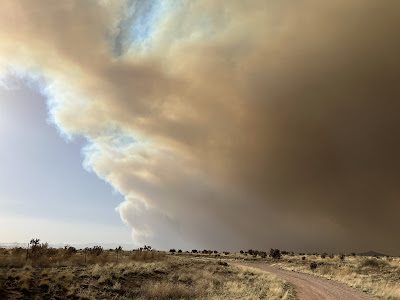
Projected to double in size in the coming days, the Calf Canyon / Hermit’s Peak Fire continued to rage on May 2nd in northern New Mexico, threatening towns and villages and forcing thousands to flee. Now, erratic winds are pushing the flames closer to Mora and Las Vegas. —KUNM, May 2, 2022. Photo: View of the Calf Canyon / Hermit's Peak Fire from Santa Fe. Courtesy Of Shaun Griswold via KUNM.


on shores of my eyelids – remnants
of forest/plain/pastureland scorched to ghost –
not last year – not last month – as I write –
cell buzzes with warnings to evacuate –
nearly fifteen towns – in two counties
next to mine – since afternoon yesterday

                                *

gusts – without let up – race across
ground at sixty miles an hour – back
of throat feels I’m feasting on ashes –
smoke’s blackened cargo tumbles skyward –
cooler atmosphere whitens the boil –
if cows/horses/sheep/pigs/fowl notice –
who can say – who can say how farmers
corral/truck herds of livestock – in trailers
built for two – or maybe four – animals –
and to where – how decide who stays/goes

                                 *

homesteads – over a hundred – some
generations old – now dust – color of bone –
swirling – swirling around Sangre’s peaks –
this way – who can say this way – to bear/
deer/tarantula/snake – to bees and honey-
blooded flora – who to bore tunnel in sky
for birds on nest – for geese/ducks/owls
buzzards – if they survive – sideline until
the earth clears – party on barbecue
of their lives

                                  *

a controlled burn – preserving the forest –
they call it – human-struck match turned
into rogue torch – wind rocketing cinders
mile or more – no human way to keep up/
stay ahead – two blazes converging –
in marriage from hell – hell today – yes –
hell’s tomorrow beyond sorrow – black/
bleak/barren – no playbook to restart Eden –
no mind/memory trick to erase replaying
the present

                                  *

smell forest’s burnt flesh – fireplace’s scent
of pine/spruce/fir – except flesh gave up
the seasoned old age we cherish – its aroma
of solace/comfort/home – second life we –
with love – endow it – gone – gone up –
swallowed – in somebody else’s smoke
 

Dick Altman writes in the high, thin, magical air of Santa Fe, NM, where, at 7,000 feet,
reality and imagination often blur. He is published in Santa Fe Literary Review, American
Journal of Poetry, riverSedge, Fredericksburg Literary Review, Foliate Oak, Blue Line,
THE Magazine, Humana obscura, The Offbeat, Haunted Waters Press, Split Rock Review,
The RavensPerch, Beyond Words, Sky Island Journal, and others here and abroad.  A poetry
winner of Santa Fe New Mexican’s annual literary competition, he has in progress two collections
of some 100 published poems.  His work has been selected for the forthcoming first volume
of The New Mexico Anthology of Poetry to be published by the New Mexico Museum Press.

Thursday, July 22, 2021

NEW SHEPARD

by Monica Mills


the billionaire space race
is one without a finish line.
space tourists auction star
costs, haggle down heaven,
as latitude chokes the poor.
on supersonic joyrides white
collars pray greed into hemisphere.
on Earth oceans thrash aflame.
souls without homes look for sky.
find smog. find dollar signs
disguised as constellations.
the shepherd is a wolf. steals the herd.
no scapegoats are leashed
in fields of crumbling infrastructure.
rampant thistles, dandelions,
leeches of the grain root deep
into soil and call themselves farmers. 


Monica Mills is a Jamaican-American writer and poet. She is from Maplewood, New Jersey and has a bachelor’s degree in political science and English from Rutgers University. Monica’s work appears in journals such as The West Trade Review, The Anthologist, The Normal Review, and The Quiver Review among others. She enjoys rainy days and ginger tea. 

Wednesday, November 25, 2020

THANKSGIVING

by Jennifer Freed


Source: MIT Medical


For our kitchen,
for the sourdough starter we learned to make
when the stores were still out of yeast,
for my husband,
who tends and feeds the starter for days, who kneads
the dough, shapes two round loaves, waits.
For the neat white bags of flour in our cabinet,
for the grocery store, its night-cleaners, their night hours
spraying disinfectant sprays.
For the cashiers in their comfortable shoes
and the blue-haired woman bagging our food,
her purple gloves, her back brace,
the peace signs on the mask across her face.
For the long-distance truck drivers driving
past closed restaurants, closed restrooms.
For the farm, the farmer, the wheat.
For the soil, its dark depths
of invisible lives,
and the sky, answering its thirst, charming it
with sun and moon and stars.
For that same sky rounding my own yard, lighting
my window, and my daughters at the table
doing their schoolwork on-line. For their breath.
For the air
scented with bread.
For the butter, the knife, the four plates rimmed in green.
And the two round loaves, now cooled, now     
on the cutting board, now ready
for our tongues,
our bodies,
our praise.


Jennifer Freed lives  in Massachusetts. Her poetry appears/is forthcoming in various journals, including Atlanta Review, Comstock Review, Worcester Review, and Zone 3. Her chapbook These Hands Still Holding (Finishing Line Press) was a finalist in the 2013 New Women’s Voices contest. She was awarded the 2020 Samuel Washington Allen Prize from the New England Poetry Club.

Thursday, January 11, 2018

ALL YOU HAVE TO DO IS DREAM

by George Salamon


President Trump speaks at the American Farm Bureau Federation's annual convention in Nashville, Tenn. on Monday. Photo by Jim Watson/AFP/Getty Images via NPR

"Farmers are the president's people," Agriculture Secretary Sonny Perdue said in an interview with Morning Edition on Monday. "These are the people that elected the president. The president knows that. These are the people the president cares about. And he wants them to enjoy the American Dream just like all the people in the cities." Farm income has suffered in recent years from sagging commodity prices. Net farm income in 2017 was up modestly from the previous year, but still only about half what it was in 2013. —NPR, January 8, 2018


It's too soon to bury the old American Dream,
Riding wobbly in the saddle of our minds.
Put there by the founding fathers,
It grew into the million-dollar salesman
Of Wall Street's enormous con,
The nation's permanent floating crap game
Of wealth and power and fame.
The dream infected our people's soul,
Crushed their spirit, played with their hearts.
It immersed us in flush darkness,
Acquiring new horizons every might,
Yet gaining new followers every day.
It gave us under-educated leaders
Emerging from ivy-covered breeding grounds.
It left no space for nobler visions,
For women who know, for children who care.
It governs our minds through men with no vision at all,
Men with the temperament of their attire,
The stern-browed suits of the old American Dream.


George Salamon watches the pursuit of the American Dream from the heartland in St. Louis, MO.

Wednesday, April 10, 2013

WITH GENTLY STREAMING EYES

by Jerome Betts


FARMING leaders have warned that up to an estimated 10,000 ewes and lambs have died in the recent snowstorms, costing the industry hundreds of thousands of pounds and leaving farms struggling to stay afloat. --The Herald (Scotland), 10 April 2013
 

Poor lambs! No chance to play your parts
On legs that learn to leap and run
And touch so many human hearts
With games and gambols in the sun?

Your jumping joints won’t now assert
That spring’s a time to cast off cares −
Though youth and charm would not avert
Your fate as bloody butchers’ wares.


Jerome Betts lives in Devon, England, and has contributed verse to LightenUp OnLine, New Verse News, Per Contra, Snakeskin and Tilt-A-Whirl, as well as numerous print publications.