Guidelines


Submission Guidelines: Send 1-3 unpublished poems in the body of an email (NO ATTACHMENTS) to nvneditor[at]gmail.com. No simultaneous submissions. Use "Verse News Submission" as the subject line. Send a brief bio. No payment. Authors retain all rights after 1st-time appearance here. Scroll down the right sidebar for the fine print.
Showing posts with label soil. Show all posts

Friday, November 08, 2024

BLANK PAGE

by Jocelyn Ajami

AI-generated graphic by Shutterstock for The New Verse News.


After Francesca Albanese’s U.N. report on
               “Genocide as Colonial Erasure”

a poem’s lines ripple 
like ridges of ancient sands

couplets ring fervent notes
a distant hand intrudes

unfamiliar chimes
the new timbre

incongruent to the tone
it clips the old refrains

although the verse lingers
it is never free 

the fitful hand scrubs lines
slowly mutilating the structure

gobbling vowels and vows
nothing satisfies its lust

the poem still has claws
but no wings

clinging to its soil 

when battered lines shrill 
against white space, the hand races 

to delete remaining words
and proclaim erasure

a blank page all its own


Jocelyn Ajami is an award winning painter, filmmaker and poet. Jocelyn has received several awards for her films, Oasis of Peace, Gypsy Heart and Queen of the Gypsies. She turned to writing poetry in 2014 as a way of connecting more intimately with issues of social conscience and cultural awareness. She has been published in several anthologies of prize winning poems. Born and raised in Caracas, Venezuela, she speaks five languages and lives in Chicago, Illinois.

Thursday, March 21, 2024

MARCH


AI-generated graphic by Shutterstock


Once again we’ve let ourselves be taken in by spring. 
Words we haven’t spoken for months come tumbling 
from our mouths. Tulip, soil, survival. 
Fools that we are to trust a tease so early in the season, 
we need it like we need the cat to see ourselves 
in a rosier light—young and more attentive—aspiring 
to the better selves we seem to have forgotten. 
We need it like we need the moon to make the universe 
believable. I’ve been thinking about how hard it is to write 
a poem without any mention of spring or moon or hope
so maybe that’s worth a try. But night still comes too early. 
I see you’ve already poured the wine, set a glass 
beside my chair where a cat sits watching the fire. 
If I don’t close these blinds right now, the rising moon 
might keep me here, wandering the galaxies. 
In case it’s true that hope cannot eternally renew itself
or spring last longer than today, let me let me stay with 
what I know tonight, release the cord and step away.
 

Juditha Dowd’s fifth book of poetry, Audubon’s Sparrow, is a lyric biography in the voice of Lucy Bakewell Audubon (Rose Metal Press). She has contributed poems to Beloit Poetry Journal, Cider Press Review, Kestrel, Poet Lore, Poetry Daily, Presence and elsewhere.

Wednesday, March 02, 2022

FUTURE ORIENTATION

by Imogen Arate


Tweet by The Kyiv Independent.


There is talk of war
in the shushing peacetime
desires for cracking 
delineations to self-heal 
without tending

There is talk of utopia 
in the blunt wielding
of firebombs Why not
room for better)

On the bodies of whose
children friends parents
and lovers A question 
suppressed or answered
by the jutting of chins
toward the detested
"Other" 

though history’s fingers
point to mutual others
who have become as
anonymous as the sides 
they took

whose bodies grew
their bones still beg 
for time to reunite
with the consolation
of a soothing soil

There is paradise
in the overtaking 
by tendrils grown
from the dust of war

in the dawning
that we are multitudes
of singular imperfections
who seek out others 
to share our wounds
perchance to heal


Imogen Arate is an award-winning Asian-American poet and writer and the Executive Producer and Host of Poets and Muses, a weekly poetry podcast that won second place at National Federation of Press Women's 2020 Communications Contest. She has written in four languages and published in two. Her poems, “A Declaration of Loyalty” and “Sanctuary” placed Second and Third, respectively, in the 2020 National Federation of Press Women at-Large Communications Contest. Her poetry has appeared in 18 publications on four continents, most recently in I Wanna Be Loved by You: Poems on Marilyn Monroe, Dwell Time, Nude Studio, and dyst.  You can find her @PoetsandMuses on Twitter and Instagram.

Monday, January 31, 2022

STILL LIFE IN DISARRAY

by Suzanne Morris


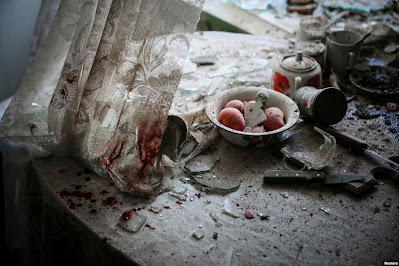
Sergei Ilnitsky, a Russian photographer of the European Pressphoto Agency, won the 2015 World Press Photo First Prize in the General News Category, Singles, for this image of damaged goods lying in a kitchen in downtown Donetsk, in war-torn eastern Ukraine.


Imagine, just
moments before.

No artist could more deftly
arrange these few articles
while conjuring
a still life in Ukraine.

See the embroidered lace curtain
swept aside to reveal
a kitchen table covered in
dainty muslin,

on which are placed
a small bowl of ripe tomatoes,
a lidded porcelain teapot with
poppies on the side; nearby

stout mugs, an empty tin can,
a cutting board with knives.

The view, tilting from above
and to the left,

the artist’s palette dabbed with
simple colors in homespun hues–
vermilion red, salmon pink,
maize yellow, white, gray blue.

Not seen, but understood:
the chairs drawn near,
a hand reaching for the teapot

to fill the mugs 
and slice tomato wedges
for tea

in the midday light
streaming through the 
kitchen window.

What family had sat 
having tea?

Were the children
present?

Did all escape
the bomb,
exploding in near range:

still life impastoed with
shattered window glass
and dust?

But no, a new color,
burnt umber,
spatters the scene;

it soils the table cover and
collects in indentations of
lace flowers and leaves.


A novelist with eight published works, Suzanne Morris began writing poetry in the context of her fiction.  Eventually she shifted her creative focus from novels to poetry only.  Her poems appeared in No Season for Silence - Texas Poets and Pandemic (Kallisto Gaia Press, 2020) and have frequently appeared online in Texas Poetry Assignment.

Wednesday, January 05, 2022

A "NEW" YEAR BEGINS

by Gordon Gilbert


wild geese, Hudson River Park, NYC


the same earth that buries the dead 
nourishes new life coming forth from that same soil 
 
the same air through which the dead leaves fall 
lifts the wings of those who call it home
 
the same water that overwhelms in sudden storms 
and drowns those who can't escape to higher ground 
gives life and shelter to aquatic beings 
and is from whence we came and still we need
 
the same fire that destroys all in its path 
we harness for our purposes and progress 
 
destruction and creation, condemnation, resurrection 
but alternatives among a multitude 
coexistent in a four dimensional realm 
in one of a multiplex of universes 
the one that we inhabit
 
we are no different from that from which we came 
neither truly good nor evil in our nature 
 
we are but the natural progression and expression 
of a larger whole with this exception:  
we self-conceive and give that self expression 
 
now here we are again the same side of the sun  
this moment that we choose to call a "new" year 
a starting line across the oval track our planet travels 
artificially designated, of recent origin 
not that once chosen by
hunters, gatherers, herders and farmers 
in many lands, in many other eras 
 
we have come so far we tell ourselves 
but we have gone so far from where we were 
and we are lost now to the earth that birthed us 
before it is too late, we must return, reclaim
who and what we truly are 
we must be born again 


Gordon Gilbert is a long-time resident of the West Village in NYC who has found solace and inspiration for the past two years in his walks along the Hudson River, photographing and writing about the wildlife, flora and river traffic during the pandemic as the seasons changed.

Friday, October 29, 2021

COUNTING BONES

by Sister Lou Ella Hickman, I.W.B.S.


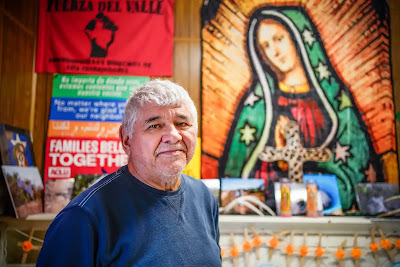
Eddie Canales, director of South Texas Human Rights Center. Photograph: Gabriela Campos via The Guardian.


for john meza and eduardo canales


how many graves received them 
that is 
what was left of their bodies… 
for two days 
you will sift the soil 
with your hands and small trowels  
letting the earth 
fall away 
from the whiteness of bone 
i cannot fathom how you . . . 
(my heart aches with this almost thought) 
how will you touch the small remnants of lives 
and still breathe… 
how…
only by kneeling 
                                     

Author’s Note: John Meza is one of the volunteers working with Eddie Conales, director of the South Texas Human Rights Center. With members of the Texas State University Forensic Pathology Department, they exhume bodies in graves in San Ygnacio, Texas to help identify missing migrants.

 
Sister Lou Ella has a master’s in theology from St. Mary’s University in San Antonio and is a former teacher and librarian. She is a certified spiritual director as well as a poet and writer.  Her poems have appeared in numerous magazines such as America, First Things, Emmanuel, Third Wednesday, and The New Verse News as well as in four anthologies: The Night’s Magician: Poems about the Moon, edited by Philip Kolin and Sue Brannan Walker, Down to the Dark River edited by Philip Kolin, Secrets edited by Sue Brannan Walker and After Shocks: The Poetry of Recovery for Life-Shattering Events edited by Tom Lombardo.  She was nominated for the Pushcart Prize in 2017 and in 2020. Her first book of poetry entitled she: robed and wordless was published in 2015 (Press 53.) On May 11, 2021, five poems from her book which had been set to music by James Lee III were performed by the opera star Susanna Phillips, star clarinetist Anthony McGill, pianist Mayra Huang at the 92nd Street Y in New York City. The group of songs is entitled “Chavah’s Daughters Speak.” 

Friday, September 03, 2021

COMPOS[T]ING MYSELF

by Barbara Simmons 


Washington state became the first state to legalize natural organic reduction in May 2019; Colorado followed suit in May 2021; and Oregon became the third state to sanction human composting in June 2021. —Treehugger, August 24, 2021. "The powerful [California] Senate Appropriations Committee has held a bill that would legalize the composting of human remains. The bill, AB 501, was authored by Assemblywoman Cristina Garcia, D-Bell Gardens, and had sailed through the Assembly with a unanimous vote.... Garcia said in a statement. 'This is another sad reminder that we must legalize a more environmentally friendly option like Natural Organic Reduction (NOR) as soon as possible. AB 501 will provide an additional option for California residents that is more environmentally-friendly and gives them another choice for burial.'” —Sacramernto Bee, August 30, 2021. Photo from Recompose, "a public benefit corporation powered by people who believe in changing the current death care paradigm."


I remember times when soil smelled rich,
a kind of coffee bean rich, a kind
of patchouli rich, a rich that flared my nostrils 
scenting the air with inhale more. 
The time we worked our garden soil 
composting it, the elements of peat and perlite
caking fingernails, our prepping
beds for rows and rows of plants
yearning for elements beyond clay. We dreamt
of growing foxglove, ferns and fuchsias,
entwining them with flowers mixing other letters
into soil with pansies, daffodils, impatiens.  
But it was always soil, prepared, that led to color,
soil inhabiting our very blood and bones, 
a deep affinity for dust to dust we have within,
rich dark coffee-colored soil, aromas lifting up and
taking us to early earth when scientists say the smell
was more like rotten eggs, rich with H2S. This richness lives
within me, my body’s future with the possibility of
decomposing into one cubic yard of soil,
along with wood, alfalfa, even straw, all
assisting me along the way to my new form, 
my inert self reduced to fragrant future supplements
for growing flowers after I have gone.
Something to think about, while legislators ponder laws
to handle soil that’s human-sourced. Right now, it’s not
Assembly Bill 501 I’m thinking of; I’m smelling soil, the
rich rich soil that flowers hunger for, the soil that’s fed
my soul, the gardening days when turning over dirt
was very much like leafing through a sacred text, 
when I’ve translated who I’ve been into the earth
from which I’ve come.


Barbara Simmons is a poet who celebrates the many worlds she inhabits using language to explore the ways we remember and envision. A graduate of Wellesley College, she received an MA in The Writing Seminars from Johns Hopkins. As a secondary school English teacher, she revisited texts with students who inspired her thinking about communication's diversity. Retired, she savors smaller parts of life and language, exploring the world's stories in her poetry. Publications have included Santa Clara Review, Hartskill Review, Boston Accent,  The New Verse News, Soul-Lit, Writing it Real Anthologies, Capsule Stories Anthologies, and the Journal of Expressive Writing.  Her book of poetry Offertories: Exclamations and Disequilbriums will appear in 2022.

Saturday, February 20, 2021

A PANDEMIC PRAYER

by Roderick Deacey


Don’t let me die a COVID death
pinned and tied by wires and tubes,
felled by fear and pain,
enduring dark visions
from potions that numb and confuse,
unable to touch the infinite,
losing the inevitable tussle for breath.

Instead, let me choose a worm’s death,
gently stilling movement
in the warm black soil.
Feeling the earth shiver and move
as it wraps me in its vast body
and cradles me
in its perpetual swing around the sun.

Or let me walk into the ancient forest
and sense the slow sap of centuries
sliding through the rough bark I lean against.
Let me mark the deep rhythm of the wood
as I feel myself slowly sink
into the tree’s heart,
to rest serene among leafy limbs.

Best of all, let me die a bird’s death,
swooping and swirling
high in a star-pricked sky—
not even aware
of tumbling flesh and feathers falling
as I joyously fly on
toward that brilliant rainbow slash of dawn.


Roderick Deacey is a performing poet in the DC area, based in Frederick, MD. In normal, non-viral times, he regularly performs with his drummer/percussionist and bass-player, presenting “neo-beat” poems inspired by the Beat Poets’ poetry and jazz forays of the nineteen-fifties. His beat poetry chapbook neo-beatery ballads was published in 2019. Deacey was awarded the 2019 Frederick Arts Council Carl R. Butler Award for Literature. Crossing genres, he won the Gold Award for best lyrics in the 2020 Mid-Atlantic Song Contest held by the Songwriters Association of Washington.

Wednesday, November 25, 2020

THANKSGIVING

by Jennifer Freed


Source: MIT Medical


For our kitchen,
for the sourdough starter we learned to make
when the stores were still out of yeast,
for my husband,
who tends and feeds the starter for days, who kneads
the dough, shapes two round loaves, waits.
For the neat white bags of flour in our cabinet,
for the grocery store, its night-cleaners, their night hours
spraying disinfectant sprays.
For the cashiers in their comfortable shoes
and the blue-haired woman bagging our food,
her purple gloves, her back brace,
the peace signs on the mask across her face.
For the long-distance truck drivers driving
past closed restaurants, closed restrooms.
For the farm, the farmer, the wheat.
For the soil, its dark depths
of invisible lives,
and the sky, answering its thirst, charming it
with sun and moon and stars.
For that same sky rounding my own yard, lighting
my window, and my daughters at the table
doing their schoolwork on-line. For their breath.
For the air
scented with bread.
For the butter, the knife, the four plates rimmed in green.
And the two round loaves, now cooled, now     
on the cutting board, now ready
for our tongues,
our bodies,
our praise.


Jennifer Freed lives  in Massachusetts. Her poetry appears/is forthcoming in various journals, including Atlanta Review, Comstock Review, Worcester Review, and Zone 3. Her chapbook These Hands Still Holding (Finishing Line Press) was a finalist in the 2013 New Women’s Voices contest. She was awarded the 2020 Samuel Washington Allen Prize from the New England Poetry Club.

Sunday, August 12, 2018

CHARLOTTESVILLE: A CAUTIONARY TALE

by Deborah Kahan Kolb


The Nazis have returned. To Charlottesville, VA.
        Pale wizards, frenzied mass, mad with purity.
Wands ablaze, heads of skin, howling blood and soil.

Tell your Jewish son. Repeat the story. Pray.
        Tell him he will never replace the whiteness of their line.
He will never replace never replace the blood pooled in the soil.

Tell your son the truth about the trains of yesterday.
        When children came in cattle cars and left as clouds of ash.
When memories were skin, bones, weeping bloody soil.

In Charlottesville the torches turn the nighttime into day.  
        Long ago these torches fired ovens for the Jews.
Step-children of goose-steppers want blood spilled on their soil.

Tell your Jewish daughter. Find the words to say
        They are raging to destroy her with fire and a flag.
Swear never again never again. No more blood for soil.
    
        Now you’ve told the story that bears repeating every day.
You’ve told your son. Now try to drain the olive from his skin.
You’ve told your daughter. Try to drain the darkness from her hair,
        Fix the hook that is her nose. Bury the blood lost in the soil.


Deborah Kahan Kolb is the author of Windows and a Looking Glass (Finishing Line Press, 2017) and the recipient of numerous poetry awards, including the 2018 BRIO (Bronx Recognizes Its Own) award. Much of her poetry is informed by the unique experiences and challenges of growing up in, and ultimately leaving, the insular world of Hasidic Judaism. Her work has appeared in various print and online publications, including Poetica, TheNewVerse.News, Literary Mama, 3Elements Review, Poets Reading the News, Tuck, Rise Up Review, Writers Resist, and Mom Egg Review.

Friday, May 04, 2018

MEMORIAL

by Akua Lezli Hope


The National Memorial for Peace and Justice . . .  is dedicated to the victims of American white supremacy. And it demands a reckoning with one of the nation’s least recognized atrocities: the lynching of thousands of black people in a decades-long campaign of racist terror. —The New York Times, April 25, 2018


We are constrained by the smog
created by this history
between slavery and civil rights
something obscures understanding
death, maintaining status quo
pain of the unrequited
failed promises, justice denied
no explanation for why
assassinated aspirations
the tumult and terror of
long enduring enslavement
large jars of soil from profane sites
of murder, disinter witless tragedy
to forget is to disable
to forget is to cripple
steel pillars are mute towers
piercing witness, carved remembrances
aligned, mass incarceration now
wrongfully convicted prisoners
presumptions of guilt for those
summarily dispatched unarmed,
whose names are known and multiply in
bleak countings of perpetuated loss
to forget is to repeat


Akua Lezli Hope is a creator who uses sound, words, fiber, glass, handmade paper and wire to create poems, patterns, stories, music, adornments, sculpture and peace whenever possible. She has published 125 crochet designs. Her poetry collection THEM GONE will be published by The Word Works Publishing in June, 2018.

Saturday, April 19, 2014

THE OTHER NINETY-EIGHT PER CENT

by Laura Rodley


28th Annual Alma Spinach Festival, April 19, 2014


Migrant worker’s hands stained green
from picking spinach, green leaves
full of iron he cannot eat, washes
his hands in a bowl in his room
sleeps on a bare mattress on the floor
window glass broken, curtains frayed
their once brilliant yellows whitened
with sun that only tans his face
deeper, squints his eyes when
he walks back out to the rows of spinach
washing his hands in the sprinkler
set for the plants, not allocated
for him, the chuckwagon rolls in, sells
warm bagels and cream cheese, hot coffee
but not Columbian like he drank at home,
the drops of mercy that carried him through
the morning, saving money for his daughter’s
communion, the priest's drops of mercy,
holy water touched to her forehead
to protect her, keep her from a future
like this where he bends his back to the hot soil
the green leaves he cannot eat;
they are for sale, not for him.
Maybe at home the corn he planted
has come up, maybe his conchita
has already picked them, or his son,
what he would give to go back home,
only drops of mercy now
the sweat that rolls down his face
ten o’clock sun and it’s already eighty degrees,
and the spinach needs picking before it wilts.


Laura Rodley’s New Verse News poem “Resurrection” appears in The Pushcart Prlze XXXVII: Best of the Small Presses (2013 edition). She was nominated twice before for the Prize as well as for Best of the Net. Her chapbook Rappelling Blue Light, a Mass Book Award nominee,  won honorable mention for the New England Poetry Society Jean Pedrick Award. Her second chapbook Your Left Front Wheel is Coming Loose was also nominated for a Mass Book Award and a L.L.Winship/Penn New England Award. Both were published by Finishing Line Press.  Co-curator of the Collected Poets Series, she teaches creative writing and works as contributing writer and photographer for the Daily Hampshire Gazette.  She edited As You Write It, A Franklin County Anthology, Volume I and Volume II.