Guidelines


Submission Guidelines: Send 1-3 unpublished poems in the body of an email (NO ATTACHMENTS) to nvneditor[at]gmail.com. No simultaneous submissions. Use "Verse News Submission" as the subject line. Send a brief bio. No payment. Authors retain all rights after 1st-time appearance here. Scroll down the right sidebar for the fine print.
Showing posts with label artist. Show all posts

Friday, November 10, 2023

APOCALYPSE

by Katherine West


detail of the poster for the film Apocalypse Now


I stand with my back to winter 
as if I could hold off blizzards 
with force of will alone 

I am the last dam without a crack 
Water trickles over my shoulders 
Flood whispers in my ears 

I am rain following fire 
tracking its crackle and whoosh 
lowering like a raptor after prey 

I am the final embrace before death 
grabs you by the ankles 
leaving only your soul in my arms 

I am the last mother
carrying a million children on my back 
swimming for safety against the tide 

I am the last dancer, the last poet
the last artist using my own blood 
to paint the last sunset 

I am the last person on Earth 
I have broken all mirrors, all my brothers 
are only songs


Katherine West lives in Southwest New Mexico, near Silver City. She has written three collections of poetry: The Bone Train, Scimitar Dreams, and  Riddle, as well as one novel, Lion Tamer. Her poetry has appeared in journals such as Writing in a Woman's Voice, Lalitamba, Bombay Gin, The New Verse News, Tanka Journal, Splash!, Eucalypt, Writers Resist, Feminine Collective, Southwest Word Fiesta, and The Silver City AnthologyThe New Verse News nominated her poem “And Then the Sky” for a Pushcart Prize in 2019. In addition she has had poetry appear as part of art exhibitions at the Light Art Space gallery in Silver City, New Mexico, the Windsor Museum in Windsor, Colorado, and the Tombaugh Gallery in Las Cruces, New Mexico.

Sunday, October 29, 2023

DRONE SHOW, NEW YORK CITY

by Jennifer Phillips


River in flood, night flocks flickering
among the skyscrapers, down canyoned glass
and concrete tunnels, southing,
all their stars obscured. Even at sunset, brass
reverberation highlighting the ledges,
zigzagging a maze like the airport lighting
flashing along their pattern's edges,
splash of solar panel panes squaring 
off on rooftops, while all the unseen soft bodies
steer, or smack and ricochet to paving,
losing their way, losing their lives.
 
In Central Park, the artist paints the same skies,
that glow with missed comets and  lunar eclipses,
with a flock of drones, loose from their hives,
cruising and folding the black air, like a fizz
of fireflies the news compares to starlings'
wondrous convolutions—of all the ironies—
iron substitutions for the flesh and song and wings
belonging even here, city-center, ground zero
for terrors we make in every size. The crows,
tough and wise, don't migrate much. Sad that we do
not notice, or speak of a murder of swallows.


Jennifer M Phillips is a  bi-national immigrant, painter, gardener, Bonsai-grower. Her chapbooks: Sitting Safe In the Theatre of Electricity (i-blurb.com, 2020) and A Song of Ascents (Orchard Street Press, 2022)A poem is like a little brass pan to carry fire's coals through the winter weather, and so she writes. 

Thursday, February 24, 2022

THE ARTIST

by Louise Wilford


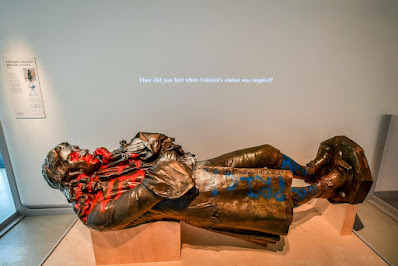
Covered in red and blue graffiti, the toppled statue of British politician Edward Colston, who enslaved tens of thousands of people, stood in the city of Bristol, UK for more than 100 years before it was pulled down by angry protesters during a wave of Black Lives Matter protests across the country last summer—after the death of George Floyd at the hands of Minneapolis police. Demonstrators used rope to tug the statue from its stone plinth and their bare hands to roll it through the streets and into the murky waters of a nearby harbor as onlookers cheered. Others chanted “Black Lives Matter,” in solidarity with those across the Atlantic dealing with issues of police brutality, systemic racism and complex histories. —The Washington Post, June 4, 2121


She painted Love on a garage roof,
in throbbing streaks of purple-red, the convolutions of a colon.
Sprayed Birth inside a canal bridge arch–metallic mist of bronze and copper,
cream and jungle green—its colours glowing loud as we moved
closer. Joy on a fire-damaged caravan, in orange streaks, fading
at their edge to silver fairy-dust against a woodland midnight.
 
Paintings drifted off around the tow –first drafts, discarded
—or maybe gifts, or threats. A wisp of air, she moved
about the streets, unseen save for the spores that trailed behind,
hand-prints on lamp-posts, splashes on a fence, office windows
and abandoned cars. Tragedy in a bus shelter, thick brown strokes
with an uneven brush; Bliss rolled up a shutter’s sides in jolting yellow
stripes; the turquoise-blue of Hope rubbed on the bricks of an abandoned
warehouse—and Innocence, black as a crow’s wing, sprawling, smug, along
a dry-stone wall.   
 
On the beech-tree avenue in the park, she painted the stretch of Life,
from gold to god, each stage a different tree. Her colours startled
like a kestrel’s swoop, on bollards, awnings, road signs, multi-storey
concrete car-parks. On a crossing, she painted the white stripes shocking
pink. She filled the holes of letters with tiny dots like grains inside an hour-glass;
 
scrawled a Nightmare on an underpass, a Daydream on a council refuse bin;
Ambition on the tall side of a Tesco van, Destruction on the shovel of a JCB.
Peace, soft as sand, perched on picnic tables. She spread her peacock tail
so the hues that churned inside her could escape, Tenderness like a swirl
of oil on a puddle, blood-red Anger, bile-green Envy, the pewter-grey
of Misery, and the sharp vermilion ache of Fear, vinegar shiny as a magpie
feather. Shades and shadows, grit and silk and dust and grease, stirred
and shifted, blended and erased.
 
Until one day, she drenched with the fishbone-white of Death,
a statue of a man whose alchemy created gold from blood and bone.
This man of stone had swaggered in that square for a hundred and fifty years.
Her colours now were spent. She hiccuped out a final few beige coughs,
a gentle sneeze that left a cloud of baby-pink dancing in the sun—and then,
with a flap of her wings, she left.
 

Louise Wilford lives in Yorkshire, UK. Her work has been widely published, most recently in Bandit, English Review, Goats’ Milk, Jaden, Makarelle, POTB, The Fieldstone Review, and Parakeet. In 2020, she won the Arts Quarterly Short Story Prize, the Merefest Poetry Prize, and was awarded a Masters in Creative Writing (Distinction). She is working on a children’s fantasy novel.

Monday, January 31, 2022

STILL LIFE IN DISARRAY

by Suzanne Morris


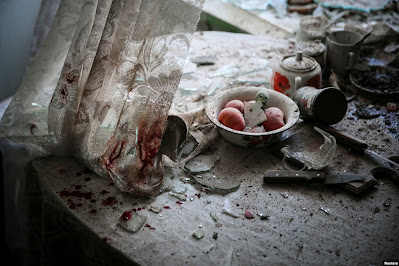
Sergei Ilnitsky, a Russian photographer of the European Pressphoto Agency, won the 2015 World Press Photo First Prize in the General News Category, Singles, for this image of damaged goods lying in a kitchen in downtown Donetsk, in war-torn eastern Ukraine.


Imagine, just
moments before.

No artist could more deftly
arrange these few articles
while conjuring
a still life in Ukraine.

See the embroidered lace curtain
swept aside to reveal
a kitchen table covered in
dainty muslin,

on which are placed
a small bowl of ripe tomatoes,
a lidded porcelain teapot with
poppies on the side; nearby

stout mugs, an empty tin can,
a cutting board with knives.

The view, tilting from above
and to the left,

the artist’s palette dabbed with
simple colors in homespun hues–
vermilion red, salmon pink,
maize yellow, white, gray blue.

Not seen, but understood:
the chairs drawn near,
a hand reaching for the teapot

to fill the mugs 
and slice tomato wedges
for tea

in the midday light
streaming through the 
kitchen window.

What family had sat 
having tea?

Were the children
present?

Did all escape
the bomb,
exploding in near range:

still life impastoed with
shattered window glass
and dust?

But no, a new color,
burnt umber,
spatters the scene;

it soils the table cover and
collects in indentations of
lace flowers and leaves.


A novelist with eight published works, Suzanne Morris began writing poetry in the context of her fiction.  Eventually she shifted her creative focus from novels to poetry only.  Her poems appeared in No Season for Silence - Texas Poets and Pandemic (Kallisto Gaia Press, 2020) and have frequently appeared online in Texas Poetry Assignment.

Tuesday, September 08, 2015

MAKE AMERICA GREAT AGAIN

by Judith Terzi


Not the Grand Canyon
California oak  
sycamore
Not the city park
the swings  
the dandelion
Not the baseball  
the G-O-A-L
Not the community garden
the harbor  
anchor of vessel
Not the daisy  
the buttercup
the Mojave
Not the poet
the potter
Not the artist
the artist
Not the walls
of books
allure of fireflies
walls of museums
Not the grasshopper
on a tea rose
a tea rose
Not Beethoven
under summer stars
And not the Venezuelan
who conducts him
Not the steel of Disney Hall
Not the wind of steel
the cut of space
Not the waterfall
the wildflower
the thickness of skin.


An educator and poet living in Southern California, Judith Terzi's poems have appeared in journals and anthologies including Caesura, Myrrh, Mothwing, Smoke: Erotic Poems (Tupelo), Raintown Review, Times They Were A-Changing: Women Remember the 60s & 70s (She Writes), Unsplendid, and Wide Awake: The Poets of Los Angeles and Beyond (Beyond Baroque). Her most recent chapbook, If You Spot Your Brother Floating By, is a collection of memoir poems from Kattywompus Press.

Tuesday, March 03, 2015

ONLY IN MY ROOM, NOT IN GAZA

by Catherine Wald


“Everything is beautiful in my room, but only in my room, not in Gaza.” --Nidaa Badwan quoted by Jodi Rudoren in The New York Times February 28, 2015


Call me radical, you who uphold
hegemony of the hothead; call me
artist when I find beauty on the
inside, where it’s supposed to
have been stamped out; call
me traditionalist, locked away in
my own self-inflicted zenana.

Here, no one will beat me or throw
stones after me.  Here, I can forget about
which missile coming from which side
may explode my face. Here, I have
rediscovered what safety feels like.
Look carefully: let me remind you, too.

This is the only way I know to honor
perfection of nests and eggs and those
fledglings straining at the windows who
will have to learn to fly inside their heads
like I have, like we all have, in this ageless
conga line of barefoot women on hot sands.

Here, when I am punched in the gut, it’s by sunlight
or soul; colors or ideas. Freedom, I call this freedom.
No need to send for a doctor. This is how I heal.

Some day I would like to fit the whole world into this room.


Catherine Wald's books include poetry (Distant, burned-out stars, Finishing Line Press, 2011), nonfiction (The Resilient Writer: Stories of Rejection and Triumph From 23 Top Authors, Persea Books, 2005) and a translation from French of Valery Larbaud’s Childish Things (Sun & Moon Press). Her poems have been published in American Journal of Nursing, Buddhist Poetry Review, Chronogram, Exit 13, Friends Journal, Jewish Literary Journal, The New Poet, Society of Classical Poets, The 5-2 Crime Poetry Weekly and Westchester Review.