Guidelines


Submission Guidelines: Send 1-3 unpublished poems in the body of an email (NO ATTACHMENTS) to nvneditor[at]gmail.com. No simultaneous submissions. Use "Verse News Submission" as the subject line. Send a brief bio. No payment. Authors retain all rights after 1st-time appearance here. Scroll down the right sidebar for the fine print.
Showing posts with label color. Show all posts

Sunday, June 21, 2026

UPON THE BEAUTY OF COLOR

by Anne Herrick


Ducks Likely OK As Trump Admin Dumps Hydrogen Peroxide Into Green Reflecting Pool —HuffPost, June 19, 2026


Days after his administration claimed the pool was actually “crystal clear,” despite an unmistakably green hue, the US president acknowledged issues—and, without evidence, blamed foul play. —The Guardian, June 20, 2026


Who doesn’t agonize over color

for a kitchen, bathroom, house siding,

a fence, the front door? Or

even the color for a pool, to make

it bright, enticing, exciting.

So you try strolling down past doors

and walls in Ireland, Italy, Mexico,  

or find yellows in Van Gogh’s flowers

his blues in Starry Night, perhaps examine

the deep and bright reds of Kahlo,

or even view the wide selection

of Monet’s greens. Some study flags,

like the yellow and blue of Ukraine,

the red, white, and blue of the UK,

or, for that matter, of proudly independent

America—the blue perfect to highlight

a very long pool, a tourist attraction

feting a famous president,

and perfect, too, to invite the beauty

of algae, that emerald green 

celebrating warmth, humidity, and sun.

Yes—such is the power of summer energy,

it gifts green to water, and even peels

blue paint, encouraging new tourists, 

ducks, to fly in for a visit hoping it is a snack

of duckweed, while men and women 

in waders, scoop and scoop, day after day,

until the pool eventually becomes dry.

Until, in fact it will lie still in peace

in its comfortable century-old familiar

worn grey coat.


Anne Herrick has published a few poems and prose in the US and UK.

Sunday, February 22, 2026

A NIGHTMARE OF COLOR

by Dick Altman
 
 
As reports come out across the country of Immigration and Customs Enforcement agents detaining Native Americans, a couple dozen New Mexico lawmakers are pushing a bill that would allow tribal citizens to update their state-issued IDs to reflect their enrollment status. House Bill 20 would give people enrolled in a federally recognized tribe the option to request a “distinguishing mark” identifying them as Native American on their driver’s license or other identification cards. A similar law passed in Arizona last year went into effect in January. On a sample license posted online by that state’s Motor Vehicle Division, “Native American” is written on the bottom left side of the card. —New Mexico In Depth, February 12, 2026


Northern New Mexico


In my mind

it begins,

a Pow Wow

of dance,

chant,

drum,

lofting

my Anglo dreams

to heights

of ritual

more ancient

than Columbus.

Despite the festive air,

masked figures,

I don’t

recognize as Native,

badged and holstered,

lurk in the shadows,

beyond

the drum circle—

waiting.

*

I try to sense,

living as I do,

in Indian Country,

what you,

a Native American,

feel like

awakening now

to a face

in the mirror,

that greets

morning’s light,

not with a smile,

but fear

your complexion,

perhaps only a shade

darker than mine,

might find you

in ICE’s

angry grasp,

two steps away

from expulsion.

*

Identity docs,

once sacred sources

of pride,

and connection,

sat vaulted

in your tribal home,

rarely,

if ever,

in need

of exposure,

to the world

outside.

Now,

I’m told,

you dare not leave

the reservation,

without

your paper shields

of origin.

*

Your biggest fear—

how could I not feel

the same—

likely separation

from your children,

an old fear,

dating back

to early last

century,

when federal agents,

as if yesterday,

drag off

Native offspring

to attend

schools,

to acquire

more “whiteness”.

A curriculum

leading often

to forced labor

and early death,

as history’s

numerous

graves attest.

*

I hesitate,

these days,

to stroll

the town square,

birthed

and sustained

by Puebloans

like  yourself,

long before

the arrival

of Europeans.

I reel,

with broken heart,

as ICE grabs you

off the street,

to challenge

your sovereign right,

stretching back

a thousand years,

to call America

home.


Dick Altman writes in the thin, magical air of Old West’s high desert plains, where, at 7,000 feet, reality and imagination often blur. He is published in the American Journal of Poetry, Santa Fe Literary Review, Fredericksburg Literary Review, Foliate Oak, Landing Zone, Cathexis Northwest Press, Humana Obscura, Haunted Waters Press, and others here and abroad.  His work also appears in the first edition of The New Mexico Anthology of Poetry, published by the New Mexico Museum Press.  Pushcart Prize nominee and poetry winner of Santa Fe New Mexican’s annual literary competition, he has authored over 290 poems, published on four continents.

Thursday, August 22, 2024

TRUMP AI GENERATES HIS SECOND INAUGURATION

by Chad Parenteau


Holding, staring at open bible
with no words. He knew it.
God’s law is whatever you want.
 
Behind him, swiftboat Swifties
dressed in handmaiden style,
coats, blouses buttoned to nape.
 
Harem of doting daughters, 
great grab bags of grabbables, 
whole cabinet of nondisclosures.
 
Blonde broken up by added spots
of colored faces, hands in gnarled
prayer, proof they weren’t paid.
 
He swears off to imagined duties 
under a dome of glass as strong
as his faith in this divine design. 


Chad Parenteau hosts Boston's long-running Stone Soup Poetry series. His latest collection is The Collapsed Bookshelf. His poetry has appeared in journals such as Résonancee, Molecule, Ibbetson Street, Pocket Lint, Cape Cod Poetry Review, Tell-Tale Inklings, Off The Coast, The Skinny Poetry Journal, The New Verse News, dadakuku, Nixes Mate Review and anthologies such as French Connections and Reimagine America. He serves as Associate Editor of the online journal Oddball Magazine. Chad generated these AI graphics on behalf of the former guy.

Sunday, July 16, 2023

THE SEA CANNOT SPEAK FOR ITSELF

by Renée M. Schell


More than half of the world’s ocean has changed colors in the past 20 years, a phenomenon that is likely driven by climate change, according to a study published Wednesday in the journal Nature. The study, which analyzes decades’ worth of satellite data, found that 56% of the global ocean—a territory larger than the total land area on Earth—experienced color change between 2002 and 2022. While the researchers didn’t identify an overall pattern, tropical ocean regions near the Equator seem to have become steadily greener over time. (Photo: Edoardo Fornaciari—Getty Images) —Time, July 13, 2023


Fifty-six percent has become green.
Can we still say azure ocean
or blue sea?
 
Now Aqua, the research satellite,
reflects back the lush color
of phytoplankton,
 
tells us with its seeing eye
that for the past twenty years the vast
waters of Earth have been changing 
color.
 
With chlorophyll out of balance,
how can our oceans,
the teeming gallons,
 
survive this attack?
Revert back?
 
 
Renée M. Schell’s debut collection Overtones was published in 2022 by Tourane Poetry Press. Her poetry appears in The New Verse News, Catamaran Literary Reader, Literary Mama, Naugatuck River Review, and other journals. In 2015 she was lead editor for the anthology (AFTER)life: Poems and Stories of the Dead. She taught for seven years at a Title I elementary school in San José, California. 

Friday, June 30, 2023

PRIDE

by Marion Evalee


Carrying a jumbo rainbow flag onto the Salem Common under the rainbow arch are Ken Elie, left and Ed Hurley, right of the group Boston Pride, who turned out to support the North Shore Pride group. Joe Brown photo via The Salem News, June 25, 2023


The great Arc-en-ciel
Is colorless,

Not on the wing.
A heart needs something,

Color needs light,
A flag needs the wind—

Whoever’s eternal
Rebounding breath

Has deadened with the night,
As it often does.

I keep walking
Over what was

The parade grounds
(What will be the Commons

By the time we celebrate
Our independence)

Like an old vet,
Though it’s getting dark.


Marion Evalee, a Pushcart Prize nominee, has appeared in The Amethyst Review, Willows Wept, Survivor Lit, The Boston Compass, Neologism, and Montage. A selection of her poetry is featured in the anthology 14 International Younger Poets (Art and Letters, 2021). She lives in Salem, Massachusetts.

Monday, June 12, 2023

LET HER WEAR GREEN

by Tricia Knoll


Did the ‘Barbie’ Movie Cause a Pink Paint Shortage? The film recreates the famous doll’s brightly colored world—with the help of one specific shade of pink. —Smithsonian, June 8, 2023


Witness a shortage 
of pink paint
from the set design
of a Barbie movie. 
 
Let her wear green
for chlorophyll,
eco-warrior for a hurting
planet short on good sense
 
as cancer drugs are hard
to come by. This rainbow
month colors fly
 
on flagpoles and banners. 
I’m so sick of pink. The only
Barbie I have sits in a wheelchair;
she is a woman of color
 
beautiful color. 


Barbie Fashionistas Doll #166 With Wheelchair & Crimped Brunette Hair


Tricia Knoll is a Vermont poet well beyond Barbie years. Her work appears widely in journals, anthologies, and seven collections—the most recent being One Bent Twig (FutureCycle Press, 2023) which brings together poems about about trees she has planted, loved, or worries about due to climate change.

Wednesday, April 26, 2023

DOES TIME HAVE COLOR TOO?

by L. Smith


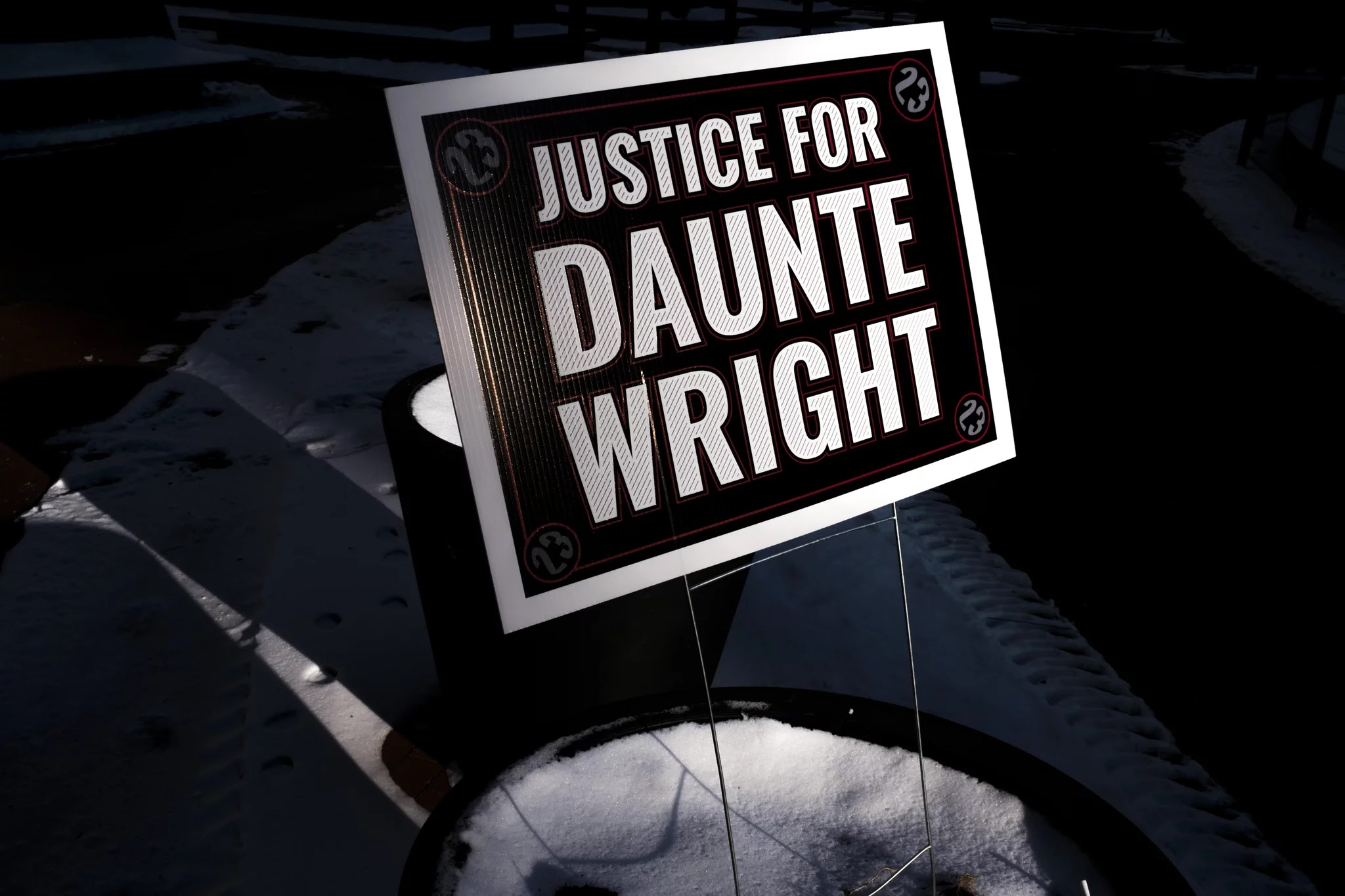
Disgraced Minnesota police officer Kim Potter walked free from prison after serving just 16 months for shooting dead Daunte Wright when she mistook her gun for a Taser during a traffic stop. Potter, 50, was released from Minnesota Correctional Facility-Shakopee in the early hours of Monday morning to serve the remainder of her sentence on supervised release. —The Independent (UK), April 24, 2023


So, does time have color, too?
Why do they get less time for the same offense that, say, we might do?
Is their time more valuable than, say, mine?
I mean, ain’t we living on the same clock? Same timeline? Same century?
Maybe we need to leave the time up to the jury, because the judge is too easily nudged by emotion. Are you sentencing the crime, or are you sentencing the color? Are you sentencing the crime, or are you crying for a mother? Are you sentencing the crime, or are you sympathetic to the other?
 
Is one color more fragile than the other? You know the phrase, right? —"Don’t do the crime,
if you can’t do the time.” Does that not apply for every color?
What? Y’all think we got a time machine? Think time go by for us at warp speed?
Is time not supposed to affect the brother like it does the other?
Y’all don’t age the same, but them years don’t go by no faster for us.
We age on different scales, but them years go by the same. 
 
I thought time was about alignment, about the crime,
about time to match the crime—not the color. Not how sullen one is once seized.
But it seems the brother gets more time than the other because of his color.
Does color determine risk? After all, who has the means to take the most risk?
The brother? Or the other?
 
Or is it: don’t do the crime, unless you got the right color? 
I mean, can y’all meet us in today? Can we at least decide time like we living in the same decade?
Whose family will suffer most under the cloak of the time?
During the absences, the voids, the gaps, the setbacks brought on by the time? Whose family is already behind?
 
Why can’t white time and black time be on the same damn black line?
I didn’t know time had color, too.
I guess time, like fairness, are both abstract, are just a construct. 
Time being obstruct for the fair-skinned,
abundant for the brother, but absent, lightened, or lifted for the other.
Intangible for the other, hard-lived for the brother.
Time itself is colored obtuse.
Color makes time profuse.
For the colored, time is abused.
And in today, time is a noose.
I didn’t know time had color, too.
And since it does, why can’t our time have the color of you?


L. Smith, a New Orleans native, is a writer, multi-certified, English and master reading teacher, who has freelanced for local newspapers. Her poems “Black Man Running” and “Worse Than Rodney King” have also been published in The New Verse News. She has an anthology of poems and prose set to publish spring 2023 that her mother and daughter created space for her to write. She also has begun this blog for writer teachers.

Thursday, February 24, 2022

THE ARTIST

by Louise Wilford


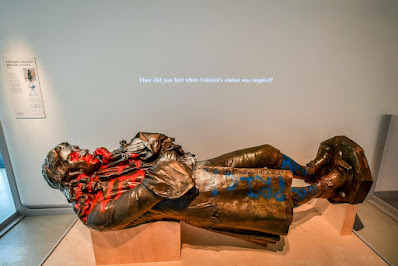
Covered in red and blue graffiti, the toppled statue of British politician Edward Colston, who enslaved tens of thousands of people, stood in the city of Bristol, UK for more than 100 years before it was pulled down by angry protesters during a wave of Black Lives Matter protests across the country last summer—after the death of George Floyd at the hands of Minneapolis police. Demonstrators used rope to tug the statue from its stone plinth and their bare hands to roll it through the streets and into the murky waters of a nearby harbor as onlookers cheered. Others chanted “Black Lives Matter,” in solidarity with those across the Atlantic dealing with issues of police brutality, systemic racism and complex histories. —The Washington Post, June 4, 2121


She painted Love on a garage roof,
in throbbing streaks of purple-red, the convolutions of a colon.
Sprayed Birth inside a canal bridge arch–metallic mist of bronze and copper,
cream and jungle green—its colours glowing loud as we moved
closer. Joy on a fire-damaged caravan, in orange streaks, fading
at their edge to silver fairy-dust against a woodland midnight.
 
Paintings drifted off around the tow –first drafts, discarded
—or maybe gifts, or threats. A wisp of air, she moved
about the streets, unseen save for the spores that trailed behind,
hand-prints on lamp-posts, splashes on a fence, office windows
and abandoned cars. Tragedy in a bus shelter, thick brown strokes
with an uneven brush; Bliss rolled up a shutter’s sides in jolting yellow
stripes; the turquoise-blue of Hope rubbed on the bricks of an abandoned
warehouse—and Innocence, black as a crow’s wing, sprawling, smug, along
a dry-stone wall.   
 
On the beech-tree avenue in the park, she painted the stretch of Life,
from gold to god, each stage a different tree. Her colours startled
like a kestrel’s swoop, on bollards, awnings, road signs, multi-storey
concrete car-parks. On a crossing, she painted the white stripes shocking
pink. She filled the holes of letters with tiny dots like grains inside an hour-glass;
 
scrawled a Nightmare on an underpass, a Daydream on a council refuse bin;
Ambition on the tall side of a Tesco van, Destruction on the shovel of a JCB.
Peace, soft as sand, perched on picnic tables. She spread her peacock tail
so the hues that churned inside her could escape, Tenderness like a swirl
of oil on a puddle, blood-red Anger, bile-green Envy, the pewter-grey
of Misery, and the sharp vermilion ache of Fear, vinegar shiny as a magpie
feather. Shades and shadows, grit and silk and dust and grease, stirred
and shifted, blended and erased.
 
Until one day, she drenched with the fishbone-white of Death,
a statue of a man whose alchemy created gold from blood and bone.
This man of stone had swaggered in that square for a hundred and fifty years.
Her colours now were spent. She hiccuped out a final few beige coughs,
a gentle sneeze that left a cloud of baby-pink dancing in the sun—and then,
with a flap of her wings, she left.
 

Louise Wilford lives in Yorkshire, UK. Her work has been widely published, most recently in Bandit, English Review, Goats’ Milk, Jaden, Makarelle, POTB, The Fieldstone Review, and Parakeet. In 2020, she won the Arts Quarterly Short Story Prize, the Merefest Poetry Prize, and was awarded a Masters in Creative Writing (Distinction). She is working on a children’s fantasy novel.

Saturday, January 08, 2022

BEHOLD

by Geoffrey Aitken


the cat
our predatory
suburban
household favourite
cannot change
its spots

the cuttlefish
the octopus
and the squid
like the chameleon
can change colour

now
the automobile


A minimalist industrial signature drives Geoffrey Aitken away from the scene of mental unwellness for the eyes and ears of those without voices. Widely published locally (AUS), and internationally (the UK, US, CAN, CN & FR), he chases ongoing congeniality.

Friday, September 03, 2021

COMPOS[T]ING MYSELF

by Barbara Simmons 


Washington state became the first state to legalize natural organic reduction in May 2019; Colorado followed suit in May 2021; and Oregon became the third state to sanction human composting in June 2021. —Treehugger, August 24, 2021. "The powerful [California] Senate Appropriations Committee has held a bill that would legalize the composting of human remains. The bill, AB 501, was authored by Assemblywoman Cristina Garcia, D-Bell Gardens, and had sailed through the Assembly with a unanimous vote.... Garcia said in a statement. 'This is another sad reminder that we must legalize a more environmentally friendly option like Natural Organic Reduction (NOR) as soon as possible. AB 501 will provide an additional option for California residents that is more environmentally-friendly and gives them another choice for burial.'” —Sacramernto Bee, August 30, 2021. Photo from Recompose, "a public benefit corporation powered by people who believe in changing the current death care paradigm."


I remember times when soil smelled rich,
a kind of coffee bean rich, a kind
of patchouli rich, a rich that flared my nostrils 
scenting the air with inhale more. 
The time we worked our garden soil 
composting it, the elements of peat and perlite
caking fingernails, our prepping
beds for rows and rows of plants
yearning for elements beyond clay. We dreamt
of growing foxglove, ferns and fuchsias,
entwining them with flowers mixing other letters
into soil with pansies, daffodils, impatiens.  
But it was always soil, prepared, that led to color,
soil inhabiting our very blood and bones, 
a deep affinity for dust to dust we have within,
rich dark coffee-colored soil, aromas lifting up and
taking us to early earth when scientists say the smell
was more like rotten eggs, rich with H2S. This richness lives
within me, my body’s future with the possibility of
decomposing into one cubic yard of soil,
along with wood, alfalfa, even straw, all
assisting me along the way to my new form, 
my inert self reduced to fragrant future supplements
for growing flowers after I have gone.
Something to think about, while legislators ponder laws
to handle soil that’s human-sourced. Right now, it’s not
Assembly Bill 501 I’m thinking of; I’m smelling soil, the
rich rich soil that flowers hunger for, the soil that’s fed
my soul, the gardening days when turning over dirt
was very much like leafing through a sacred text, 
when I’ve translated who I’ve been into the earth
from which I’ve come.


Barbara Simmons is a poet who celebrates the many worlds she inhabits using language to explore the ways we remember and envision. A graduate of Wellesley College, she received an MA in The Writing Seminars from Johns Hopkins. As a secondary school English teacher, she revisited texts with students who inspired her thinking about communication's diversity. Retired, she savors smaller parts of life and language, exploring the world's stories in her poetry. Publications have included Santa Clara Review, Hartskill Review, Boston Accent,  The New Verse News, Soul-Lit, Writing it Real Anthologies, Capsule Stories Anthologies, and the Journal of Expressive Writing.  Her book of poetry Offertories: Exclamations and Disequilbriums will appear in 2022.

Saturday, February 06, 2021

TO KNOW A MONARCH

by Phyllis Klein


To know it only as a photograph, a memory.
Never to witness again a community of millions clustered 
on Eucalyptus branches, now empty.
These fragile slivers of stained glass
no longer clinging to winter respites.
What is a world that would allow
this extravagant pollinator to die off?
This migrational miracle. 
Rumi says, You were born 
with wings, why prefer to crawl through life?
I want a humanity that weeps 
copiously for this animal who starts off 
in a crawl, shows us how to fly. I want
processions, dirges everywhere,
want to howl over milkweed, bereft, without 
purpose. So much loss. I want to rend my garments.
Burn kaleidoscopes of butterflies into my skin.
What good would that do? Or I could slice
open the sky, so their ghosts torrent down. 

What do I know of softness—my origins 
in an ice-house, in a tradition of cruelty,
of abhorration, torn appendages. Where
are the wings for this? Where the flashes 
of orange slipped through our fingers?


Phyllis Klein’s work has appeared in numerous journals and anthologies. She is a finalist in the Sweet Poetry Contest, 2017, the Carolyn Forché Humanitarian Poetry Contest, 2019, and the Fischer Prize, 2019. She was nominated for a Pushcart prize in 2018 and again in 2020. She has a new book, The Full Moon Herald  from Grayson Books. Living in the San Francisco Bay Area for over 30 years, she sees writing as artistic dialogue between author and readers—an intimate relationship-building process that fosters healing on many levels. 

Tuesday, March 17, 2020

FIERCE FRAGILE SEASONS

a poem in four parts
by Jill Crainshaw


I

mama cardinal studies me as i stand
in rain-wet morning sunlight

i see fire flash in her feathers
when she flits and flashes

from fencepost to flaming forsythia
nesting in preparation for whatever

springtime color waits to touch the earth

II

sepia-soaked scrapbooks ensconce
human fragilities exposed

i study faces retreating from
fiery colors of aliveness buried

in catacombs where mortal coils
were torn away too soon from butterflies

waiting even now to meet the sunrise

III

night settles down into streets emptied
of laughing children and lingering lovers

spinning cocoons to hide fragile dreams
while the world shuts out a sinister stalker

a brave pinion pushes open a window
slips a lonely song into the silence and hope

throbs in voices that swell together on the breeze

IV

backyard cardinals carry
springtime rhythms in their beaks

wrens domicile in the abandoned eaves
of the church belfry next door

and we humans study yet again how to
weave into our nests fiery threads of hope

longing to color unsettled nights with song


Jill Crainshaw is an ordained minister in the Presbyterian Church (U.S.A.) and a liturgical theology professor at Wake Forest University School of Divinity in Winston-Salem, North Carolina.