The New Verse News presents politically progressive poetry on current events and topical issues.
Guidelines
Submission Guidelines: Send 1-3 unpublished poems in the body of an email (NO ATTACHMENTS) to nvneditor[at]gmail.com. No simultaneous submissions. Use "Verse News Submission" as the subject line. Send a brief bio. No payment. Authors retain all rights after 1st-time appearance here. Scroll down the right sidebar for the fine print.
Gordon Gilbert is a NYC west village writer who takes walks along the Hudson River to find some relief in nature from the almost daily unrelenting bad news. But he finds reason to hope for a better 2026 with the new mayor, Zohran Mamdani.
Jan Chronister is a retired educator who splits her year between the extremes of northern Wisconsin (by Lake Superior) and southern Georgia. She has authored three full-length poetry collections and twelve chapbooks. Jan edits and publishes the work of fellow poets under the imprint of Poetry Harbor.
Reported birth of rare white buffalo calf in Yellowstone park fulfills Lakota prophecy: “The birth of this calf is both a blessing and warning. We must do more,” said Chief Arvol Looking Horse, the spiritual leader of the Lakota, Dakota and the Nakota Oyate in South Dakota, and the 19th keeper of the sacred White Buffalo Calf Woman Pipe and Bundle… Lakota legend says about 2,000 years ago—when nothing was good, food was running out and bison were disappearing—White Buffalo Calf Woman appeared, presented a bowl pipe and a bundle to a tribal member, taught them how to pray and said that the pipe could be used to bring buffalo to the area for food. As she left, she turned into a white buffalo calf. “And some day when the times are hard again,” Looking Horse said in relating the legend, “I shall return and stand upon the earth as a white buffalo calf, black nose, black eyes, black hooves.” A similar white buffalo calf was born in Wisconsin in 1994 and was named Miracle, he said. —AP, June 14, 2024. More photos by Erin Braaten here at YouTube.
When a bison calf appears white-furred
On a patch of yellow stone prairie
The People know it is mine Me:
Dark-haired/Dark-eyed
When first I came to them Yes:
Miracle Yes:
Sacred-birth leucism Rarest
Of rare Lakota-blessed prayer Grass-
Rolled And a pipe I left Change
Among the geysers/Great
Change meaning What most excites
Returns Like hunger Just totally totally
Floored a woman says in a baseball cap:
White Holding a camera: a long-range lens
Joanne De Simone Reynolds would like to acknowledge Nadia Colburn, of Align Your Story, and Tom Daley, both of Cambridge, Massachusetts, for their indispensable writing workshops; Doug Holder, of Boston Area Small Press and Poetry Scene, for his ongoing support; and Susan Richmond, poet and children's book author, who coaxed Ms Reynolds into Plein Air Poetry at Old Frog Pond in Harvard, Massachusetts, a collaboration of poets that lasted ten years and produced as many, beautiful, chapbooks. She is grateful to all.
Jacqueline Coleman-Fried is a poet living in Tuckahoe, NY. Her work has appeared in The Orchards PoetryJournal, pacificREVIEW, Topical Poetry, Quartet Journal, and soon, Consequence and HerWords magazine.
More than half of the world’s ocean has changed colors in the past 20 years, a phenomenon that is likely driven by climate change, according to a study published Wednesday in the journal Nature. The study, which analyzes decades’ worth of satellite data, found that 56% of the global ocean—a territory larger than the total land area on Earth—experienced color change between 2002 and 2022. While the researchers didn’t identify an overall pattern, tropical ocean regions near the Equator seem to have become steadily greener over time. (Photo: Edoardo Fornaciari—Getty Images) —Time, July 13, 2023
Fifty-six percent has become green.
Can we still say azure ocean
or blue sea?
Now Aqua, the research satellite,
reflects back the lush color
of phytoplankton,
tells us with its seeing eye
that for the past twenty years the vast
waters of Earth have been changing
color.
With chlorophyll out of balance,
how can our oceans,
the teeming gallons,
survive this attack?
Revert back?
Renée M. Schell’s debut collection Overtones was published in 2022 by Tourane Poetry Press. Her poetry appears in The New Verse News, Catamaran Literary Reader, Literary Mama, Naugatuck River Review, and other journals. In 2015 she was lead editor for the anthology (AFTER)life: Poems and Stories of the Dead. She taught for seven years at a Title I elementary school in San José, California.
Bradley McIlwain works as a Teacher-Librarian, where he strives to provide meaningful and inclusive spaces for knowledge exchange and advocacy. He believes that poems and poets can be agents for social change. Bradley’s latest book, Dear Emily, was published by Roasted Poet Press in July.
Scott C. Kaestner is a Los Angeles poet, writer, dad, husband, and deadbeat dreamer extraordinaire. Google ‘scott kaestner poetry’ to peruse his musings and doings.
holds her cardboard sign: Homeless, anything helps,
sits to the left of the entrance of Green Field’s Market.
They rarely ask her to move.
I have no change, not even for the meter,
and walk towards the market door.
“Hey, hey,” she calls, “They’ll give you a ticket.”
“I don’t have any change,” I say.
“Here, I do,” she says, unzipping her tracksuit pocket.
“No, no, I can’t take any money from you.”
Inside the store, I shop, use my debit card,
extract money for her, return.
“Here, thanks for protecting my car.”
“I do it for everybody,” she says. “It’s not good
to get a ticket, it goes against your license.”
“What’s your name?” I ask.
“Wendy,” she answers.
Wendy, all grown up, no longer led into Neverland,
protecting my car, sitting
on the cold hard sidewalk,
teeth chattering.
Laura Rodley, Pushcart Prize winner, is a quintuple Pushcart Prize nominee and quintuple Best of Net nominee. Latest books: Turn Left at Normal by Big Table Publishing, Counter Pointby Prolific Press, and As You Write It Lucky Lucky 7, a collection of 11 writers' work.
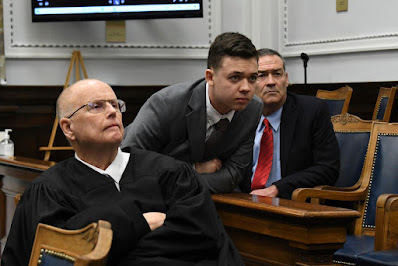
From left, Judge Bruce Schroeder, Kyle Rittenhouse and defense attorney Mark Richards watch a video Nov. 12 during Rittenhouse’s homicide trial in Kenosha, Wis. (Mark Hertzberg/Pool/AP via The Washington Post)
I don’t wish death
or solitary confinement
or even the hell
of half a life wasted
behind bars. No:
I want him to be stricken
with disgust—at the blood
he’s spilled, at the horror
of his rash heroics. I want God
to part the clouds of his mind
and set afire
its nest of fear and folly.
I want the clearing smoke
to open his eyes
to true manhood: the facing down
of an enemy hiding
within—the answering
of a people’s need
for sobriety, not messiah.
I want him to rise
above the buzzfed grapevines,
the twitter of rumor
and rumble of propagandas
and remember history:
to become his republic’s
most disarming
spokesman. I want him
to march and preach
civility—to be Prince Hal
to a nation of Hotspurs,
to become (in the unpredictable
flowerings of time)
our next King
of change.
David Southward teaches in the Honors College at the University of Wisconsin-Milwaukee. He is the author of Apocrypha (Wipf & Stock 2018) and Bachelor’s Buttons (Kelsay Books 2020).
In science, Delta means a sometimes triangular mass of sediment.
As in:
silt and sand lodged in a river’s mouth
spit into the sea or a lake or a plain
as in Mississippi or Okavango or Kalahari
tides and waves create sandbars and dendritic silt
as in the Nile or the Ganges
estuaries of brackish water form at the confluence of sea and river
as in China’s Yellow River.
Some Deltas become abandoned
the rivers leave discard their channels dry up
that too denotes movement change.
That change is called avulsion:
As in:
the sudden separation of mass from one place to another
the sudden separation of reason from the brain
the sudden movement from reality to fantasy.
Delta can be a girl’s name:
books of baby names call it appealing chic unique
fit for a child of grace and distinction.
This too will change.
Mary K O'Melveny is a recently retired labor rights attorney who lives in Washington DC and Woodstock NY. Her work has appeared in various print and on-line journals. Her first poetry chapbook A Woman of a Certain Age is available from Finishing Line Press. Mary’s poetry collection Merging Star Hypotheses was published by Finishing Line Press in January, 2020.
"The world is changed. I feel it in the water. I feel it in the earth. I smell it in the air. Much that once was, is lost." —opening words of Lord of the Rings, cited by David French, "Yes, America Could Split Apart," The Dispatch, September 20, 2020.
George Salamon, after teaching German in five colleges, reporting business news, editing a military magazine, and writing in corporate public affairs, is "retired" and contributes to The Asses of Parnassus, Dissident Voice, One Sentence Poems, and The New Verse News from St. Louis, MO.
Jeremy Nathan Marks lives in London, Ontario. New work appears this fall in Anti-Heroin Chic, Dissident Voice, So It Goes, Chiron Review, Bewildering Stories, The Last Leaves, Unlikely Stories, The Journal of Expressive Writing, Boog City, and Ginosko Review.
Marguerite Keil Flanders is the Managing Editor of Crosswinds Poetry Journal. For nine years she was part of the Ocean State Poetry team running a poetry workshop in the Men’s Medium Security prison in Cranston, Rhode Island. Margie is the author of a poetry collection, The Persuasive Beauty of Imperfection. Her work has appeared in many publications, including Boston Review, Yankee Magazine, Comstock Review, Nimrod International Journal, Connecticut River Review, and Main Street Rag.
Florida Rights Restoration Coalition policy coordinators Sharon Madison, right, and Kellie Atterbury present Cynthia Craig with a receipt showing her last court payments have been paid at the Richard E. Gerstein Justice Building in Miami in early March. (Scott McIntyre/For The Washington Post)
Washington, July 16, 2020 (CNN)The Supreme Court on Thursday said Florida can enforce a law barring ex-felons from voting if they still owe court fines or fees that they are unable to pay associated with their convictions. The unsigned order likely means the law will be in effect for the November election, although the court did not declare the law to be unconstitutional or limit ongoing court challenges. Liberal Justices Sonia Sotomayor, Ruth Bader Ginsburg and Elena Kagan dissented. "This Court's order prevents thousands of otherwise eligible voters from participating in Florida's primary election simply because they are poor," Sotomayor wrote in the dissent. "This Court's inaction continues a trend of condoning (disenfranchisement)," she added.
She sat in her beat up Chevy on the right-hand side of the road. Window down, radio up. Oldies streamed ribbons of light in the unseasonably cool air. Beatles and Bruce, mainly. Billy Joel, too. Piano Man got her fingers moving. Her left arm dangled, fingers tapped the exterior car door panel. Striking notes a few inches above the door’s deeply dented exterior. Not unlike the beat she’d use for nightly rituals when imprisoned. She and the girls had a system. Tap, Tap, Tap. Intentional pauses and extended rhythms. A form of Morse code—of sorts. Everything was some sort of something in there. Generic and off brand only, of course. No matter. Always made them feel smart - smarter than the system. Only now, she realizes the system had them all along. Damn fines awaiting her release. The others’, too. Piles of unopened envelopes—stacked on the linoleum kitchen table. Most yellowed. Some stained in coffee, soda pop, and a mix of bitter jams. Never did understand how they expected her to pay those fines. Not until she could find work, that is. And even then. Didn’t they know she had babies to feed? Especially after having fed the mouths and egos of grown men for far too long and in far too many ways. Late at night, she and the others would dream of release day. Lofty talk of voting. Making change. In many ways the dreams got them through - and out. No matter most of them should never have been there in the first instance. Out was always the goal. On the other side, where the sun’s rays beat down on open backs, freshly washed heads, and bare feet - no socks, no shackles. Only to once again be silenced. And tied to a system with no conscience. She wasn’t having it. Sat curbside for upwards of six hours on primary day. Planned to do the same come election day. Until she’s welcome behind the curtain. No doubt, she’ll push buttons wherever permitted. Wherever tolerated, too. The passersby didn’t want to hear her talk. She knew it, but spoke no matter. Their voices mattered. Of course they do. As does hers.
When systems lay bare their many flaws and faults that serve only to penalize those for whom change is most needed, and work only to silence the voices of those for whom there is no recourse, and far too must resignation for there is too often no other way, on whom does the opportunity to speak rest and on whom does the responsibility to act fall—yet too often falter?
Signatures are checked
as licenses are confirmed.
Go ahead, Sir. Please.
Old fines resurface
to silence a right to vote.
Not today, Ma’am. No.
Dusty curtains drop
as inside voices whisper.
Seal the status quo.
Red painted fingers
tap as outside voices speak.
Time for change is now.
Jen Schneider is an educator, attorney, and writer. She lives, writes, and works in small spaces throughout Philadelphia. Her work appears in The Popular Culture Studies Journal, unstamatic, Zingara Poetry Review, Streetlight Magazine, Chaleur Magazine, LSE Review of Books, and other literary and scholarly journals.
The Major League Baseball Players Association informed MLB on Saturday night that they are done negotiating and want an answer by Monday on how many games they’ll play and when to show up for work. —USA Today, June 13, 2020 In earlier news: Baseball released a thorough health and safety protocol to help protect its players during the 2020 MLB Season. But there’s one new rule that will certainly be tough to follow: No Spitting. —Fansided, May 22, 2020
Crude are the subtleties of the double play
compared to the majestic hock and graceful spray
of spittle professionally spurt. Slaver to
mound, slicking home plate—wet thwack
of saliva oiling well worn mitts. See that! I’d say
after a bulky loogie—caught on TV
back in the old days (last season). Leaping
from the couch, I’d grab the remote, hit
playback and slow-mo
the slobber projectile. Freeze frame
itsemergence, rising flight and Pollack splatter.
“See that cheek suck, check out that lips purse,
that thick tongue flick—that bountiful gush!”
O beautiful for spacious fly!
If you don’t understand the spit you don’t understand baseball.
If you don’t understand baseball go back to the shithole
you came from—to toss around today’s cheap seat
banter from the trash talker in chief.
Let the bowlers groan, yuk, eww, gag, groan, gross!
If you ban spittin’ seeds—you might as well outlaw outs,
strikes, fouls, hits. What’s next, Commissioner?
Crotch grabs and sack realignments?
It’s an American fan’s right to recount celebrities of sputter
and spew: Why, have a seat my child, I’ll tell ya
about Legendary Lefty the Lip
who could launch a loogie further than the Bambino’s
most prodigious rip and was every bit as accurate –
pointing out his expectorant’s dart, arc
and splash-down. O yes! To the very speck
of red dirt he’d swamp
with juicy Tennessee chaw—outta
both sides of his maw.
Not to your taste? Take a walk.
Good as a hit in the score book.
So, when you see a crappy pitch, take it, kid.
Like the old timers said, “just spit on it.” That’s how
the greats played this hard-scrabble, historic game.
It’ll be sad not to know shit about spit—
soon just a dried-up old asterisk. I for one
will rise from my chair - let the chips fall—
sing proud our national hymn
and hum a prayer:
Play ball againboys! But please take care—
we don’t want anyone hurt by squirt
in dirt or thin air. And remember it’s still legit—
here, my heart does thump—
behind your MLB approved Covid masks –
to holler, Kill the ump!
Michael Mark’s poetry has been published or is forthcoming in Alaska Quarterly Review, Copper Nickel, Michigan Quarterly Review, Salamander, Salt Hill Journal, The Southern Review, The New York Times, The Sun, Waxwing, The Poetry Foundation's American Life in Poetry, Verse Daily. He’s the author of two books of stories including Toba and At the Hands of a Thief (Atheneum). @michaelgrow
My People stand
in the streets with masked faces
and painted signs,
to rage against,
not the “dying of the light,”
but the dying of our kind.
My Brother stands
eleven years old, holds
my hand when I
cry, because
the tear gas and bullets are loud,
and we can’t hear the chants of the crowd.
My Grandma stands.
Watches at the door when I go,
because the people
in our town that
she doesn’t know
look too much like they might call me something.
The system stands
on the backs of its people.
On those who scream proud that
We want change.
That we want chains gone.
To be equal.
CeCe NeQuai is an Ohio based creator of poetry, fiction, screenplays, and films. She is a writing, film, and media student at Bowling Green State University. Keep up with CeCe NeQuai via Twitter at @nequai_
David Rosenthal lives in Berkeley, California and teaches in the Oakland public schools. He's been a Pushcart Nominee and a Nemerov Sonnet Finalist. His collection The Wild Geography of Misplaced Things was published by White Violet Press.
On a lawn down a side street off a main drag
in Portland Maine, it catches my eye—
simple phrase in red, white and blue
with a big bang center stage
to that intact region our current leader
can’t claim—a brain that thinks, acts,
feels with compassion, caring, humanity.
A sign in a yard can’t change the world
but it can open thinking beyond
media thrum and whimper—
insult, injury, uncertainty, and help us feel we can make a difference
as clichéd as that may be. Grab your pen,
paper, keyboard, text, phone, load up
the information highway with a message
echoing these immortal words— Yes We Can.
Marc Swan has poems forthcoming in Stonecoast Review, The Nashwaak Review, Channel Magazine, Floyd County Moonshine, among others. His latest collection today can take your breath awaywas published by Sheila-na-gig Editions in 2018. He lives in coastal Maine with his wife Dd, an artist, clothing designer and maker.
“But I’m also torn between my pleasure at seeing part of American culture take significant strides toward equality and my sorrow due to the diminishment of interest in my work.” —Bob Hicok (above left), "The Promise of American Poetry,” Utne Reader, Summer 2019.
So now you know how those sonneteers
Must have felt, quietly posting along the
Bridle path with their rhyming dictionaries
And penchant for inversions, when you came along
Riding your free verse helter-skelter, breaking
Lines without regard like a mounted militia
In full rebellion. With your red wheelbarrow
And petals in the metro. White men of privilege,
You’re passe as the people of color race by on motorbikes
Down the crowded lanes where you used to
Summon a rickshaw. Plus ça change. And women
Shouting hands-off! Poems by non-binary
People who use the pronoun they
And where are you now with your forlorn
Confessions that cannot be absolved. This
Is penance contributor: the immigrants
Crossing the river on innertubes
Taking the risk you took once
Writing the word fuck flat out as a racehorse
Hitting the wire and snorting blood.
Joan Colby’s Selected Poems received the 2013 FutureCycle Prize and Ribcage was awarded the 2015 Kithara Book Prize. Her recent books include Carnivalfrom FutureCycle Press, The Seven Heavenly Virtues from Kelsay Books and Her Heartsongs from Presa Press. Her latest book is Joyriding to Nightfall from FutureCycle Press.