Guidelines


Submission Guidelines: Send 1-3 unpublished poems in the body of an email (NO ATTACHMENTS) to nvneditor[at]gmail.com. No simultaneous submissions. Use "Verse News Submission" as the subject line. Send a brief bio. No payment. Authors retain all rights after 1st-time appearance here. Scroll down the right sidebar for the fine print.
Showing posts with label punishment. Show all posts

Saturday, May 17, 2025

WHAT POPE LEO MIGHT BE THINKING

by Lynne Barnes


Your mother was ill and away
when you were very little.
Did this mean that one of your
foundation beams was laid out as clay,
creating that listing psychic gait
that seems to have hobbled you
since toddlerhood?
 
Your early language threw darts
of defense against harm inside
your family’s nest of punishment
alternating with neglect.
You began sharpening knives
of revenge, destructiveness
back then, just to survive.
As you matured, you were mentored
by those who were traumatized like you.
 
Oh, if only your resilient spirit had been
gifted just a little more warmth
at your first hearth, perhaps your sense of
self-worth would not have become pea-sized,
inside and protected by, a hot air balloon.
Heated molecules of fear inflate
that bubble of space around your core.
 
Your borders are so thin and vulnerable
that you must strike first, slur people away
to feel safe, and your re-tells of conversations
all have others referring to you as sir.
 
You use loser, lowlife, liddlelightweight,
for others. And for yourself you say
tremendousperfectwinnergreatest,
and speak with clueless pride
that other humans kiss your ass.
 
You, dear sir, learned so early to strike first,
before anyone could breach your fragile border,
see the size of your ego infirmity,
but now, power has enriched, fused your childhood’s
uranium grains into a global nuclear cruelty.
 
We must fight, drain your power, disarm you whose wounds
block you from the language of human love and care.
As we face off we’re terrified, but also Sad!—witnessing
a fellow human walled off from the beauty of empathy as prayer.


Lynne Barnes is a retired psychiatric nurse and librarian who has lived in San Francisco since 1969. Her poetry memoir, Falling into Flowers (Blue Light Press, 2017) was a finalist for the 2018 Eric Hoffer Book Award.

Saturday, January 07, 2023

THE SHOW-ME STATE GOES ROGUE

by George Salamon


"In Missouri, a new state law that took effect on 1 January makes it a crime for any person to sleep on state property. For unhoused people, sleeping in public parks or under city highways could mean up to $750 in fines or 15 days in prison for multiple offenses." —The Guardian, January 5, 2023. Photo: An unhoused person in Los Angeles. Photograph: David Swanson/AFP/Getty Images via The Guardian.


Homelessness is a crime
in the state of Missouri,
where sleeping on the 
street is not punishment 
enough for so capital a sin 
by those who belong in a
loony bin for the criminally
cruel and heartless, claiming
the voices in their heads
are those of God or Jesus,
without even being facetious.


George Salamon thinks he sees where this is going. As Richard T. Evans pointed out in The German Underworld. Deviants and Outcasts in German History (1988): "The Nazis planned their first big round-up of the homeless as soon as they came to power."

Monday, November 15, 2021

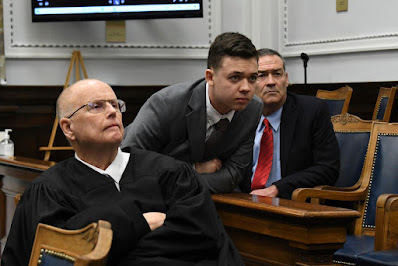
FOR THE BOY ON TRIAL

by David Southward


From left, Judge Bruce Schroeder, Kyle Rittenhouse and defense attorney Mark Richards watch a video Nov. 12 during Rittenhouse’s homicide trial in Kenosha, Wis. (Mark Hertzberg/Pool/AP via The Washington Post)


I don’t wish death
or solitary confinement
or even the hell
of half a life wasted
behind bars. No:
I want him to be stricken
with disgust—at the blood
he’s spilled, at the horror
of his rash heroics. I want God
to part the clouds of his mind
and set afire
its nest of fear and folly.
I want the clearing smoke
to open his eyes
to true manhood: the facing down
of an enemy hiding
within—the answering
of a people’s need
for sobriety, not messiah.
I want him to rise
above the buzzfed grapevines,
the twitter of rumor
and rumble of propagandas
and remember history:
to become his republic’s
most disarming
spokesman. I want him
to march and preach
civility—to be Prince Hal
to a nation of Hotspurs,
to become (in the unpredictable
flowerings of time)
our next King
of change.
 
 
David Southward teaches in the Honors College at the University of Wisconsin-Milwaukee. He is the author of Apocrypha (Wipf & Stock 2018) and Bachelor’s Buttons (Kelsay Books 2020)

Saturday, February 02, 2019

THIRST

by Mary K O'Melveny


FOUR NO MORE DEATHS VOLUNTEERS FOUND GUILTY FOR PROVIDING LIFE-SAVING HUMANITARIAN AID ON “TRAIL OF DEATH” IN ARIZONA DESERT —No More Deaths, January 18, 2019


I.
What do most of us know of it?
Safe in our homes, cars, streets, sidewalks.
Plastic water bottles piled up,
filling the bellies of sperm whales.

We are half filled with liquids. Yet,
when water vanishes in an
eye blink, thirst is just death’s first sign.
A face reddens. A tongue swells. Limbs

cool, cramp. A brain aches. Eyes sink,
as if they might find liquids still
sloshing about under shrinking skin.
Deluge dreams become delusions.


II.
An Arizona desert turns crime scene.
Not because bodies of immigrants
lie scattered about, bone-thin hands
still clutching their rosaries,

but because someone has placed jugs
of water, cans of beans along
a ragged trail hoping to stave
off more gruesome deaths.

Four women may spend prison time
for desecration of a refuge.
Their water cans ran afoul of
the pristine nature of the place.

III.
Perhaps bodies gathering dust
along an arroyo where final
prayers for salvation once formed
do not amount to misdemeanors.

As dying travelers shed hats,
shirts, backpacks, photographs, sandals,
rangers scooped up remnants of lost
lives like so much tourist trash.

There is no one left to pay fines
for property abandonment
except earnest water bearers.
Our thirst for punishment wins out.


Mary K O'Melveny is a recently retired labor rights attorney who lives in Washington DC and Woodstock NY.  Her work has appeared in various print and on-line journals. Her first poetry chapbook A Woman of a Certain Age is available from Finishing Line Press.

Thursday, April 30, 2015

FUGITIVES

by Philip C. Kolin


Drawing of fugitives running from the Eastern Shore of Maryland. Image source:  A Guide to the History of Slavery in Maryland (The Maryland State Archives, Annapolis MD and the University of Maryland College Park, MD)


Black blood rushes from city
after city; running is now a crime,
guilty or not, the verdict is the same
and so is the punishment; backs
broken, heads smashed,
necks choked, chests exploded,
organs silenced; hope ended.
There is no escape, no plea, no trial.

Every black man is now afraid he wears an invisible
target only dashboard cameras can capture.
Hanging-noose ropes are strung around
the killing scene; black sons set in  buckled asphalt.
The community  fears that American history has
reversed itself, the  Fugitive Slave Acts
reenacted.


Philip C. Kolin, University Distinguished Professor in the College of Arts and Letters at the University of Southern Mississippi, is the editor of The Southern Quarterly and has published more than 30 scholarly books on African American playwrights, Shakespeare, Tennessee Williams, and Edward Albee. Also a poet, Kolin has published five books of poems, the most recent being Reading God's Handwriting: Poems (Kaufmann, 2012), as well as hundreds of poems in such journals as the Michigan Quarterly Review, Louisiana Literature, South Carolina Review, Christian Century, Spiritus, Seminary Ridge Review, America, and has co-edited Hurricane Blues: Poems about Katrina and Rita (Southwest Missouri UP, 2006) with Susan Swartwout.

Wednesday, July 02, 2014

THE PRISONS

by Howard Winn


Image source: Credit Family Caregiver Alliance via WVTF


are full of old men serving time.
What to do about them
has become a penitent issue.
The punishment of young men,
or middle-aged men
has become
what do the frail and sick
criminals deserve as they age.
Eternal puritan punishment,
handcuffed to hospital beds,
tied to oxygen tubes to the nose
until death do them part?
Was that the original decision
of judge and jury?
Give them walkers for the exercise yard?
Attach them to dialysis until dead?


Most recently Howard Winn had poems and fiction published in The Dalhousie Review, Descant (Canada), Cactus Heart, Main Street Rag, Caduceus, Burning Word,  Pennsylvania Literary Journal. Southern Humanities Review, Cutting Edgz andBorderlands. His B. A. is from Vassar College. His graduate degree is from the Writing Program at Stanford University. His doctoral work was done at New York University. He is a State University of New York faculty member.

Friday, December 07, 2012

SOCRATES AND CASEY ANTHONY, A DIALOGUE

by Jan Keough


The poet's photoshopped image of Casey Anthony with Socrates and a young student in Raphael’s "School  of Athens".


ORLANDO, Fla. (AP) — The Florida sheriff's office that investigated the disappearance of Casey Anthony's 2-year-old daughter overlooked evidence that someone in their home did a Google search for "fool-proof" suffocation methods on the day the girl was last seen alive. . . . WKMG reports that sheriff's investigators pulled 17 vague entries only from the computer's Internet Explorer browser, not the Mozilla Firefox browser commonly used by Casey Anthony. --Huffington Post

The wily fox, as some called Socrates,
spoke with Casey Anthony the other day
at an unknown cellular location.

Casey, in hiding after the trial, and Socrates,
freed from bodily inconvenience after his trial,
converged to resolve a thorny dilemma.

“Which is best,” she texted, “to escape punishment and live to regret?
Or to face the punishing side-effects of actions
made from a selfish and immature attitude?”

Socrates, reclining on his metaphysical marble couch,
lifted the Droid close to his eyes.
Texting was not his favorite method of communication.

He preferred to gaze directly at those
who wished to be freed
from the burning disgrace of ignorance.

“Tell me,” he began,
“which Browser is best to use,
Internet Explorer or Firefox?”


Jan Keough lives in RI and the internet.  She is co-founder of The Origami Poems Project which aspires to free the poet by promoting micro-chapbooks of original poetry.