Guidelines


Submission Guidelines: Send 1-3 unpublished poems in the body of an email (NO ATTACHMENTS) to nvneditor[at]gmail.com. No simultaneous submissions. Use "Verse News Submission" as the subject line. Send a brief bio. No payment. Authors retain all rights after 1st-time appearance here. Scroll down the right sidebar for the fine print.
Showing posts with label camera. Show all posts

Tuesday, September 15, 2026

INCIDENTAL CAPTURE

by Celeste DeSario

Cartoon by Nick Anderson

 
META DATA
Timestamp: 2026-08-28 2:15 EST
Geographical Coordinates: 40.8458° N, 72.8972° W
Direction of Travel: Northbound
Vehicle Make: Ford Escape
Primary Color: American Flag Blue?
License Plate reads: TRACK THIS
 
Driving to Walmart
for a two-dollar pack of sticky notes.
Placing them over the T’s or the K on the plate—
My best defense.
 
And just like that,
The million-dollar system fails.
And I vanish.
 
Or better yet,
I take an alternative route
where no Flocks have yet taken root.
The safer option to being watched,
Photographed.
 
Can I duck a camera
while walking to grab a burger and root beer?
Maybe.
 
If the shutter clicks
and I’m in the background,
I’m an unwilling celebrity,
now in the database
Filed Under:
“Incidental Capture.”
 
You’re not their target
unless you’re an exclusive story.
 
Undocumented.
Dark-skinned.
A headline—
 
 If you’re from Norway.
Or Sweden.
Relax.
 But every tabloid needs an editor.
Who is that sitting at the stationhouse keyboard?
Scrolling, scrolling, scrolling through the candid shots?
A chorus of Troopers.
 
Officer Pacheco in Massachusetts,
typing a plate number into the void.
Tracking her
ex-girlfriend.
 
Officer Zahir in Kentucky,
searching for those unposed shots—
The ones that let us glimpse behind the curtain.
Running her fingers through her hair before
turning onto a street
whose name he doesn’t recognize.
 
Officer Klein in Texas
 looking for that Money Shot—
The one where she leans in for a kiss,
The one where she opens his front door with her own key.
       
Click.
Main Street.
 
Click.
Medical Center.
 
Click.
The new lover’s driveway.
 
Do the Troopers have his plate, as well?
 
Or are they tracking Hector?
Our undocumented farm worker?
The one who helps me pick out ripe melons,
carries my bags to my car,
asks about my day.
 
Pinpointing where he lives.
Where he works.
Where he can be apprehended.
Intercepted.
Arrested.
 
Those apples aren’t going to pick themselves, you know.
 
Remember the days
when we could go out into the world
and no one wanted to film us?
 Now Flock is the 21st-century paparazzi,
always watching
Recording
Cataloguing.
 
Once you step outside your door,
Your movements are saved to a hard drive.
A web woven tightly—
no escaping the fingerprint
the timeline of your movement—
one you never asked for and yet…
 
Uploading…
 
           That quick drive to the store—
           A sighting. A hit.
           That walk down the block—
           A capture.
 
            Flock.
      Eliminating crime
      In your neighborhood.
      In your life.
 
     The right to move unhampered,
     the right to exist undetected?
     No longer a given.

     For any of us.
     For all of us.

   Achievement Unlocked: Full Equality


Celeste DeSario writes poetry to process and make sense of life’s events. Her work is featured in The New Verse News, The SportsScribe, The Changing Times, The Ekphrastic Review, The Dissident Voice, and Three-Line Poetry. She lives in Shoreham Village, NY—a town where no Flock cameras have been sighted… yet.

Tuesday, January 16, 2024

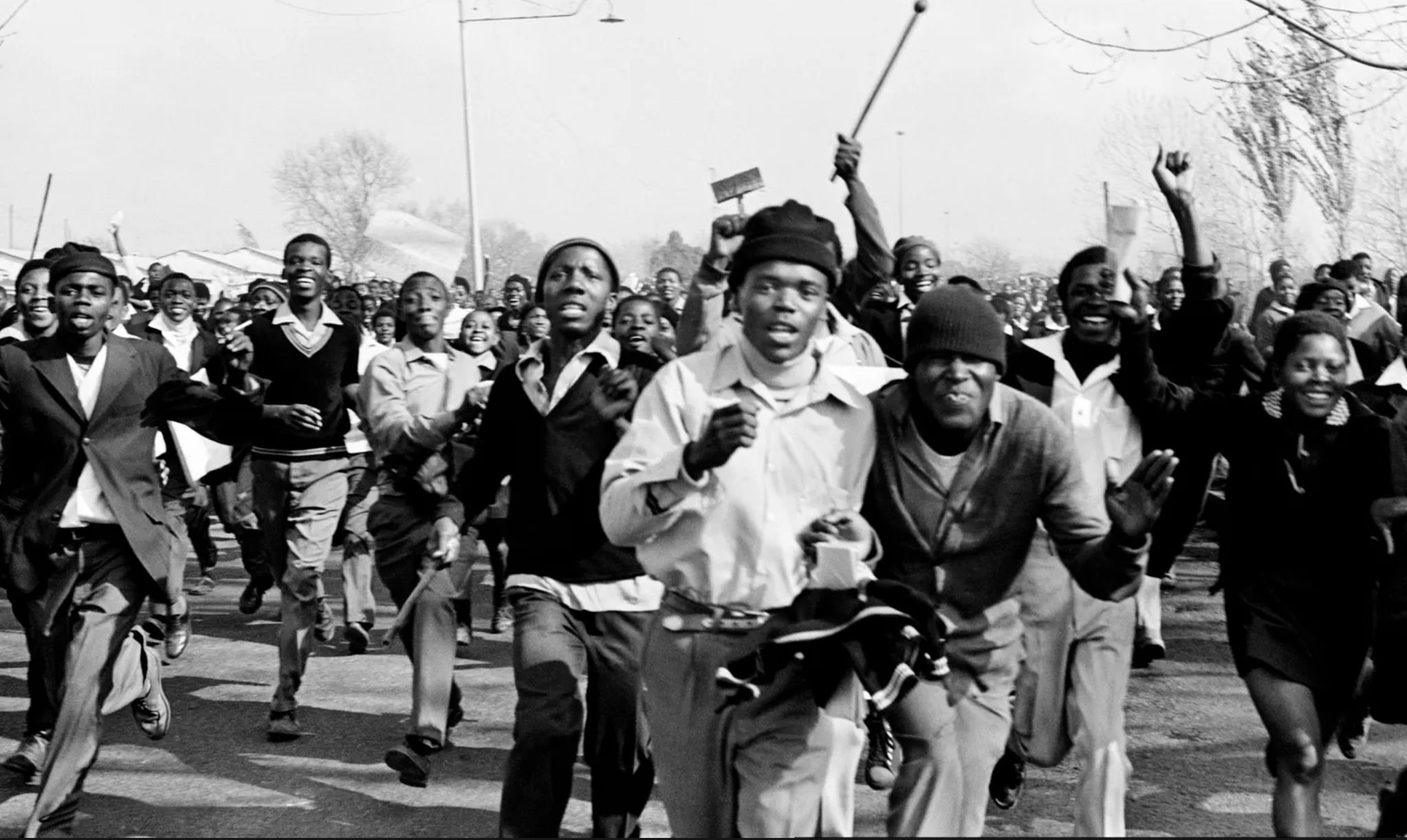
BLACK AND WHITE

by Donna Katzin

for Peter Magubane


Born in Johannesburg in 1932, Peter Magubane documented the brutality of apartheid and suffered from banning orders, solitary confinement and beatings as a result. From teaching himself as a boy with a Brownie camera, he went on to work for the influential magazine Drum and became Nelson Mandela’s official photographer. He died on New Year’s Day aged 91.  Photo: The Soweto uprising on 16 June 1976, when more than 15,000 children protested against an editct making Afrikaans the medium of instruction in black schools. At first, the refused to be photographed but Magubane said a struggle without documentation was no struggle and they had to show the world what was going on in South Africa. The students agreed and this picture was taken by Peter Magubane. —The Guardian, January 12, 2024


With shadow and light
you engrave enduring images
in our collective consciousness,
lend us your eyes as microscope 
that bores deep beneath the skin,
telescope that scans beyond the stars.
 
Broken bodies scattered at your feet—
one camera concealed in a milk carton,
another in a loaf of bread or Bible—
you chronicle histories of struggle,
reveal the beast that lurks within
and humanity that is possible.
 
Confined to solitary
blocks of cold cement,
you do not let them hold
or break your indomitable will, 
bequeath your hammering heart
to our beleaguered world.
 
You squint far beyond the time
you have seeded with your vision,
reclaim the radiance of rainbows,
splendor of the setting sun,
knowing, somewhere,
it will rise again.
 

Donna Katzin has served as the founding and former executive director of Shared Interest, a 30 year old non-profit organization that facilitates access to credit for low-income Black Southern Africans. In that capacity, she was privileged to meet and collaborate with Peter Magubane, and honor him. She currently co-coordinates Tipitapa Partners, which helps feed impoverished children and empower their mothers in Nicaragua. She also serves on the Board of the Fund for Community Change, as well as the Tikun Olam Commission of Reconstructing Judaism—working on reparations in the U.S.  A proud wife and mother, she is a contributor to The New Verse News and author of With These Hands—poems about the "new" South Africa giving birth to itself.

Sunday, October 22, 2023

A SLAP IN THE FACE

by Paul Hostovsky


One man slaps another
as hard as he can in the face.
A third runs up with a microphone
and asks the slapped man
how it feels to be slapped in the face.
And it feels like a slap in the face,
which the man begins to say but then
starts weeping, and his words
trail off as the camera goes in
for a close-up of the wet glisten
in the eyes of the weeping man.
How does it feel to be weeping? 
asks the man with the microphone 
while we sit at home and watch 
and weep for the weeping man
and rage at the man who slapped him,
who is standing somewhere off-camera
waiting for his turn to be asked
why he did the slapping and how
it felt and please pass the popcorn 
because as it turns out the man 
who slapped the slapped man 
is a slapped man himself, and though
he isn’t weeping now, we can feel ourselves 
feeling for the unweeping man who slapped 
the weeping slapped man who has just
slapped the man with the microphone—
and though we really can’t blame him,
we do blame him, and we don't blame
ourselves, and we keep on chewing.


Paul Hostovsky's poems have won a Pushcart Prize, two Best of the Net Awards, the FutureCycle Poetry Book Prize, and have been featured on Poetry Daily, Verse Daily, The Writer's Almanac, and the Best American Poetry blog.

Saturday, May 30, 2020

FOR GEORGE FLOYD

by Donna Katzin


In the streets of Minneapolis                                                            
fires, flashbangs rip night from slumber
as marchers breach barriers,
swell down 27th Avenue
to the Third Precinct.

From its roof, gas wrings tears
from eyes that thought
they’d cried themselves dry,
chokes lungs that burn for breath
in memory of George Floyd—
unarmed, pinned like a sacrificial lamb
by four white men in uniform                                            
for seven never-ending minutes            
while a knee to his neck slowly squeezed
the last air from lips pleading for his life,
gasping Eric Garner’s last words—
I can’t breathe.

While he worked, the cold killer stared into the camera      
of a seventeen-year old brown-skinned girl
who may never graduate from nightmares.

For black mothers, fathers, sons, daughters
terror hangs like a hungry noose.                                                                  
Never takes a vacation.
Refuses to sleep.

It’s not that every officer is a murderer.
It’s just—you never know.


Donna Katzin is the founding executive director of Shared Interest, a fund that mobilizes the human and financial resources of low-income communities of color in South and Southern Africa. A board member of Community Change in the U.S., and co-coordinator of Tipitapa Partners working in Nicaragua, she has written extensively about South Africa, community development and impact investing. Published in journals and sites including TheNewVerse.News and The Mom Egg, she is the author of With the Hands, a book of poems and photographs about post-apartheid South Africa’s process of giving birth to itself.

Friday, December 20, 2019

RING

by Alejandro Escudé


A Motherboard report found Ring lacking basic security measures for preventing hackers from hijacking the devices. —threatpost, December 18, 2019


In the family of moments, there are unique
and strong passwords—living, bobbing like
ripe apples on the Tree of Knowledge, no snakes
coiled, ready to speak to you, to impersonate
God. The voice that comes at us from the ether
demanding we “Wake up!” like Mayakovsky’s sun.
We know better than to repeat our usernames,
passwords strung around our lives like
the rings around Saturn—a tall pot boiling,
a crackle from the device, and it is someone
talking to our daughter from the beyond.
The Ghost of Christmas Past? A horrible clown?
But why urge the child to destroy her room?
What a pinch one feels from this new reality.
Isn’t funny the things people will bring into
their house? A discarded needle, a live mine,
a tiger, a splintered chair, a vial of cyanide.
Once someone speaks to you from a device,
you cannot wash that out of your hair. It’smore
than an experience, it’s a like an experience
turned object; one you buy for the holidays
for instance, a device on which to order
a pizza or a Nintendo Switch box filled with
condoms and soda caps. All of human life
reduced to a child’s bedroom, liquified
on a small screen, the pinks pinker than pink
and the dark voice darker than darkness.


Alejandro Escudé published his first full-length collection of poems My Earthbound Eye in September 2013. He holds a master’s degree in creative writing from UC Davis and teaches high school English. Originally from Argentina, Alejandro lives in Los Angeles with his wife and two children.

Saturday, December 01, 2018

MARS

by David Feela


isn’t ours
but what if
as our InSight

touched down, 
shaking pink dust 
off its gadgets

a robot camera
whirred and clicked
to photograph 

the horrified face
of a dodo—
the same bird 

we never suspected
could survive 
an interplanetary

migratory escape  
from a feckless 
flightless human race.


David Feela writes a monthly column for The Four Corners Free Press and for The Durango Telegraph. A poetry chapbook, Thought Experiments, won the Southwest Poet Series. The Home Atlas appeared in 2009. A Collection of his essays, How Delicate These Arches, was a finalist for the Colorado Book Award. Unsolicited Press will release his new chapbook, Little Acres, in April 2019.

Monday, July 20, 2015

ARIANA LEAVES A BAD TASTE IN OUR MOUTHS

by Michael Mark


That empty calorie confection
can lick my 12 hour factory job.
She can take the tip of her tongue
and taste the lonely dark of 3AM
alarms to get to the donut shop,
to mix the batter, to bake the donuts,
spread the icing that she licked and
did not buy. So another customer
tasted her spit. She can suck my middle-
class mortgage. And laugh because I’m
the sucker who has to work two jobs
to pay for it. I can’t walk away. She
can show up at a donut shop and bitch
about America’s obesity issues with all
the sincerity of imitation whipped cream.
She can eat her disgusting words on camera
in front of fat America. She can slip
her tongue in her dessert dancer of a boyfriend
then slide it over the sugary icing and leave
it tasting of arrogance, of pure meanness. That
customer who brought those donuts home
had to wonder why they stunk of revulsion. “I
asked for Boston Cream and got Rude Insolent
Post Teen.” She can flip that tongue so that simple,
happy, rainbow sprinkles smack of stupidity and
selfishness. That tongue can sell out stadiums.
And she can lie with that tongue that she really,
truly, honestly loves what the camera caught her
saying she hates. She can climb to #1 with that tongue.
And the rest of us, we can take a bite of what she leaves
us and pray for a little taste of forgiveness.


Michael Mark is a hospice volunteer and long distance walker. His poetry has appeared or is forthcoming in Gargoyle Magazine, Lost Coast Review, Rattle, Ray’s Road Review, Spillway, Tar River Poetry, Sugar House Review, and other nice places. His poetry has been nominated for the Pushcart Prize. 

Thursday, April 30, 2015

FUGITIVES

by Philip C. Kolin


Drawing of fugitives running from the Eastern Shore of Maryland. Image source:  A Guide to the History of Slavery in Maryland (The Maryland State Archives, Annapolis MD and the University of Maryland College Park, MD)


Black blood rushes from city
after city; running is now a crime,
guilty or not, the verdict is the same
and so is the punishment; backs
broken, heads smashed,
necks choked, chests exploded,
organs silenced; hope ended.
There is no escape, no plea, no trial.

Every black man is now afraid he wears an invisible
target only dashboard cameras can capture.
Hanging-noose ropes are strung around
the killing scene; black sons set in  buckled asphalt.
The community  fears that American history has
reversed itself, the  Fugitive Slave Acts
reenacted.


Philip C. Kolin, University Distinguished Professor in the College of Arts and Letters at the University of Southern Mississippi, is the editor of The Southern Quarterly and has published more than 30 scholarly books on African American playwrights, Shakespeare, Tennessee Williams, and Edward Albee. Also a poet, Kolin has published five books of poems, the most recent being Reading God's Handwriting: Poems (Kaufmann, 2012), as well as hundreds of poems in such journals as the Michigan Quarterly Review, Louisiana Literature, South Carolina Review, Christian Century, Spiritus, Seminary Ridge Review, America, and has co-edited Hurricane Blues: Poems about Katrina and Rita (Southwest Missouri UP, 2006) with Susan Swartwout.

Tuesday, December 10, 2013

THE MAN NEXT DOOR

by David Chorlton


Image source: still from The End of Violence by Wim Wenders


The neighbor who wants to know everything
has a way of asking, even though
it’s none of his business. But he seems harmless
so you tell him where you’re going, why
the next house along has been empty for a week,
and put it down to friendly conversation.
You’re aware that he’s watching

you leave and come home, not that it matters
any more than being recorded
wherever you go, by a camera that sees
each withdrawal and deposit, by one
placed in the stairway where you work
and one above the swing
in the playground at the park.
Why should you care?
If you’ve done nothing wrong
there’s no need to worry.
It’s all to keep you safe,

even if safety is a state of mind
when the camera doesn’t stop
bad things from happening
but just records them when they do.
Where can you go to snuggle in peace,

let alone have a discreet affair?
How wrong is wrong enough for consequences?
The cameras never sleep. Do you? Do you know
who the four thousand in Lower Manhattan
are focused on? You get facial recognition
thrown in for no charge.
How far apart are your eyes?
How broad is your nose?
Who does the measuring?
If you need to feel secure

install your own system
with a dummy for only fifteen bucks
positioned to intimidate.
If you’ve done nothing wrong
there’s no need to worry.

China installed ten million cameras in a single year.
London has one for every thirty-two people.
Chicago has ten thousand recording
the income gap between the rich and the poor.
These cameras announce a place is safe for investment,
a nice place to shop
and buy more than you need.
Even if someone is watching, keeping count,

nobody will stop you
before you spend too much
and when the man next door asks
how much your purchase cost
you can never be sure whether he knows already.


David Chorlton has lived in Phoenix since 1978, and still sees his surroundings with an outsider's eye. This helps his writing projects, which include a new poetry collection,"The Devil's Sonata," from FutureCycle Press.