Guidelines


Submission Guidelines: Send 1-3 unpublished poems in the body of an email (NO ATTACHMENTS) to nvneditor[at]gmail.com. No simultaneous submissions. Use "Verse News Submission" as the subject line. Send a brief bio. No payment. Authors retain all rights after 1st-time appearance here. Scroll down the right sidebar for the fine print.
Showing posts with label bones. Show all posts

Saturday, June 20, 2026

ELEVEN HOMICIDES, GILGO BEACH, SUFFOLK COUNTY, NY

by LindaAnn LoSchiavo

 
Author's Note: Suffolk County, New York law enforcement sabotaged and delayed investigating the deaths of eleven corpses found along Gilgo Beach for years until their corrupt Police Chief James Burker was arrested in connection with a different case and imprisoned along with Thomas Spota, District Attorney, and Christopher McPartland, Assistant District Attorney. All three were convicted of witness tampering, obstruction of justice, and conspiracy charges. Only then did the Gilgo Beach murder investigation proceed. On Wednesday, June 17th, 2026 the killer was sentenced.


New Yorker and award-winner LindaAnn LoSchiavo is a member of British Fantasy Society,  HWA, SFPA, and The Dramatists Guild. Find out more about her on Substack @GreenwichVillagePoet .

Monday, February 23, 2026

X-RAYS

by Matthew Murrey


‘Deliberate targeting of vital body parts’: X-rays taken after Iran protests expose extent of catastrophic injuries. Expert analysis of images from one hospital suggests severe trauma to the face, chest and genitals was caused by metal birdshot and high-calibre bullets. —The Guardian, February 17, 2026 

 
reveal the structure beneath,
miracle of how strong and fragile
I am, we are. I keep one

of my right hand with its fifth bone
broken—a now-healed ridge I still feel
after half a lifetime. And these

(sent in secret from a country
whose leaders, like so many leaders,
hate the people they rule) reveal

ghosts haunting the injured
bones. Here is one with bright dots
of birdshot fired into the face,

another with pellets peppering
the chest, and one where the target was
the tenderness between the legs.

I do not understand what I see,
am not trained to diagnose what disease   
carries a shotgun into a crowd

of unarmed souls, levels it point-blank,
and pulls the trigger.  


Matthew Murrey is the author of Little Joy (Cornerstone Press, 2026) and Bulletproof (Jacar Press, 2019). He has recently had poems in Flyway, En•Trance, ballast, and elsewhere. He was a public school librarian for more than 20 years and lives in Urbana, IL with his partner. He can be found on Bluesky and Instagram under the handle @mytwords.  

Monday, February 16, 2026

THE WEEKEND NEWS

by Bonnie Naradzay


Crouching amid a pile of rubble that used to be his Gaza home, Mahmoud Hammad scoops dirt into a large sieve and shakes it, looking carefully before dumping it out. In recent days, tiny bones have appeared. Mr Hammad believes they belong to the unborn girl his pregnant wife was carrying when an Israeli air strike hit the family's building more than two years ago, killing his wife and their five children. —ABC (Australia) News, February 12, 2026

Israel used weapons in Gaza that made thousands of Palestinians evaporate. Al Jazeera investigation reveals how US-supplied thermal and thermobaric munitions burning at 3,500C have left no trace of nearly 3,000 Palestinians. Al Jazeera, February 10, 2026 

 On February 13, Russian troops attacked a hospital in Sumy where children are being treated. Two strikes were carried out on the medical facility with attack drones at intervals of about half an hour. —Top News in Ukraine, February 13, 2026 


Putin is targeting Ukrainian children now; we must not look away.
With a flour sifter, a father in Gaza searches for his incinerated family
while Putin’s precision drones obliterate schools, hospitals, daycares.
Using shovels, people helped the father locate the rubble of his home.
 
With a flour sifter, a father in Gaza searches for his incinerated family.
Praise be to God, he says, pointing to the pile of bone fragments.
Using shovels, people helped him locate the rubble of his home.
In Gaza, the living are surrounded by the dead.
 
Praise be to God, Hammad says, pointing to a pile of bone fragments.
Israel returned decomposed bodies showing severe mutilation, abuse.
In Gaza, the living are surrounded by the dead.
Israel has restricted the use of bulldozers to excavate the corpses.
 
Israel returned decomposed bodies showing severe mutilation, abuse.
Hammad keeps a photo of his family, smiling, when they were alive.
Israel has restricted the use of bulldozers to excavate the corpses.
Body parts returned in boxes contain only skulls and some bones.
 
Hammad has a photo of his family, smiling, when they were still alive,
while Putin’s precision drones obliterate schools, hospitals, daycares.
Body parts returned in 66 boxes contained only skulls and a few bones,
but Putin is targeting Ukrainian children now; we must not look away.


Bonnie Naradzay has been leading weekly poetry sessions for homeless people at Street Sense and at Miriam’s Kitchen and also at a retirement community, all in Washington, DC.  While at Harvard University in the late 1960s, she was in Robert Lowell’s class on “The King James Bible as English Literature.” In 2010 she was awarded the University of New Orleans Poetry Prize–-a month’s stay in Northern Italy–-in the South Tyrol castle of Ezra Pound’s daughter Mary. A 2017 graduate of the St John’s College (Annapolis) Graduate Institute, her book of poems Invited to the Feast was published by Slant Books in October 2025; three of the poems were nominated for Pushcart Prizes. 

Tuesday, February 25, 2025

BONES OF THE REPUBLIC

by Earl David Freeland


I weep.

The king didn’t take the throne.
The elephant knelt—
tuskless,
trumpeting fear,
its weight crushing the roots
of a nation it once carried.

Palms open,
backs bent,
offering the crown
wrapped in fear,
cheap flags for bows.
Will there be midterms?
Will it matter?
When power hums the same note,
ballots dusted under a golden sneaker,
lines redrawn to cut out the noise—
cut out us.

Maps don’t divide now.
They silence.
States, neat and obedient,
stacked under a crown.

What world waits for my son?
A place where truth
gets dragged—
hair tangled in fists,
paraded like a lesson.

Freedom?
Traded for chain-slick comfort.
Easy.
Cheap.

The anthem plays.
Hands rise—
not for hearts.

I see it—
the Mouth of Putin,
slick, wide, laughing.
Spitting out slogans,
black seeds rooting into
boots,
barbed wire,
burned books.

Long live the king,
they say.
And mean it.

I weep.

But I’m watching.
And if democracy dies here—
I’ll bury it with teeth.
Bared.
Fists raw.
Tear the ground open
and dig through the bones
the elephant left behind


Earl David Freeland is a mathematician, former cartographer, and teacher whose poetry balances precision with raw vulnerability. His work explores societal critique, existential themes, and human complexity with unflinching honesty. His poems have appeared in Poets Reading the News and reflect a deliberate rejection of polish in favor of visceral authenticity.

Tuesday, December 10, 2024

ON THE DEATH OF A CEO

by Lori D’Angelo


We don't trade one life for another or
a thousand. With every loss, the universe
cries out and also keeps on. Nothing, not 
yet, stops it. So, yes, whether your mother
just found out she has cancer or your father
has just entered hospice, the clock still tick
tocks, minutes go by. Every year, around this
time, we watch Dickens' A Christmas Carol
and think, Ah yes, even a miser had a soul. 
But yet when a man whose company did 
some shitty shady things dies, don't join in
the chorus of he deserved it haters. It's not 
much different to do that than it is to weigh
worth by a claim denied algorithm. If you say
all of them, mean all of them, even the maybe 
he deserved it bastards. In earth, their bones, 
our bones, all rot the same. The minute you 
forget, you become what you thought you’d
never be: callous, jaded, alive but also dead. 
Instead,                                      mourn it all. 


Lori D'Angelo is a grant recipient from the Elizabeth George Foundation, a fellow at the Hambidge Center for Creative Arts, and an alumna of the Community of Writers. Her work has appeared in various literary journals including BULL, Gargoyle, Drunken Boat, Moon City Review, and Rejection Letters. Her first book, a collection called The Monsters Are Here, was recently published by ELJ Editions. 

Saturday, February 03, 2024

NOT/KNOT

by Alison Luterman


Palestinian children killed in Israeli attacks in Gaza:  Here is a list of the names we know, from more than 11,500 children killed during Israel’s war on Gaza. Even this is less than half of those killed. | Al Jazeera Newsfeed


If I'm being honest about it
and I'm probably not, 
I've had my head in the sand
all this time, not
like an ostrich, but like a person
who doesn't know which voice to listen to
amid the explosions and the shouting,
and I don't know what I'd do 
if I were in charge of anything
over there, which, 
thank God, I am not,
I don't know anything
anymore, but still—if the price
of the place
is to kill and kill
and keep killing
children,
and if you had to
see it up close, for yourself,
the small, shattered bodies, 
the homes, markets, schools, the
hospital
with its roof torn off,
the piles of naked, bound men
loaded onto a truck
going nowhere, and be told, not
for the first time,
that this was all being done
for your supposed benefit
or ultimate safety—
then what? Not
in my name, we say, 
but that does not
change anything 
on the ground, the knot
of history, too snarled and 
tightly matted with the blood 
of innocents, cannot
be picked apart
by even the most nimble fingers, 
and the riddle: 
how many babies' bones
are worth the illusion
of a homeland?  


Alison Luterman is the author of four books of poetry, most recently In the Time of Great Fires from Catamaran Press. She teaches and writes in Oakland, California. 

Thursday, April 20, 2023

STICKS AND STONES

by Sister Lou Ella Hickman


break my bones 
words can never hurt me 
but words are hurting 
even killing 
now  
to shut down 
to shut up 
tit for tat 
with bigger stones 
and bigger sticks 
we’ll show you who’s boss
while children die 
the hungry starve 
families live in cars 
books burn 
(this needful list is long) 
as bones break 
bodies break 
spirits die 
the world watches 
as hands take aim


Sister Lou Ella has a master’s in theology from St. Mary’s University in San Antonio and is a former teacher and librarian. She is a certified spiritual director as well as a poet and writer.  Her poems have appeared in numerous magazines such as America, First Things, Emmanuel, Third Wednesday, and The New Verse News as well as in four anthologies: The Night’s Magician: Poems about the Moon, edited by Philip Kolin and Sue Brannan Walker, Down to the Dark River edited by Philip Kolin, Secrets edited by Sue Brannan Walker and After Shocks: The Poetry of Recovery for Life-Shattering Events edited by Tom Lombardo. She was nominated for the Pushcart Prize in 2017 and in 2020. Her first book of poetry entitled she: robed and wordless was published in 2015 (Press 53.) On May 11, 2021, five poems from her book which had been set to music by James Lee III were performed by the opera star Susanna Phillips, star clarinetist Anthony McGill, pianist Mayra Huang at the 92nd Street Y in New York City. The group of songs is entitled “Chavah’s Daughters Speak.”

Wednesday, March 22, 2023

THIS POEM IS DEDICATED TO NORMAN DUBIE

by Ralph Culver


Author’s note: Be at peace and travel well, Norman Dubie, singularly gifted American poet and teacher, who died 20 February, 2023 at 77.


Ralph Culver is a past New Verse News contributor. His most recent poetry collection is A Passable Man (MadHat Press, 2021), available in bookstores and through all the usual internet sources. He divides his time between Vermont and central Pennsylvania.

Wednesday, July 20, 2022

FIRE

A Poem for Ada Limón, using her words


by Pauletta Hansel
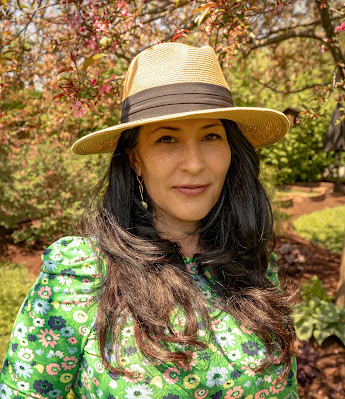


Ada Limón Is Named the Next Poet Laureate: Poetry, she said, can help the nation “become whole again” in a fraught, divided moment. Photo by Carla Ciuffo for The New York Times, July 12, 2022


Sometimes I imagine all my lovely poets 

out there in the world of their bodies

having a poetry party

with dry red wine uncorked and pimento cheese 

spread out on a warm lawn, or gathered 

around the inside of a picture window,

still black water holding the stars, 

talking poems made 

            in the white heat of the moment… or 

            written from inside the well ...

Reminding themselves that

            when things are bad, 

            we still have our words

            and each other.

And then I get on Facebook

and I see it really is true. 

            When the day calls for fire 

            and your friends have all the matches 

            to burn it down, Ada posts,

and I know these friends,

some of them anyway,

and the R.J Corman rail line

running by her house,

            surrounded by wild things, 

            green trees, grasses.


But never mind my invitation

lost on the internet,

I’ll read myself in

between the lines—

            “If you want to win anything—your race, your self, your life—

            you have to go a little berserk”—this woman even gets good fortune cookies, 

and on the radio now Ada Limón is talking 

about female rage and how

                        sometimes we need

                        to step into that room and make ourselves

                        fully known and fully seen.


Even “The Onion” loves this woman, the railroad spike

bisecting Trump’s hypothalamus and he calls a meeting 

to name her poet laureate.

            When we name things we are more tender to them…

            But I am also aware of the hubris of naming things.


She’s not my friend,

even though she seems to live inside my body,

            more tired than I should be, 

            …hurting more, 

            my brain keeps saying 

            “this country hates women, 

                        this country hates women”

                                    over and over…

            And of course women are hesitant

            about our subject matter. 

            Of course we are. 

            We’ve been taught that from the very beginning

to ask ourselves,

            Should I take the “I” out? Should I erase my being?

But there she is, Ada Limón, singing the song 

of our shared bones, and, yes,

sometimes the song 

is enough.


Author's Notes:

Italicized lines are from the following sources

Ada Limón's Facebook timeline, October 2018

https://soundcloud.com/kutnews/this-is-just-to-say-ada-limon-and-carrie-fountain https://www.cleavermagazine.com/a-conversation-with-ada-limon-author-of-the-carrying-interview-by-grant-clauser/

https://politics.theonion.com/calm-measured-trump-hard-at-work-after-freak-accident-1829686798

“The Poetry of Perseverance: An Interview with Ada Limón,” Poets & Writers September/October 2018.


The final lines reference “A New National Anthem,” The Carrying, by Ada Limon


Pauletta Hansel’s newest poetry collection is Heartbreak Tree, an exploration of the intersection of gender and place in Appalachia. Her writing is featured in Oxford AmericanRattle, The New Verse News and Poetry Daily, among others. Pauletta was Cincinnati’s first Poet Laureate and is 2022 Writer-in-Residence for The Cincinnati and Hamilton County Public Library. 

Wednesday, March 02, 2022

FUTURE ORIENTATION

by Imogen Arate


Tweet by The Kyiv Independent.


There is talk of war
in the shushing peacetime
desires for cracking 
delineations to self-heal 
without tending

There is talk of utopia 
in the blunt wielding
of firebombs Why not
room for better)

On the bodies of whose
children friends parents
and lovers A question 
suppressed or answered
by the jutting of chins
toward the detested
"Other" 

though history’s fingers
point to mutual others
who have become as
anonymous as the sides 
they took

whose bodies grew
their bones still beg 
for time to reunite
with the consolation
of a soothing soil

There is paradise
in the overtaking 
by tendrils grown
from the dust of war

in the dawning
that we are multitudes
of singular imperfections
who seek out others 
to share our wounds
perchance to heal


Imogen Arate is an award-winning Asian-American poet and writer and the Executive Producer and Host of Poets and Muses, a weekly poetry podcast that won second place at National Federation of Press Women's 2020 Communications Contest. She has written in four languages and published in two. Her poems, “A Declaration of Loyalty” and “Sanctuary” placed Second and Third, respectively, in the 2020 National Federation of Press Women at-Large Communications Contest. Her poetry has appeared in 18 publications on four continents, most recently in I Wanna Be Loved by You: Poems on Marilyn Monroe, Dwell Time, Nude Studio, and dyst.  You can find her @PoetsandMuses on Twitter and Instagram.

Thursday, November 11, 2021

GHOST FORESTS EXPLAINED

by Mickey J. Corrigan


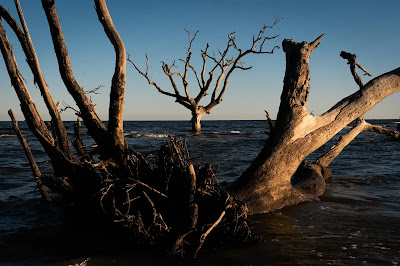
Ghost forests occur when high tides push seawater into forested areas and salt poisons the trees, turning them a bleached white. Ghost forests are currently appearing up and down the east coast of the US at an alarming rate. Photo: Cameron Pollack for NPR


The sun comes up
the sun goes down
the trees turn white
the beach looks skeletal.

The rain comes down
the sea comes in
the trees soak in salt
instead of fresh water.

The storms come up
the sea washes in
our forests poisoned
dead limbs in the sand.

We walk the beach
stuffing our sandbags
as storms come in
more storms come in
the tides rise up 
the tides rise higher... 

our bones flash white
littering the shore.


Originally from Boston, Mickey J. Corrigan writes tropical noir with a dark humor. Novels include the mystery pandemic tale Songs of the Maniacs (Salt Publishing, 2014), Project XX about a school shooting (Salt Publishing, 2017), and What I Did for Love, a spoof of Lolita (Bloodhound Books, 2019). In 2020, Grandma Moses Press released the poetry micro-chapbook Florida Man

Friday, October 29, 2021

COUNTING BONES

by Sister Lou Ella Hickman, I.W.B.S.


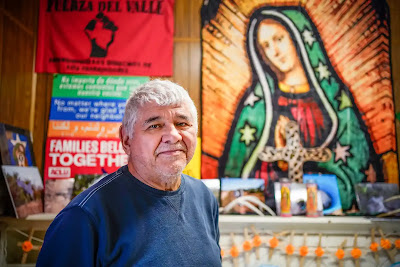
Eddie Canales, director of South Texas Human Rights Center. Photograph: Gabriela Campos via The Guardian.


for john meza and eduardo canales


how many graves received them 
that is 
what was left of their bodies… 
for two days 
you will sift the soil 
with your hands and small trowels  
letting the earth 
fall away 
from the whiteness of bone 
i cannot fathom how you . . . 
(my heart aches with this almost thought) 
how will you touch the small remnants of lives 
and still breathe… 
how…
only by kneeling 
                                     

Author’s Note: John Meza is one of the volunteers working with Eddie Conales, director of the South Texas Human Rights Center. With members of the Texas State University Forensic Pathology Department, they exhume bodies in graves in San Ygnacio, Texas to help identify missing migrants.

 
Sister Lou Ella has a master’s in theology from St. Mary’s University in San Antonio and is a former teacher and librarian. She is a certified spiritual director as well as a poet and writer.  Her poems have appeared in numerous magazines such as America, First Things, Emmanuel, Third Wednesday, and The New Verse News as well as in four anthologies: The Night’s Magician: Poems about the Moon, edited by Philip Kolin and Sue Brannan Walker, Down to the Dark River edited by Philip Kolin, Secrets edited by Sue Brannan Walker and After Shocks: The Poetry of Recovery for Life-Shattering Events edited by Tom Lombardo.  She was nominated for the Pushcart Prize in 2017 and in 2020. Her first book of poetry entitled she: robed and wordless was published in 2015 (Press 53.) On May 11, 2021, five poems from her book which had been set to music by James Lee III were performed by the opera star Susanna Phillips, star clarinetist Anthony McGill, pianist Mayra Huang at the 92nd Street Y in New York City. The group of songs is entitled “Chavah’s Daughters Speak.” 

Sunday, October 24, 2021

THOSE THE EARTH TAKES IN SECRET

by Bradley McIlwain


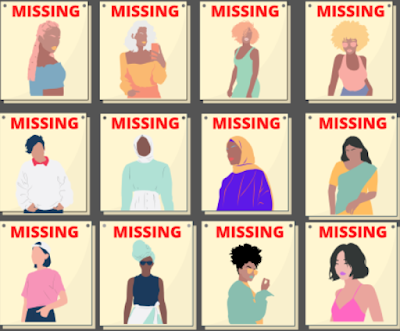
Outdoorsy. Beautiful. Outspoken for justice. Full of humor. “Being outdoors and enjoying nature gave her that feeling of empowerment of being free,” a line from her obituary read. The 23-year-old woman was reported missing by her family after she failed to return home. Weeks later, her remains were discovered in a field in Wyoming. This wasn’t Gabrielle Petito, who disappeared a month ago and has over 20 million search results associated with her name on Google. The 23 year old was Jade Wagon, a member of the Northern Arapaho Tribe who went missing from her home on the Wind River Reservation in January 2020. Her death was ruled accidental due to hypothermia and drug intoxication, but her mother, Nicole Wagon, believes that her daughter was a victim of violence. Jade Wagon has 3,610 search results mentioning her name on Google. While developments on Petito’s case have made national news and retained engagement for weeks running, her story is one of tens of thousands of Americans that experience interpersonal violence every year. For many like the Wagons, the tide of activism in Petito’s case reaffirmed what was missing for women of color in similar circumstances. The vast majority do not receive widespread media coverage, let alone sizable social media investigation. Feminist journalist Gwen Ifill originally coined the term “missing white woman syndrome” in 2004, highlighting media’s tendency to favor sensationalized coverage toward white female victims of violence whilst neglecting stories of women of color, who face violence at a disproportionately higher rate, according to the Oregon Coalition Against Domestic and Sexual Violence. —Kyran Berlin, Golden Gate Express, October 15, 2021


Cloudy skies.
The world shadows
Itself from prying eyes.

A shudder 
cracks the night
like a hammer
Shattering ice.

We fall through.
Our souls know
No use.

Water safeguards 
Our secrets, washes 
Away 
old bones.
We don’t see
The murder of crows
Until Valhalla is near.

After the battle
Valkyries peck 
At the armour 
we don’t need.

What’s dead
We leave behind:
Our blood on the blade.

The earth takes
Our stories, scattered
And scavenged 
under the trees.

Who will see?
Is there anyone left
Who will speak for me?


Bradley McIlwain is a Canadian writer and poet, whose works have appeared in The New Verse News, The Origami Poems Project, Platform Magazine, and others. He is the author of Elementals: Poems (IOWI, 2015).

Friday, September 03, 2021

COMPOS[T]ING MYSELF

by Barbara Simmons 


Washington state became the first state to legalize natural organic reduction in May 2019; Colorado followed suit in May 2021; and Oregon became the third state to sanction human composting in June 2021. —Treehugger, August 24, 2021. "The powerful [California] Senate Appropriations Committee has held a bill that would legalize the composting of human remains. The bill, AB 501, was authored by Assemblywoman Cristina Garcia, D-Bell Gardens, and had sailed through the Assembly with a unanimous vote.... Garcia said in a statement. 'This is another sad reminder that we must legalize a more environmentally friendly option like Natural Organic Reduction (NOR) as soon as possible. AB 501 will provide an additional option for California residents that is more environmentally-friendly and gives them another choice for burial.'” —Sacramernto Bee, August 30, 2021. Photo from Recompose, "a public benefit corporation powered by people who believe in changing the current death care paradigm."


I remember times when soil smelled rich,
a kind of coffee bean rich, a kind
of patchouli rich, a rich that flared my nostrils 
scenting the air with inhale more. 
The time we worked our garden soil 
composting it, the elements of peat and perlite
caking fingernails, our prepping
beds for rows and rows of plants
yearning for elements beyond clay. We dreamt
of growing foxglove, ferns and fuchsias,
entwining them with flowers mixing other letters
into soil with pansies, daffodils, impatiens.  
But it was always soil, prepared, that led to color,
soil inhabiting our very blood and bones, 
a deep affinity for dust to dust we have within,
rich dark coffee-colored soil, aromas lifting up and
taking us to early earth when scientists say the smell
was more like rotten eggs, rich with H2S. This richness lives
within me, my body’s future with the possibility of
decomposing into one cubic yard of soil,
along with wood, alfalfa, even straw, all
assisting me along the way to my new form, 
my inert self reduced to fragrant future supplements
for growing flowers after I have gone.
Something to think about, while legislators ponder laws
to handle soil that’s human-sourced. Right now, it’s not
Assembly Bill 501 I’m thinking of; I’m smelling soil, the
rich rich soil that flowers hunger for, the soil that’s fed
my soul, the gardening days when turning over dirt
was very much like leafing through a sacred text, 
when I’ve translated who I’ve been into the earth
from which I’ve come.


Barbara Simmons is a poet who celebrates the many worlds she inhabits using language to explore the ways we remember and envision. A graduate of Wellesley College, she received an MA in The Writing Seminars from Johns Hopkins. As a secondary school English teacher, she revisited texts with students who inspired her thinking about communication's diversity. Retired, she savors smaller parts of life and language, exploring the world's stories in her poetry. Publications have included Santa Clara Review, Hartskill Review, Boston Accent,  The New Verse News, Soul-Lit, Writing it Real Anthologies, Capsule Stories Anthologies, and the Journal of Expressive Writing.  Her book of poetry Offertories: Exclamations and Disequilbriums will appear in 2022.

Tuesday, July 06, 2021

FOSSIL FUGUE

by Dustin Michael


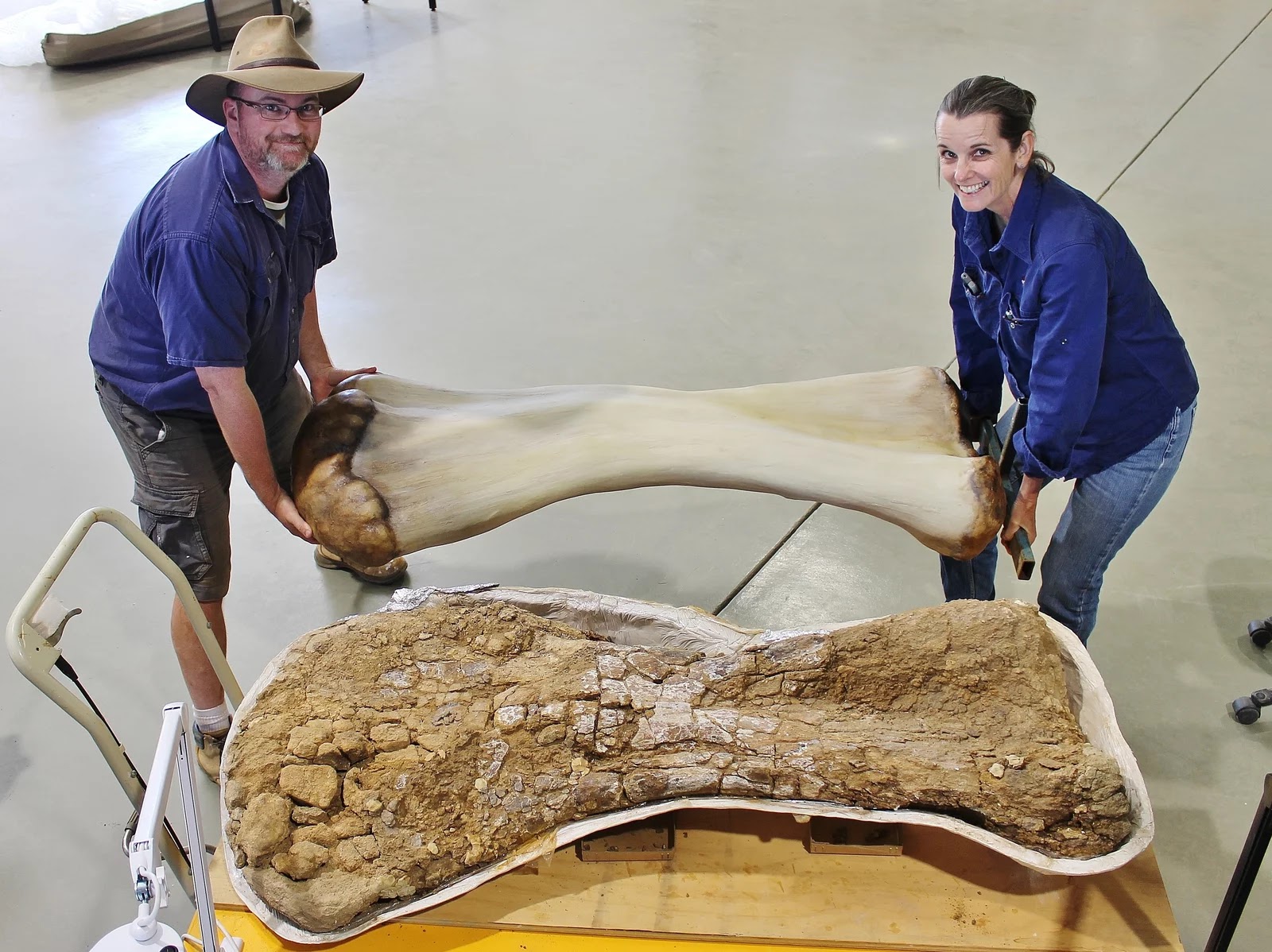
Researchers in Australia have confirmed the discovery of Australia's largest dinosaur species ever found. Australotitan cooperensis was about 80 to 100 feet long and 16 to 21 feet tall at its hip. It weighed somewhere between 25 and 81 tons. For comparison, the Tyrannosaurus rex was about 40 feet long and 12 feet tall. Photo: Scott Hocknull and Eromanga Natural History Museum Director Robyn Mackenzie hold a model of what the humerus of the dinosaur would have looked like next to the fossilized remains of the humerus. Credit: Eromanga Natural History Museum via NPR,June 8, 2021.


What is the price for a puppet show with 
fewer puppets but more stories? Always 
the same story endlessly staged, 
every age’s marionettes and the same 
tired tale, a shifting cast of shadows 
behind the age-old screen.

Study any desert, and behold 
that same sun blistering their backs,
baking their bodies and bones, the breadcrumbs 
of immigrants, their grim trail markers and that same
the docile plodding rhythm, a drumbeat of footsteps 
from the fossil record ringing through time. 

Here is another variation. 
They walked, shielding their young 
with their own bodies, their necks 
like cracked leather, craned high
toward new skies, the breath
of hunger, thirst, and danger fogging 
each footfall, their scaled feet disturbing 
the dust, scattering already ancient rocks, stale
wind whistling faint melody in the world’s eternal 
fugue.

The news reports these dinosaur bones came 
from creatures as big as basketball courts
whose Patagonian ancestors crossed connected 
continents and arrived in Australia. 
No boats to be turned back, no papers to be denied, 
no armed agents or bureaucratic barriers to halt them—
only land in stretches longer 
than even their tales and necks,
and vengeful heat, and hungry earth
whispering Not to worry, not to worry, 
even if they never find all of your bones
the story of your journey 
will always be retold. 


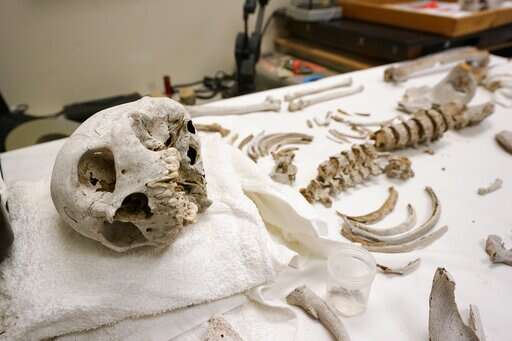
Faith-based groups are working to protect migrants and honor those who have died while attempting to cross the southern border from Mexico into the United States. Humane Borders is an organization that sets up water stations in the Arizona desert on routes used by migrants to cross the border. The group also works with Pima County chief medical examiner Dr. Gre Hess to document the discovery of bodies of those who died on the journey. According to the Associated Press, Hess's office received the remains of 79 border-crossers this year as of late May. In 2020, Humane Borders documented 227 deaths, the highest in a decade after a record hot and dry summer in Arizona. Activists fear this year will be even worse. —Newsweek, July 5, 2021. Photo: Unidentified bones found in the desert and suspected to be that of a migrant are assembled together for examination at the Pima County Medical Examiner's forensic labs in Tucson, Ariz. Credit: Ross D. Franklin/Associated Press via The Journal, July 5, 2021.


Dustin Michael lives in Georgia and teaches college writing and literature. His work has appeared in numerous literary journals and his favorite dinosaur is stegosaurus, not that anyone asked.

Tuesday, February 18, 2020

THE ANTARCTICA BEAUTY PAGEANT

by Christopher Woods


Temperature in Antarctica soars to near 70 degrees, appearing to topple continental record set days earlier. —Headline in The Washington Post, February 14, 2020


Has fewer contestants this year.
Girls from every continent once competed
Before the heat became too intense.
No more bikini strut, wet tee shirt parade.
Now just a few stagger about in a white furnace
Where the fevered winds that killed the penguins
Blow incessantly across the bones of elephant seals.


Christopher Woods is a writer and photographer who lives in Chappell Hill, Texas. He has published the novel The Dream Patch, the prose collection Under A Riverbed Sky, and a book of stage monologues for actors, Heart Speak. His photographs can be seen in his gallery. His photography prompt book for writers From Vision To Text is forthcoming from Propertius Press.

Friday, March 09, 2018

LINE OF POSITION

by Peleg Held


Bones discovered on a Pacific island in 1940 are "likely" to be those of famed pilot Amelia Earhart, according to a US peer reviewed science journal. —BBC, March 9, 2018


We are running on a line between
celestial navigation and dead reckoning
tempting the keepers of the crossings:
To live now into the skies.

Gas running low, unable to reach you yet
Electra's song still sings above the static,
the scraping tide where shells are emptied, torn
and wings churn back to ore--
identification in the debris field is a matter of scale.

We must be on you but we cannot see you.
As the sun-line sweeps towards our flight path
we grope for an island. A large ring
of white sand around a bright lagoon.

This is Emil Harte.

We lay out the bones of frigate birds, a testament
on sand. In our dreams Electra remains on the reef
we lean into the transmitter, spit into sunspot
and whisper our coordinates into the harmonic.
Give us a bearing—what is our position now?

I am an island where lost flyers make landfall,
where mercurial fingertips sign the freckled glass
buried in the strand. Here post-loss transmissions
still crackle the air, even as the rest
is carried over in the pincers of crabs.

We are listening.


Author’s Notes: Italicized bits are from the final transmissions of Amelia Earhart. Earhart submitted her poems to Poetry Magazine under the pseudyonym Emil Harte.


Peleg Held lives in Portland, Maine with his partner and his dog Emitt. There is also the semi-feral cat, Smudge. And a kid or two. pelegheld(at)gmail.com.