Guidelines


Submission Guidelines: Send 1-3 unpublished poems in the body of an email (NO ATTACHMENTS) to nvneditor[at]gmail.com. No simultaneous submissions. Use "Verse News Submission" as the subject line. Send a brief bio. No payment. Authors retain all rights after 1st-time appearance here. Scroll down the right sidebar for the fine print.
Showing posts with label explosions. Show all posts

Tuesday, December 31, 2024

WHAT A CHILD NEEDS IN A WAR ZONE

by Jerrice J Baptiste


The impact of armed conflicts on children around the world reached devastating and likely record levels in 2024, according to an assessment by the UN Children’s Fund (UNICEF). —UN News, December 27, 2024


Child searches for sweet embrace
of mother, father or next of kin.
Child finds limbs
along the way, a blueish face once  
known, red eyes that stare 
into bleak unknown.

You, soak dry mushrooms this season. 
Serve warm broth to this child
from a dead zone 
while agile mind can still imagine
a world of peace and freedom. 

You, gather essence of the earth to feed
desolate orphan, fruits, nuts, seeds
moonbeams for dreams.
Child will need your lap to curl on when
the sounds of night 
frighten even ghosts who have seen, 
who have heard explosions of hearts.


Jerrice J Baptiste is a poet, educator and facilitator of poetry for healing and self-expression. Her new book of prose poems is titled Coral in the Diaspora published by Abode Press (August 2024).  Her writing has been published and is forthcoming in The New Verse News, Artemis Journal, Urthona Buddhism and Art Magazine, The Dewdrop, Shambhala Times, The Yale Review, Wax Poetry & Art, Black Fox Literary Magazine, Mantis, Penumbra Literary & Art Journal, The Banyan Review, Kosmos Journal, Silver Birch Press, and many others. Her collaborative songwriting and poetry are featured on the Grammy-nominated album Many Hands Family Music for Haïti. 

Saturday, February 03, 2024

NOT/KNOT

by Alison Luterman


Palestinian children killed in Israeli attacks in Gaza:  Here is a list of the names we know, from more than 11,500 children killed during Israel’s war on Gaza. Even this is less than half of those killed. | Al Jazeera Newsfeed


If I'm being honest about it
and I'm probably not, 
I've had my head in the sand
all this time, not
like an ostrich, but like a person
who doesn't know which voice to listen to
amid the explosions and the shouting,
and I don't know what I'd do 
if I were in charge of anything
over there, which, 
thank God, I am not,
I don't know anything
anymore, but still—if the price
of the place
is to kill and kill
and keep killing
children,
and if you had to
see it up close, for yourself,
the small, shattered bodies, 
the homes, markets, schools, the
hospital
with its roof torn off,
the piles of naked, bound men
loaded onto a truck
going nowhere, and be told, not
for the first time,
that this was all being done
for your supposed benefit
or ultimate safety—
then what? Not
in my name, we say, 
but that does not
change anything 
on the ground, the knot
of history, too snarled and 
tightly matted with the blood 
of innocents, cannot
be picked apart
by even the most nimble fingers, 
and the riddle: 
how many babies' bones
are worth the illusion
of a homeland?  


Alison Luterman is the author of four books of poetry, most recently In the Time of Great Fires from Catamaran Press. She teaches and writes in Oakland, California. 

Thursday, July 13, 2023

SWINGING ON WINGS OF FLAME

by Mary K O’Melveny


There's a house somewhere I know where the fire's burnin'
All night long… 
And even though the wind may now be howlin'
The stars are bright and they push me on and on
—“Half Moon Rising” (Yonder Mountain String Band)
  

We keep exploring outer space for answers.
Out there, we learn that black holes make sounds
of music as they swallow everything
around them. Celestial destruction
to the tune of string band melodies, as if
the Osborne Brothers or the Red Clay Ramblers
had booked a cosmic venue where eager stars
do-si-do around dark matter’s edges.
 
Sit still and you will hear creation’s story
spelled out with mandolins, fiddles, five-string
banjos. On Earth we are orchestrating our
own demise. Everything has turned extreme.
Our hottest week just past will not be last.
The burning air tastes like barbeque.
Put an ear to ground, hear it singe, smolder,
sear from simmering smog and haze.
 
Far better to harmonize and tap our feet
as Earth’s axis shifts and we wobble, weave
like drunken sparrows. Saharan sands might
land in Kansas while floodwaters choke New
Jersey highways and algal blooms poke out
from Florida’s rivers. Grab a good seat
at our cosmic amphitheater where smoke
rises from the speed of guitar picking.
 
If you listen closely, you can hear some scat,
nonce, argot. Go with the flow. Flat Foot Floogie,
Tutti Fruiti. Explosions of fervor, fury
unleashed by gas ripples in galaxy
clusters. Who can say this fate will not be
ours as well? One hopes we won’t be around
by then. For now, we can dance as glissandos
of sound drift from the heart of the Milky Way.


Mary K O'Melveny is a recently retired labor rights attorney who lives in Washington DC and Woodstock NY.  Her work has appeared in various print and on-line journals. Her most recent poetry collection is Dispatches From the Memory Care Museum, just out from Kelsay Books. Her first poetry chapbook A Woman of a Certain Age is available from Finishing Line Press. Mary’s poetry collection Merging Star Hypotheses was published by Finishing Line Press in January, 2020.

Thursday, July 07, 2022

I GREW UP IN HIGHLAND PARK

by Tricia Knoll


Twenty-nine spaces in the US carry this name.
When the news broke, I wondered if it was my home town.
It was. The place I lived for the first twenty years of my life. 
My home town as much as any other. Where I was born
 
more than seventy years ago. I hadn’t wondered how much
or what had changed. Videos brought it home. The store
that was once Chandlers where every year I went 
with my mother to get new pencils, pens, and notebooks
 to go back to school. The shoe store with the Xray
machine. The laundry owned by Chinese Americans 
where the windows always dripped with water. 
Mr. Leeds' jewelry store. Across the street
I bought my prom dress to dance with my first love. 
My first bank account on the corner of Central. 
Learning to drive in town across the railroad tracks.
Our library. Smelling the alewives on Ravinia Beach 
where I learned to swim and loved a sun tan.  
Hearing Louis Armstrong sing "Hello Dolly" 
at the festival. My father’s service
on the school board. The flooded
field where I learned to ice skate. The miles
of roads where I careened around on a bike. 
The day a migrating whooping crane stopped
in our flooded back yard. Long ago. Green
skies over oaks before tornados. 
 
My feet once knew every inch of that parade route.
You never really leave those old home towns. 
The red flags didn’t wave true here. The young man
got his assault rifle in a state and town known
for its tougher-than-most gun laws.
I supposed I wouldn’t know anyone who was there
after all these decades. That wasn’t true.
I knew two people who fled the explosions, one
a man I went to school with who fled with his
grandchildren and one a woman who lived next door
to me as a child. Everyone says it can happen
anywhere. I know that now. 


Tricia Knoll is a Vermont poet. When media people describe Highland Park's 30,000 residents as a small town, she's aware that in Vermont Highland Park would be Vermont's second largest city. She worried about possible violence in June for friends in Portland, Oregon going to the Pride Parade. Her next collection of poetry One Bent Twig is coming out from Future Cycle Press in early 2023—poems reflecting her love and concern for trees facing climate change. She has written about the red oaks of Highland Park.

Tuesday, March 01, 2022

FOUND POEM OF WAR

by Ellen Austin-Li


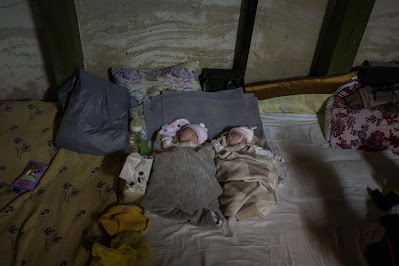
Newborn twin brothers sleep in a basement used as a bomb shelter at the Okhmadet children's hospital in central Kyiv, Ukraine, Monday, Feb. 28, 2022. (AP Photo/Emilio Morenatti)


A line from Yeats’ poem that reverberates
like a bass chord that becomes a strum,
combined with an image of babies 
kept alive in a bomb shelter, underground,
each breath bagged by ambu into tiny lungs.
This hum an undercurrent—under, under, under
my thumb. This rough beast lumbering, a ton,
a hundred years running, but truly thousands before, 
more’s the sum of history in a new poem—not new, 
but old. What crumbling humans, such endless war.
My hands weary as if I’m delivering each breath.
I know what this means—we cannot take a rest
or the children expire. I tire, but the poem is found.
The cannon, the fodder: explosions of sound. 


Ellen Austin-Li’s work has appeared in Artemis, Thimble Literary Magazine, The Maine Review, Pine Mountain Sand & Gravel, Rust + Moth, and other places. Her two chapbooks were published by Finishing Line Press—Firefly (2019) and Lockdown: Scenes From Early in the Pandemic (2021). She is a Best of the Net nominee. A recipient of the Martin B. Bernstein Fellowship, she earned an MFA in Poetry at the Solstice Low-Residency Program. Ellen lives with her husband in a newly empty nest in Cincinnati, Ohio.

Sunday, January 12, 2020

HUNTING SEASON, JANUARY 2020


Katherine West lives in Southwest New Mexico, near the Gila Wilderness, where she writes poetry about the soul-importance of wilderness, performs it with her musician husband, Yaakov, and teaches seasonal poetry workshops that revolve around "wilderness writing."  She has written three collections of poetry: The Bone Train, Scimitar Dreams, and Riddle, as well as one novel, Lion Tamer.  Her poetry has appeared in journals such as Lalitamba, Bombay Gin, and TheNewVerse.News  which recently nominated her poem "And Then the Sky" for a Pushcart Prize.

Tuesday, November 04, 2014

TELEGENIC

by Erica Goss


A family’s shoes arranged by size, smallest first. The bones of a child’s foot. I write a poem for a man named Mark. He sits on the street and weeps. He’s seen the shoes, seen them filling up with blood. This summer grinds on. We congratulate ourselves, as if we didn’t know one piece of land is worth more than another, one child’s life is worth more than another’s. Death is telegenic and dead children most of all. Explosions branch through the ear and jaw but quiet, please, this game requires the world’s silence. Mark rakes the little bones together, collects the shoes in heaps all over the city. At night when they burn the fires smoke and sputter and then go out, smallest first.


Erica Goss is the Poet Laureate of Los Gatos, CA. She is the author of Wild Place (Finishing Line Press 2012) and Vibrant Words: Ideas and Inspirations for Poets (PushPen Press 2014). She won the 2011 Many Mountains Moving Poetry Contest and was nominated for the Pushcart Prize in 2010 and 2013. Recent work appears in Atticus Review, Lake Effect, The Red Wheelbarrow, Passager, Main Street Rag, Pearl, Rattle, Wild Violet, and Comstock Review.  

Tuesday, April 16, 2013

SHARON OLDS, PULITZER PRIZE WINNING POET, BUMPED FROM PBS BY BOMBS

by Alan Catlin


Her book of personal loss,
a marriage gone way wrong,
intense as personal grief can be.

Moving on, recovery, takes years,
if ever; a lifetime, if you are lucky.

This day, Tax Day, Patriot’s Day,
a time of celebration for millions,
the hundreds upon thousands of
people who ran a marathon or who came
to watch as the race is run.

And, Sharon’s Stag’s Leap to be feted
on National TV as well, as it should be,
bumped from the spot by terrorists’
bombs and we all mourn the loss.

Come back Sharon,
come back

we need words that heal.


Alan Catlin has published numerous chapbooks and full-length books of poetry and prose, the latest of which, from Pygmy Forest Press, is Alien Nation.