Guidelines


Submission Guidelines: Send 1-3 unpublished poems in the body of an email (NO ATTACHMENTS) to nvneditor[at]gmail.com. No simultaneous submissions. Use "Verse News Submission" as the subject line. Send a brief bio. No payment. Authors retain all rights after 1st-time appearance here. Scroll down the right sidebar for the fine print.
Showing posts with label environmental disaster. Show all posts

Saturday, October 24, 2020

JEREMIAH 2020AD

by Julie Kramer


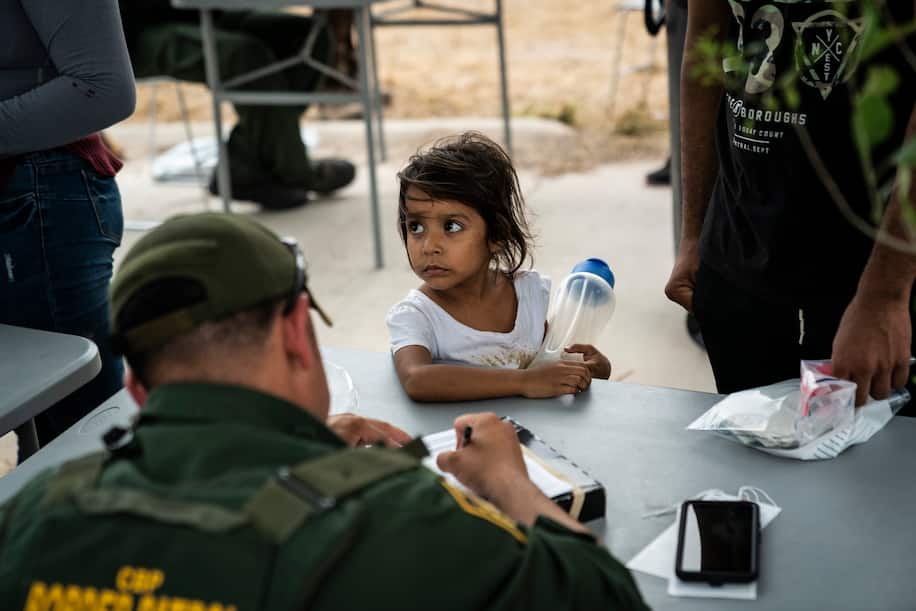
Immigrant families wait in May 2019 in Los Ebanos, Tex., to be searched and taken to a U.S. Border Patrol station after they were caught illegally crossing into the United States from Mexico. Credit: Jabin Botsford/The Washington Post, October 23, 2020


“Suffer little children, and forbid them not, to come unto me: for of such is the kingdom of heaven.” —Matthew 19:14
 

You put them in cages
    and arm their enemies with AK47s
You take away their food
   and say that it is for their own good
You dirty their air and water
   and point to it as progress
You make their world uninhabitable
   and call their cries a hoax
You let your police
   murder them in their beds
   and say they deserved it
You punish their governors
   for standing up for them
You take away their families’ health insurance
   and say it’s in service of freedom
You beat them in the streets
   because they challenge your authority
You promise them relief
   and present it to the rich
You insult their allies
   and sell out their friends
You sit by as they die of a dread disease
  saying it will just... go away
You defile and debase
   the halls of their government
   with petty criminals and yes men
You make their lives less sane, less safe, and less free
 
You think that their God is sleeping
   do not be deceived
God will bring about his justice
   through the least of things
Including teenage TikTokers
               small dollar donations
                                absentee ballots
                                               and subpoenas.
 

Julie Kramer is a molecular biologist, lay minister, marketer, and mom of three teenagers living in Madison, Wisconsin.  In 2012, she made the unforeseen and disconcerting discovery that she is also a poet. Her themes include family, religion, #me too, and current events. She has had previous work published in the Journal of Women and Religion, and the Wisconsin UCC Conference newsletter.

Tuesday, September 22, 2020

CUSP OF WHAT COMES NEXT

by Annie Stenzel


The Bay Bridge and San Francisco skyline, seen from Treasure Island, are barely visible through Sept. 11’s hazy air because of smoke from the state’s wildfires.Photo: Nick Otto / Special to The San Francisco Chronicle, September 19, 2020


Avert your eyes. That window frames a post-apocalyptic sky. Standard issue.
Darkness at 9:00 a.m. Six months into one cataclysm; three-plus weeks into
another. Make no joke involving sword, famine, or beasts from the wild.

Solace is scarce. Mental shelves looted of stock a person needs for survival.
Inventory now includes next to no patience. Scant fortitude. Very little
good cheer. How to re-order, regenerate, when the supply-chain is depleted?

Impossible not to think the worst. You sketch a picture captioned, “The End Times
Loom.” Remembered images from other horror stories crush barriers hastily
built to keep reality out. Reptile brain advises flight, because

how could one even begin to fight such an enemy? We are the tiny creatures
around which ash swirls wildly in our inescapable globe. All those prior
chances to live and learn; to change the course of our headlong tumble

into climate chaos. Fifty-eight years since Silent Spring. Fourteen years beyond
An Inconvenient Truth. And us with two hands still over our eyes, two
over our ears and our merry mouths declaiming, “Move along! Nothing to see here.”


Annie Stenzel was born in Illinois, but has lived on both coasts of the U.S. and on other continents at various times in her life. Her book-length collection is The First Home Air After Absence (Big Table Publishing, 2017). Her poems appear in print and online journals in the U.S. and the U.K., from Ambit to Willawaw Journal with stops at Chestnut Review, Gargoyle, Gone Lawn, On the Seawall, Psaltery & Lyre, SWWIM, The Ekphrastic Review, and The Lake, among others. A poetry editor for the online journals Right Hand Pointing and West Trestle Review, she currently lives within sight of the San Francisco Bay.

Tuesday, September 01, 2020

KYOTO PROTOCOL

by Katherine Williams


Even in August there is now wildfire.
In spring, rains will take what remains.
Kyoto calls us from bygone times.
Hearing Kyoto, everyone stops and turns.
The fires are a small state now.
Cuckoo’s eggs roast in foreign nests.
Cry for help, cry for mercy.
I scan the river, a trickle on pavement.
Long ago we were warned.
For one hundred years we flew into the sun—
Kyoto, we did not stop and turn in time.


Author's Note: The poem is a haiku acrostic, with the words of Basho forming the first word of each line of the poem.


Katherine Williams has published four chapbooks and read at venues from the L.A. Poetry Festival to the College of Charleston. A Pushcart nominee, her poems appear in Spillway, Projector, Diagram, Measure, and elsewhere. She is a retired biomedical research technician living on James Island, SC, with her husband, poet Richard Garcia, and their dog, Max.

Wednesday, August 26, 2020

WHAT WE DON'T TALK ABOUT WHEN WE TALK ABOUT THE FUTURE

by George Salamon


“Installation 3, Lance-tooth Crosscut Saw” by David Ellingsen.

Daily the inhabitable world gets
Smaller by the length of a wheat field,
Soon millions will make do with
The corner of a bed, scrape by and endure,
Dream of guard dogs betraying the master.


George Salamon has endured one convention but is not sure he can do two. He lives in St. Louis, MO.

WHEN IS THE CARIBOU CALVING SEASON?

by Xander Balwit


As the Trump administration edges closer to opening up oil and gas drilling in Alaska’s Arctic National Wildlife Refuge, Gwich’in communities are taking action. Within a day, the Gwich’in Tribal Council based in Inuvik and the Vuntut Gwich’in First Nation (VGFN) in Old Crow had issued a joint statement arguing that the decision was “a result of a rushed and inadequate environmental review process.”… The refuge, 30,500 square miles stretched along the Alaska-Yukon border, has been under US federal protection since 1960 after decades of campaigning on the part of environmentalists and Indigenous communities. It’s home to polar bears, wolves, and dozens of species of birds. It also serves as the calving grounds for caribou in Canada’s Arctic. —Cabin Radio, August 24, 2020


I do not know when the caribou calves
Untangle their legs and rise to canvass
The serpentine glacier rivers of the
The Alaskan coastal plain for the first time

An advocate says that any oil company who dares to drill
Could face “reputational risks.”
I do not know if there a season in which insatiable capitalists
Consider their reputations

It is in the spring, that the Porcupine Caribou calves
Are coaxed into being by the cold breeze
Off the ice of the Arctic Ocean,
Just one in four evading accidents
and arriving into adulthood

The fingers of caribou antlers extend above them
Extolling the immensity of wild Yukon mountains
While the fingers of T***p Administration reach
Below their hooves and extract
that which they should not

The seasons in the Alaskan Arctic Refuge are as distinctive
as the creatures roving it
Greed knows no season
although it too seeks greener pastures


Xander Balwit is a student of philosophy and German in Portland, Oregon. Her poetry and writing are often informed by her indelible passion for nature and the many marvelous creatures that dazzle and perplex us.

Tuesday, July 28, 2020

PEBBLE MINE / SOCKEYE SPEAKS

by Pepper Trail


Spawning Sockeye Salmon, Lake, a photograph by Nick Hall at fineartamerica. A male sockeye salmon (Oncorhynchus nerka) catches its breath after stranding itself in very shallow water, Hanson Creek, Lake Aleknagik, Bristol Bay, Alaska, USA 4th August 2008. 


     T***p officials concluded Friday that a proposed gold and copper mine in Alaska—which would be the largest in North America—would not pose serious environmental risks, a sharp reversal from a finding by the Obama administration that it would permanently harm the region’s prized sockeye salmon.

     The official about-face regarding the bitterly contested project epitomizes the whiplash that has come to define environmental policy under President Trump, who has methodically dismantled many of his predecessor’s actions on climate change, conservation and pollution.
     A final environmental analysis issued Friday by the U.S. Army Corps of Engineers found that Pebble Mine—which targets a deposit of gold, copper and other minerals worth up to $500 billion —“would not be expected to have a measurable effect on fish numbers” in the Bristol Bay watershed, which supports the world’s largest sockeye salmon fishery. The Washington Post, July 25, 2020


My sisters, we are too many
The gift that we give, that we are
Is too generous
The rhythm of our lives, our faithful renewal
Is too reliable

To be valuable, we must be scarce
To be scarce, we must be destroyed
We will be destroyed

The gold, the copper
(You remember, that thin metal taste
      upon your lips in the sweet water)
That is scarce
That is valuable
For that, the earth will be moved
The mountains cut apart
The rivers choked in their beds

The gold, the copper
That can be taken, locked up, sold
Each gram worth more, until all is gone
Leaving nothing but the residue
The pure residue  -
"Money"

With that money, someday
It may be possible for the few
The very few
To buy a few ounces of our flesh
Our wild flesh

Nothing like it in the world, they will say

Nothing like it left in the world


Pepper Trail is a poet and naturalist based in Ashland, Oregon. His poetry has appeared in Rattle, Atlanta Review, Spillway, Kyoto Journal, Cascadia Review, and other publications, and has been nominated for Pushcart and Best of the Net awards. His collection Cascade-Siskiyou was a finalist for the 2016 Oregon Book Award in Poetry.

Saturday, May 09, 2020

SURVIVAL MATTERS

by John W. Steele  


The human cost of the climate crisis will hit harder, wider and sooner than previously believed, according to a study that shows a billion people will either be displaced or forced to endure insufferable heat for every additional 1C rise in the global temperature. —The Guardian, May 5, 2020. Photograph: An Indian farmer walks across the bed of a pond that has dried out during a water crisis. Credit: Sanjay Kanojia/AFP via Getty Images


Give us a pandemic or a war.
They bring out the best and worst of us.
Survival’s what we’re made for. Give us more.

Set the world on fire, let it roar.
We’ll find a way to put it out, no fuss,
then wrangle a pandemic or a war.

When the oceans breach suburban shores
watch what we do to save the upper crust.
Survival’s what we’re made for. Bring on more.

As for the slow creep of global warming
let science-based predictions gather dust.
We don’t want a pandemic or a war

to wake us up to what’s worth fighting for.
Renouncing fossil fuels would bankrupt us.
Survival’s what we’re made for, nothing more.

Our threatened habitats must be ignored.
Wall Street greed is where we place our trust.
Don’t give us a pandemic or a war.
Bottom line, we’re done for. And we want more. 


John W. Steele is a psychologist, yoga teacher, assistant editor of Think: A Journal of Poetry, Fiction and Essays, and graduate of the MFA Poetry Program at Western Colorado University, where he studied with Julie Kane, Ernest Hilbert and David Rothman. His poetry has appeared or is forthcoming in Amethyst Review, Boulder Weekly, Blue Unicorn, Colorado Sun, Copperfield Review, Heron Clan Anthology, IthacaLit, The Lyric, Mountains Talking, New Verse News, The Orchards, Society of Classical Poets, Urthona Journal of Buddhism and the Arts, and Verse-Virtual. He was nominated for a Pushcart prize, won The Lyric’s 2017 Fall Quarterly Award, won an award in the Soul-Making Keats Literary Competition, and was awarded Special Recognition in the 2019 Helen Schaible International Sonnet Contest. His book reviews have appeared in Cha: An Asian Literary Journal, and Raintown Review. 

Tuesday, February 18, 2020

SPILLED WATERCOLORS

by Diane Elayne Dees


Tweeted by NASA astronaut Jessica Meir from the International Space Station.


From space, the aqua, cream, azure, and cerulean
appear as if blended by a master painter
with an eye for serenity and expansion. I imagine
a second painting, this one bright, yet soft,
with puffs of spoonbill pink and splashes
of sea turtle green streaked across a peaceful
background of bunting indigo. From space,
the Louisiana delta is an impressionist’s dream
of water and feathers and the reflections
of a stippled sky. Up close, the picture tears
at the edges as the coastline rapidly recedes.
The Rusty Blackbird, black bear and Great Blue
fade behind a foreground of erosion and loss.
From space, the watercolors spill a dream-like
beauty onto a canvas teeming with life,
while the landscape shifts precariously,
altering the perspective forever.


Diane Elayne Dees has two chapbooks forthcoming. Her microchap Beach Days is available for download and folding from Origami Poems Project. Diane also publishes Women Who Serve, a blog that delivers news and commentary on women’s professional tennis throughout the world.

THE ANTARCTICA BEAUTY PAGEANT

by Christopher Woods


Temperature in Antarctica soars to near 70 degrees, appearing to topple continental record set days earlier. —Headline in The Washington Post, February 14, 2020


Has fewer contestants this year.
Girls from every continent once competed
Before the heat became too intense.
No more bikini strut, wet tee shirt parade.
Now just a few stagger about in a white furnace
Where the fevered winds that killed the penguins
Blow incessantly across the bones of elephant seals.


Christopher Woods is a writer and photographer who lives in Chappell Hill, Texas. He has published the novel The Dream Patch, the prose collection Under A Riverbed Sky, and a book of stage monologues for actors, Heart Speak. His photographs can be seen in his gallery. His photography prompt book for writers From Vision To Text is forthcoming from Propertius Press.

Friday, January 24, 2020

JULIANA V. UNITED STATES

by Pepper Trail


Twenty-one children brought a lawsuit arguing that the government needs to act on climate change. A federal court dismissed it. —The Atlantic, January 22, 2020. Photo: Kelsey Juliana, a lead plaintiff in the case arguing that the federal government must act on climate change, outside the Supreme Court. (KEVIN LAMARQUE / REUTERS)


Plaintiffs cannot identify any injury to a concrete and particularized legally protected interest because their grievance is universally shared and generalized.  —U.S. Department of Justice

Seeking to quash this suit, the government bluntly insists that it has the absolute and unreviewable power to destroy the Nation – U.S. District Court Judge Josephine L. Staton, in dissent


The problem, dear children, is—
            causing universal disaster is not against the law

The government, indeed, has made a strong case to the contrary—
            that it is our most characteristic activity

Every tree that grows, bird that flies, fish that swims
Every drop of rain, every acre of ground, every river flowing—
            come on, you know this–is for us

And so we cut and cleared, emptied the sky and sea
Harvested the rain, plowed and burned, dammed and drained –
            the technical term is Stewardship—everything
         
All the while thinking … well, there must be more        
            somewhere

Dear children, the court admits some sympathy for your situation—
            you chose a most unfortunate time to be born

But that does not change the facts of the case
Destroying the planet has always been a basic human right—
            a precedent this court must respect

Therefore, we hereby declare and affirm that we—
            in conjunction with all judicial and political authorities worldwide—
            deny your misguided attempt to save the world

Case dismissed


Pepper Trail is a poet and naturalist based in Ashland, Oregon. His poetry has appeared in Rattle, Atlanta Review, Spillway, Kyoto Journal, Cascadia Review, and other publications, and has been nominated for Pushcart and Best of the Net awards. His collection Cascade-Siskiyou was a finalist for the 2016 Oregon Book Award in Poetry.

Tuesday, January 14, 2020

ECLIPSE

by Gail Goepfert


Thick plumes of smoke rise from bush fires on the coast of East Gippsland in Victoria, Australia, on Saturday. (Australian Maritime Safety Authority/Reuters via The Washington Post, January 5, 2020)


Fog out the window. Low-
slung and grayed,
eddying
near the ground.
Veiling what will come of this day.

Waken, light summons.

©

I read snippets—
weigh want and need
to know
against my belly’s grit.

Bulletins. Updates.

Winter. Closed in.
No sound of the wire-buzz,
outside—safety and beauty de-
flowered by a string of high-
voltage lines, transmits
news that’s breaking.

©

Nothing gray about cancer.

I shouldn’t be recycling
store receipts—paper
with Bisphenol A, a cancer-
causing chemical that contaminates
what China recycles
of “foreign trash”—
yang laji.

How to recycle the unrecyclable.

©

Australian bushfires
beyond beyond.
A smoke cloud
discernible by satellite vaster
than our continent.

The ache of witness—
beneath plumes and plumes
of orange haze, droves
of charred carcasses, kangaroo
and koala, slumped
on the roadsides.

People wobble
on their heels in the sand,
imprint the beaches
of retreat and escape—
lungs’ bronchi robbed
of oxygen.

Who cannot succumb
to the fire-slaughter?
The news of it?

Some still blind-eyed
though they see.

©

At home, in the land
of the free, I skim word
of the playground bravado
vis-à-vis the erasure of Iran’s
Soleimani as if erasure
will cure anything.

Tarzan-­ian inflated chests
playing Red Rover
with weapons
forgetting others left to spin
on the merry-go-round.

He should have been killed years ago.

Promises of hard revenge,
the boasts of bullies.

You started it. We will end it.

©

Will anyone be left to weep
where the gravediggers bury?

©

Forecast: ashen.


Gail Goepfert, an associate editor at RHINO Poetry, is a Midwest poet and photographer. She has two published books—A Mind on Pain in 2015 and Tapping Roots 2018. Get Up Said the World will appear in 2020 from Červená Barva Press. Recent publications include Kudzu House, Stone Boat, Postcard Poems and Prose Magazine, Bluestem, Open: Journal of Arts and Letters, SWWIM, and Beloit Poetry Journal.

Saturday, December 28, 2019

RAPE OF THE FLOCK

by Janice D. Soderling


President Donald Trump has taken historically unprecedented action to roll back a slew of environmental regulations that protect air, water, land and public health from climate change and fossil fuel pollution. The administration has targeted about 85 environmental rules, according to Harvard Law School’s rollback tracker. … However, the consequences of eliminating these regulations include more premature deaths from pollutants and higher levels of climate change-inducing greenhouse gas emissions, according to research from the NYU Law School. —CNBC, December 24, 2019. Illustration by Victor Juhasz for Rolling Stone.


Higgledy piggledy,
Donald J. T***p
raped Mother Nature
in meadows and parks

till she lay dead with dead
bees and dead sheeple, dead
biodiversity,
dead oligarchs.


Janice D. Soderling is a poet, writer and translator with three poetry chapbooks and another forthcoming in February. All of them include poems that first were published at TheNewVerse.News.

Thursday, December 05, 2019

THE BRING OF DISASTER

by Mark Williams


O Heavenly Father,

It’s me again Austin Baggerly. I cant talk long tonight.
Mom says to say my prayers and get to sleep pronto
cause Dad got me home late. Home to my house
where he used to live but now is just Mom and me
and my box turtle Bradley. But you know that.
Pastor Crandall says you know everything there is.
He says You are Omniportant. Everyother Sunday Dad
takes me to praise You at Sudden Glory Fellowship.
Pastor Crandall says You made our President President.
Pastor Crandall says our President is The Chosen One.
Mom says that The Chosen One destroyed her marriage
and that if you chose him then you must want
to take everyone to the bring of disaster.
Why do You want to bring us there? For instants why
did You choose someone who does not care
if the world gets too hot for us to live? Where will we go?
And why did You pick someone who lets fires
burn up all the trees and forest animals
that You made in the Beginning? Plus why
is it OK to let people buy guns to shoot me in school?
Mom says the President wants to build a wall
to keep out poor people so they can stay poor
in there poor countrys? Why would You God
want to keep people poor in poor countrys
when You cared for the birds in the air
before the President let them burn up in the forests?
Maybe You chose someone to bring us to disaster
so that next time when it is our turn to choose
we will choose someone who stops us
before going all the way in to it. But in my pinion
You are cutting it awful close. Dear God,
when I turn ten will all this make sense? I hope so.
Sometimes I wish I could pull in my head like Bradley.

                                                            Amen


Mark Williams lives in Evansville, Indiana. His poems have appeared in The Hudson Review, The Southern Review, Rattle, Nimrod, New Ohio Review, and The American Journal of Poetry. His poems in response to the current administration have appeared in Poets Reading the News, Writers Resist, and Tuck Magazine. This is his fourth appearance in TheNewVerse.News.

Saturday, November 30, 2019

WHEN WE ARE THANKFUL

by Tricia Knoll


“‘Sleepwalking toward climate catastrophe:’ World must slash emissions immediately, UN report says.” —USA TODAY, November 26, 2019. Photo: Lightning is seen over the Atlantic Ocean on Sept. 4 as Hurricane Dorian approaches Carolina Beach, N.C. (Elijah Nouvelage/For The Washington Post)


We know there is only today
and that yesterday failed
to stop the planet’s demise.

That egos balloon up huge
and denying. Storms twirl
on gusts and blusters.

Whoever named the Black
Friday meant those days
after the forgetting,

the pivoting on spindles
as if the sunrise will always
bring on the chitter of chickadees.

When we are thankful,
we own the worry,
plumb the despair and feel

that today we are breathing.
That today we are breathing
and for this gentle gratitude.


Tricia Knoll acknowledges the irony of the bleak U.N. climate change report coming out during the Thanksgiving week in the United States. With forecasts of a polar bomb on the way, she buckles her boots. She is an eco-poet who lives in Vermont.

Friday, November 15, 2019

EVENING IN VENICE

by Allene Nichols


The water is rising.
The waiter with the red-checked shirt,
eyes darting, is ready to run.
But there is time for red wine,

baccala’ mantecata, and tiramisu.
There is time as the water
laps at our feet
and the sky scowls.

The boat shies nervously against the pier.
Our glasses clink too loudly.
Our laughter echoes
high and clear
like struck porcelain.

We’ve wept over the skeletons
of churches and museums.
St. Mark’s floor is covered
with mud. The Doge’s palace
is listing dangerously.

The statues, paintings, and friezes
are safe in Rome,
But we will never step here again.
No weeping now, though our cheeks are wet
and our eyes bright.

Clowns, wits, and bon vivants
do their best,
but their eyes drift back
to the sinking buildings
and a shadow passes
over their faces.

The air is thick with mosquitos.
Our clothing clings to us.
The smell of decay,
Held at bay for centuries,
creeps in from the alleyways.
The city, empty except for us,
echoes eerily.

All is lost and nothing is lost.
The world will go on.
The waiter cranks an old phonograph.
Vivaldi strains against the silence,
almost lost in it.

We dance as the fish swim at our ankles.
The sun glowers on the horizon.


Allene Nichols lives in Dallas, Texas, where she teaches at Richland College and at the University of Texas at Dallas. Her poetry has appeared in many journals and anthologies including Veils, Halos, and Shackles, and Impossible Archetype. Her poem, “Queer Salt,” was a 2017 winner of OUTSpoken’s creative writing contest.

Tuesday, October 29, 2019

DARK OF THE MOON, HEAT OF THE SUN

by Pepper Trail


“One hundred percent girls,” whispered the biologist, crawling next to the pregnant reptile. “This nest will be 100 percent girls.” As the earth gets hotter, turtle hatchlings worldwide are expected to skew dangerously female, scientists predict, making the animals an unwitting gauge for the warming climate. —The Washington Post, October 22, 2019. Photo: A marine biologist helps a newborn sea turtle reach the sea on Cape Verde’s Boa Vista island. Credit: Danielle Paquette via The Washington Post.


In the dark sea, a greater darkness
An absence of starlight, moving
Then on the wet sand, a stone

Stone into turtle, with gathering of breath
And the climb begins, pull and drag
Against all the weight of earth

Far up the beach, with pause for gasp
The turtle curves wings
Into mittened hands, and digs

For this warmth of nest, the ocean shed
This gush of eggs into the place prepared
Hidden among the grains of sand

Then the lurch, the thrash
The torn-up ground, last concealment
Before the run toward home

At the first break of wave
She lifts head, trailing earthly tears
Rests, breathes full, and flies free

So it has been, the mothers forever
Returning to their mothers’ beach
The fathers waiting in the fathers’ surf

But now, the warmth too warm
The nests send only girls into the sea
Until fathers can be found no more

For long barren years, turtles will swim
Far from the beckoning useless land
Bearing eggs for no generation, the last


Pepper Trail is a poet and naturalist based in Ashland, Oregon. His poetry has appeared in Rattle, Atlanta Review, Spillway, Kyoto Journal, Cascadia Review, and other publications, and has been nominated for Pushcart and Best of the Net awards. His collection Cascade-Siskiyou was a finalist for the 2016 Oregon Book Award in Poetry.

THIS IS HOW WE DO WHAT WE DO NOW

by Alan Catlin


A dead dolphin was found washed ashore in Westerly RI, Oct. 27, 2019. Photo: Zac Perrin, Channel 10 Providence.


Kill things
                 Dolphins
                 Seals
                 Birds
                 Endangered species
                 Separated from parents children
                 Allies

Then we send troops into the country
we betrayed to defend the oil fields


Author’s note: Written after finding a full grown dolphin washed ashore on an offshore island


Alan Catlin has published dozens of chapbooks and full-length books, most recently the chapbook Three Farmers on the Way to a Dance (Presa Press), a series of ekphrastic poems responding to the work of German photographer August Sander who did portraits of Germans before, during, and after both World Wars.

Thursday, October 10, 2019

OCTOBER LIGHT

by Buff Whitman-Bradley


It is quiet now
In the corners
Where dust collects itself
And afternoon light
Relaxes its shoulders
As it prepares
For its daily departure.
All day it has been
Early October
Hot as August or July
And drier than dry—
But we are not fooled.
Look at the leaves
Teasing us
With the faintest hints
Of the russets and golds
And wild vermillions
That soon enough
Will inhabit the snug dwellings
Where their green sister chlorophyll
Has resided
Since the February arrival
Of spring.
Look at the long shadows
Falling across houses and streets
Lounging in parks and playgrounds,
Look at the honeyed light
Sprawling on manicured lawns
And fading gardens.
Feel the air,
Apologetically hot
And promising that this heat,
This spit-thickening dryness,
Will not last much longer,
That the familiar, reassuring chill
Of autumn
Will soon return to our evenings
To herald the arrival
Of the season of heavy rains.
But of course these days
With the climate being systematically mauled
By billionaire carbon-suckers
We can’t be sure
What the coming months
Will have in store for us.
And for that matter
We cannot even count on October
Remaining the October
We have always loved,
That paragon of months,
The crown jewel
In the year’s annular passage,
The golden door
Between summer and winter.
We must struggle and hope,
Defy and resist and disrupt
To defeat those who are ravaging
Our weather and our earth
And replace them
With our kind of folks,
The ones who believe in communities
Of mutual support and nourishment,
The ones who reject profit
As a way to measure human worth,
The ones whose furious spirits take flight
In October light.


Buff Whitman-Bradley's poems have appeared in many print and online journals. His most recent books are To Get Our Bearings in this Wheeling World and Cancer Cantata. With his wife Cynthia, he produced the award-winning documentary film Outside In and, with the MIRC film collective, made the film Por Que Venimos. His interviews with soldiers refusing to fight in Iraq and Afghanistan were made into the book About Face: Military Resisters Turn Against War. He lives in northern California. He podcasts at: thirdactpoems.podbean.com .

Wednesday, October 09, 2019

IN THE NEW CLIMATE

by Elizabeth Kerlikowske


This is what it looks like when national parks are sacrificed for a #borderwall. Footage at Organ Pipe Cactus National Monument via Kevin Dahl, NPCA Arizona Senior Program Manager pic.twitter.com/VE9UKziPzl
— National Parks Conservation Association (@NPCA) October 4, 2019


no need to migrate, so geese fly laps around the county
lake to lake at dawn, louder than garbage trucks.

A friend makes a demon cozy, so she doesn’t always have to face it.
She can know where it is even if she doesn’t know what it is

unlike mosquitos with valises full of Eastern equine encephalitis
come to visit. Swatting lunchmates, even on the face, becomes socially acceptable.

A friend draws stories with her own language of shapes not everyone can read.
That’s okay. Lilacs do not bloom this year; there is a mid-April blizzard.

Fawns come to the door wanting the cat to play.  Children holding hands
walk across a lake of grass. Yard lights never let the trees sleep, not deeply.

A friend grieves deeply and with laughter, at once. She raises monarchs
and tonight the government will poison them as well as mosquitos.

On her balcony flickers and doves fight squirrels and raccoons for seeds
and a little honey.  Tomorrow the butterfly rain.


Elizabeth Kerlikowske most recent book is Art Speaks with painter Mary Hatch. She tries to live outside as much as possible while owning a house.

Tuesday, October 08, 2019

WHITE HOUSE MENU, OCTOBER 8, 2019

by Pepper Trail


Amuse bouche: honey-soaked Smyrna fig with bitter Kurds

Soup:  bisque of watered-down regulations, topped with nutmeg and shredded tax
            returns

Appetizer: bruschetta of tariff-marinated soybeans and pork belly, dusted with
                     artisanal Kentucky coal

Salad:  wilted checks and balances, arugula, and raw ego, with a drizzle of raspberry—
            infused Saudi sweet light crude

Entrée:  tenderloin Republican reputation, flash-seared and bloody in the center,
                served with blanched asparagus wrapped in subpoena parchment

Sorbet:   whipped frozen tears of Guatemalan children, with savor of Miller lemon

Dessert:  half-baked crumble of sour grapes, drowned in a simple syrup of self-pity


Wine List:  Diet Coke


Pepper Trail is a poet and naturalist based in Ashland, Oregon. His poetry has appeared in Rattle, Atlanta Review, Spillway, Kyoto Journal, Cascadia Review, and other publications, and has been nominated for Pushcart and Best of the Net awards. His collection Cascade-Siskiyou was a finalist for the 2016 Oregon Book Award in Poetry.