Guidelines


Submission Guidelines: Send 1-3 unpublished poems in the body of an email (NO ATTACHMENTS) to nvneditor[at]gmail.com. No simultaneous submissions. Use "Verse News Submission" as the subject line. Send a brief bio. No payment. Authors retain all rights after 1st-time appearance here. Scroll down the right sidebar for the fine print.
Showing posts with label mothers. Show all posts

Tuesday, February 25, 2025

LOSING MY MOTHERS

by Nancy Fitz-Hugh Meneely


Detail of a Boomf greeting card.


I'm mother to a mother and the mother
she is married to. I love their way with Lilly, 
child whose mysteries will not be plumbed. 
The picture of her father shows him 
blond and serious at 8 
and that is all we know of him except that 
Lilly's smarter than her mothers can account for
and given to a fear of dark and a ready shame
they do not suffer in themselves.
But they are gorgeous in their mothering.
Asked “How Are You Unique?”, the daughter writes
I HAVE TWO MOMS. All caps.
 
I love these mothers, too, so much I miss them
when we’ve been apart a week. I am ridiculous.
They live five miles away.
 
And now I contemplate a brute and sudden loss.
I picture Jackboots hauling, shackling them
in such a way they cannot touch.
I see their neighbor, welcoming with cookies last July,
now watching from an upstairs room,
bitter with contrition, fearful for herself.
 
I’m powerless against the monstrous threats.
My terror, even loneliness, begins ahead of time.
Perhaps I am ridiculous, but if I lose my mothers
and their child, I'lI will myself
to swallow memory
or die of it.
 

Nancy Fitz-Hugh Meneely's first book Letter from Italy 1944 was noted by the Hartford Courant as one of thirteen important books published by Connecticut writers in 2013. It provided the libretto for an oratorio of the same name which was performed by Connecticut chorales and symphony orchestras. Her second book Simple Absence (Antrim House) was nominated for The National Book Award. 

Tuesday, April 09, 2024

THE NEIGHBOR

by Corley Norman


It is near twilight and the man next door is mowing his yard.
I am fighting my impulse to go over there, pull him away and shout
What are you doing? No one mows at night!
It defies all common sense! Stop right now!
 
I would catch him off-guard, unnerve him with my unneighborly outburst.
I wouldn’t be mad enough to shoot him or anything. I don't own a gun.
But I'm pretty sure I wouldn't shoot him even if I did own a gun.
I suddenly realize he might own a gun and enjoy shooting.
 
What is on my mind is that today many mothers were crying
As they held signs and yearned to be heard by men whose deafness did not know sign language.
Mothers wailing with the cries of their crooked-toothed, messy-haired children:
Hear us! Help us! Like me, they did not want to be shot.
 
Maybe their sounds just ricocheted like bullets off the fine marble walls of the Capitol.
Maybe it felt wise and just to the quasi-lawmakers to tune out the inconvenient citizenry.
Maybe they were thinking of things they had to do. Urgent things.
Like: I think I’ll mow the yard this weekend. 


Corley Norman is a writer living in Nashville , Tennessee. She has spent most of her life in the field of dramatic literature where she picked the wildflowers of Shakespeare to inspire her.She has an MFA from the Univ. of Tennessee.

Saturday, February 24, 2024

IMAGINE

by Steven Croft


AI-generated graphic for The New Verse News by Shutterstock


If instead of munitions, we could send Ukraine a spring
without war,

see Russian soldiers march off singing, "There is No Rank
Higher Than a Soldier's Mother," as mothers

who love them call them back home,

As the Dnieper thaws, let Ukraine beat its swords
into ploughshares for its golden fields of wheat, the farmers
no longer molested by fighter jets,

Let its cities be beautiful European cities again, free of
shelled and crumbling buildings, with

vibrant commerce and carefree nightlife, let people
sit idly in cafes, reaching calmly for coffee cup, newspaper,

its list of dead gone – for now,

Unwind stacked car graveyards of burnt-out husks,
bomb-twisted chassis, put them new again on roads
unpocked by explosion,

Let the countryside host tortoiseshell butterflies and roe deer,
the sound of bees visiting flowers, instead of armies
of tanks,

Let unstartled horses and cattle whip their tails idly in pastures
behind mended fences,

Let Ukraine part the dark curtain of daily anticipatory death,
box up the war strategy, the screams of wounded and dying, grief
of the living, tape them shut—for now,

Send home its stretched-thin, worn-out army of war,

Let its President wear a suit again, let his face cast off its war
fatigue, his body the green battle fatigues,

All over Ukraine let bells of peace and respite ring from the shingled
belltowers of wooden churches, let them dance the hopak

with fevered joy.


Steven Croft lives on a barrier island off the coast of Georgia. His latest chapbook is At Home with the Dreamlike Earth (The Poetry Box, December 2023). His work has appeared in Willawaw JournalSan Pedro River ReviewSo It GoesAnti-Heroin ChicThe New Verse News, and other places, and has been nominated for the Pushcart Prize and Best of the Net.

Saturday, March 04, 2023

WHAT PEOPLE MEAN WHEN THEY SAY LATER

by Devon Balwit


The headlines scream of war and child labor,
the ways humans brutalize each other. The authors
hope to shame us out of apathy. Near
their blare gapes a book with a cow on the cover.
Her long-lashed eyes make this reader hunger
to press my face to hers. She’s been slaughtered,
one of tens of millions every year, numbers
too large to render back into individual creatures,
a fact, with our favorite and customary foods, we prefer
to ignore. We ought care more for human mothers
some argue—for farmers and workers, for the poor,
who cannot afford to eat ethically. Later
we can worry about animal welfare. Later
my friends, is a common synonym for never.


Devon Balwit walks in all weather. Her most recent collection is Spirit Spout [Nixes Mate Books, 2023].

Tuesday, November 29, 2022

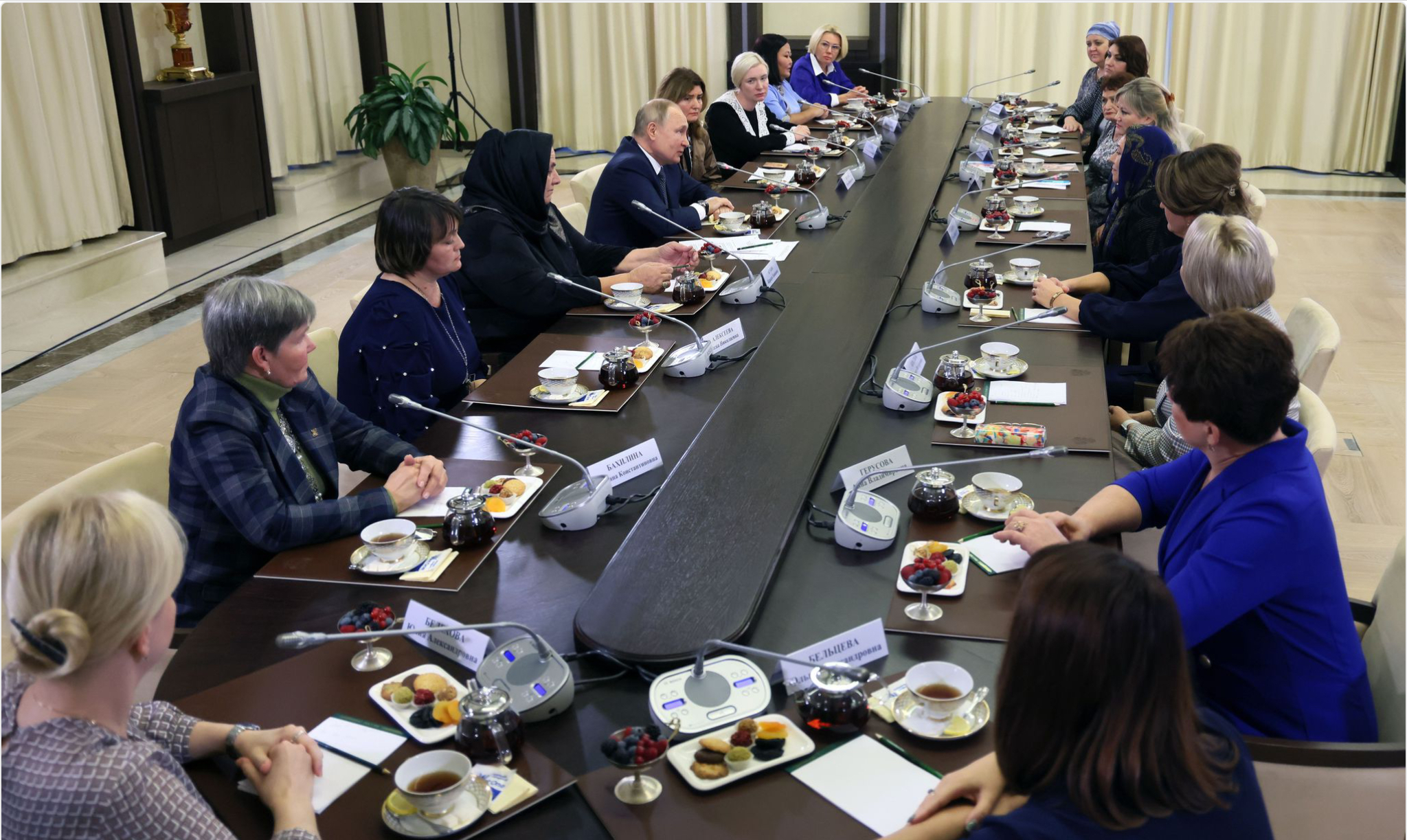
RUSSIAN MOTHER’S DAY MESSAGE

by Bruce Bennett


As anger over the drawn-out invasion simmers in Russia, President Vladimir Putin on Friday held his first public meeting of the nine-month-long war with mothers of soldiers who had been fighting in Ukraine, a move likely aimed at quelling discontent. In a clip broadcast by Russian state media, Putin is seen sitting down with a group of women around a table adorned with ornate tea cups and fresh berries for a talk coinciding with Russian Mother’s Day. “I want you to know that I personally, the entire leadership of the country, we share your pain,” Putin said, pausing and clearing his throat. “We understand that nothing can replace the loss of a son, a child, especially for the mother, to whom we all owe the birth.” —The Washington Post, November 26, 2022


“I share your pain,” says Vlad the Great 

to mothers grieving loss. 

He reassures them that the State 

appreciates the cross 


They have to bear. To lose a son 

“that nothing can replace….” 

He’s clearly moved. When he is done 

there’s nothing on his face 


To indicate he has a clue 

this has to do with him, 

or that there’s something he could do 

to alter what the grim 


And vicious plans of godless foes 

have caused and cruelly wrought. 

Grim faces testify to woes 

that reinforce his thought 


And make it clear he’s in control. 

The Dark Night’s not near dawn. 

This glib ghost of the Russian Soul 

decrees the War goes on. 


Bruce Bennett is the author of ten books of poetry and more than thirty poetry chapbooks. His most recent full-length book is Just Another Day in Just Our Town: Poems New and Selected, 2000-2016 (Orchises Press, 2017). From 1973 until his retirement in 2014, he taught Literature and Creative Writing at Wells College, and is now Emeritus Professor of English. In 2012 he was awarded a Pushcart Prize. He predicted what we were in for in his November 2016 YouTube video, The Donald Trump of the Republic.


Sunday, May 22, 2022

UKRAINE HAIKU

by G. R. Kramer


On May 20, Dmytro Kozatskyi, a soldier of the #Azov Regiment posted his photos of the defenders of #Mariupol, calling on the world media and those who can help to distribute them. "Well, that's all. Thank you for the shelter; Azovstal is the place of my death and life. See you".


all across the road
blood of butchered                  root in cracks
seed of black spring             bloom
 
weapon
 
below white flowers
we lie with the fray of bees
nowhere people are
 
child
 
mir meant peace to both
when trees leafed over laughter
now           stumps             stand    their     ground
 
      explosive
 
see how the flies help
keep down             the odor of rot
old men in ditches
 
witness
 
may the good endure
tanks missiles sunflowers plows
may the lost                    return
 
annihilate
 
family        stained             red
parlor tatters                      open sky
empty sniper eyes
 
artillery
 
war machines rust out
wind blown blood loam covers steppe
lily bulbs open
 
memory
 
when do nations live
empires feed         death to their dead
human history
 
for get       ting
 
mothers of soldiers
whose blood drains to the black sea
mothers of soldiers

 
G. R. Kramer grew up in Canada, Kenya and the U.S., the child of refugees from fascism and communism. A lawyer by vocation, his passion for writing poetry has rekindled in late middle-age. His first poetry chapbook is forthcoming from Finish Line Press and he has published in numerous journals. 

Saturday, March 12, 2022

WHAT MOTHERS KNOW ABOUT WAR

a pantoum by Sandra Anfang


"I’ve never liked my daughter’s stroller. I put it on the baby registry without trying it in person and when it arrived the dimensions felt wrong. The button that was supposed to facilitate one-handed folding did not facilitate one-handed folding. But over the weekend I saw a photograph of this stroller—the same style and color—sitting on the platform of a Polish train station, and this was the thing that finally obliterated what was left of my journalistic steel and made me sob about Ukraine. More than a million Ukrainian refugees have now poured into neighboring Poland, most of them women and children. When Polish mothers learned of this, it seems, they went to the railway stations and border crossings where the refugees were arriving, and they began dropping off baby strollers. A photojournalist [Francesco Malavolta/AP] covering the conflict snapped a picture of seven empty ones waiting at the Przemysl Glowny station [at the border crossing in Medyka, Poland]." —Monica Hesse, The Washington Post, March 9, 2022


I never liked my daughter’s stroller
I bought it unseen from an online store
when the box arrived I opened it and cried   
somehow the dimensions felt all wrong 
 
I bought it unseen from an online store
gave it to the family across the square
somehow the dimensions felt all wrong
today I found it—same model, same make
 
I gave it to the family across the square
I felt ungrateful for I had so much
today I found it—same model, same make 
abandoned with others at the Medyka station
 
I felt ungrateful for I had so much
the sight of it triggered deep despair
abandoned with others at the Medyka station
waiting for refugees’ lives to begin 
 
the sight of it triggered deep despair
as we welcome the mothers—one million and more
waiting for their lives to begin again
storming the border, babes at their breasts
 
As we welcome the mothers—one million and more
who pour into Poland on tides of tears
storming the border, babes at their breasts
all that they own strapped like mail to their chests
 
They pour into Poland on tides of tears
packed strollers await them, fit for a prince
infants strapped like mail to their chests
piled blankets and diapers to warm their new lives
 
Packed strollers await them, fit for a prince
refugees flow in wearing thin cloth coats
piled blankets and diapers to warm their new lives
symbiotic survival—mothers’ hard truth of war
 
Refugees flow in wearing thin cloth coats
after heat was shut off, the water lines cut
symbiotic survival—mothers’ hard truth of war
starved by the greed of the Russian state
 
after heat was shut off, the water lines cut
women were forced to flee and to hide
starved by the greed of the Russian state
victims of men’s urges, tossed like ashes
 
women were forced to flee and to hide
and after their flight, raped and tossed again
victims of men’s urges, tossed like ashes
their bodies are beachheads where battles are won
 
after their flight, raped and tossed again
their bodies as shelter, as instruments of war
their bodies are beachheads where battles are won
the things we don’t mention that all mothers know
 
their bodies as shelter, as instruments of war
I never liked my daughter’s stroller
the things we don’t mention that all mothers know
when the box arrived, I opened it and cried
 

Sandra Anfang is a much-published poet, poetry teacher, and visual artist who lives in Northern California. She's been hosting a monthly poetry series since 2013. She walks and writes daily to process her overconsumption of news stories. Her grandparents hailed from Minsk and Budapest, and she feels a deep connection to Ukraine and Eastern Europe.

Saturday, June 06, 2020

LAST DAYS OF FREEDOM

by Mickey J. Corrigan


What about the women who think
they are shore birds in startled flight
over the unruffled sand, eggs nestled
in jagged rock crevices slap-fed
by the bathe and bash sea?

Don't blame the shoreline, comfortable
in the lap and suckle, the eating away
the sloping of high grass dunes
hillcrests ever flattened by time
and growth spurts of starlit cities.

What about the clotted clapboard graves
narrow streets, neighborhoods blissful
in their ignorance, their pancake morning
sameness, their white cream frosting
smothering rich cakes of desire?

Don't blame the strong men barging
onto the ark, boarding forcefully
pillage in their knife eyes, hammy fists
full of weaponry, double strapped bullets
draped across broad hairy chests.

What about the meat-and-potato talk
in the pubs and pastel living rooms
all our fears shrunk to shadows
blued under hot white moons
gibboning in a lurching black?

Don't blame the suck and slur of the tide
days trailing by, forgetting themselves
in the flutterkick to a shared illusion
spoon-fed to us in flying dreams

the windswept sky like a blue door
that will swing shut behind us.


Originally from Boston, Mickey J. Corrigan writes Florida noir with a dark humor. Novels include  Project XX about a school shooting (Salt Publishing, UK, 2017) and What I Did for Love a spoof of Lolita (Bloodhound Books, 2019). Kelsay Books recently published the poetry chapbook the disappearing self

Tuesday, October 29, 2019

DARK OF THE MOON, HEAT OF THE SUN

by Pepper Trail


“One hundred percent girls,” whispered the biologist, crawling next to the pregnant reptile. “This nest will be 100 percent girls.” As the earth gets hotter, turtle hatchlings worldwide are expected to skew dangerously female, scientists predict, making the animals an unwitting gauge for the warming climate. —The Washington Post, October 22, 2019. Photo: A marine biologist helps a newborn sea turtle reach the sea on Cape Verde’s Boa Vista island. Credit: Danielle Paquette via The Washington Post.


In the dark sea, a greater darkness
An absence of starlight, moving
Then on the wet sand, a stone

Stone into turtle, with gathering of breath
And the climb begins, pull and drag
Against all the weight of earth

Far up the beach, with pause for gasp
The turtle curves wings
Into mittened hands, and digs

For this warmth of nest, the ocean shed
This gush of eggs into the place prepared
Hidden among the grains of sand

Then the lurch, the thrash
The torn-up ground, last concealment
Before the run toward home

At the first break of wave
She lifts head, trailing earthly tears
Rests, breathes full, and flies free

So it has been, the mothers forever
Returning to their mothers’ beach
The fathers waiting in the fathers’ surf

But now, the warmth too warm
The nests send only girls into the sea
Until fathers can be found no more

For long barren years, turtles will swim
Far from the beckoning useless land
Bearing eggs for no generation, the last


Pepper Trail is a poet and naturalist based in Ashland, Oregon. His poetry has appeared in Rattle, Atlanta Review, Spillway, Kyoto Journal, Cascadia Review, and other publications, and has been nominated for Pushcart and Best of the Net awards. His collection Cascade-Siskiyou was a finalist for the 2016 Oregon Book Award in Poetry.

Saturday, March 23, 2019

APPRECIATION

by Penelope Scambly Schott


W.S. Merwin (1927-2019)Photograph by Tom Sewell / NYT / Redux via The New Yorker


The old men poets are dying
even the ones younger than my father
One by one they are leaving us
leaving their words on the page
their voices on tape
I have no recording anywhere
of my father’s voice
Not even on an answering machine
I can call and recall him over and over
but he will never answer again
Year by year and day by day
the old men poets are leaving us
they who were our fathers in poetry
before we women learned to appreciate
our mothers in poetry, bless them all


Penelope Scambly Schott, author of a novel and several books of poetry, was awarded four New Jersey arts fellowships before moving to Oregon, where her verse biography A is for Anne: Mistress Hutchinson Disturbs the Commonwealth received an Oregon Book Award for Poetry. Several of Penelope’s books and individual poems have won other prizes. Her individual poems have appeared in APR, Georgia Review, Nimrod, and elsewhere.

Sunday, April 16, 2017

MOTHER OF ALL

by Mimi German


Marker Painting "PIETA-2" Black Pieta Ethnic Folk Art Black religious art African


The Mother

of all

Bombs


the

(space)

mother

(space)

of

(space)

ALL

(space)

bombs

The
Mother
of all
bombs

repeated chanted repeated chanted
sung liturgized canonized infantilized eroticized epitomized

into being

a mantra of man

the Mother
of All

Bombs

the mother of ALL bombs

chants the news so many times
that it becomes a thing

this

Mother

of all
Bombs


My
nipples
lactate
blood


tonight
cloaked inside
my Grandmother’s blanket
my mother’s mother,
i write
with mourning sickness
under my fingernails

the taste of burnt skin
inhabits my tongue

my grandmother
had a scar
on her abdomen
a c-section.

my mother
wanted
to enter life
feet first

the Mother
of ALL
Bombs

an
empty
womb
is
bleeding


mother
mother
mother
mother

mother of all
mother of ALL
Mother of ALL

bombs

goes the chant


mother
of dead child
on exploded soil
on Mother Earth
in the Mother Land
in Afghanistan


314,000,000 dollars worth
of
mothers
of
dead children
and
children
with
dead mothers

wrote a poem this morning
about shadows

while

the Mother
of All
Bombs

was chanting itself
into being

there are

no Mothers

of

Bombs


only
men
who
make
bombs
to
drop
them
on
Mothers.


Mimi German is a Queer Poet, Free Radical and an Activist for human rights in Portland, OR.

Sunday, December 04, 2016

TENDING

by Jeremy Thelbert Bryant


BREAKING NEWS: The Army Corps of Engineers said that it would not approve permits for construction of the Dakota Access Pipeline beneath a dammed section of the Missouri River. —The New York Times, DEC. 4, 2016

A mother bird, in the tree my grandfather planted, drops food into babes’ beaks.
How long have mothers tended this world?
A police officer opens hose on a woman protesting pipeline. A piece of her rips away.
How long have women fought for earth and man?
The babes without knowing to be grateful, blindly eat.
Water washes away blood, but dirt and rocks remember.


Jeremy Thelbert Bryant is a poet and a writer of creative nonfiction who lives in Virginia. When he is not teaching English, he is burning incense, listening to music, drinking coffee, and writing. He finds inspiration in the red of cardinals, in the honesty of Frida Kahlo’s artwork, and in the frankness of Tori Amos’ lyrics.

Friday, October 07, 2016

SUFFERING CHRISTA

by Devon Balwit


The artist Edwina Sandys with her sculpture “Christa,” the centerpiece of an exhibition [at New York's Cathedral Church of St. John the Divine] of more than 50 contemporary works that interpret the symbolism associated with the image of Jesus. Credit Hiroko Masuike/The New York Times, October 4, 2016


Nowadays, it’s easy to imagine a suffering Christa—
the mothers of Aleppo, limp children at the breast,
Black mothers in America bent over sons in the road,
the mothers called to school in the wake of a shooter.

Who feels the world’s nails more keenly than the mother,
flesh pierced by the suffering of those she formed and suckled,
side oozing, rib cage unable to rise as her children lose breath?

She hangs between stars and rubble, arms outspread.
Lift her your sponge of vinegar.  Sit vigil.
You do not need to believe, only bear witness.
Better yet, shield the tender bodies of her young.


Devon Balwit is a poet and educator from Portland, OR.  Her poems have found many homes, for which she is grateful.  She welcomes contact from her readers.

Tuesday, January 19, 2016

THE BOOK OF NEMESIS, CHAPTER 2016

by Gilbert Allen


Image source: DonkeyHotey


And He said, I am The Great Candidate.
All the others?
Low energy.
Stop and think for a minute, people.
You really want a GOTUS who looks like that?
This is gonna be huge.
I’ll build a ginormous wall in the desert, and Saddam is gonna pay for it.
He’s history, and I know where his money is.
I’ve got some experience with walls.
And money.
You’ll be the father of many nations, after I smite them into The Stone Age.
You’ll mark all their members with red ties, before you let them out of the rubble.
Have I said you’ll be the mother of many nations, too?
I cherish mothers.
Mothers love me.
Especially Mexican mothers.
Listen, I know how to make deals.
I’ve been making deals for a pretty long time now.
You’re gonna have so many victories you’re gonna get sick of them.
Did anyone ever tell you you look just like Abraham?        
Abraham Lincoln?
Now fall on your face already.


Gilbert Allen's most recent collection of poems is Catma, from Measure Press. A book of short stories, The Final Days of Great American Shopping, is forthcoming from USC Press in April. He lives in Travelers Rest, South Carolina.

Sunday, November 15, 2015

RECOMBINATION

Editor's Note: We are pleased to repost this poem, originally published in TheNewVerse.News on Saturday, August 15, 2015. It is one of our 2015 Pushcart Prize nominees.


RECOMBINATION
by Jim Bartruff


Image source: Collateral Damage


1.

Spurred by the aroma of wheat and lamb,
we had been starving the last hundred miles,
we lathered the horses over steppe and stone,
and before the body of our force had forded
the clearest rivulet we had crossed in a year,
a bustle of water circuiting their gate,
we dammed it with the limbs of the boys
they pushed out to be sacrificed, and delay.
Only the backward ship their decrepitude
into the hills to hide, let strong men die,
and leave their women to hold back the horde.
The white, the broken hairs black shawls tear
from their heads in a show of grieving and pain,
their village merely a smudge of charnel and ruin,
would never amount to half a hand of cordage,
not nearly enough to stake a calf to the grass.
We are feared but we are not amoral.
We killed the idiots as weak for refusing
to rape the children of the unbelievers,
and also the one who stormed the palisade
to get at the girl the king had set aside.
Tomorrow, when we mount and are gone,
the ancients skulking back will have a shame
to eat and little else, though once they awaken,
they'll see we have diluted their waste away,
have given them a purpose to pierce their ache.
By spring next year the rivulet will clear,
and if their golden roof thatch is erased,
there will be babies with other eyes than blue,
eyes with folds across their lids, and slants
of mind the likes of which they've never abided.
They'll know, just as we ascertained the mothers knew,
prying their tears apart to watch our teeth.

2.

If I wasn't so young I wouldn't have fought;
because I fought them I was easy to find.
They smell as rank as elk must smeared on fur.
Only the first of them hurt, and their things were shriveled
compared to what I have seen attached to my brothers,
little vicious men with little things.
Eventually lazy and less insistent, they have let
me to the well on guard to wash them out.
I thought to jump but even drunk they held me
to have me later. Aunt they killed for complaining
but they needn't have, and mother's somewhere.
It is sister they have strapped in the cage.
If she fights, the king will call it a sign.
If she screams, she'll be eliminated.
Kings use any excuse they can to keep
their weakling and their swords within their sway,
and brothers long ago taught what works best.
I hope my sister can intuit His need.
I hope she chooses to survive and escapes,
and one day straggles through the wilderness
to what was home. The men are half-asleep.
Once their wine digests, we'll have a night,
and they will force me to watch their shudders and shakes.
But there are others who'll remember this.
From the lintel, like a hollyhock,
Father's head swivels on a silken knot.


Jim Bartruff's work has appeared in Canto, Westwind, Barney, Marilyn, Drastic Measures.  He is a past winner of the William Carlos Williams and Academy of American Poets prizes.  A third-generation native of Los Angeles, he was previously a print journalist and screenwriter, now living in Portland, Oregon.

Saturday, August 15, 2015

RECOMBINATION

by Jim Bartruff


Image source: Collateral Damage


1.

Spurred by the aroma of wheat and lamb,
we had been starving the last hundred miles,
we lathered the horses over steppe and stone,
and before the body of our force had forded
the clearest rivulet we had crossed in a year,
a bustle of water circuiting their gate,
we dammed it with the limbs of the boys
they pushed out to be sacrificed, and delay.
Only the backward ship their decrepitude
into the hills to hide, let strong men die,
and leave their women to hold back the horde.
The white, the broken hairs black shawls tear
from their heads in a show of grieving and pain,
their village merely a smudge of charnel and ruin,
would never amount to half a hand of cordage,
not nearly enough to stake a calf to the grass.
We are feared but we are not amoral.
We killed the idiots as weak for refusing
to rape the children of the unbelievers,
and also the one who stormed the palisade
to get at the girl the king had set aside.
Tomorrow, when we mount and are gone,
the ancients skulking back will have a shame
to eat and little else, though once they awaken,
they'll see we have diluted their waste away,
have given them a purpose to pierce their ache.
By spring next year the rivulet will clear,
and if their golden roof thatch is erased,
there will be babies with other eyes than blue,
eyes with folds across their lids, and slants
of mind the likes of which they've never abided.
They'll know, just as we ascertained the mothers knew,
prying their tears apart to watch our teeth.

2.

If I wasn't so young I wouldn't have fought;
because I fought them I was easy to find.
They smell as rank as elk must smeared on fur.
Only the first of them hurt, and their things were shriveled
compared to what I have seen attached to my brothers,
little vicious men with little things.
Eventually lazy and less insistent, they have let
me to the well on guard to wash them out.
I thought to jump but even drunk they held me
to have me later. Aunt they killed for complaining
but they needn't have, and mother's somewhere.
It is sister they have strapped in the cage.
If she fights, the king will call it a sign.
If she screams, she'll be eliminated.
Kings use any excuse they can to keep
their weakling and their swords within their sway,
and brothers long ago taught what works best.
I hope my sister can intuit His need.
I hope she chooses to survive and escapes,
and one day straggles through the wilderness
to what was home. The men are half-asleep.
Once their wine digests, we'll have a night,
and they will force me to watch their shudders and shakes.
But there are others who'll remember this.
From the lintel, like a hollyhock,
Father's head swivels on a silken knot.


Jim Bartruff's work has appeared in Canto, Westwind, Barney, Marilyn, Drastic Measures.  He is a past winner of the William Carlos Williams and Academy of American Poets prizes.  A third-generation native of Los Angeles, he was previously a print journalist and screenwriter, now living in Portland, Oregon.

Tuesday, September 23, 2014

SINNED AGAINST

by Kit Zak


For fifteen seconds they streaked across the TV
three gals sporting signs for Ray
boobs pressed against t’s in baiting provocation
pom-pomming their support
for Ravens’ player Rice (only the latest)

maybe it happens in infancy
ingrained in DNA
the girl-child, Adam’s cast-off rib
second best/ split tail
cheerleading their hearts out

maybe the father preferred sons
or he submerges the mother’s weak ego--
witness the daughters, their voiceless smiling
how some touchstone for female being
repeats/repeats

ritualized violation
in one hundred and twenty countries
girls as young as five
held down by fellow females
their womanhood razored or knifed
and if they survive
proclaimed pure.                                                                                                        

uncounted nuns minioned to priests
unequal for centuries
tonguing their shame
as ‘the good father’ dispenses the wafers                                                                                                  
and we, who have been tattooed to serve
smile and offer tea.


Kit Zak retired from teaching and threw herself into some environmental projects in sea-threatened Delaware. She has published poems in The New Verse News, California Quarterly, A Time of Singing, The Blue Collar Review, and The Broadkill Review as well as several anthologies. 

Sunday, June 22, 2014

FOG FORCES CANCELLATION OF MILWAUKEE AIR SHOW

by Ed Werstein


Fog leads to cancellation of Milwaukee lakefront air show Saturday  --Milwaukee Journal-Sentinel, June 21, 2014


If only it were that easy
to stop a real bombing raid
mothers all over the world
would pray for bad weather
everyday
to spare their homes
their homelands
their children.

But here on Milwaukee’s lakefront
the spectacle is rescheduled for tomorrow.

This roaring assault on eardrums
and sensibilities is nothing
compared to the price paid by others
for the live ammo show
rain or shine.

Here, parents bring the kids
wave flags
eat ice cream.


Ed Werstein, Milwaukee, Wisconsin spent 22 years in manufacturing and union activity before his muse awoke and dragged herself out of bed. He advocates for peace and against corporate power. A member of the Wisconsin Fellowship of Poets, his poetry has appeared in Verse Wisconsin, Blue Collar Review, Mobius: Journal of Social Change, Stoneboat. His first chapbook Who Are We Then? was published in 2013 by Partisan Press.

Friday, December 28, 2012

MARS

by Howie Good


The god of carnage has grown
a balding man’s stringy ponytail.
Red, he says, means danger.
He shrugs his cruelly thin shoulders.

A tractor stands abandoned
in a field of what looks from here
like black puddles of blood.

The future will burn a full 40 days.
We will walk beside our coffins.
Starvelings will stare out

from behind barbed wire.
Mothers will shriek. There will be
nice grass in the cemetery.


Howie Good, a journalism professor at SUNY New Paltz, is the author of five poetry collections, most recently Cryptic Endearments from Knives Forks & Spoons Press. He has a number of chapbooks forthcoming, including Elephant Gun from Dog on a Chain Press. His poetry has been nominated multiple times for the Pushcart Prize and Best of the Net anthology. goodh51(at)gmail.com.