Guidelines


Submission Guidelines: Send 1-3 unpublished poems in the body of an email (NO ATTACHMENTS) to nvneditor[at]gmail.com. No simultaneous submissions. Use "Verse News Submission" as the subject line. Send a brief bio. No payment. Authors retain all rights after 1st-time appearance here. Scroll down the right sidebar for the fine print.
Showing posts with label beach. Show all posts

Thursday, December 18, 2025

LIGHT

by Chris Reed


Flakes of snow glow orange like fireflies

over a winter field of bare and capped heads,

candles held high in the snow swept vigil.

Light gathers itself to the campus lamp,

lone glow behind a policeman’s head, 

his face like ours in shadow.


We connect light to morning and sight,

to warmth and touch, to seasons

of planting and harvest,

and in our winters, to what still returns

after the night, the storm, and the losses.


But light doesn’t care for our veneration.

Indifferent, it turns the glow back on us.

Red radiates off the side of a face at a window.

reflects the ambulance light in the night,

red hands holding back the drapes.


Flashes of gunfire on Bondi Beach

found celebrants honoring a festival

of light, light as healing and possibility,

as the connection and love that endures,

telling the story of an ancient flame.


I look up from my screen of news and photos

as light sends the shadow of a bird outside

my window, flying across my pale nubby rug. 

Sunlight paints the many leaves of the jade tree

and stretches along the floor to my feet.


Light remembers that in the beginning

it took on the job of radiance and promise,

and we took on the job of repairing

the vessels that we are, 

so that we might hold the light. 


In recent news photos, light is reserved,

embarrassed for us, 

embarrassed to have been the gold on snow,

the red glare on the cheek at the window,

the sun setting over a bloody beach,

— and asks — Can’t you do better than this?


Chris Reed has been writing poetry for five years. As a writer and a retired Unitarian minister she values the work of social justice and witnessing that is done through poetry. But admits she has sometimes had a difficult time reading news stories during this last year. And this is not a comment on her eyesight. Her first chapbook Two Years and Two Months was published last month by Finishing Line Press.

Friday, June 13, 2025

CONNECTING THE DISCONNECT

by Dana Yost


“A strange unrest hovers over the nation: / 

This is the last dance.” —Robert Bly, “Unrest”


I wake to the harshest

of dreams. I make a poster

one weekend—photo of a little

girl from Gaza, hungry. Afraid.

Arms reaching out, a begging,

pleading moment—so much

agony on that little face.

I write a caption:

"Please don’t kill me."

I show this to people, and they

say you can't share this: 

it's too terrible, too severe.

So it sits on my desk.


Someone wants me to write

about my earlier days,

But do they really matter?

I try, humoring them, but get

nowhere. Those days seem

puny. Even childhood, formative,

but so far away, lost to thunder

and the blasts of artillery

in another land. Someone says

there is goodness yet. They point

to flowers in a garden

down the street. They smell nice,

but, for me, it doesn't last. A man holds

a woman's hand down at the

beach, but I don’t sit with them.


In Ellay, the masks come

as the faces of hatred serving

power, power serving hatred.

The same. I come from

the same farmland as Robert

Bly, forty years later. The snow

blows across fields, the corn

groans to be born. 

But the prairie is no barrier

to speaking truth about evil,

no hindrance to fulminating

about the big wrongdoing.

I wake from a new dream

alive with anger and clarity:

these words must be said.

I want the men in masks

to lift them from their faces,

join the masses, the evil

to be buried at the point

of a pen. Then, I will sit.


Dana Yost grew up in southwestern Minnesota, an hour from Robert Bly’s farm, forty years after him. But Yost shares Bly’s early interest in taking on the establishment.

Monday, March 17, 2025

I DREAMED LAST NIGHT

by Gordon Gilbert


Mile Stretch Road, Fortunes Rocks, Maine. Photo by the poet.


I Dreamed Last Night
of Mile Stretch Road and of a world to come,
perhaps only after I myself am gone,
but perhaps in my remaining years.  
 
I dreamed last night
that I was walking south
along a down-east beachside stretch
of crumbling asphalt.
 
On either side the road lay only ruins
where once stood so many houses
up and down the beach,
like all those visited behind
and not so far ahead,
what I feared I’d soon see.
 
But then I saw the colors
blue and red and white
on wooden boards covering a window
in all that still remained of a beach house,
and I walked over for a closer look
and realized why all this came to be: 
It was the end of immigration,
as the nation forgot
that it was the immigrants
who made this country great.
  
It was end of the commons,
as all had been privatized,
further enriching the already rich,
further depriving the already deprived.
 
In the end, it was the end
of all that we once had,
the end of the American dream. 


Gordon Gilbert is a writer living in the west village in NYC, who finds solace in walks along the Hudson River, even while contemplating with trepidation another new year of climate change and political mayhem.  

Friday, July 26, 2024

CARCASS

by Melanie DuBose


World’s Rarest Whale Washes Up on New Zealand Beach, Scientists Say: Only six specimens of the spade-toothed whale have ever been identified. This carcass could be the first that scientists are able to dissect. —The New York Times, July 17, 2024


swimming by
he notices 
on the ocean floor 
something long  sleek  dead

they hang the body by its tail on the beach
some things never change

very small fins long beak
an endless loop on repeat in my brain

my brain with its depths I can not reach
but perhaps could synthesize and become a pop star
if I knew how to make thoughts into sound
outside the window the hills are outlined  in red
along the horizon

am I ashamed to be human?
the whale comes from mountains higher than any on earth
I get vertigo floating  

Ex means out  my brain circles the parking lot
Extinction Existence Depth
very small fins long beak 

proof of life in death hanging by its tail on the beach
another dead whale out of water hoisted not quite extinct 
it seems though rare

another summer of fires
I swim in the deepest water and wish for something
sleek and alive


Melanie DuBose lives in Los Angeles. Recent poems and prose have appeared or are forthcoming in the Los Angeles Press, Kelp, Gyroscope, and Drunk Monkeys among others. Her favorite award is from the National Weather Association for helping six-year-olds write about the value of wetland preservation. 

Friday, May 19, 2023

OF SNAKES AND STONE

by Olivia Fortier


“Self-portrait in the style of Medusa” by Andrea Mantegna c. 1474 Uffizi Gallery. 
Photo via Web Gallery of Art


Though afraid of the water, 

my mother hand-scooped the lake 

to wet my skin before she blew up 

water wings, and slid them to the tops

of my arms. 


I floated on the surface of a calm lake, 

the flotsam of a failed marriage;

my father had sided with the man 

who’d raped my mother, when he, 

the rapist, denied any wrongdoing, 

as rapists often do, and it was then 

my mother lost her head.


From the water, I watched my mother 

walk the beach in search of driftwood 

for garden ornaments. An hour later, 

her pile was small, her harvest thin, 

so I swam back to shore to help her, 

my skin burned from the sun’s reflection 

on the lake’s mirror top. Seeing her error, 

my mother glossed me with sunscreen. 

Then, stony-faced, as single mothers 

must be at times, doing everything alone, 

she removed my wings, deflated them, 

and withdrew into herself.


When it comes to driftwood, 

gnarls and knots are lovely decorative 

features. Dead tree roots are rare finds; 

initially disturbing to look at, yes, but 

given a couple coats of shellac to bring 

out their natural beauty, they transform 

into octopi, or staghorn coral. Or, as 

my mother explained to me as I grew,

the rape survivor Medusa’s head of snakes—


snakes being her punishment for Poseidon's

assault against her body with his venomous 

viper; the rape turned any future hopes she had 

for normalcy to stone, which is to say, as Medusa

lied under his shadow, Poseidon projected himself 

onto her—a terrifying appearance, a petrifying gaze.

Then she was called monster while he continued 

to reign freely. Any man who slayed Medusa 

with his long, sharp blade would be called hero, 

and brave; her severed head and deadened mind, 

a trophy. But until then, she was forced to withdraw 

from society and live alone in a cave,


for shame. Before Mother died, she told me nothing 

has changed for women, and that I am Medusa’s daughter, 

and that statistically speaking, I will also become

Medusa.


I am Medusa.


Olivia Fortier’s work has appeared in multiple literary journals. She is currently a Master of Fine Arts candidate.

Thursday, November 11, 2021

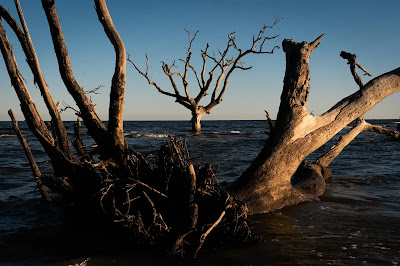
GHOST FORESTS EXPLAINED

by Mickey J. Corrigan


Ghost forests occur when high tides push seawater into forested areas and salt poisons the trees, turning them a bleached white. Ghost forests are currently appearing up and down the east coast of the US at an alarming rate. Photo: Cameron Pollack for NPR


The sun comes up
the sun goes down
the trees turn white
the beach looks skeletal.

The rain comes down
the sea comes in
the trees soak in salt
instead of fresh water.

The storms come up
the sea washes in
our forests poisoned
dead limbs in the sand.

We walk the beach
stuffing our sandbags
as storms come in
more storms come in
the tides rise up 
the tides rise higher... 

our bones flash white
littering the shore.


Originally from Boston, Mickey J. Corrigan writes tropical noir with a dark humor. Novels include the mystery pandemic tale Songs of the Maniacs (Salt Publishing, 2014), Project XX about a school shooting (Salt Publishing, 2017), and What I Did for Love, a spoof of Lolita (Bloodhound Books, 2019). In 2020, Grandma Moses Press released the poetry micro-chapbook Florida Man. 

Wednesday, July 06, 2016

NEAR AND DISTANT SHORES

by Bette Lynch Husted


A German rescuer holds the corpse of a drowned baby off the Libyan coast May 27. Source: Christian Buettner/Eikon Nord GmbH Germany via Reuters and The Washington Post, May 31, 2016.


“Again! again! again!”
On our way to the Pacific
we snuggle in the back seat
with The Poky Little Puppy—
“Rice pudding,” our little traveler echoes,
“He likes it!”

At the beach, we splash through
currents, waves breaking warm
around her ankles

Bodies small as hers
wash up on other shores,
refuse of war
their families refused
safe passage

refuge

My son’s body
disappears
in green-white breakers

He resurfaces
and waves

A yellow shovel
shapes her first sandcastle
A man says he wants only
to bury his children
and sit by their graves
until he dies

Fresh from her evening bath,
her dark head emerging from a white-towel chrysalis
safe in her father’s arms
both of them laughing—

Beneath the Milky Way
the sea returns
again again again    


Bette Lynch Husted lives in Eastern Oregon, where she chairs a monthly writers’ series. Her books include two collections of memoir essays, Lessons from the Borderlands and Above the Clearwater: Living on Stolen Land, and the poetry collection At This Distance.

Wednesday, May 27, 2015

OIL SPILL

by Elizabeth McMunn-Tetangco


Last Tuesday, an onshore pipeline belonging to the Texas-based oil company Plains All American burst, spewing roughly 105,000 gallons of crude down a storm drain and into an undeveloped stretch of coastline just north of Santa Barbara. Roughly a fifth of that oil made its way into open water. It may be the worst oil disaster the California coast has seen since a devastating 1969 spill in the very same region sparked a national wave of environmental legislation. This photo provided by the Santa Barbara County Fire Department shows an oil slick from the broken pipeline near Santa Barbara on Tuesday, May 19, 2015. Photo credit: Mike Eliason/Santa Barbara County Fire Department via AP —Gizmodo, May 24, 2015


The water
paints the shoreline
black.

No.

We did this to ourselves.


Elizabeth McMunn-Tetangco lives in California's Central Valley. Her poetry has appeared in The New Verse News, The Kentucky Review, Paper Nautilus, The Tule Review, Right Hand Pointing and The Lake, among others.

Monday, September 09, 2013

A CHANGE IN AIR

by James Cronin


A change in air soon defines a lonely beach
after Labor Day, as if a calmed breeze,
dark clouds and serene gunmetal seas
could lineate my life’s declining reach.

A world away, the gassed move, but not much,
the juvenile debate of where to draw,
or not, a line in sand. Its final flaw
—the dead don’t count—waits for sand’s tacit touch.

Displayed, as in an Irish wake gone mad,
the bodies, lacking souls that once they had,
their lungs gargled with blood, the air as gun,

it’s murder, and it cries out, but for what?
Revenge?  Justice? The law is pled for naught.
What sire lets sand entomb the rising sun?


After a four decade career in the law, James Cronin has returned to his first loves, literary studies and writing.