Guidelines


Submission Guidelines: Send 1-3 unpublished poems in the body of an email (NO ATTACHMENTS) to nvneditor[at]gmail.com. No simultaneous submissions. Use "Verse News Submission" as the subject line. Send a brief bio. No payment. Authors retain all rights after 1st-time appearance here. Scroll down the right sidebar for the fine print.
Showing posts with label summer. Show all posts

Sunday, September 07, 2025

BLOOD MOON BIRTHDAY WISH

by Marjorie Tesser


On the seventh of September, the earth 

will impose itself between moon and sun

and the eclipsed moon will blush red, 

color of love and rage. It’s the anniversary 

of my long-ago birth. Of late I’m less 

than sanguine about aging. Ghosted 

by family and friends—deaths, drugs, 

dementia, dogma—my circle has waned 

to a thinner crescent. I’m not immune, 

myself at summer’s end not yet red, 

but no longer vibrant green; wan, faded. 

Back in spring my sap loved to rise, roots 

to branch-tips aspiring. Now I lay low. 

Keep mum. Abide, 


though our home-space tumbles 

toward burn, wreck and ruin bought 

with others’ blood. Words like “liberty”

mean something different. it’s almost 

enough to shock one silent, numb one 

to the beauties we still, for now, 

number our blessings. Blood Moon 

is said to augur transformation, 

a flushing away to make room for change. 

In this red tide, may we stay afloat, unmute, 

sow songs of praise and rage, words vivid 

as rubies. May our hues distill, deepen—

cerise to crimson, vermilion to claret,

cabernet, rufous, russet—articulate

full spectrum against falling.


Marjorie Tesser’s poetry and fiction have appeared in Whale Road Review, Cutleaf, SWWIM, The New Verse News, and others. She is the author of poetry chapbooks The Important Thing Is, (Firewheel Chapbook Award Winner), and The Magic Feather (FLP). Her poem “April” won the 2019 John B. Santoianni Award from the Academy of American Poets. She has co-edited three anthologies and is editor-in-chief of MER-Mom Egg Review. 

Saturday, August 16, 2025

THIS BIRD HAS FLOWN

A Prose Poem
by Howie Good


President Trump and President Vladimir V. Putin of Russia concluded their summit in Alaska on Friday without declaring agreement on any issue, much less the one Mr. Trump said was at the top of his agenda, ending the war in Ukraine. —The New York Times, August 15. 2025


The other day I saw a bald eagle for only the second time in my life. It soared over the treeline on the far side of the marsh. Almost in the same instant that I recognized it from its distinctive silhouette, it was gone, our national bird, symbol of strength and freedom. We are entering the last days of summer. Some of the plants I planted in the spring never grew, and the plants that did grow have begun dying. I dread the coming winter, a hulking, red-eyed monster roving streets of blackened ruins.


Howie Good is a professor emeritus at SUNY New Paltz whose poetry collections include The Dark and Akimbo, available from Sacred Parasite, a Berlin-based publisher. 

Wednesday, August 21, 2024

THE GRANITE STATE

by Melanie Choukas-Bradley


Wildfire smoke from western Canada settles in the atmosphere in Franklin [New Hampshire] on Friday evening. Wildfires from western provinces of Canada brought smoke to the Northeast, where an air quality advisory last weekend included central and western Massachusetts, all of Vermont and northern New Hampshire. (Daniel Sarch/The Laconia Daily Sun photo August 19, 2024)


My Dad remembers 
Dust on snow in the 1930s
Drifted cross-continent from the Plains
 
But he doesn’t remember early 
Wildfire smoke from Canada
Locking the mountains in haze
 
Every summer now
Dimensionless white days
Hot-hued sunsets, red moons 
 
At 96, he sighs, resigned
We ignored the elements 
At our peril and now 
 
Air is visible, Water speaks in drowning tones
And Fire strips us down to Earth
Down to the granite state

 
Melanie Choukas-Bradley writes from New Hampshire, known as the “Granite State,” where the White Mountains are currently engulfed in Canadian wildfire smoke. This morning she asked her 96 year-old dad if he remembered wildfire smoke earlier in his lifetime. He replied: “No, but I do remember dust on the snow when I was a child during the Dust Bowl.” Melanie is a naturalist and award-winning author of eight nature books, including Wild Walking—A Guide to Forest Bathing Through the Seasons, City of Trees, A Year in Rock Creek Park, andFinding Solace at Theodore Roosevelt Island. She has had two previous poems published in the New Verse News and many poems published by Beate Sigriddaughter’s Writing in a Woman’s Voice, including four that have won “Moon Prizes.” Her poems have also been featured on nature-oriented websites.

Friday, July 26, 2024

CARCASS

by Melanie DuBose


World’s Rarest Whale Washes Up on New Zealand Beach, Scientists Say: Only six specimens of the spade-toothed whale have ever been identified. This carcass could be the first that scientists are able to dissect. —The New York Times, July 17, 2024


swimming by
he notices 
on the ocean floor 
something long  sleek  dead

they hang the body by its tail on the beach
some things never change

very small fins long beak
an endless loop on repeat in my brain

my brain with its depths I can not reach
but perhaps could synthesize and become a pop star
if I knew how to make thoughts into sound
outside the window the hills are outlined  in red
along the horizon

am I ashamed to be human?
the whale comes from mountains higher than any on earth
I get vertigo floating  

Ex means out  my brain circles the parking lot
Extinction Existence Depth
very small fins long beak 

proof of life in death hanging by its tail on the beach
another dead whale out of water hoisted not quite extinct 
it seems though rare

another summer of fires
I swim in the deepest water and wish for something
sleek and alive


Melanie DuBose lives in Los Angeles. Recent poems and prose have appeared or are forthcoming in the Los Angeles Press, Kelp, Gyroscope, and Drunk Monkeys among others. Her favorite award is from the National Weather Association for helping six-year-olds write about the value of wetland preservation. 

Friday, October 06, 2023

PLAY FOR THE TEAM

by Buff Whitman-Bradley


“Why Summers May Never Be the Same” The globe’s warmest months on record redefined summer for many Americans. —Julie Bosman reporting from Chicago, where it is 84 degrees in October, for The New York Times, October 5, 2023


Even though summer heat

Has stopped by to remind us

That we are living in precarious times,

Autumn is unmistakably upon us.

The light is liquid gold,

Long, lanky afternoon shadows 

Are sprawling all over 

The houses and gardens and lawns

Up and down the block,

And there is something about

The taste and smell of the air,

Something leafy and loamy 

And earthily aromatic.

Even though summer heat

Has stopped by to remind us

That we don’t have a whole lot of time left

To flip the climate narrative,

To turn the dire story on its head.

Seasons do still come and go

And will keep doing so

If we are smart enough

And brave enough

And passionate enough

And organized enough

To resist the despoilers of earth and air,

Confiscate their piggy banks,

And stick the spoiled kids back

In their play houses and their little red wagons

Until they can learn

To get with the program

And play for the team.


Buff Whitman-Bradley’s latest book is And What Will We Sing? (Kelsay Books). He podcasts at thirdactpoems.podbean.com and lives with his wife Cynthia in northern California.

Sunday, September 24, 2023

DREAMING SUMMER DOWN

by David Chorlton


Yesterday’s news sent the city to bed
with domestic terror for a nightcap, home grown
it said, easy to fund, you can’t
keep bad men down. And fall begins today
even if summer still has
a scorpion’s tail. A night of interrupted sleep
 
with a dream of far away;
how well those friends of years ago
appeared. Good health among the living
and even better with
the dead. Who would have expected such
 
a fine reunion, or found
the references to erotica made in Vienna?
Outside, it’s Arizona warm
with coyotes wandering the starlit streets
and bus shelters doubling
as bedrooms for the poor. The midnight traffic
on the interstate is singing
 
in a sparkling monotone
and the moon hangs
like half a cup of fire between two
leaning palms. Let the past
 
be the past, say Goodnight
and ride a beam of dreamlight home.
Fumble for the key.
Ignore the splinters in the door where someone
must have brought a crowbar.
Imagine! The cracking wood, the aching
hinge, the next door neighbor’s
 
reassuring words: don’t worry,
it could never happen here.


David Chorlton has considered Phoenix home for several decades. He used to live in Vienna but rarely dreams about it. Much of his poetry comes from life in Arizona, where he has found strains of unrest and social disquiet that he can't ignore.

Thursday, August 31, 2023

BLINK

by Maxine Susman


Fireflies may disappear, so NY scientists are trying to count how many are left. —The Gothamist, August 22, 2023


They don’t light the lawn as they used to.

They don’t light up my brain.

As a kid I’d cup my hands into a lantern

and catch a dozen or more at a time,

they were so tame they glowed through my fingers,

lit my hands and then the jar I filled with them, 

the dotted love songs of bugs—

then I’d set them free to speckle the summer grass. 


Remember on the mountain how fireflies rose

high as the trees, spread a yellow Milky Way—

and the meadow we named Fireflyworks Hill 

where fireflies at dusk outnumbered wildflowers.     

Remember when they arrived each year to kindle 

our brains, they’d set our neurons firing, 

rising like wishes through the summer doldrums.


This year as each year their numbers dwindle. 

I see one or two flittering solitary, 

no one to answer, 

to answer to, 

be lit for. 


Maxine Susman, from central New Jersey, has published seven poetry collections, with poems in journals such as Paterson Literary Review, Fourth River, Earth’s Daughters, Crab Orchard Review, Slant, and Canary. She teaches poetry at the Osher Lifelong Learning Institute of Rutgers University.

Saturday, August 19, 2023

AUGUST

by Juditha Dowd


This evening it occurs to me I ought to call my mom and dad
because it’s been a while. And for a moment they are not
gone some fifteen and thirty-six years, but still at the house 
where I left them, the first of their children to depart.
It’s summer and steamy and all the windows are open wide.
She’s on the porch working the Sunday crossword.
He’s out back picking tomatoes or wielding some tool—
lawnmower, drill, or paint brush. For what they may lack 
in talents or skill they substitute perseverance.  
Today I took tomatoes from the garden we extended again
in this post-pandemic summer, the leaves already mottled 
with a virus that will kill the plant but doesn’t harm us. 
Here too it’s hot and humid, like that year my twin brothers 
caught polio, from swimming at a public pool some said.
The same August our younger brother almost drowned 
in the deep end and our country joined the Korean war,
though my father was too old to fight in that one. 
If only my phone could find them tonight, I’d assure them 
I’ll get another booster. Or bemoan the endless shootings,
the forest fires, the latest wars… Or instead I might say 
It’s 100° and I’m making a tomato sandwich. 
Maybe leave it at that. They’d know what I mean.
 
 
Juditha Dowd’s fifth book of poetry, Audubon’s Sparrow, is a lyric biography in the voice of Lucy Bakewell Audubon (Rose Metal Press). She was a 2022 finalist for the Adrienne Rich Award and has contributed poems to Beloit Poetry Journal, Cider Press Review, Florida Review, Poet Lore, Poetry Daily, and elsewhere.

Sunday, January 01, 2023

A YEAR'S LAST FLIGHT

by David Chorlton


The waking skies of summer
opened like a hand of cards spread daily
when the white sun rose
and a cloud held Heaven’s fire close
to Earth while all was golden light behind
Four Peaks.
                     Each day
broke into song against a stage set brightly
for the doves and mockingbirds and
flickers who arrived without
a campaign slogan or
a lie. Pigeons flocked together for safety
while hawks and candidates
hunted alone through dry heat
and monsoons. Anniversaries flew by
with months sliding
down a rainbow to
                                   disappear the way
time does when it has used up
its energy and wants to sleep the winter sleep
that follows an election when all
that’s left are losers crying foul
and birds lost in migration
showing up at the most unlikely
destinations. There is one late rain
turning to mist
                            on the south side
of a desert mountain. And hummingbirds
for whom each day is much the same as
the one before it. They are driven
by their unending appetites
and swear allegiance to the sugar
hanging from the sky.


David Chorlton is a longtime resident of Phoenix with great affection for the desert. His newest book is Poetry Mountain published by Cholla Needles Arts and Literary Library in Joshua Tree, CA. 

Wednesday, September 14, 2022

FIRE SEASON

by Laton Carter


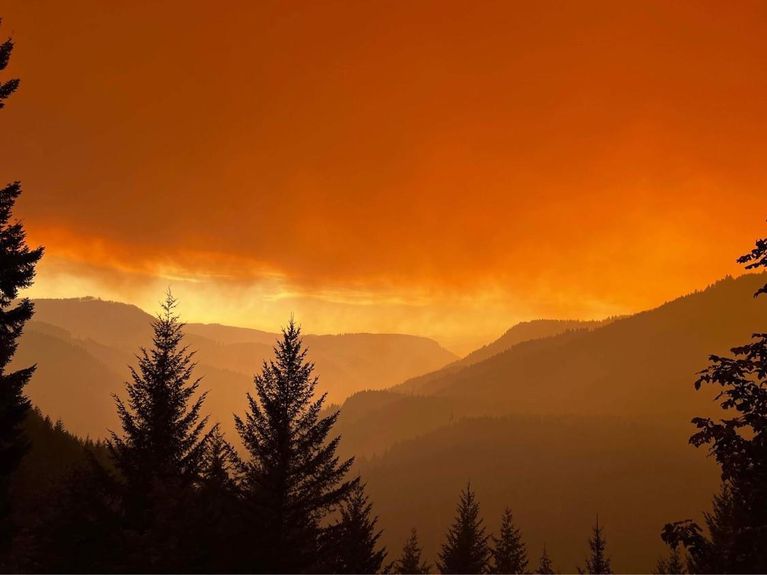
Smoke turns the morning light orange on Saturday in this photo taken near the Huckleberry Lookout, provided by the Cedar Creek Fire Incident Command. Credit: Cedar Creek Fire Incident Command via InciWeb and OPB, September 12, 2022


It is not that fire is snow. It is not even
that falling ash is snow. The sky
 
is stunned, swallowed
by a yellow glove whose palm
 
opens to haze and drifting filament. Burned
bodies, trees that pursed their mouths, that
 
refused to gasp or cry, handrails that melted, that
obeyed the persistence of time, they are
 
floating. (Floating only appears directionless.)
Summer is winter. Hold up your hand. In winter
 
no one answers. It is not that snow
is winter. Breathe in. Your lips, your throat,
 
your lungs. Prepare yourself.
Floating is not a weightless task.
 
Crucible,
blind pilot, un-
yielding conflagration.


Laton Carter's Leaving (University of Chicago Press) received the Oregon Book Award. His writing also appears in Indiana Review, Narrative, and Split Lip Magazine.

Monday, August 24, 2020

WHAT MY MOTHER TAUGHT ME ABOUT THE USPS


Sister Lou Ella is a former teacher and librarian. Her poems have appeared in numerous magazines such as America, First Things, Emmanuel, Third Wednesday, and TheNewVerse.News as well as in four anthologies: The Night’s Magician: Poems about the Moon, edited by Philip Kolin and Sue Brannan Walker, Down to the Dark River edited by Philip Kolin, Secrets edited by Sue Brannan Walker, and After Shocks: The Poetry of Recovery for Life-Shattering Events edited by Tom Lombardo. She was nominated for the Pushcart Prize in 2017. Her first book of poetry entitled she: robed and wordless was published in 2015. (Press 53.)

Friday, May 17, 2019

REPRIEVE

by Emily Jo Scalzo


months will bleed by
when gunshots don’t echo
down school hallways
in classrooms or lecture halls
a reprieve from hero-teenagers
called to sacrifice themselves
jump on the grenade
clot the flow of bullets
to buy seconds
for their classmates

red rivulets dammed
not due to prevention
or common sense
but because summer
darkens these venues
empty of fear for now
the halls lie waiting
for fall and more
blood shed


Emily Jo Scalzo holds an MFA in fiction from California State University-Fresno and is currently an assistant teaching professor teaching research and creative writing at Ball State University in Muncie, Indiana. Her work has appeared in various magazines including Midwestern Gothic, Mobius: The Journal of Social Change, Blue Collar Review, and others. Her first chapbook, The Politics of Division, was published in 2017 and awarded honorable mention in the Eric Hoffer Book Awards in 2018.

Wednesday, May 30, 2018

ANOTHER MEMORIAL DAY

by Howard Winn

NORWALK, CT — While stationed in northeast India during World War II, Nick Samodel repaired cargo planes that hauled supplies over the towering Himalaya Mountains to allied soldiers fighting the Japanese. “We had five airbases close to the mountains,” said Samodel, who served as an aircraft mechanic in the U.S. Army Air Corps. “We had to change the engines and fix oil leaks — that was a big problem because at high altitudes the oil leaks out through the seals. It takes a lot of maintenance. We lost some planes. They found one 10 years ago on the side of a mountain.” On Monday, Samodel, 97, of Norwalk,  served as grand marshal in the 2018 Memorial Day Parade. —The Hour, May 26, 2018


Summer begins
and the ice cream shop
on the corner
opens for the season
while the families
gather on the corner
of Route 77 and Shore
Road to applaud
the earnest children
in the high school band
marching by led by the
grizzled World War II
survivor wearing his
old uniform which he
must preserve in a clothes
bag at the back of a closet
to remember once a year
the deaths in the Battle
of the Bulge or the killings
in the Western Pacific or
perhaps just service in Army
Supply in New Jersey where
heroes not quite lurked in view of
the sea and vacation beaches
and waited for discharge
while spending time being
entertained by the young
women volunteering for
time to party in the USO
so war could be forgotten
for a social moment to be
resurrected each year on
Memorial Day dedicated to
the waste of war even good ones
for patriotism is both the flaw
and the consequence of nationalism
even when reduced to jingoism


Howard Winn's novel Acropolis is published by Propertius Press. He has poems in the Pennsylvania Literary Journal and in Evening Street Magazine.

Monday, August 21, 2017

ONE FINAL LOOK

by J. D. Mackenzie


Image source: Blue Sky Vineyards
via Belleville (IL) News-Democrat
It burns within us, a need to look skyward
toward this thing, so dangerous and rare.

The heavens chose a route
meant to pierce our needful heartland
and gather together long-lost friends.

With all the hoopla and hype Gomorrah
there’s also a cautionary note,
that some things
like Gomorrah and Eurydice
should never be seen
for fear of losing it all.

But what if we knew it was our time
and every thing we did
was the last thing?

That last saved magnum of Margaux
a final, torrid roll around the blankets
and one last, urgent look
at the shrouded summer sun.


J. D. Mackenzie writes poetry, prose, and an occasional political rant. He toils in near anonymity as a dean at a small community college in western Oregon, and lives in the foothills of the Coast Range.

Thursday, October 27, 2016

A LEGAL CASE AGAINST AUTUMN

by Jo Ann Steger Hoffman


Bold Autumn Colors Abstract is a photograph by Carol Groenen which was uploaded on November 2nd, 2013 at fineartamerica.


Bold autumn steals light from summer.
Even dumber
he strips trees of lavish green dress,
forces excess
of brilliance to camouflage dying.
He’s lying.
He plans to prove summer is trying
to falsely convict him of stealth,
of hiding vice beneath radiant wealth.
Even dumber, he forces excess. He’s lying.


Jo Ann Steger Hoffman is a writer, editor, and former communications director whose publications include a children’s book, short fiction and a variety of poems in literary journals.  Her 2010 non-fiction book, Angels Wear Black, recounts the only technology executive kidnapping to occur in California’s Silicon Valley.  A native of Toledo, Ohio, she and her husband now live in Cary and Beaufort, North Carolina.

Thursday, July 14, 2016

VACATION DURING A WEEK OF KILLINGS

by Gail Martin


A truck drove into a crowd at Bastille Day celebrations in Nice, France, leaving many dead and sending hundreds running for safety. —The New York Times, July 14, 2016. Photo by Eric Gaillard/Reuters.

One daughter posts a picture of her face, sad,
reading Hannah Arendt On Violence; my husband
watches Wimbledon, says he has no perspective
on it yet. One daughter is growing a son. Her app
says he’s the size of a coconut. Another texts
from the West: I can’t sleep -- I feel traumatized.
A client calls from home to say his anxiety’s up.
People kayak on the flat lake, ignoring the thunder.
This makes me anxious. The dog sleeps beneath
the dining room table. All I want is to read 89 Ways
to Love Summer!  Can we afford to let sleeping dogs lie?
I take my pills, prelude to a walk, and eat strawberries,
small and sweet, on Cheerios. Wheaties are more
American but my daughters can’t tolerate wheat.
How much can we tolerate? The storm is sweeping
across the lake. I need a megaphone to shout out
my grief and anger. My fear. If you hear thunder,
the warning repeats over and over on the news,
you’re close enough to be struck by lightning.


Gail Martin’s book Begin Empty-Handed won the Perugia Press Poetry prize in 2013 and was awarded the Housatonic Prize for Poetry in 2014. Her first book The Hourglass Heart (New Issues Press), was published in 2003. New work is forthcoming in Tar River Poetry and The Southern Review. Martin works as a psychotherapist in private practice in Kalamazoo, MI.

Tuesday, September 02, 2014

HOFFA, AFTER LABOR DAY

by David Feela


The arrow points to where Anthony "Tony Z" Zerilli says Jimmy Hoffa was buried in Oakland Township, Michigan (Oakland Press, June 17, 2013). Other reports claim Hoffa was "garroted by Anthony 'Tony Pro' Provenzano, a notorious New York mobster" in Inkster, Mich., and fed into a wood chipper (Huffington Post, June 21, 2013).


The ground is hard,
not worth turning,
and of the mystery
the air has cleared.

We gather at the lake,
park, or every backyard
we ever mowed,
all our sorrow at the passing
of summer served up cold.
 
The celebration lasts
three days, but Tuesday comes
and we take our places
in a line of expectations,
the ones we formulated
for the future against the ones
imposed by bosses.

“How was your weekend?”
Fine, great, stupendous,
we claim, but the truth,
like Hoffa is that the time,
it just disappeared.


David Feela writes a monthly column for The Four Corners Free Press and for The Durango Telegraph. A poetry chapbook, Thought Experiments, won the Southwest Poet Series. His first full length poetry book, The Home Atlas appeared in 2009. His new book of essays, How Delicate These Arches  , released through Raven's Eye Press, has been chosen as a finalist for the Colorado Book Award.

Saturday, May 24, 2014

FOOTNOTE TO THE UNOFFICIAL BEGINNING OF SUMMER

by Howie Good


Image source: Crane Lake Nature Blog

Poem inspired by “Black-Throated Blue Warbler: Listen, Stop and Watch” by Dave Taft, NY Times “City Room” Blog, May 16, 2014


You don’t
need to call
yourself
a bird-
watcher

Anyone
can take
a cue from
the black-
throated blue
that last
night’s winds
blew in

This wasn’t
something
I’d experienced
before –

new leaves
and buds
and a buzz
that sounded
maybe not
to others
but to me
just like
“I’m-so-lay-zee!”


Howie Good, a journalism professor at SUNY New Paltz, is the author of the 2013 chapbooks Echo's Bones and Danger Falling Debris, both from Red Bird Chapbooks. He co-edits White Knuckle Press with Dale Wisely.

Monday, September 02, 2013

AT SUMMER'S ENDING

by B.Z. Niditch


In this zig zag life
still breathless for a swim
over reddish waves
at summer's ending
a patient first light
stills the crystal waters
where a sun reflects
the cork bottles we throw
overboard into the sea
containing peace wishes,
hoping on some muddy shore
a soft glance will lead
these words like shadows
to speedily embark
with our small voices,
or on earth-wise hooks
to crisscrossed fates
telling with our tongues
to stop quicksands of war,
that with elated eyes
by states along the equator,
between continents
or by a footbridge
children on all fours
at another humid morning
such as this,
searching for fish or shells
outstretched to sail
or diving along a salty beach
will discover our note
and bring into play
what Picasso's dove
would convey.


B.Z. Niditch is a poet, playwright, fiction writer and teacher. His work is widely published in journals and magazines throughout the world, including: Columbia: A Magazine of Poetry and Art; The Literary Review; Denver Quarterly; Hawaii Review; LeGuepard (France); Kadmos (France); Prism International; Jejune (Czech Republic); Leopold Bloom (Budapest); Antioch Review; and Prairie Schooner, among others. He lives in Brookline, Massachusetts.