Guidelines


Submission Guidelines: Send 1-3 unpublished poems in the body of an email (NO ATTACHMENTS) to nvneditor[at]gmail.com. No simultaneous submissions. Use "Verse News Submission" as the subject line. Send a brief bio. No payment. Authors retain all rights after 1st-time appearance here. Scroll down the right sidebar for the fine print.
Showing posts with label Soviets. Show all posts

Friday, February 25, 2022

90TH BIRTHDAY IN KYIV

by Corey Weinstein


In just four weeks in the summer of 1941 the German Wehrmacht wrought unprecedented destruction on four Soviet armies, conquering central Ukraine and killing or capturing three-quarters of a million men. This was the battle of Kyiv–one of the largest and most decisive battles of World War II and, for Hitler and Stalin, a battle of crucial importance. Hundreds of thousands of Soviet prisoners of war were taken in the aftermath of the battle of Kiev, but very few would survive German captivity. —Arthur Grimm, “Kiev 1941: Hitler's Battle for Supremacy in the East,” Semantic Scholar


I live in a breadbasket,
That’s the whole problem,
Fields of wheat, of barley
for the soup the family loves,
Carrots, onions, meat scraps
or beets for borscht that stains,
Blood reluctantly on our hands.
None of them: the Whites, the Reds,
the Iron Crossed Pure Whites,
the new Green with wallets and promises,
None of them know our voices,
taste our beautiful farms,
Now still again the Reds attack,
and we are stained again
with what must be done,
I was nine standing at the pit’s edge,
Some cheered, not me, some retched,
The ground heaved and belched for a week,
Father cooked their lunches, never recovered,
A drunk in Kyiv gutter dirty to the end.
Again the shrieks of bombs and moms,
Blasts and dust and blood in the air,
These Reds of famine and orders and lies
roll over our wintered earth to plant
their seeds of our despair, now still again.


Corey Weinstein is a retired homeopathic physician whose poetry has been published in Vistas and Byways, The New Verse News, Forum, California State Poetry Society, and Jewish Currents. He currently attends writing classes at Osher Lifelong Learning Institute in San Francisco and hosts their Poetry Circle. Weinstein has also been published in a number of medical/academic publications. He was an advocate for prisoner rights as the founder of California Prison Focus, and he led the American Public Health Association’s Prison Committee for many years. In his free time, he plays the clarinet in a local jazz band, his synagogue choir and woodwind ensembles.  

Monday, January 31, 2022

NUCLEAR WASTE

by Charles Rammelkamp


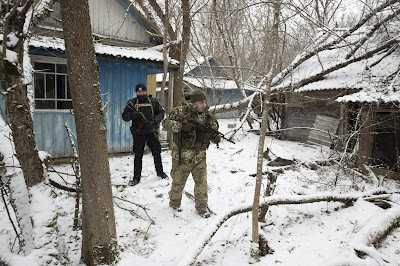
Ukraine has initiated a defensive strategy for the Chernobyl Exclusion Zone, one of the most radioactive places on Earth, which lies on the shortest path between Russia and Ukraine’s capital, Kyiv. Photo: A Ukrainian border guard on a joint patrol with the Ukrainian police inside the Chernobyl Exclusion Zone. —The New York Times, January 22, 2022


“It doesn’t matter if it’s contaminated,
or if nobody lives here,” Yuri declared,
responding to the unspoken skepticism 
in the sheen of the reporter’s dark eyes.
“It’s our territory, our country,
and we have to defend it.”
Shouldering his Kalashnikov, Yuri patrolled 
the snowy fields of the Chernobyl zone;
winter in northern Ukraine.

“I remember reading about the Soviets
parading the children on May Day 
through the swirl of radioactive dust
right after the accident 
to try to make us—and the world—believe 
nothing serious had happened.
Thank goodness I wasn’t alive then.

“Pripyat’s a ghost town now;
used to be the biggest city in the area.
You can still see the old Soviet propaganda –
a sign extolling the virtues of nuclear energy.
‘Let the atom be a worker, not a soldier.’”

Hunching his shoulders, as if to toss away his anger,
shifting the rifle, Yuri went on:
“Now we don’t know 
what will kill us first,
the virus, radiation, or Putin’s bombs.”
 

Charles Rammelkamp is Prose Editor for BrickHouse Books in Baltimore, where he lives with his wife Abby. He contributes a monthly book review to North of Oxford and is a frequent reviewer for The Lake, London Grip, Misfit Magazine, and The Compulsive Reader. A poetry chapbook, Mortal Coil, was published in 2021 by Clare Songbirds Publishing and another, Sparring Partners, by Moonstone Press. A full-length collection, The Field of Happiness, will be published in 2022 by Kelsay Books.

Friday, April 05, 2013

THE RED LINE

by Roger Sedarat 
 

Mahmoud Ahmadinajad by Tamer Youssef


                “We will not allow Iran to develop a nuclear
                weapon.” -- Leon Panetta (former US Defense Secretary)

“Where’s all this terror they find in Iran?”
She asked, over the New York Times. “They act
Like it’s the Nazis or the Soviets.”
Long married, they’d had this same talk before.
He wanted to take notes on what they said,
Banal reporter instead of poet.
“They mean the military threat.” He poured
More coffee, pleased to stir the pot again.
“Okay,” she said, the iPad in her hand:
“A single missile on a transport truck.
I saw one of these last time in Shiraz;
They brought it out in some stupid parade
To show their military might (such men).
It’s really all they fucking had besides
Teen soldiers, bearded boys who looked hungry,
As if they missed their moms.” It was his turn
To launch a counterstrike, antagonize
The enemy like Ahmadinejad.
“How do we know what they might be hiding?”
She dropped her breakfast bar and rolled her eyes.
“Oh sure, a nuke! Just like Bush with Iraq;
I think the threat’s completely overblown,
A bluff in poker.” “But Muslims don’t bet,”
He interjected. Using his smug tone
She knew belonged in academia.
“Oh Roger! You’re just looking for a fight!”
“I know,” he said, ‘performing’ my Iran.”
“I know,” she said with heavy sarcasm.
“It all comes down to art for you, who cares
About reality as long as it
Becomes a poem.” “Life is just a dream,”
He said in Persian. “Just a dream?” she asked.
“Suppose we drop real bombs and people die.”
“But you yourself keep saying it’s a game.”
He knew this last comeback had gone too far.
“You’re being difficult!” She slammed her fist.
“I know, and so are you,” he said in kind.
“It’s like we’re taking turns at acting like
The U.S. and Iran, always at war.”
She sighed, frustratingly, and he sighed back,
Aware how much she hated being mocked.
In silence they went back to the paper,
Avoiding talk of new conflicts they read.


Roger Sedarat is the author of two poetry collections: Dear Regime: Letters to the Islamic Republic, which won Ohio UP's 2007 Hollis Summers' Prize, and Ghazal Games (Ohio UP, 2011). He teaches poetry and literary translation in the MFA Program at Queens College, City University of New York.