Today's News . . . Today's Poem
The New Verse News
presents politically progressive poetry on current events and topical issues.
Guidelines
Submission Guidelines: Send 1-3 unpublished poems in the body of an email (NO ATTACHMENTS) to nvneditor[at]gmail.com. No simultaneous submissions. Use "Verse News Submission" as the subject line. Send a brief bio. No payment. Authors retain all rights after 1st-time appearance here. Scroll down the right sidebar for the fine print.
Thursday, February 06, 2025
THE DOOMSDAY CLOCK
Tuesday, August 06, 2024
ELECTION 2024 GHAZAL
![]() |
Vice President Kamala Harris appeared for the first time alongside her newly announced running mate, Gov. Tim Walz of Minnesota, introducing him on Tuesday evening at a packed rally in Philadelphia. “Thank you for bringing back the joy,” a beaming Mr. Walz turned to tell Ms. Harris after she presented him to the crowd. —The New York Times, August 6, 2024 |
What a long time have we been waiting for joy!
Like brassy laughter, what we really need is joy.
Today, our air is alive, electric. A chorus
of voices can be heard in harmonies of joy.
No one disputes that such emotion is good for us.
What else can balance doomsday fears like joy?
Once I heard a wood thrush hidden in a porous
bush, its notes sensuous with forbidden joy.
It’s been too long since we could bask in glorious
sound. Listen as it rises like a songbird, joy-
ous with promise, ascendant with purpose, raucous
with Hope—which we now know by its other name: Joy.
Mary K O’Melveny, a happily retired attorney, is the author of four poetry collections and a chapbook. Her most recent If You Want To Go To Heaven, Follow A Songbird (Jerry Jazz Musician 2024) is an album of poems, art and music. Mary’s collection Flight Patterns was nominated for the Eric Hoffer Book Award. Her book Merging Star Hypotheses was a semi-finalist for The Washington Prize, sponsored by The Word Works. Mary has been twice nominated for a Pushcart Prize. She is an active member of the Hudson Valley Women’s Writing Group and her poetry appears in the Group’s two published anthologies An Apple In Her Hand and Rethinking The Ground Rules. Mary lives with her wife near Woodstock, New York.
Friday, July 14, 2023
GHAZAL FOR THE WOMEN OF AFGHANISTAN
Thursday, November 25, 2021
GHAZAL: THANKSGIVING
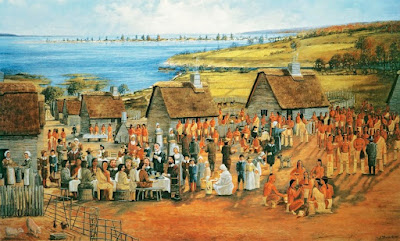
| A painting done in 1995 by Karen Rinaldo, of Falmouth, Mass., depicts what many Wampanoag tribal leaders and historians say is one of the few accurate portrayals of “The First Thanksgiving 1621,” between the Wampanoags and the Pilgrims. —Dana Hedgpath, “This tribe helped the Pilgrims survive for their first Thanksgiving. They still regret it 400 years later.” The Washington Post, November 4, 2021 |
Sunday, November 17, 2019
CAPO GHAZAL
Of course I’ll release the funds. But first, do me a favor.
No, of course you’re not being coerced—just do me a favor.
Those shitholes out there are trying to undermine me!
They have to be slimed and aspersed, so do me a favor.
Help me out with this and I’ll invite you to the White House.
Just do your best (i.e. worst) and I’ll take it as a favor.
Rudy is coming with an offer you can’t refuse:
end up in the Dnieper feet first, or do me a favor.
This transcript is going to the secret computer system,
so forget that we ever conversed; just do me a favor.
Monday, May 13, 2019
A GHAZAL FOR VENEZUELA: PRESIDENT MADURO DENIES HUMANITARIAN CRISIS
![]() |
| CARACAS, Venezuela (AP) — Red Cross volunteers distributed the first shipment of badly needed emergency supplies in Venezuela on Tuesday after months of feuding between the government, which has denied the existence of a humanitarian crisis, and opponents who have been seeking to use the delivery of aid to force President Nicolás Maduro from power. —AP, April 16, 2019 |
A father hugs his child good night, his nightmare, her dwindling insulin doses.
For love of his country, Maduro turns down aid, insists “We aren’t beggars.”
A mother sells her thick, braided hair to buy rice, beans and chicken for her children.
With chants of venceremos, Maduro raises his fist “We aren’t beggars.”
A mother grieves for her older child stabbed when they grabbed his cell phone.
With hatred toward his enemies, Maduro resists “We aren’t beggars.”
A pregnant teen reveals there were no contraceptives or money to buy them.
In his embrace of the dead Chavez, Maduro can’t desist “We aren’t beggars.”
Now a father lines up by a Red Cross van for water purification tablets.
As a maid pours his fine wine, Maduro shifts yet persists “We aren’t beggars.”
In the latest issue of Journal of Global Oncology, Elane Gutterman, a health researcher, read how cancer care in Venezuela has been transformed from an advanced level of diagnosis and treatment to rudimentary services through government policies and indifference. In addition, she credits her friend and former Spanish teacher, Ana M., with making the needless suffering of the population personal through sharing stories of her Venezuelan family. Elane has published poems in Patterson Literary Review, U.S. 1 Summer Fiction Issue, Kelsey Review and TheNewVerse.News.
Tuesday, May 01, 2018
THE WEIGHT OF SILENCE
![]() |
| Women at the site of a car-bomb attack in Kabul in May 2017. Credit Shah Marai/Agence France-Presse — Getty Images via The New York Times. Afghan photographer Shah Marai was among the nine journalists killed in Kabul on Monday as they “rushed to the site of yet another bombing, when a second attacker detonated his explosives amid the reporters and first responders. Altogether 25 people were killed.” —The New York Times, April 30, 2018 A week before, “on April 22, 2018, an ISIS-affiliated suicide bomber in Kabul, Afghanistan killed at least 57 and injured more than 120 people lining up to receive national identity cards that would allow them to vote in the country’s parliamentary elections. Twenty-two women and eight children were among those killed. A neighborhood resident, Mohammad Kalgrim, told a reporter ‘I have carried so many bodies that I cannot even talk.’ Most survivors of the blast said they were no longer likely to cast votes.” The New York Times, April 22, 2018 |
Our dead lie scattered
like funerary flowers
while tattered voter cards
sift downward past shards
of glass. Entwined with ashes,
like ribbons of faded hours,
they land in drainage moats
where torn school uniforms
drift past like tiny boats
in reddened waters.
We must endure, if able,
the weight of such sorrow.
A small girl whose pink schoolbag
becomes her final pillow.
The body of her young mother,
hollowed out like a vessel.
A clerk, smothered by debris,
lists at his wooden table,
still holding forms and pencils,
his stricken face sallow.
We bore them all away
from places that had heard
their final words. We worked
all day harvesting slain
neighbors like crops. None shirked
as firemen tried to wash away the sins
of our street corners
and cordons of policemen
tried to contain mourners
wailing above the din.
Once, the things we ferried
were cups of cinnamon tea,
books of ghazals, prayer carpets,
promises of prophets. We passed time
at windowsills or waiting in lines.
We pursued relief from lesser grief
like failures of imagination.
Now, we move evidence of ruination.
Unbalanced by weight of what we carried,
we have been silenced.
Sunday, March 18, 2018
MADNESS
![]() |
| Nevada looked like its NCAA tournament was going to come to end Sunday in the second round. But after trailing by 22 points in the second half, the Wolf Pack rallied to beat the Cincinnati 75-73 and advance to the Sweet 16. Nevada’s stirring comeback – the second-largest in tournament history – came just two days after the No. 7 seed rallied from 14 points down in the second half to beat Texas for its first NCAA victory since 2007. “Nothing feels better than this,” Nevada coach Eric Musselman said. “Nothing. Sweet 16!” —USA Today, March 18, 2018 |
A snow hiker finds fifty-four hands: frozen hands, unfettered hands,
gnarled hands, grisly hands, bloodstained hands, dissevered hands.
So many cats: cougars, bearcats, panthers, tigers, wildcats
pounce on blue jays, bulls, highlanders with their weathered hands.
A thundering herd evades the cowboys’ ropes, pursued by shockers,
those pesky prods pressed to haunches by men’s leathered hands.
The quakers fight, their weapon, inner light, as those jayhawks
swoop and fly, yellow beaks like iron, wings like feathered hands.
Even friars shake in fright, as lawless aggies bare their whips
and guns, no honor to men bound to God with forevered hands.
From myths, the titans from old kingdoms rise to snuff out fires
of boilermakers, crush the torches, hammers of endeavored hands.
Will the gods send hurricanes to spin and drench and swirl,
to tame all claws, talons, hooves, with wind’s untethered hands?
But wait. Imagine the wagging retriever, prancing, dancing.
He takes the bone from cavaliers’ unwilling, levered hands.
We’re in the madness. We back our pack of wolves who dodge
the long, curved horns. The bearcats loom. We lift together-hands.

Saturday, November 26, 2016
OTHER SIDE GHAZAL
The quinceañera, the college graduation. You won't be here.
For your parents' fiftieth. Sorry, you won't be traveling here.
Deported for one ounce of grass. You rode the big bus twice.
You wander dreamless south of the border. You won't be here.
Your mother––sin papeles. Twenty years of tucking corners.
Ten more nurturing others' kids. She can't go there, she's here.
Your father––paperless––mower of grass, nurturer of crops.
Builder of bookcases, family, walls. Thirty years of here.
No re-entry to the USA. No entry. Stay in Aleppo, Mosul.
Trek to Gaza City, Jordan, Istanbul. No welcome mat here.
Endure the tarp of tents, bitterness in your husband's glance.
Let dust on your wife's hijab thicken. You can't come here.
Another quiet cycle through your prayer beads––misbaha.
Kiss weariness from your children's smiles. Not allowed here.
We're sorry our gods have seized the heart of this matter.
They say our country may be great again. You won't be here.
Thursday, November 24, 2016
GUZZLING DOWN THE BLUES
by Joe Pacheco
![]() |
My coffee’s cold and bitter with the Sore Loser Blues.
Start to write a poem, but I can’t find my muse,
She’s run away and left me with just Sore Loser Blues.
Called up Liberty Travel for a one-way Canada cruise,
They told me they’re booked solid with the Sore Loser Blues.
I’m keeping my Clinton sign, in case we didn’t lose,
But don’t know where to hide it with these Sore Loser Blues.
Maybe I’ll jump into the mainstream and drown my liberal views,
It’ll be easier to swim the narrows with the Sore Loser Blues.
The President-elect is desperate, no Dems left to abuse,
He’s willing to twitter anyone with the Sore Loser Blues.
Our nation’s divided, Pacheco, pick a side to choose,
It’s either freeloading Red states or the Sore Loser Blues.
Saturday, August 27, 2016
GHAZAL: A NIGHT ALREADY DEVOID OF STARS
Returning violence for violence multiplies violence,adding a deeper darkness to a night already devoidof stars. —Martin Luther King Jr., Strength to Love
The stars seem dimmer, further away tonight,
the TV finally turned off, the night
moving across the globe, lights going out
in a wave. I wait on my balcony. Tonight’s
forecast: meteor showers. The sky drains
of light. A dying star shoots across night’s
dark screen. Moments ago, a lighted stage,
applause for a man who claimed the night
for himself, promised to keep us safe,
pledged to return violence, multiply night
in the foreign places it hides, all darkness
walled out. But I saw it hiding in plain sight tonight.
Hate can’t drive out hate, Martin Luther King
said. Only love can do that. And tonight
I’m remembering something I read once,
that our blood comes from dying stars. Yes, night
is mingled with the starlight, but we can
be the starlight or we can be the night.
Today, another bombing in return
for last week’s bombing. Fear is like moonless night.
It obscures everything, makes us lose sight
of truth, conscience, rationale. Yes, the night
is upon us. It will get worse before
it gets better, my husband said last night
after the news: severe flooding, more lives
lost, and still the wildfires burn tonight.
I asked him When? The round moon looked down
the way I looked at our daughter tonight,
bent to kiss her forehead, switched off the lamp,
the glow-in-the-dark stars lighting her night,
and she called me my favorite name. Night, night,
Mommy, she said as I made a wish. Night, night.
Jackleen Holton Hookway’s poems have been published in the anthologies The Giant Book of Poetry, and Steve Kowit: This Unspeakably Marvelous Life, and have appeared or are forthcoming in American Literary Review, Bayou, North American Review, Poet Lore, Rattle, and Sanskrit. In 2014, her poem “Goldfish” won Bellingham Review’s 49th Parallel Poetry Award.
Tuesday, December 03, 2013
BASTARD GHAZAL FOR THE DEATH OF SNAP
![]() |
| Photo by James Mollison, via NPR, from his book Where Children Sleep: Portraits From Around The World. Alyssa, an only child, lives with her parents in Kentucky, in Appalachia — a beautiful, mountainous region that is also one of the poorest parts of America. Their small, shabby house, heated only by a wooden stove, is falling apart. Alyssa's grandmother, uncle and orphaned cousin live close by. |
At the start of [November 2013], low income recipients of SNAP throughout the country experienced a reduction in their SNAP benefits due to the expiration of a temporary increase provided through the American Recovery and Reinvestment Act (ARRA) to help families through a difficult economic period. A family of four saw their SNAP benefits fall by $36 a month, or 5 percent, as a result of this change. All SNAP recipients were affected, including nearly 22 million children (10 million of whom live in “deep poverty,” with family incomes below half of the poverty line) and 9 million people who are elderly or have a disability. Additionally, nearly 900,000 veterans and 5,000 active duty service members experienced benefit reductions, according to estimates by the Center on Budget and Policy
Priorities. --- White House Report, November 2013
Without the Recovery Act’s boost, SNAP benefits will average less than $1.40 per person per meal in 2014.”
—Center on Budget and Policy Priorities, August 2, 2013
The sound a whip makes on the hide of a steed—SNAP!—
to keep the needy in need, enough to believe: SNAP.
They just changed the name, “Food Stamps” to “Assistance.”
An Act renamed to stay the same. The “reconceived” SNAP.
Not Recover as in restore, but cover again.
Not Act as in action, but as in make-believe: SNAP.
To remove all the shame, the stigma of need.
To say no blood in bleeding when skin has been cleaved: SNAP.
Instead of stamps, plastic cards, what the public sees,
but separate bundles at the checkout, the public is peeved: SNAP.
Because EBTs don’t cover diapers or cleaners,
or soaps or toilet paper or Christmas Eve: SNAP.
In 2014, only $1.40 per mouth per meal.
A heavy burden for young mothers to heave: SNAP.
This is a poet’s plea to Senator Reid.
Benefits will bleed. It’s time we all grieve the SNAP.
Lauren Schmidt is the author of three collections of poetry: Two Black Eyes and a Patch of Hair Missing; The Voodoo Doll Parade, selected for the Main Street Rag Author’s Choice Chapbook Series; and Psalms of The Dining Room, a sequence of poems about her volunteer experience at a soup kitchen in Eugene, Oregon. Her work has appeared or is forthcoming in journals such as North American Review, Alaska Quarterly Review, Rattle, Nimrod, Fifth Wednesday Journal, New York Quarterly, Bellevue Literary Review and The Progressive. Her awards include the So to Speak Poetry Prize, the Neil Postman Prize for Metaphor, and the Bellevue Literary Review’s Vilcek Prize for Poetry. Schmidt is an Instructor of Development Reading and Writing at Passaic County Community College and she volunteer teaches creative writing at a transitional house for homeless mothers.