Guidelines


Submission Guidelines: Send 1-3 unpublished poems in the body of an email (NO ATTACHMENTS) to nvneditor[at]gmail.com. No simultaneous submissions. Use "Verse News Submission" as the subject line. Send a brief bio. No payment. Authors retain all rights after 1st-time appearance here. Scroll down the right sidebar for the fine print.
Showing posts with label pilgrims. Show all posts

Monday, February 19, 2024

DEL’ MONOCLE TALES

by R Longfield


AI-generated graphic for The New Verse News by Shutterstock


Prologue

In the monthe of March, as the Ides blew colde,
Climbers of Capitol Hille, younge and olde,
And woerkers of the grate howse whyte would meet,
Their sorrows to drowne with wynes so strong and sweet,
Or bourbon’s amber anodyne in glass,
To make all sadness and trouble quickly pass.
Del’Monocle was called this wondrous place,
With its olde-tyme feel and ambient grace,
And I as the host of these raconteurs,
Their stories I will attempt to preserve.
The first, a staffer, an assistant younger,
In the grate howse whyte, so demure in tongue,
Yet so strong and brave in manner of speech,
Her spirit of golde let no man impeach.
Then, was an intern of the people’s howse,
Fair of face and hair, but a flitter-mouse,
Paled in comparison to what she heard,
Oh how she did clingge to every word.
A reporter of news was in their midst,
His drinkes, the strongest, and always a twiste,
Just like his stories and searches for truthe,
His favorite remedy was in vermouthe.
A cooke was among those in this party,
His laugh was loud, his appetite hearty,
For Oysters, Manhattans, and Cowboy steaks,
His favorite saying was, “Them’s the breaks.”
Next to the reporter, a Fixer sat,
His clothing was dark, his demeanor flat,
His eyes looked downe, his vicissitudes were blacke,
As if a large target were attached to his backe.
Beside the Fixer sat an Aesthetician,
Whose countenance was far from patrician,
Her language was flowery, to say the least,
While comparing her client to a beaste.
An ancient Senator joined them later,
Upon his escape from the high chamber,
Flaccid was his face of whyte, thin, his haar,
His half-pied clothes, from no Haberdasher,
Behind him a ladye from Georgia, faire,
With bleached wyhte teethe and badly tinted haar,
Many were her tayles of conspiracies,
Laysers from spayce and other such theories.
Last in the group, an insurrectionist, 
His convictions stronge, a long, written listed,
With grievances many, his anger and rayge,
Spewed forth from his mowth, discretion uncaged.

All of these pilgrims here rested awhile,
Each told a tale with various style,
Before heading home or travelling south,
To kisseth the ring of the man with the mowth.
The man with the mowth and the bright orange fayce,
Their object of worship, some seen as disgraced,
At least, this is what was told me tonighte,
Their tales I recount here as best I might,
Read on as you please, with scorne or delighte.


R Longfield was born in Atlanta but has lived nearly all her life in Southern California. She believes in magic and the power of laughter to bring tyrants and buffoons down to size. Down to an extremely small size.

Tuesday, November 08, 2022

ELECTION DAY

by Howie Good


We shout for help, but the music from a passing car is so loud our shouts are drowned out. I punch in the emergency number stored on my phone and after listening to interminable ringing get a fuzzy pre-recorded message: “All our representatives are resisting” – assisting? – “other customers at this time.” And people wonder why the Wampanoag, the tribe that taught the Pilgrims how to survive their first winter in Plymouth, still regret it 400 years later. I fear for my country. Bodies are lying here and there and walking through dark forests. 


Howie Good's latest poetry book is The Horses Were Beautiful (2022), available from Grey Book Press. Redhawk Publications is publishing his collection Swimming in Oblivion: New and Selected Poems later this year.

Thursday, November 25, 2021

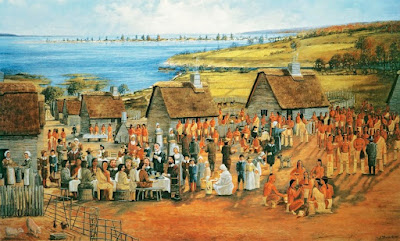
AUTUMN ELEGY


Photo source: Plimouth Patuxet Museums


Howie Good
is the author most recently of the poetry collections Gunmetal Sky (Thirty West Publishing) and Famous Long Ago (Laughing Ronin Press).

GHAZAL: THANKSGIVING

by Rebekah Wolman


A painting done in 1995 by Karen Rinaldo, of Falmouth, Mass., depicts what many Wampanoag tribal leaders and historians say is one of the few accurate portrayals of “The First Thanksgiving 1621,” between the Wampanoags and the Pilgrims. —Dana Hedgpath, “This tribe helped the Pilgrims survive for their first Thanksgiving. They still regret it 400 years later.” The Washington Post, November 4, 2021


We’ve read the picture books about the harvest feast we call the first Thanksgiving—
no mention that for the Wampanoag it was a cursed Thanksgiving.
 
How many ways to brine and roast a turkey? Ask the food editors
what’s the virtue of this excess in which we’ve been immersed, Thanksgiving.
 
Some kids dressed up as Pilgrims; others wore construction paper feathers.
What did they learn about the Wampanoag when they rehearsed Thanksgiving?
 
In COVID quarantine, we roasted Cornish hens for one or two. Instead
of hand-drawn place cards we had names in Zoom squares at our dispersed Thanksgiving.
 
Two years after settling on Wampanoag land, the Pilgrims saw no rain
for two long months. Two months of fast and prayer and then a cloudburst Thanksgiving.
 
Family tensions linger, wrongs go unredressed, pain unspoken. Food and drink
are plentiful but other hungers go unsated at lips-pursed Thanksgiving.
 
What I’m asking, settlers’ descendants and other white folk, is what if we returned
ill-gotten gains, atoned, and then observed—a people reimbursed—Thanksgiving?


Author's Note: This poem was written in the shelter of a house built and bought and sold multiple times on stolen land...the unceded ancestral homeland of the Ramaytush Ohlone people, the original inhabitants of the San Francisco Peninsula.


Rebekah Wolman is a retired educator living in San Francisco. A previous contributor to The New Verse News with poems also appearing recently in Limp Wrist, she is a 2021 winner of Cultural Daily’s Jack Grapes Poetry Prize.

Monday, February 08, 2021

PILGRIMS PROGRESS

by Deborah Gorlin


Phineas Pratt's Grave in Charlestown MA


The inscriptions a kid could cartoon
on a gravestone, crude and simplistic,
the skull-soul effigy a kind of gothic lithic
Jack-o-lantern, wide hollows for eyes,
triangle for nose, slotted mouth,
snaggle-toothed, Medusa-like heads
winging hair. A second childhood
for the Puritan church as some feature
breasts, amen, as God-besotted poet
Edward Taylor wrote unblushingly,
his syntax, don’t ask, “to put these
nibbles, then my mouth into and suckle
me therewith humbly pray.” Gravestones
that put one in mind of crumbly English
biscuits, taken at teatime. Their headboards
face east towards the sunrise, when the dead
will wake one fine Sunday morning to the smell
of pancakes the Lord makes at a sleepover.
 
But the news today tells me they won’t
wait—rebranded their black white outfits,
buckled shoes, top hats, dressed this time
as the half-naked shaman in bear skins,
horn helmet, face paint, just like their old
enemies the Indians, why not, it’s on their land,
the Senate floor, to save us from those devils
in Pederast Forest. Fake 'em out. Boys. 
An impatient breed these new pilgrims, grown
young, who, in their first iteration, claimed
that specters in dreams and visions, those
with a third nipple, an ugly birthmark, a black
cat familiar, were evidence in a court of law
for burning witches and warlocks. Emboldened,
always exceptional, they invent new ways to rise
from their shallow graves of history, their scraggly
tombstones askew, who refuse, even their God, to die.
 

Deborah Gorlin is the author of two books of poems, Bodily Course (White Pine Poetry Press Prize) and Life of the Garment (Bauhan Publishing, winner of the 2014 May Sarton New Hampshire Poetry Prize). She has published in a wide range of journals including Poetry, Antioch Review, American Poetry Review, Seneca Review, The Massachusetts Review, The Harvard Review, Green Mountains Review, Bomb, Connecticut Review, Women’s Review of Books, New England Review, and Best Spiritual Writing 2000. Recent poems appear in Plume, On the Seawall, Chicago Quarterly, Trampoline, and the Ekphrastic Review. Emeritus associate faculty of the Writing Program at Hampshire College, she serves as a poetry editor at The Massachusetts Review

Monday, February 01, 2021

WHEEL OF FORTUNE

 by Mary K O’Melveny


“Vaccine Wheel of Fortune” by JMbucholtz at Deviant Art.


               In the Circle of Life
                    It's the wheel of fortune
                    It's the leap of faith
                    It's the band of hope
                    Till we find our place…
—“The Circle of Life” (Lyrics by Tim Rice)


No one wants to be the last woman down before the cure.
So everyone is staring at computer screens, leaning into
laptops, cradling cell phones. Legions of faithful vaccine
seekers are as determined as El Camino de Santiago pilgrims.
Or would-be buyers of Hamilton tickets back when Broadway
was still open.  There are waiting lists, rumors, promises.
Appointments made, then cancelled. Lines form, disband.
Recorded messages say don’t call us, we’ll call you.
 
Everyone is at risk. But not enough to be advanced to more
fortunate categories. We reside in data bases far and wide.
We’ve filled out forms as if they were lottery tickets, sent
every scrap of personal data to would-be hackers around
the globe, called doctors we’ve not seen in years, even searched
for fake college IDs that might jump us to new age brackets.
Some neighbors raced to appointments in neighborhoods they
had never seen, forgetting who the odds had already disfavored.
 
As usual, the privileged see serendipity. Everyone else
knows how often the game is rigged. Kismet is a figment.
The carnival barker is gone but his fabrications linger
like smoke from a cheap cigar. Even as chilled vials traverse
the highways like pilgrim caravans, new viral strains mutate,
shapeshift. Before all our waiting arms are raised, half a million
will likely die. So we click and call and cry for our chance
at good fortune. Once again, Lady Luck smiles, then disappoints.


Mary K O'Melveny is a recently retired labor rights attorney who lives in Washington DC and Woodstock NY.  Her work has appeared in various print and on-line journals. Her first poetry chapbook A Woman of a Certain Age is available from Finishing Line Press. Mary’s poetry collection Merging Star Hypotheses was published by Finishing Line Press in January, 2020.

Saturday, February 29, 2020

IN THE TIME OF PLAGUE

by Alejandro Escudé


When the so-called Black Death swept through northern Lincolnshire during the middle of the 14th century, sick and desperate people turned to the nearby Thornton Abbey's hospital for care. So many people died there that the members of the abbey's clergy were unable to prepare individual burials and instead had to bury the bodies in a so-called plague pit … But even though dozens of people were consigned together to a shallow mass grave over a period of just a few days, the remains were nonetheless treated with respect and received individual attention, according to a new study. Photo: A close-up shows part of the mass grave at Thornton, where the deceased were carefully positioned and placed in an organized manner without any overlapping. (Image: © University of Sheffield/Antiquity Publications Ltd.) —Live Science, February 18, 2019


Forty eight humanoid figures
on the archaeological diagram
of the Black Death burial site;
Thornton Abbey monks, patient,
pious, wrapped each individual,
performed last rites, conscious
of the space between negligence
and love, light separating all us
pilgrims making the trek out
to the country to die with hope
of afterlife. Why does the cross
resemble a key? Why is the answer
always more patience, a power
more like prayer than habit?
I won’t forgive some around me
despite our woes widespread.
Rat-psyche world, words heady
as a virus, our bodies buried
side by side so they don’t overlap
even in life. What is love but hope?
When one looses hope does
one loose the ability to love?
These monks didn’t. Wouldn’t.
I see their bony, medieval hands
sorting it all out in the dirt,
disease, blood, vomit, their
screams suppressed by prayer
and see the same monks in
the people wearing hazmat suits
today, leading those sick with
a new disease down the stairs
of an airplane, the disease itself
the shape of the airplane,
a cruise liner, an old couple
quarantined in their cabin,
taking it all in stride, they say,
unabated fear in their hands,
their jittery faces, those carried
away in China, yelling like
hostages, stowed away in clear,
plastic houses. Abbeys whose
hymns we’d rather not hear.


Alejandro Escudé published his first full-length collection of poems My Earthbound Eye in September 2013. He holds a master’s degree in creative writing from UC Davis and teaches high school English. Originally from Argentina, Alejandro lives in Los Angeles with his wife and two children.

Thursday, November 28, 2019

THANKSGIVING 2019

by Anita S. Pulier


Pay attention
to this table
to this gathering
to the fall sky
the people who are here
and the people who are not.

Accept the truth.
Pilgrims did not come for religious freedom
but to insist on the practice of a punitive religion.
Indians not lost to gunfire or smallpox
were vigilant warriors, tribe pitted against tribe.

All this imperfection has
evolved into our holiday
celebrated by feasting,
reworking history,
telling apocryphal tales
as though history can be recast.

But please,
through the din and chatter,
find a moment,
pay attention, and
notice this rare opportunity

to be grateful,
to raise a glass,
with joy and hope,
that against all odds
we can yet become

that Nation,
that one Indivisible Nation,
of decent, fair minded celebrants—
and for that possibilty
we can be truly thankful.


After retiring from her law practice, Anita S. Pulier served as a U. S. representative for the Women's International League for Peace and Freedom at the United Nations. Her chapbooks Perfect Diet, The Lovely Mundane, and Sounds Of Morning, as well as her book The Butchers Diamond were published by Finishing Line Press. Anita’s poems have appeared both online and in print in many journals and several anthologies. Recently she has been the featured poet on The Writers Almanac.

Thursday, November 22, 2018

OUR MYTHS

by Howard Winn


from Pilgrim ancestry
that glorifies individuality
is a made-up story
that makes the official
history of our cultural
sources appear to honor
independence of belief
when in truth our national
first source was in the
world of the Puritans
quite willing to kill those
not of their sect with
other fables to guide them
to their versions of the moral
life for their redemption
in conflict with that of the pure
whom they would condemn
to the Hell of their dogma
for the beginning of our
nation was mired in the
bigotry of faith and creed
was the key to belonging
and individuality was a sin


Howard Winn's poetry has been published most recently in Mississippi's Valley Voices Literary Journal in Mississippi and Maine's The Aurorean Literary Journal.

Monday, March 20, 2017

METAPHORICALLY SPEAKING

by Howie Good


via GIPHY


Pushing again and again
as though intending to lift
the cumulative weight of heartache,
just the very, very tips emerge,
the first shoots of spring,
medieval pilgrims in weird green headgear
leaning out of the dark past.


Howie Good is the author of The Loser's Guide to Street Fighting, winner of the 2017 Lorien Prize from ThoughtCrime Press, and Dangerous Acts Starring Unstable Elements, winner of the 2015 Press Americana Prize for Poetry.

Tuesday, April 12, 2016

FOODIES ABROAD AND DOWN THE STREET

by Lee Ann Pingel


Image source: China Highlights


            On Calvin Trillin’s “Have They Run Out of Provinces Yet?”
            Published in The New Yorker, April 4, 2016


Maybe “province bagging” is a thing, foodies
like tourists collecting cathedrals.
No wonder the ancient countries
and their children
take offense at our forgetting
these places are sacred,
these dishes are mothers.
May we all—all, no matter
our birth, our skin, our standing—
remember to open our souls,
let them expand with each site or bite.
Let us be pilgrims,
let us repent of devouring,
learn to savor.


Lee Ann Pingel has lived in Athens, Georgia, since 1994 and works as a freelance editor and writer. She earned a bachelor’s degree in creative writing from UC San Diego and holds graduate degrees in political science and religion from the University of Georgia. Her work has been published in the anthologies Motif 2: Come What May from Motes Books and Crossing Lines from Main Street Rag, as well as in The Fib Review, Plainsongs, TheNewVerse.News, Contemporary Haibun Online, and other journals.