Guidelines


Submission Guidelines: Send 1-3 unpublished poems in the body of an email (NO ATTACHMENTS) to nvneditor[at]gmail.com. No simultaneous submissions. Use "Verse News Submission" as the subject line. Send a brief bio. No payment. Authors retain all rights after 1st-time appearance here. Scroll down the right sidebar for the fine print.
Showing posts with label curse. Show all posts

Sunday, February 23, 2025

FIVE THINGS I DID LAST WEEK

by W. Luther Jett


• I wrote three poems: The first compared you to a destructive gale; the second was a lament; the third was a curse.


• I met a friend for lunch. We spoke of you. Our words were not kind.


• I watched a bluebird fall in love. His love was hopeless, still it gave me hope.


• I called a friend in recovery from surgery. This was not the same friend I met for lunch, and we did not speak of you at all.


• I led a poetry workshop and hosted an open mike. I know that poetry alone cannot defeat you, but poetry is one way to say you will not defeat us. Our poems will out live your demands. You cannot fire us. We are the fire.


W. Luther Jett is a native of Montgomery County, Maryland and a retired special educator. His poetry has been published in numerous journals as well as several anthologies. He is the author of six poetry chapbooks: “Not Quite: Poems Written in Search of My Father”, (Finishing Line Press, 2015), and “Our Situation”, (Prolific Press, 2018), “Everyone Disappears” (Finishing Line Press, 2020), “Little Wars” (Kelsay Books, 2021), “Watchman, What of the Night?” (CW Books, 2022), and  “The Colour War”,  which has just been released by Kelsay Books. His full-length collection, “Flying to America” was published by Broadstone Press in 2024.

Friday, January 07, 2022

SHACKLED


In the wake of growing outrage over the role the Sacklers may have played in the opioid crisis, the Metropolitan Museum of Art and the Sackler family jointly announced on Thursday that the Sackler name would be removed from seven exhibition spaces, including the wing that houses the Temple of Dendur. —The New York Times, December 9, 2021


Bonnie Proudfoot has had fiction and poetry published in the Gettysburg Review, Kestrel, Sheila-Na-Gig, Pine Mountain Sand and Gravel, and other journals. Her first novel Goshen Road (Swallow Press, 2020) was selected by the Women’s National Book Association for one of its Great Group Reads for 2020.  The novel was also long-listed for the 2021 PEN/ Hemingway award for debut fiction.

Thursday, November 25, 2021

GHAZAL: THANKSGIVING

by Rebekah Wolman


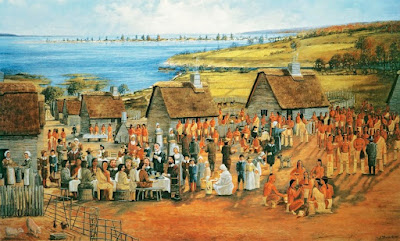
A painting done in 1995 by Karen Rinaldo, of Falmouth, Mass., depicts what many Wampanoag tribal leaders and historians say is one of the few accurate portrayals of “The First Thanksgiving 1621,” between the Wampanoags and the Pilgrims. —Dana Hedgpath, “This tribe helped the Pilgrims survive for their first Thanksgiving. They still regret it 400 years later.” The Washington Post, November 4, 2021


We’ve read the picture books about the harvest feast we call the first Thanksgiving—
no mention that for the Wampanoag it was a cursed Thanksgiving.
 
How many ways to brine and roast a turkey? Ask the food editors
what’s the virtue of this excess in which we’ve been immersed, Thanksgiving.
 
Some kids dressed up as Pilgrims; others wore construction paper feathers.
What did they learn about the Wampanoag when they rehearsed Thanksgiving?
 
In COVID quarantine, we roasted Cornish hens for one or two. Instead
of hand-drawn place cards we had names in Zoom squares at our dispersed Thanksgiving.
 
Two years after settling on Wampanoag land, the Pilgrims saw no rain
for two long months. Two months of fast and prayer and then a cloudburst Thanksgiving.
 
Family tensions linger, wrongs go unredressed, pain unspoken. Food and drink
are plentiful but other hungers go unsated at lips-pursed Thanksgiving.
 
What I’m asking, settlers’ descendants and other white folk, is what if we returned
ill-gotten gains, atoned, and then observed—a people reimbursed—Thanksgiving?


Author's Note: This poem was written in the shelter of a house built and bought and sold multiple times on stolen land...the unceded ancestral homeland of the Ramaytush Ohlone people, the original inhabitants of the San Francisco Peninsula.


Rebekah Wolman is a retired educator living in San Francisco. A previous contributor to The New Verse News with poems also appearing recently in Limp Wrist, she is a 2021 winner of Cultural Daily’s Jack Grapes Poetry Prize.

Wednesday, June 14, 2017

REFUGEES

by Terese Coe


The Vitae were not living.
The winds devolved to wild.
Their houses blown to powder,
the children were reviled.

The rancor unforgiving,
the slaughter undefined,
an end would come to giving,
then cursed was humankind.


Terese Coe’s poems and translations have appeared in 32 Poems, Alaska Quarterly Review, The Cincinnati Review, New American Writing, Ploughshares, Poetry, Threepenny Review, Agenda, The Moth, New Walk Magazine, New Writing Scotland, Poetry Review, the TLS, The Stinging Fly, and many other publications and anthologies. Her latest collection Shot Silk was nominated for The Poets Prize of 2017.

Thursday, November 17, 2016

MY GRANDMOTHER, A SHAMAN, HAS WORDS FOR THOSE WHO VOTED FOR TRUMP

by Ron Riekki


She recites a prayer, or perhaps it’s a curse,
that the souls of the unjust will also have years
to howl, that their revelation will shake their heart

until their cobweb racism awakens the spiders
of their hate and they’re forced to eat the insides
of their insides. She holds in her hand an iron pipe,

invisible, but visible, iron and air, and she sucks
deep on its end, telling me that she is taking away
their stupidity, gullibility, hegemonic ability,

and leaving them on vacation, meaning, etymologically
empty, vacated, so that something other than dumb
sexism can rest in their hollow bones. Her eyes

are fuses. Her skin reels. Her tears are middle
passages, saying we could have made history
but instead we made a bed to fuck the poor.

Behind her, there is no snow. We have assimilated
out of the Arctic, lost our language, bathed
in a drumless Michigan that has turned blood red

from apathy, tricked, pathetic, pricked to death
and not even realizing the rigor mortis. I watch
my mother open her mouth so wide that her lungs

are visible, iron and air, and I wonder if those
so easily swayed, so cinematographically fooled,
would even witness the protests of her body.


Ron Riekki's books include U.P.: a novel (Sewanee Writers Series and Great Michigan Read nominated), The Way North: Collected Upper Peninsula New Works (2014 Michigan Notable Book awarded by the Library of Michigan and finalist for the Eric Hoffer Book Award/shortlisted for the Grand Prize, Midwest Book Award, Foreword Book of the Year, and Next Generation Indie Book Award), and Here: Women Writing on Michigan's Upper Peninsula (2016 IPPY/Independent Publisher Book Award Gold Medal Great Lakes—Best Regional Fiction and Next Generation Indie Book Award—Short Story finalist).

Thursday, August 25, 2016

THE AMERICAN CREDO, 2016 VERSION

by George Salamon


The United States, the wealthiest nation on Earth, also abides the deepest poverty of any developed nation, but you would not know it by listening . . . to the major parties' presidential nominees [as] 47 million Americans yearn to reach the middle class. —“The Millions of Americans Donald Trump and Hillary Clinton Barely Mention: The Poor," The New York Times, August 11, 2016

Don't be so naive and pity the poor.
The poor, sages tell us, will always be with us.
Today there are just too many people, and
There just isn't enough to go around
For everybody to become Ozzie and Harriet.

But you must be so naive and
Believe establishment voices
That the market under god dictates
The income of capitalism's leaders to
Exceed the average worker's hundreds of times.

So you must accept, as you nod and sigh, that
The opportunity to share our nation's goods and wealth
Must remain elusive to millions
And poverty must remain
A never-ending curse.


George Salamon professed German language and literature at Harvard, Haverford, Dartmouth and Smith colleges, served as staff reporter for the St. Louis Business Journal and as Sr. Editor on Defense Systems Review. For the past five years he has contributed regularly to Jewish Currents and TheNewVerse.News from St. Louis, MO.

Thursday, September 26, 2013

FOR KENYA

by Rick Gray


Image source: Yahoo! News


We're not sorry, al-Shabaab, for wasting
our troubled youths on African pleasures
your imported bullets will never find.

Your aims will forever miss us,
whose aging hearts have grown wise on
everything you so preciously despise.

So kill the kaffirs in the mall
to satisfy your schoolboy's mind.
We know those who can make you cry

why God is great, without books or prayers,
pure as a country who offered us
everything she had

all that is holy and wild
in the wicked smiles of lovely women
who have cursed you blind.


Rick Gray served in the Peace Corps in Kenya. He currently teaches in Afghanistan. He has poems forthcoming in Salamander and r.kv.r.y.