Guidelines


Submission Guidelines: Send 1-3 unpublished poems in the body of an email (NO ATTACHMENTS) to nvneditor[at]gmail.com. No simultaneous submissions. Use "Verse News Submission" as the subject line. Send a brief bio. No payment. Authors retain all rights after 1st-time appearance here. Scroll down the right sidebar for the fine print.
Showing posts with label cadaver. Show all posts

Thursday, March 10, 2022

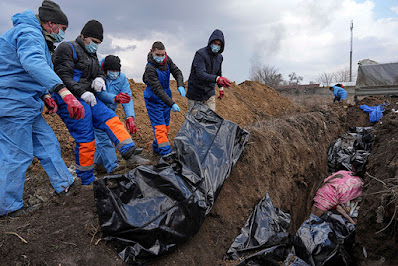
CONSIDERING WAR

by Amy Shimshon-Santo


Dead bodies are placed into a mass grave on the outskirts of Mariupol, Ukraine, on March 9. (Evgeniy Maloletka/AP)


considering that bombs 
leave craters in the earth
making it difficult
to mobilize hospitals,
carry pregnant mothers
across fields of rubble

comprehending the cold breath of sunday
broken bridges, 
families gathered beneath them 
without exact destinations
beyond a border

understanding that mammals with bombs
are cold hearted
explosive-death-machines, 
considering that men
—and I will call them that
because of their bombs —
explode sites
leaving the enduring silence
of family members

understanding that a cadaver
cannot speak

& I am just a storyteller
still living 
with the possibility of voice
I will make my breath a sign
painted in horror 
across the sky
that begs the bombing 
to stop


Amy Shimshon-Santo is a poet and educator who believes that culture is a powerful tool for personal and social transformation. Her interdisciplinary work connects the arts, education, and urbanism. She is the author of Even the Milky Way Is Undocumented (Unsolicited Press, Pushcart Prize & Rainbow Reads Award nominee). 

Tuesday, December 14, 2021

MAYFIELD

by Donna Katzin


In this photo taken by a drone, buildings are demolished in downtown Mayfield, Ky., on Saturday, Dec. 11, 2021, after a tornado traveled through the region Friday night. Ryan C. Hermens/Lexington Herald-Leader via AP


Where cold and warming winds collide,
twisters—minions of an angry earth—                    
lash out in pain, flatten farms, homes,
houses of work and worship in their paths.
As roofs rain bricks in darkness,                               
mothers, fathers, sons, daughters,
sisters, brothers sit in cellars,                                               
making calls never returned.
 
When the wild ones have gone, survivors pick
through mauled metal, shredded remains.       
A bus lies on its back—a turtle shell
with the body sucked out.
Splintered ghost trunks rise  
like hands to heaven.
There are no voices now.
Even wind has no words.
 
Cadaver dogs sniff through rubble.
Crews root around the clock
for what is left of men and women
who worked the late shift,
even after alarms screamed,
for twelve dollars an hour
making candles to light consumers’ holidays       
at the factory now extinguished.                   
 
On Sunday morning, faithful gather,
console and hold each other,
interrogate the Almighty,
sing hymns of hope
to staunch despair.  
A few pray for the mother
planet we torture at our own peril—
who will not be patient forever.
 
 
Donna Katzin is the founding and previous executive director of Shared Interest, a fund that mobilizes the human and financial resources of low-income communities of color in South and Southern Africa.  A board member of Community Change in the U.S., and co-coordinator of Tipitapa Partners working in Nicaragua, she has written extensively about South Africa, community development and impact investing.  Published in journals and sites including The New Verse News and The Mom Egg, she is the author of With the Hands, a book of poems and photographs about post-apartheid South Africa’s process of giving birth to itself.

Saturday, March 11, 2017

EXAMPLE

by Salvador Díaz Mirón 
from his 1901 collection Lascas [Stone Chippings]; 
translation by Julie Steiner


Iraqi children giggle at the body of a half-buried Islamic State militant while talking to an Iraqi soldier in the al-Barid district in Mosul, Iraq. Photo: AP via Metro, December 19, 2016.


The flyblown corpses of Islamic State militants have been rotting along a main street in north Mosul for two weeks, a health risk for passersby.  . . . Islamic State has executed thousands of Iraqi soldiers and policemen, and their comrades are eager for revenge. "We leave them in the street like that so the dogs eat them," said soldier Asaad Hussein. "We also want the citizens to know there is a price for supporting terrorists.". . . A few streets away, a group of young boys walked towards three more Islamic State corpses. "The bodies should stay. Daesh killed lots of people so why should they be buried," said Salem Jamil, 13, . . . but a man who approached said the bodies should be buried because that is everyone's right. —“Iraqi forces wage psychological war with jihadist corpses” Reuters, February 6, 2017


Brandished from a tree-branch, the cadaver was decaying
as if it were a gruesome fruit still dangling from its stalk:
a testament to judgment whose absurdity would shock;
a pendulum intruding on the roadway with its swaying.

The nudity’s indecency, the stuck-out tongue displaying,
and hair that formed a jester’s coxcomb, lock by upright lock,
gave him a buffoonish look; and where my horse should walk,
a group of ragged children mocked, derisive laughter braying.

And the melancholy carcass, with its head inclined to yaw—
abominable, bloated, on a gibbet leafy-green—
spread odors on the breeze (which was a wind, in fact, and raw)

as it rocked with swings like censer-passes, solemn and serene.
And the sun went on ascending through a blue without a flaw,
and the landscape was idyllic, a Tibullus-lyric scene.


EJEMPLO
por Salvador Díaz Mirón (de su colección Lascas, 1901).


En la rama el expuesto cadáver se pudría,
como un horrible fruto colgante junto al tallo,
rindiendo testimonio de inverosímil fallo
y con ritmo de péndola oscilando en la vía.

La desnudez impúdica, la lengua que salía
y alto mechón en forma de una cresta de gallo,
dábanle aspecto bufo; y al pie de mi caballo
un grupo de arrapiezos holgábase y reía.

Y el fúnebre despojo, con la cabeza gacha,
escandaloso y tumido en el verde patíbulo
desparramaba hedores en brisa como racha,

mecido con solemnes compases de Turíbulo.
Y el sol iba en ascenso por un azul sin tacha,
y el campo era figura de una canción de Tíbulo.


Salvador Díaz Mirón (1853-1928) was a Mexican poet from Veracruz. Julie Steiner (1968- ) is a translator in San Diego, California.