Guidelines


Submission Guidelines: Send 1-3 unpublished poems in the body of an email (NO ATTACHMENTS) to nvneditor[at]gmail.com. No simultaneous submissions. Use "Verse News Submission" as the subject line. Send a brief bio. No payment. Authors retain all rights after 1st-time appearance here. Scroll down the right sidebar for the fine print.

Tuesday, April 30, 2019

ATTEMPTED OVERTHROW

by Mickey J. Corrigan


Empty Vessel Stomping on the US Constitution
Trump Sculpture Series #4 by Judith Peck


Maybe you held the moon in your hands
and watched it morph
into a spiked border wall
in high-definition.

Maybe you saw your shaggy body
perfected
in a mirror of hashtags
believing the world wanted you.

Maybe you were soulless and filled
with explosives timed
to go off at just
the wrong time. Or not.

A king, you see, is a window
into the house. Into the heart. I meant
to say such a man is a door
into what we dream, what we think.
Not all doors open. Meanwhile
you let the rest of us
dissolve on your tongue like nitro.

Don't you know everything
you ever said or did
will be used against you
in the court of public opinion?

Maybe we can rearrange
your disorder to some kind
of warped metal sculpture
that reflects us, no longer
a bad reflection on us.

Moon or no moon
hands contain veins,
old blood. When you leave
the gilt throne you erected
in your own image
please take your fake weather
with you.


Originally from Boston, Mickey J. Corrigan lives in South Florida and writes noir with a dark humor. Books have been released by publishers in the US, UK, Canada, and Australia. Poetry chapbooks include The Art of Bars (Finishing Line Press, 2016), Days' End (Main Street Rag Publishing, 2017), and Final Arrangements (Prolific Pres, 2019). Project XX, a novel about a school shooting, was published in 2017 by Salt Publishing in the UK.

Monday, April 29, 2019

OTHERS

by John Guzlowski


Today an anti-Semitic hate crime shot and killed my friend Lori Gilbert Kaye z”l while she was praying in synagogue. Lori you were a jewel of our community a true Eshet Chayil, a Woman of Valor. You were always running to do a mitzvah (good deed) and generously gave tzedaka (charity) to everyone. Your final good deed was jumping in front of Rabbi Mendel Goldstein to take the bullet and save his life. —Audrey Jacobs, Jewish Journal, April 27, 2019


They killed us on the banks of the Danube
and in the ovens of Auschwitz. 

They killed us in our homes
and they killed us in the woods.

They killed us in the heat of summer 
and the coldest cold of winter.  

They killed us pleading to God 
and they killed us 
as we lay in the mud.  

They killed us when we were children 
and they killed us when we were old 
and too exhausted to weep.  

They killed us 
and they continue to kill us.  

In America and everywhere.


John Guzlowski's writing appears in Garrison Keillor’s Writer’s Almanac, Rattle, Ontario Review, North American Review, and other journals.  His poems and personal essays about his Polish parents’ experiences as slave laborers in Nazi Germany and refugees in Chicago appear in his memoir Echoes of Tattered TonguesEchoes received the 2017 Benjamin Franklin Poetry Award and the Eric Hoffer Foundation's Montaigne Award for most thought-provoking book of the year.  He is also the author of two Hank Purcell mysteries and the war novel Road of Bones.

Sunday, April 28, 2019

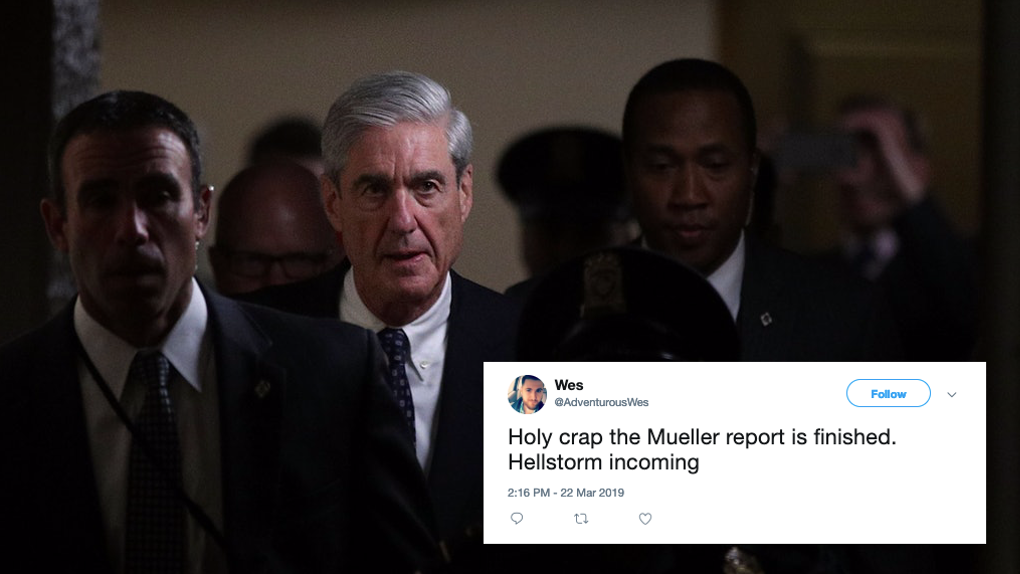
AMERICA IN THE AFTERMATH OF THE MUELLER REPORT AND THE ANGRY TWEETS THAT FOLLOWED

by Ariana D. Den Bleyker


Graphic: ALEX WONG/GETTY IMAGES NEWS/GETTY IMAGES, TWITTER via Elite Daily


I.

She swallows the news, a lump in the back of her throat,
watching all the armies who rally to save her gather,

seemingly defeated, their hopes hanging 
upon the delicate flesh of failed ghosts.

Balance of possibilities can go either way:
with just a whisper of wind, touching hand giving strength

to moments of truth swinging gently, leaning, anchored, swaying, 
rediscovering & restoring, though always permanently rooted. 

A new furnace burns brightly, metal ablaze, wrapped in red heat;
sweat pouring, glistening brighter than molten steel, boiling her people

until the day is done & lions roar by the hearth-fire. 
The sun briefly shines, allowing moments for thoughts

& strange songs of what will happen 
tomorrow that may never be real.

II.

She grits her teeth & makes a home far away—
deep within caves within caves, farther back until blue becomes blackness.

She returns to her mother, to nothing,
for inside Plato’s ultimate form illusions of illusions demystified & ugly

rely on her starkness—this & all that she saw
when he crawled in her bed unworthy of sitting by her side,

her form easy enough to reach, as if an object of his desire
left alone to bruise & soil while lying beneath the earth,

left with angry words unable to differentiate
the stomping with supposed compassionate feet, 

the head held down feeling no regrets. 

III.

She can see the revolution from her window,
the small orbits, when they turn away & return 

& sometimes a star falls, a blazing fire shot down,
a demigod dying & it comes down on her—

the thing that once was but is now lost inside her,
borrowing girder, salvaging safety for others, 

relieving the pressure amid weary shoulders grasping
for strength, taking refuge in sacrifice & pain

of her people giving what they’re willing to never receive,
as they walk breathlessly into the ether,

surveying the fact or fiction placed in their hands.


Ariana D. Den Bleyker is a Pittsburgh native currently residing in New York’s Hudson Valley where she is a wife and mother of two. When she’s not writing, she’s spending time with her family and every once in a while sleeps. She is the author of three collections, including Wayward Lines (RawArt Press, 2015), the chapbooks Forgetting Aesop (Bandini Books, 2011), Naked Animal (Flutter Press, 2012), My Father Had a Daughter (Alabaster Leaves Publishing, 2013), Hatched from Bone (Flutter Press, 2014), On Coming of Age and Stitches(Origami Poems Project, 2014), On This and That (Bitterzoet Press, 2015), Strangest Sea (Porkbelly Press, 2015), Beautiful Wreckage (Flutter Press, 2015), Unsent (Origami Poems Project, 2015), The Peace of Wild Things (Porkbelly Press, 2015), Knee Deep in Bone (Hermeneutic Chaos Press, 2015), Birds Never Sing in Caves (Dancing Girl Press, 2016), Cutting Eyes from Ghosts (Blood Pudding Press, 2017), Scars are Memories Bleeding Through (Yavanika Press, 2018), A Bridge of You (Origami Poems Project, 2019), Even the Statue Weeps (Dancing Girl Press, forthcoming 2019), and Confessions of a Mother Hovering in the Space Between Where Birds Collide with Windows (Ghost City Press, forthcoming 2019). She is also the author of three crime novellas, a novelette, and an experimental memoir. She hopes you'll fall in love with her words.

Saturday, April 27, 2019

FARM AID

by Denise Sedman


Above: Screenshot from the Farm Crisis Center webpage. See also PewTrusts Stateline.


Cows have been milked
and chickens fed.

Daddy’s awake since
before a light’s been
switched on Wall Street,

All this talk about commodities.
Finances flopping,
unmanageable stress.

I heard the neighbor tied a rope
on a beam in the barn.
Hanged himself.

He tried the suicide hotline,
but the phone rang off the hook.


Denise Sedman is an award-winning poet from the Detroit area. Recent work has been featured in San Pedro River Review, Nassau Review, Gravel Literary and Poets Reading the News. She has a poem in the 2017 Nasty Women anthology by Lost Horse Press. Her signature poem “Untitled” was the source for architect students at University of Detroit Mercy to build a temporary environment in Detroit. The original poem was featured in Abandon Automobile, Wayne State University Press, 2001.

Friday, April 26, 2019

WHEN I AM THE DAY

by Buff Whitman-Bradley


If I were ever to be a day
I would be pleased and proud
To be like this one
Modestly performing its tasks
With competence and confidence
And economy of effort
Quietly and carefully arranging above us
The great clouds bulging
With this afternoon’s rain
Spreading pale gray light
Among the hillsides, the woods
The neighborhoods and parks
And playing fields
Toting armloads of song birds
From tree to tree to tree
Mingling with flowers and bushes
With forgotten grasses in roadside ditches
And vacant lots
Conducting the cantankeous oratorio
Of a chaos of crows
Occupying the bare branches
Of the neighbor’s walnut tree.
And when I am the day
No mauling of the climate
No wars or drone strikes
Or collateral damage
No indecency in high places
No exploitation or economic collapse
No children starved or abused or neglected
No drama, no flash-and-dazzle
Or whoop-dee-doo
A plain, ordinary day of abundant courtesy
And generosity
And a night flooded with stars
To still the noise
And remind the crowd at the top of the food chain
Whence they have come
And where they are bound.


Buff Whitman-Bradley's poems have appeared in many print and online journals. His most recent books are To Get Our Bearings in this Wheeling World and Cancer Cantata. With his wife Cynthia, he produced the award-winning documentary film Outside In and, with the MIRC film collective, made the film Por Que Venimos. His interviews with soldiers refusing to fight in Iraq and Afghanistan were made into the book About Face: Military Resisters Turn Against War. He lives in northern California.

Thursday, April 25, 2019

REAGANOMITRUMPICS

by Rémy Dambron


what trickles down is not their tax breaks
is not charity or compassion

what dribbles rather their self importance
hunger for power dispassion

what trickles down is not investment is not
wealth or higher spending

what oozes rather is their gluttony vanity
and planned meddling

what trickles down are not more jobs are not
higher wages or social security

what flows rather are attacks on speech over
reach and obscurity

what trickles down is not healthcare is not
welfare or opportunity

what leaks rather are their lies transgressions
and impunity

what trickles down is not a future is not progress
or positive growth

what percolates rather their narcissism and
hypocritical oaths

what trickles down is not good faith are not
grand ideas or democracy

what slithers drips seeps and bleeds conspicuous
autocracy


Rémy Dambron is an English instructor and lyricist from San Diego, California. His work focuses on denouncing political corruption, advocating for the environment, and promoting social justice. He has been published by Poets Reading the News, The Veggie Wagon Journal, and What Rough Beast. This poem was written in response to recent reports that dozens of multi-million and multi-billion-dollar corporations (like Amazon) paid zero dollars in taxes last fiscal year.

Wednesday, April 24, 2019

TOWARD A GENTLER GOOD NIGHT

by Elane Gutterman


N.J. Gov. Phil Murphy signs the Medical Aid in Dying for the Terminally Ill Act Friday, April 12, 2019 at the New Jersey Statehouse in Trenton, N.J. New Jersey joins seven other states and Washington, D.C. to enact a law permitting terminally ill patients to seek life ending medication. The law takes effect in August. (Credit: New Jersey Office of the Governor via WHYY)


The trigger for me was the research for a poem, my artful
turn on two decades of Oregon envy, wanting their Death
with Dignity to apply in New Jersey as a law abiding act.

I stumbled on the lobbying group and the way grew less abstract.
Supporters met up at the State House. Our message fine-tuned art,
we engaged lawmakers on the need for choice when near to death.

Those opposed called it suicide, minimized long-suffering death.
Finally, the bills came up for a vote, would they be enacted?
I stared at the display as votes in favor mounted like hanging art.

Work of art, my state enters the pact. Governor affirms choice in death.


In this tritina, Elane Gutterman celebrates a milestone in advocacy work with Compassion & Choices. Her poems have been published in U.S 1 Summer Fiction Issue, Kelsey Review, Patterson Literary Review, and TheNewVerse.News.

Tuesday, April 23, 2019

IN THE THORN BUSHES

by Lois Rosen


One day last week, a call came in to the sheriff’s office shortly before 10 a.m. Border Patrol agents had found the body of a woman in the back corner of a ranch. Credit Brooks County Sheriff’s Office via The New York Times.


After the “Crossing the Border Newsletter” 
by Manny Fernandez and Nubia Reyna in The New York Times, April 18, 2019


Migrants have been dying in the South Texas brush.
“Many, many are dying. That was what surprised me.”
The president insists he’s shocked. But now that he
knows for sure, do you see him rushing from a private
dinner to order humanitarian convoys of water and food?
8 bodies were found this year, and it’s only mid-April.
Among the cactus, mesquite, sage, oak, thorn bushes,
the lost, frozen, dazed, sick men and women collapse
from heatstroke, hypothermia, dehydration. A sheriff
today found a female skeleton face down, in dirt,
U.S., Mexican, and Honduran cash around her, prayer
cards in the pockets of her jeans. A male body, face up,
a Honduran I.D. in his wallet, he’s discovered to be
the father of a three-year-old girl. There’s a selfie of
the two of them on his Facebook page. In Spanish, he
called her my princess. The sheriff runs out of body bags.
How does someone get used to bagging up the dead?


Lois Rosen’s poems have appeared twice before in TheNewVerse.News. She enjoys leading the Trillium Writers and the ICL Writing Group at Willamette University. Her published poetry books are Pigeons (Traprock Books, 2005) and Nice and Loud (Tebot Bach, 2015).

Monday, April 22, 2019

BLUE DIAMOND

by Martha Landman


Botswana has unveiled a blue diamond whose value could outstrip that of the storied Hope Diamond: the 20.46-carat, close-to-flawless Okavango Blue. The diamond was presented in Gaborone, Botswana by the state-owned Okavango Diamond Company. Found as a 41.11-carat rough stone in the Orapa mine operated by the producer Debswana, the jewel is the largest blue diamond ever found in Botswana. . . . While the Hope Diamond is larger at 45.52 carats, the Okavango Blue's immense value lies in its clarity. The Gemological Institute of America (GIA) graded the diamond as "Very, Very Slightly Included," or VVS2, meaning inclusions—internal imperfections—“are difficult for a skilled grader to see under 10x magnification." —CNN, April 18, 2019


Allotrope of carbon, unbreakable
stone of Gaborone, Okavango Blue
and glimpses of white arranged in oval shape
extracted from deep within Earth’s mantle
brings to this April month, a 20-carat sparkle


Martha Landman writes in Adelaide, South Australia, where she is a member of Friendly Street Poets. She has previously contributed to TheNewVerse.News.

SAVE THE WALRUS

by George Salamon


The walrus deaths shown in “Our Planet” are becoming increasingly common as the sea ice they depend on melts away faster than we predicted. Over the past decade, climate change has caused summer sea ice to disappear from the walrus’s shallow foraging grounds in Alaska’s Chukchi Sea. That’s because the Pacific walrus needs sea ice year-round for giving birth, nursing their young and resting. Over the past decade, climate change has caused summer sea ice to disappear from the walrus’s shallow foraging grounds in Alaska’s Chukchi Sea. Without summer sea ice for resting, walrus mothers and calves have been forced ashore in huge numbers, where they have limited access to food and are vulnerable to being trampled to death, attacked by predators or crowded into dangerous places looking for space to rest—like the edge of a cliff. “Some of them find space away from the crowds. They struggle up the 80-meter cliffs, an extraordinary challenge for a 1-ton animal used to sea ice,” narrator David Attenborough says solemnly. “At least up here, there is space to rest. A walrus’ eyesight out of water is poor, but they can sense the other down below. As they get hungry, they need to return to the sea.” What follows is footage of walruses tumbling one by one down sharp cliffs, crashing into the rocky beach and other walruses below. “In their desperation to do so, hundreds fall from heights they should never have scaled,” Attenborough says. —Common Dreams, April 17, 2019


You can quickly become nauseous
Viewing the suicidal walrus,
Latest victim of man's avarice
Driven by an appetite so ravenous
To living things it's cancerous.
If you, like many of us, turn away
It will only embolden greed's sway.
Let us form an army of resistance
And fight for the walrus's existence.


George Salamon lives and writes in St. Louis, MO and hopes to see a walrus again.

Sunday, April 21, 2019

UNBURIED ALLELUIA

by Jill Crainshaw


The devastating fire at Notre Dame Cathedral in Paris led to an immediate outpouring of donations and an ambitious pledge by the French president to rebuild within five years. But a continent away, the blaze also spurred more than $1.8 million in donations to rebuild three historically black churches burned in suspected hate crimes in Louisiana. The fires at the three churches in St. Landry Parish occurred over 10 days beginning at the end of March. Authorities said they were deliberately set and have arrested a suspect. As of Sunday, a GoFundMe campaignseeking donations for the churches had raised only about $50,000. By Thursday morning, donations had soared to more than $1.8 million. The money is to be distributed equally among the three churches, which were all a century old. —NBC News, April 18, 2019. Photo: St. Mary's Church in Louisiana was the first to burn. Natalie Obregon / NBC News file. [Editor's Note: The GoFundMe campaign is no longer accepting donations. It has raised more than $2 million, exceeding its goal.] 


a weary sister walks among the ruins
sweeping up cold ashes into a dustbin
for next year’s lenten initiation, she says as she
scoops priceless residue into her cupped hand
some of it slipping away through shaky fingers
settling again onto the charred ground
        “remember that you are dust
         and to dust you shall return”
the preacher said just 40 days ago while pressing
ashy imprints of mortality on eager foreheads
nobody even saw it coming then—
unholy tongues of fire stripping altars bare
out of sync with high holy ritual processions
where hopeful worshipers catch sparks
from an easter vigil flame and carry them
into silent sacred good friday sanctuaries
she puts a hand on her tired back and
when she lifts her face toward the pinking sky
a wayward bit of wind stirs the ashes in her hand
she lets them go
and even with all other words
smothered by smoke and tears
she tastes alleluia on her cracked lips


Jill Crainshaw is a professor at Wake Forest University School of Divinity in Winston-Salem, NC.

OLD WOOD

by Karen Greenbaum-Maya


April 16, 2019 Fallen debris from the cathedral’s burned-out roof lies near the altar. Christophe Morin/Bloomberg News via The Washington Post.


Halfway through my last dinner, I saw the blaze,
unfathomable as the Grand Canyon creaking shut.
The owner confirmed:  Everyone on staff is following

as firefighters poured the river onto the flames.
When the spire lifted as it toppled, people gasped,
wailed as though a suicide had jumped.

The day before I’d walked the quais,
browsed the bookinistes, shot mood pics of the towers,
total cornball, through the mist of new leaves.

Arrow of God, the spire had fallen before the sun was down,
The fire turned the sky red, turned the cross white-hot.

Not all the water in the world, not even the river could help.
People stood and watched, sang and wept.
Rains came only the next morning.

Ash sifted down catching, reflecting coral light
I’d brought my husband’s ashes in a carved wooden box.
No need, no need.

After dinner, the owner walked me to the door. We sniffed the air.
Vieux bois, she shrugged, wincing. Old wood.


Karen Greenbaum-Maya’s third and weirdest chapbook Kafka's Cat will soon be available at Kattywompus Press.

EASTER 1958

by Alan Walowitz


To make me feel more welcome in their home,
the new neighbor, Mrs. Kelly, told me her doctor’s a Jew,
and she wouldn’t consider any other kind.
I was small and thought that friendly and fine,
till one of her sons—Fat Bob, I think,
asked me why I killed the baby Jesus
which sent me crying from their house.

The moms thought we could patch this up,
but first I made mine swear
that all this Easter-stuff—
not the pretty eggs in the basket,
nor the man in the Kelly’s entry way
asleep and hanging from the cross—
had anything to do with us.

Still, I felt uneasy Easter morning
when I went to pick a chocolate bunny
from their crèche of green excelsior,
where, Bobby assured me, the now-risen Jesus
had been laid to rest just yesterday,
and, he said, sort of kindly,
it was partly thanks to me.


Alan Walowitz has been published various places on the web and off.  His work has been nominated for a Pushcart Prize in 2017 and 2018 and is a Contributing Editor at Verse-Virtual, an Online Community Journal of Poetry.  His chapbook Exactly Like Love is available from Osedax Press, and his full-length book The Story of the Milkman and other poems will appear shortly from Truth Serum Press.

Saturday, April 20, 2019

TRUMP'S TAKE ON THE MUELLER REPORT

by Anna M. Evans


I didn't say the things it says I said.
We didn't do the things it says we did,
and if it says we did, I say it's lying

because it also says it caught me lying
when there's no record of the things I said,
and no one witnessed anything we did.

I had my reasons for the things I did.
Everyone twists my words and says I'm lying.
You can't believe a single word that's said.

I didn't say I said I never lied.


Anna M. Evans’ poems have appeared in the Harvard Review, Atlanta Review, Rattle, American Arts Quarterly, and 32 Poems. She gained her MFA from Bennington College and is the Editor of the Raintown Review. Recipient of Fellowships from the MacDowell Artists' Colony and the Virginia Center for the Creative Arts, and winner of the 2012 Rattle Poetry Prize Readers' Choice Award, she currently teaches at West Windsor Art Center and Rowan College at Burlington County. Her new collection Under Dark Waters: Surviving the Titanic is out now from Able Muse Press, and her sonnet collection Sisters & Courtesans is available from White Violet Press.